Palm trees, dates, clay houses, desert oases, camels, bazaars, mosaics, spices, leather. I had some pictures in my mind. But what I really knew about Morocco was very little. In the 1980’s and early 90’s, when I used to consider ways to fly back to the U.S. every year, Royal Air Maroc offered a deal on flights from Athens to New York with two nights in a Casablanca hotel. But by the time I decided to take advantage of the deal, they had stopped it…
Twenty one of us participated in this Panoramic Odyssey of Morocco with Cosmorama Travel (in Athens) where we logged 2,700 kilometers (1,678 miles). Our leader Nina and local guide Saeed, who never tired of answering our endless questions, did everything to make us feel comfortable on our trip.
The route took us from Casablanca – Rabat – Meknes – Fes – Erfoud – Ourzazate – Marrakech. We crossed mountains, valleys, sea, desert, cities.
So, settle back and follow along the journey!

I. Casablanca
Casablanca’s name, given by Portuguese settlers in the 15th century (casa branca) after seeing a white house on a hill overlooking the Atlantic, was changed to “Casablanca” when the Spanish came. The financial capital of Morocco, it has one of the largest harbors in Africa and is the biggest city in Morocco. And indeed today many white buildings continue to give the city its character.
One such place is the art deco neo Gothic cathedral, downtown near the main square. It was built during the French protectorate, 1912 to 1956, when there was a sizeable French/Catholic population.

But after independence in 1956, the French population declined and eventually the Cathedral began to be used as a cultural and exhibit center, its use today.

The Mohammed V square (named for the current king’s grandfather) is dominated by the courthouse.

These colorful outfits are Berber costumes. The Berbers are the indigenous people of Morocco and other countries of the Maghreb (north Africa). More on the Berbers later.

As we enter the medina or old town, another white building greets us, Rick’s Cafe. Yes, Rick’s as in the 1941 film Casablanca. Picture Humphrey Bogart mumbling to Sam after he sees Elsa (Ingmar Bergman) in his cafe: “Of all the gin joints in all the towns in all the world she walks into mine.” This was not part of the set however; it opened 20 years ago in 2004, designed to recreate how it was in the film. With the two palm trees in front and two guards, it’s hardly a “gin joint” but an elegant restaurant where you need reservations and a certain dress code.

We’re leaving the colonialism behind now and heading for the Hassan II Mosque, the main landmark in Casablanca.
Completed in the early 1990’s and named for the father of current king Mohammed VI, the mosque holds 25,000 people.

Its minaret is the second tallest in the world, has a retractable roof and inside is a library, museum and school.

Men approached the large door on the right to enter and worship, while women went through the small archway on the left.

What makes this mosque so unusual is that its foundations are partly on land and partly in the sea. This is how it looks from the other side near the lighthouse.

And a little later in the day at twilight from afar.

Casablanca has a pleasant promenade area near the mosque, the Boulevard de la Corniche. The afternoon sun though was beating down on us and we were looking for shade but palm trees don’t give much. In the evenings it’s a popular place to stroll.
As city walkers, Elias and I found our own area to walk in, the ancient medina (walled city).

The market, which had been closed during the Ramadan hours, was opening.

It was time for the muezzin to make the final call for prayer for the day before the “iftar,” breaking the fast. Those who can’t get to a mosque, often put down their prayer rugs and pray there in the middle of the street.
As everywhere, there were striking contrasts between the haves and have nots.

II. Rabat and Meknes
The next day up the Atlantic coast, we drove on to Rabat, the capital of Morocco. Like Casablanca, Rabat shows us a modern face, but it’s a smaller and more attractive city with beautiful Moorish architecture. (Perhaps because the king has his palace here.) There seems to be a tranquility about it that we didn’t find anywhere else.

Two futuristic structures in the town are the sleek tower of Hassan II (the king’s father) which will be the highest skyscraper in Africa, and the opera house.
The city seems to be getting ready for when it cohosts the 2030 World Soccer Cup, along with Spain and Portugal.


The mausoleum of the king’s grandfather Mohammed V is near an unfinished 15th century mosque and half finished minaret, tower of Hassan II.


Founded in the 12th century as a fortified town is the Kasbah Les Oudayas, overlooking the sea.


We get our first taste of tea served in lovely glasses with a sprig of mint and a coconut cookie. The perfect perk me up custom.


The cafe leads out to a lush garden or riad.


The name above the door Dar Baraka means the House of Blessings, and it’s considered good fortune to touch the door.

From the Kasbah 12th century ramparts you could see some surfers trying out the waves. Rabat always had a strategic but fragile location on the Atlantic. After a period of decline, in the 17th century, the town became a haven for pirates.


Meknes, the second imperial city we stopped to visit, founded in the 11th century, was the capital for a while in the 1600’s. The city had a bustle to it, late in the day as people seemed to be getting ready for the souk or market.

Across from the lively square is the door known as Bab Mansou, considered North Africa’s most beautiful gate.
An Arabic inscription on it reads: “I am the most beautiful gate in Morocco. I’m like the moon in the sky. Property and wealth are written on my front.”

There was snake charmer music, snakes of course, monkeys, even an ostrich.

In the small food market or souk off the main square, we were surprised to see bees and flies all over the pastries but they were being bought anyway…


III. Fes or Fez
Next stop, Fez is the oldest city in Morocco and often considered the most spiritual. If you visit just one place in the country, I think it must be Fez.
After Rabat and Meknes, Fez is the third imperial city we visited, known that way as they were all capitals of Morocco at one time or another. (The fourth is Marrakesh.)
If you’re adventurous, you can try to navigate the 8th century walled city of the medina on your own, but remember, getting lost is a certainty in the 9,000 tiny labyrinthine alleys.
Before heading in, our local guide from Fez — who called himself “Banana” — showed us the 13th century Palace.

In the Nouvelle Ville (new city) we looked across at the great sprawling cemetery.

When you go with a group, you must expect that you’re taken to a lot of shopping places, but our visit to the ceramics factory “Art D’Argile” was indeed fascinating.

Here they show you artisans at work and you see each step along the way in making ceramics and mosaics, fashioning the product out of clay, the enormous kilns, putting the tiles together, all the workers using hand tools in a traditional way. Our factory guide explained everything, showing skilled potters and craftspeople.


We noticed in the showroom a number of Jewish symbols: Hanukah menorahs, mezzuzahs for doorposts and generally Jewish star designs on plates.

These crafts are certainly a nod to the past when throughout Morocco there was a large Jewish population, who came mostly after the 1492 expulsion from Spain. In Moroccan cities they lived in quarters called the Mellah. On our walk through the Mellah, our guide “Banana” pointed out the balconies with wrought iron railing that were particular to the area. He told us that the Jewish community was protected by the King, who used their advice and counsel for different matters.


According to “Banana,” the Jews, Muslims and Christians lived harmoniously for centuries. Today, most of the Jewish population has emigrated and the community is very small. This is a Jewish shop inside the medina.

Outside the medina: note the robe with the pointed hood, the djellaba, that many men wear.

Now we’re making our way into the 8th century medina, Fes el Bali, one of the largest walled cities in the world. Both kids and adults are pushing carts and wheelbarrows down the narrow passageways, delivering products calling out “Ballak! Ballak!” (careful, watch out!) as we try to move to get out of the way, not easy as there’s so many people moving there. Colors, smells, and a cacophony of sound.


We’re taken to a store with lovely material, scarves and dresses. Most of us buy scarves, bargaining for a good price as we believe, until some are spotted at another shop for much less. Isn’t that the way it always works!

After the scarves comes the leather, a sizeable industry. First we puff our way up up up some narrow rickety stairs to the roof to get a look at the tanneries. We’re given sprigs of mint to block out the pungent smell of the animal hides and the dyeing vats. The ancient process has them dipped first in some saline solution, then quicklime, then pigeon droppings. Yes you read that right. That provides the ammonia necessary in the process.

The different colors are from natural plants: blue from indigo, yellow from turmeric, red from poppy, orange from saffron, green from mint.

Sheep goats, cows and camel hides are used mostly in the process. For 20 days they dry out.

Back in the store, our group bargains and haggles back and forth for bags and jackets. We’re getting good at it! The cushions are beautiful but a little impractical to take.


By the time we get to the silver souk and are told “I’ll give you the best low price you can find anywhere!” we’re too glassy eyed to buy anything.
The medina has some historic landmarks, such as the early 14th century Al-Attarine Madrasa, with its intricate architectural design — the walls and roofs adorned with mosaics and carved wood decorations. The madrasa played an important role in the scientific and cultural life of Fez.

Nearby, the Kairaouine Mosque was the largest in Morocco until the Hassan II mosque in Casablanca and considered one of the most important in the western Muslim world. Next to it is one of the world’s oldest universities and foremost centers of learning, built in 857 AD. Upstairs were student dormitories. How do you like these miniature windows?

One famous student at the university was twelfth century Spanish Jewish philosopher Moses Maimonides, who after leaving Cordoba, spent some years studying medicine at this university and for a while, served as Royal physician.
On a restaurant roof up an endless number of steps, we had our mint tea poured the traditional way.


Of the 14 gates to the medina, this one, Bab Bou Jehoud, is the most ornate, but also the newest. It was built in 1913 by the French.

IV. The Road to the Desert
Fez was fascinating with a mysterious kind of feeling, but overwhelming with all the shops, tiny alleyways and shopkeepers and vendors calling out to buy. Now we were in for a totally different part of the country, with 520 km to get to the desert beyond Erfoud where our sunset camel ride was waiting for us!
We were shivering when we got off the bus the next morning in cold and misty Ifran. Known as the Switzerland of Morocco, the French had built this village to have an Alpine look. Its cedar and oak trees were practically the first non palm trees that I saw. In the nearby mountains the King goes skiing.

Ifrane’s landmark is the stone lion that commemorates the wild Atlas Mountain lion, the last one seen in the 1920’s.

After encountering a “community” of macaques, we drove through the valleys with the Atlas mountains off in the distance. Except for some small forests of fir trees, it was very dry. Every so often snowy peaks the Atlas Mountains came into view and you saw a home off in the distance, sometimes a small settlement in the mostly brown and barren landscape or sheep grazing.


Sometimes you see written on the hills letters signifying “God, country, king.”

This is Berber country. In one of the cafe/restaurants we stopped at, there was a large Berber flag on the wall. The blue represents the sea, the green, the mountains and the yellow, the desert. The red represents resistance.

About the Berbers, the name comes from the Greek “barbaros” which the Greeks used for someone not speaking the Greek language, and it was modified by the Romans to “berbers” but the Berbers themselves prefer the name “Amazigh” or “Tamazigh” which means “Free Man.” Ancient texts of antiguity attest to their existence well over two thousand years ago.
When the Arabs invaded in the 7th century, there were many clashes. Today the Berbers are mostly assimilated, but they have kept their language — it’s one of the two official languages of Morocco and as of 2011, has been taught in the schools. Tamazigh is an Asian African language, loosely the same family as Arabic. Its writing system uses the ancient Tifanagh alphabet, related to the Phoenician alphabetic system. Take a look at this street sign written in both Arabic and Berber (Tamazigh).

As for French, it might not be an official language, but it seems to be spoken and understood everywhere — and when we used French phrases, as meager as they were, we often got more of a response than with English.
Apples grow in the area around the town of Midelt, which uses an apple as its symbol. Move over Big Apple!

We stopped to see the oasis near Errachildia, known for its dates and palm trees. A zone of palm trees stretches for many kilometers.
When we stopped to see this oasis, and this happened often, a man who was hiding in the shade of a rock on one side of the bus, would jump out and go to his stand, whatever he was selling. Here it was rocks from the river — and often there was a young child silently holding out a few objects to you.


We were finally nearing our hotel in Erfoud, where the 4 x 4 jeeps were waiting to take us into the desert. Some of us were riding camels, some renting desert motorbikes.
On the way into the desert, we passed this half built “luxury” hotel. I thought of a line from Shelley’s Ozymandias: “Look on my Works ye Mighty and despair!”

I rode a camel in Cairo too years ago, but this was much more organized.

First, one of our drivers arranged my headdress, the scarf I had bought in the Fez medina.

Ready for our ride! Hip, hip, hip!


Everyone “disembarked” when we got to a hill to watch the sunset. Our camel driver took lots of photos as you see!


Back on our camels to the jeeps –and this is where they do the “sell.” Each camel driver opens a small drawstring bag with all kinds of objects that “I have made all by myself,” spreads a blanket and invites us to sit as he shows you them… the camels walk off perhaps to be watered and fed.

Back in the Kasbah Xaluca hotel … sorry we were leaving this little paradise the next morning! A lot of the guests sitting around the pool having a drink, were hiring motorcycles and riding into the desert the next morning.

It was originally an old kasbah converted into a hotel with traditional Moroccan decor both outside and inside the rooms.

V. On to Ouarzazate
About 500 million years ago, Erfoud and the surrounding area was underwater and sea creatures of the time were fossilized. Our first stop was the Macro Filles Kasbah, a factory working with fossils.

Here they slice and chisel open rocks to unearth fossils of prehistoric kalamari, snakes, ammonites etc. and make them into unusual and beautiful gorgeous art pieces — decorative slabs and also tables and other kinds of furniture. With a piece of rock, they demonstrated throwing water on it and so revealing the fossilized creatures.
In the storeroom they were eager to ship large pieces, no problem! Very tempting but … they also had smaller pieces on sale like spice boxes and even jewelry.


Because this is a semi desert area, water of course is very precious. The guide pointed out in the distance water holes used by families in the 17th century. The ownership of a water hole was sacred and was to be respected. (If you remember the scene in Lawrence of Arabia where Omar Sharif (Ali) shoots Lawrence’s guide because he drank from his own watering hole…)

Our host prepared the usual hospitality tea:

His house is what a lot of the houses in the countryside look like, made of clay or concrete with one door and small windows.

The landscape is the usual clay houses, palm trees and shrubs.

In the dusty town of Tingrit, this pretty inner courtyard is found in a hotel that seemed empty of guests.

In this empty room, a table is all set and ready.

The town is known for its almonds, olives and carpets and we’re taken to a carpet factory, where after their demonstration they unsuccessfully try their best to sell. You can see them preparing the tea in the lower left (and the cat enjoying the carpet softness).

We’re on the way to the Tonga Gorge with its tall limestone walls above the dry river bed, the Deddes River. Vendors are in full force. ” “Low price for you! Come here! I show you. How much you pay?” Walking along the dry river bed we faced a veritable wind tunnel with scarves blowing back and forth and we walked bowing our heads against the wind.
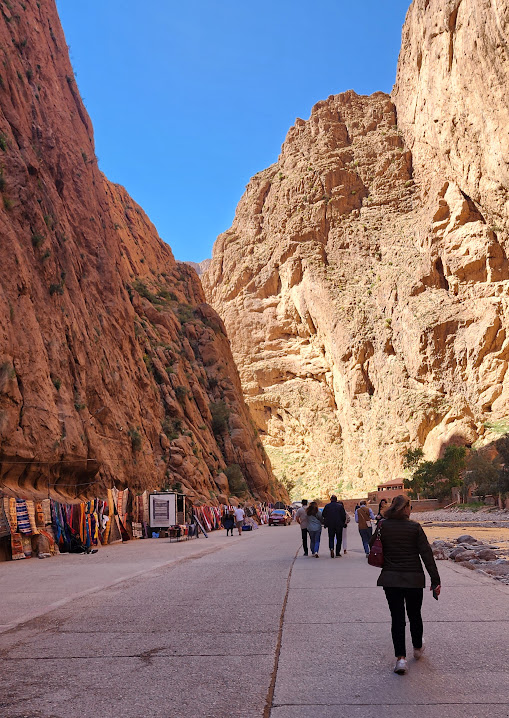
We stop to admire the view of one of the largest kasbah settlements, known as 1,000 Kasbahs.


As before, when the bus pulls up, the vendors suddenly appear next to their products.

And here we are in Ouarzazate!


Like Erfoud, Ourzazate had a lovely pool area and ornate furnishings. We make ourselves comfortable under the portrait of the king, which adorns many walls.


VI. From Ourzazate and the Atlas Studios to Marrakech
Ouarzazate was an isolated military outpost during the years of the French protectorate. It has a strange kind of end of the road feeling.
It’s home to the Taourirt Kasbah, the biggest Kasbah in southern Morocco, built in the 19th century by the el Glaoui clan who were interested in controlling the caravan route that goes to Marrakech. It has that reddish ochre color so common in Moroccan monuments and is made of a sun-dried mixture of mud and clay, held together with straw.


Across the street is a branch of the Italian Cinecitta film studios.

But visiting the kasbah is not the real reason we’re here. The desert and mountains around provide a great film backdrop, but it’s the Atlas Studios outside town that has put Ouarzouzate on the map.
Who would imagine that this is the home of one of the largest film studios outside of Hollywood? Lawrence of Arabia, the Prince of Persia, Cleopatra, Gladiator II, Aladdin, Kundun, Jewel of the Nile and the new film version of the Odyssey with Matt Damon, (also being filmed in the southwest Peloponnese) are just some films that were all or partially filmed at these studios.
This tour of the Atlas Studios was a highlight of the trip. Because they keep most of the sets used in films, visiting the studios is a big tourist attraction.

Here’s the entrance and the plan of the studio:

The bus used in Babel, jeep in Black Hawk Down and the sports car in a James Bond film:

We can’t resist getting into the jeep.


To tour the studios, you had to have a guide. Ours, who introduced himself as “Brad Pitt,” told us actually 250 movies had been shot here, as well as various episodes of “Game of Thrones” and the final season of “Prison Break.” It’s like the perfect background for the “east,” anything from Baghdad to Bethlehem! It can double for Afghanistan, the Middle East, even Tibet, like in “Seven Years in Tibet” or “Kudrun,” a film about the Dalai Lama, where they “imported” 300 Chinese extras.

Just to give us an idea of costs, “Brad Pitt” showed us a set used for an Italian film “Prima Natale” that cost 400,000 euros for 5 minutes of cinema. (Seems a lot but as a comparison, he told us that the budget for Gladiator II was 300 million). But this set for Prima Natale was used over and over, for example the marketplace in Aladdin and in other films.


Even a tannery was constructed.

Cleopatra’s palace and a replication of the temple of Abu Simbel was used in “Asterix and Obelix: Mission Cleopatra” and probably another Cleopatra version — there have been so many. It seemed that each tour group, ours included, filmed a little video of welcoming the Queen.


If you’re a total film buff, you can stay next door at the Oscar Hotel.

It was a delightful tour and a must if you’re in the area of Ouarzazate!
We’re taking more or less the ancient caravan route from Timbuktu that stopped in Ourzazate on the way to Marrakech, through the High Atlas Mountains, traditional home of the Berbers.
Along the route is the ksar, or fortified village of Ben Haddou. A UNESCO World Heritage site from 1987, it’s famous for its 11th century earthen clay architecture. Here’s what it looks like from afar:

As we get closer, there are some really colorful tourist stands. I love that deep blue.

You cross the bridge to get to the settlement. Very few families live in the ksar itself now but in the village on the other side of the river. They make their living from agriculture and the tourist trade. And what a tourist trade it is!

Again, you may have seen this backdrop in various films like “Kingdom of Heaven,” “Lawrence of Arabia,” “Gladiator” and others.

One of the main market streets:

Many hike up to the top for a great view. I felt like we were climbing up to Acropolis settlements on the Greek islands or island capitals in the mid day heat.

The guides dress in colorful Berber attire and lead groups exploring the settlement. There is also a Muslim and a Jewish cemetery.
Back across the bridge. Good luck finding a table at one of the restaurants…on a cafe was printed the Berber alphabet if you’d like to take a look.

Visiting Ben Haddou was a unique step back into history and seeing a tradtional kasbah settlement but just too many tourists were climbing up and down its narrow streets…
This is argan oil country and our next stop we see part of the extraction process. The tree seems to grow only in Morocco, which accounts for why it’s so expensive.


We’re in the High Atlas area and are climbing to the Col du Tichka Pass, at 2260 m (7,415 feet). The wind nearly knocks you down when you step out of the bus. This austere monument hides all the tourist shops around it in this isolated spot.

On the other side of the mountains lies Marrakech.


VI. Marrakech or Marrakesh
“Would you know we’re riding on the Marrakesh Express?
They’re taking me to Marrakesh
All aboard the train, all aboard the train“
Crosby, Stills and Nash
The most visited city in Morocco, Marrakech was founded in 1070 and our first impression is that it’s very flat. It’s known as the “red city,” not for its politics but for its reddish color buildings using local red clay. Behind the garlic truck, you can see the reddish ramparts in the background that extend for 15 km (9 miles)

The jardins Menaro, which used to supply water to the city, is known for its olive groves, that belong to the state and are sold to traders, who sell them at markets. In the park it used to supply water. You can just see the outline of the snowy Atlas Mts. in the background.

Visible from afar is the minaret of the 12th century Koutoubia mosque, which inspired the design of the Giralda bell tower in Seville. Koutoubia comes from the Arabic for bookseller as the area used to be surrounded by book vendors.
All those unfinished columns next to the mosque? It was discovered that the building didn’t align with Mecca exactly and another mosque was built next to it, a few years later.

The old and the new:

On our way to the Bahia Palace, first we make a detour in the old town where we’re given a lively demonstration at a pharmacy and spice store on spices, cosmetic oils and medicinal herbs. Every time we get up to leave the store, the lovely young carefully made up woman keeps begging us to listen for just a few more minutes…


To get to the palace, we walk through the Mellah or Jewish quarter. Note as in Fez, the balconies. The Lazama synagogue, with its pleasing blue design, is a functioning synagogue along the street, first built in 1492 and renovated over the centuries.


Ahead of us is the Bahia (meaning ‘beautiful’) palace, once home to a 19th century harem. Indeed it’s a lovely place: painted wood, ceramics, gardens, arches, carved cedar ceilings (cedar keeps out the insects), marble finishes.


The interesting thing is that each room varies in size according to the importance of each wife (four official ones) or concubines (around 20). In this room, for his very favorites, the Grand Vizier had soothing music playing for them.


For poor families, it was considered a great honor to have the daughter live in the palace as a concubine –this was a good position in society.
With the arrival of spring, the fragrant blossoms of the bitter orange trees, are used in distilling orange blossom water, used in cooking, cosmetics and spiritual practices.

We’re a short walk from the main square Djemaa el Fna, but first a walk through the souk. It might be a short distance, but you can’t help but stop, look, bargain a bit, walk away, buy something, all part of the game. But when Elias, exasperated in reality with the selling pressure, walked away, one of the vendors told me, “You are a nice lady but your husband is a bad man,” and lowered his price for a little tagine pot even more. (I couldn’t resist.)

The square, once a trading, resting place on the ancient caravan route, today is a meeting point for regional farmers, traders, but also fresh orange juice sellers, storytellers, healers, snake charmers, musicians, vendors and a lot of tourists.


At a terrace restaurant we enjoyed our afternoon mint tea and a good view of the square below.
It’s after dark when it really comes alive when most of the souvenir stands close up and hundreds of stalls are set up grilling meat for street food.
You might be wondering, where’s the food in this blog?
Well, we were warned again and again about eating anything raw, or salads or anything at all outside the hotel (maybe unnecessarily, maybe not)
Certainly if you go, drink only bottled water and even that be careful where you get it from.
Moroccan food is famous for its subtle and diverse spices. Besides saffron couscous, one of the main dishes is a slow cooked stew in a tagine pot, like the following:


As it was the period of Ramadan, our guide Saeed was fasting during the day. At night, the iftar or fast breaking menu is offered by some restaurants and large hotels, like where we stayed in Casablanca and in Marrakech. There was live music too.

We found that everything is negotiable, even taxis, which you need to bargain for and set a price before using. (The petits taxis hold 3 and the grandes can hold as many as 6) To go from the hotel to the Jemaa it could be anything from 50 to 100 Moroccan dirhams (5 to 10 euros) depending on your bargaining skills.
A popular respite from all the haggling in the souks, is a visit to the Jardins Majorelle. Even with advance registration (that they require) with a chosen time slot, we still had to wait in line for a while to get in. French painter Jacques Majorelle lived here from 1922 to 1962 and then a famous French occupant bought the gardens and settled here: Yves Saint Laurent.
The gardens, that Majorelle created over the decades, range from green bamboo thickets to lily ponds to more kinds of cactus than you knew existed.


The gardens are a delight to walk in, but also on the complex there’s a museum inside Majorelle’s former studio that’s dedicated to the Berbers (or Amazigh) with tribal jewelry, costumes, weapons, tools etc.
In 1980, when Yves Saint Laurent and Pierre Berge bought the complex, it had fallen into a sad state of neglect, that they restored and now it’s open to the public.
You can visit the Yves Saint Laurent museum, devoted to, as you’d expect, to fashion and haute couture.

You can buy a combined ticket for the gardens, the Berber museum and the Yves St. Laurent museum, but leave plenty of time to slowly enjoy.
We found beautiful gardens also at the La Mamounia Hotel. Built in 1923, it’s Marrakech’s most opulent and ornate, and considered one of the finest in the world. (The room prices start at around 1,000 euro a night.)


Inside La Mamounia


Some of our group members did one of Marrakech’s big attractions, a sunrise ride in a hot air balloon over the desert nearby and then a breakfast. You might want to try that!
Our trip was drawing to a close. So much to assimilate from what we learned and saw. We were lucky to have a terrific group and a wonderful leader and a Moroccan guide. Shukran! (thank you!)
I’d like to end with the story of the young woman in this photo on the grounds of our hotel. Her name is Siti Izza, known as Notre Dame de Marrakech. Who was she?

The answer is found in a little booklet left in the hotel room. Early 1800’s: the daughter of a Jewish mother and Muslim father from Erfoud, Siti Izza, who has absorbed both cultures, then falls in love with and marries a Christian. At her wedding, there is great feasting and mingling of the guests. Years pass and later to her son, she explains acceptance and tolerance. Siti Izza might be a symbol of the multifaceted humanity that makes up society — I like to think that travel helps us all with realizing that message, as long as our hearts and minds remain open…
If you like what you read, hit the like button and subscribe. Please share with your friends and social media. I’d love to hear your comments below.
There’s no need to log in to leave a comment. Just give an email address and your name.
Subscribe to become part of the olivesandislands community! Get new blogs and occasional newsletters delivered directly to your inbox. It costs nothing to subscribe. Olivesandislands does not share email information.
Note: Be sure to click on the confirmation email after you give your email address.

Sherri Moshman Paganos is a writer and former educator, inspired by her life in Athens, where she and her husband are happily retired and enjoying their travels in Greece and abroad. You can check out her writing — fiction, non-fiction, poetry and articles here.


Thanks for the great tour.
Neil S.
LikeLiked by 1 person
Sherri, This looks like a fantastic trip! Your photos are great. I love the cats as usual. Did you like the food?Chava hopes to visit you when she visits Greece with a friend next month. I gave her your phone number.Happy Passover. Ann
LikeLiked by 1 person
Thanks Ann and same to you! We were not so adventurous about the food on this trip but I did enjoy it. It was lovely to hear from Chava.
LikeLike
what a spectacular place
LikeLiked by 1 person
Definitely!
LikeLike
This is fantastic and timely Sherri. We are hoping for a trip to Morocco with “ road scholar“ in October. We traveled with them to Panama and Mexico, and both trips were excellent.
Joshua Schor MD
LikeLiked by 1 person
Thank you Josh. That’s great to hear — you’ll have a wonderful time. Hope my blog provides a helpful guide!
LikeLike
Really wow!! What great pictures and storytelling of this offbeat trip. Hope you didn’t feel like a tourist but more as a traveler to a very different part of the world and assimilate with the cultural distinctions.
LikeLiked by 1 person
Thanks! Well I aim to be a traveler not a tourist — it’s a certain mindset — but when you go for such a short time, it’s hard to achieve. Maybe with a 2nd visit!
LikeLike
Wow what a trip!!!
Your description and photos impressive as usual.
LikeLiked by 1 person
Thanks much Katy! It was quite interesting for us.
LikeLike
i really enjoyed all the photos in this post – the gardens and the gorgeous mosaics and the cute camels. I would need one of those camels just to haul around all the souvenirs I would want to buy. I also appreciated the little bits about the history of Jews in the country – which i shared with my daughter.
LikeLiked by 1 person
Thank you Rachael. You’d have a great time bargaining for all the souvenirs! There’s for sure much to discover about the Moroccan Jewish history.
LikeLike
One of your best ever blogs, Sherri!
What a trip! So unique!
Thank you for sharing this amazing experience with us!
LikeLiked by 1 person
Thank you so much Stella! Many unforgettable experiences —
LikeLike