The month of October is when the crowds go home, right? Well this might be true for Genoa but not for Portofino or Cinque Terre!
Capital of Liguria, Genoa (or Italian Genova) along the Italian Riviera and reputed birthplace of Christopher Columbus, is indeed a jewel but a little unpolished. As a major port city, it has a reputation for toughness, but it also lives up to its nickname “La Superba.” This is what medieval scholar Francesco Petrarch enthusiastically called it back in the 14th century when he visited the city, overwhelmed by its majestic appearance, its grand palaces and its role as a dominant maritime republic.
Since Genoa reached its glory as a medieval maritime power, let’s start our visit to this gritty yet elegant city down at the Porto Antico, the old port.
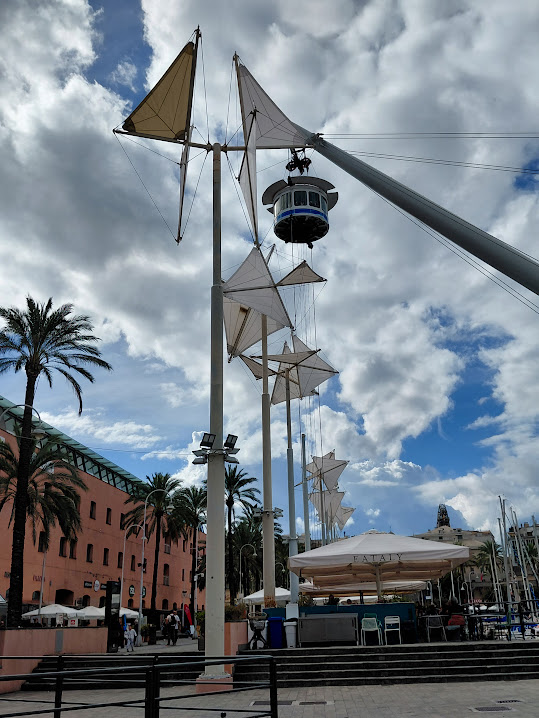
The area had been rather run down until 1992 when local architect Renzo Piano, (the same who did the Niarchos Foundation park in Athens) redesigned the harbor for the Genoa Expo, commemorating 500 years after Columbus’ voyage
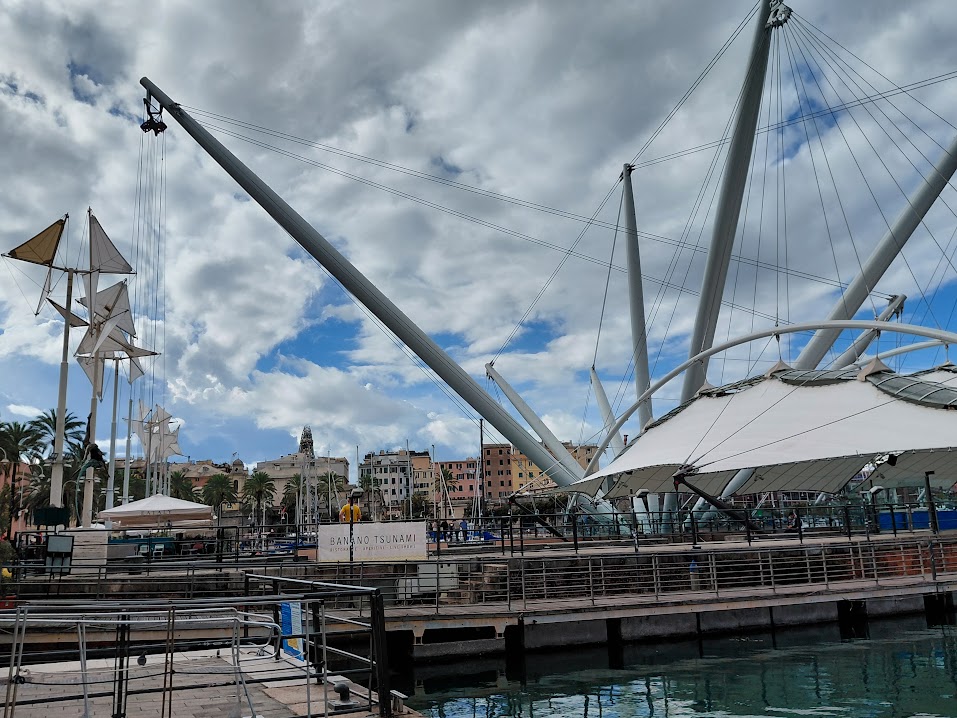
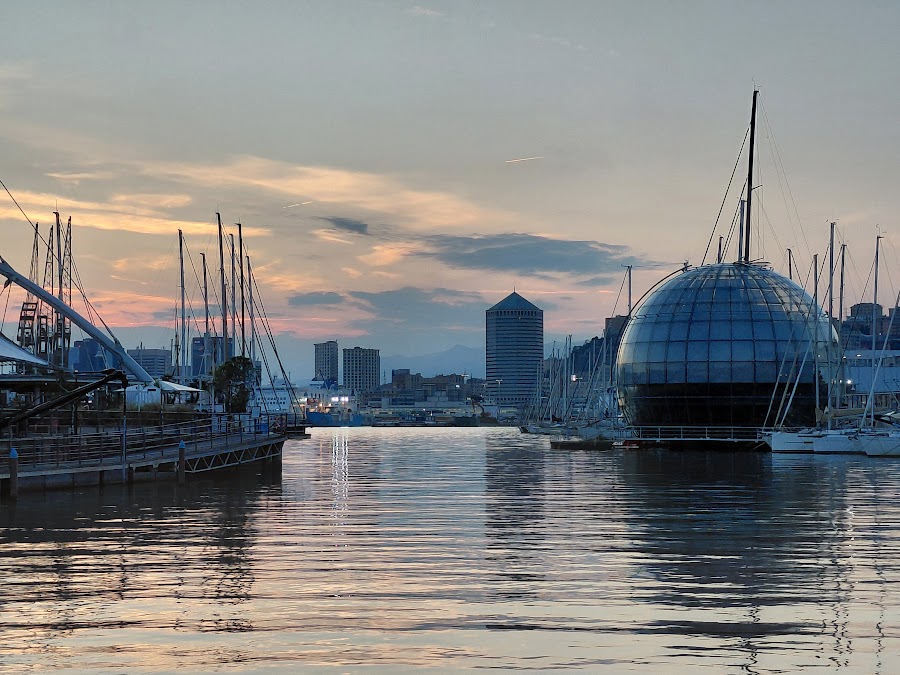
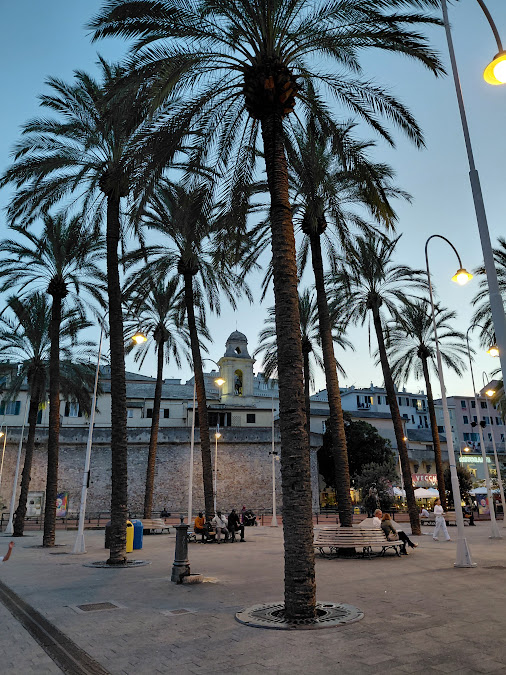
This panoramic lift known as the “Bigo” was designed to resemble a crane used to unload freight from the ships
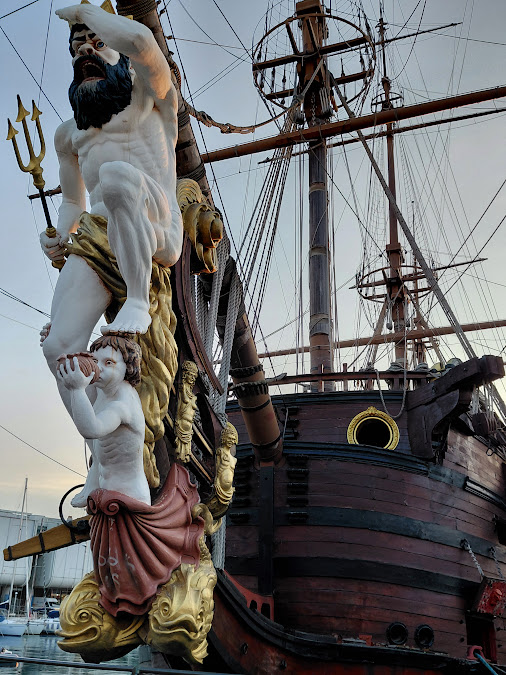
This replica of a 17th c Spanish galleon was used in the 1985 Roman Polanski film “Pirates”, as well as Captain Hook’s ship in the miniseries “Neverland” . With a ticket you can go on deck and explore.
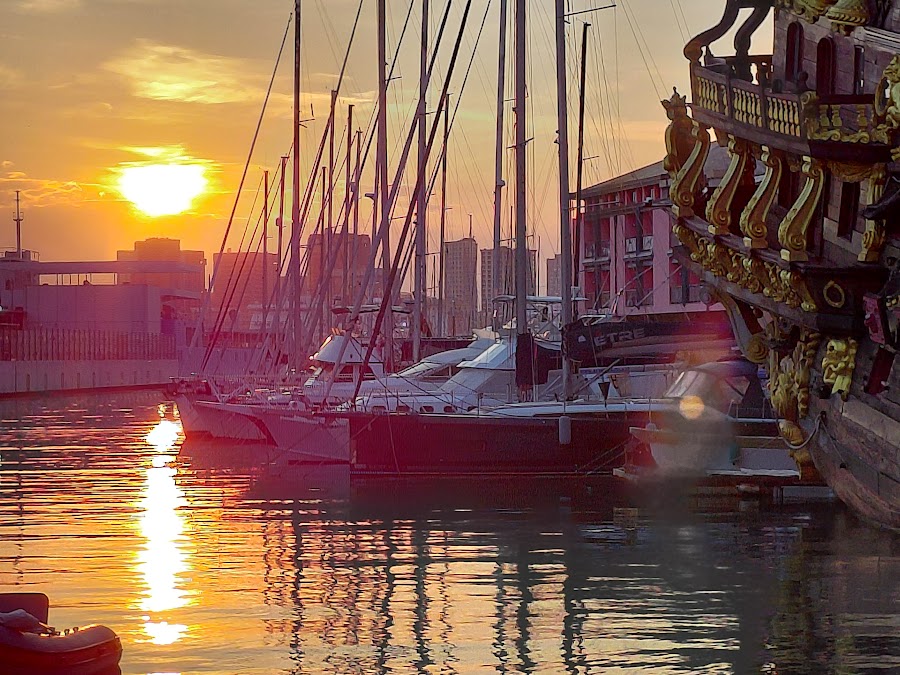
The first day we actually had enough sun for it to set
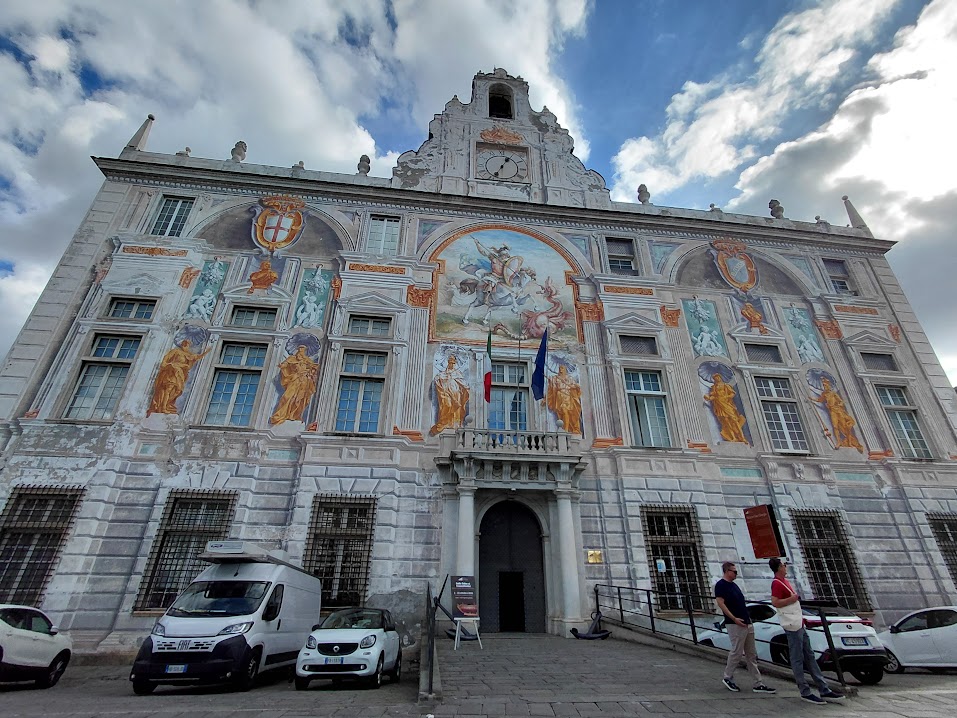
That gorgeous building on the waterfront is the Palazzo Giorgio, one of Genoa’s landmarks, which dates from 1260. In the early 15th century, it became the headquarters for the Bank of San Giorgio, widely considered the world’s first modern bank (when Genoa started to expand from maritime power to banking). The frescoed facade dates from the Renaissance. Today it’s the headquarters of the Port Authority, and holds temporary exhibits.
Along the harbor lies the Genoa Aquarium, largest in Europe and also the Maritime Museum. If you keep walking along the port (nearly 2 km) you can reach La Lanterna, the lighthouse, second tallest in Europe and one of the oldest in the world.
Wide open spaces and benches make the port a popular place to sit and people watch. Especially on Sunday mornings, lots of visitors are out taking a stroll and sitting there.
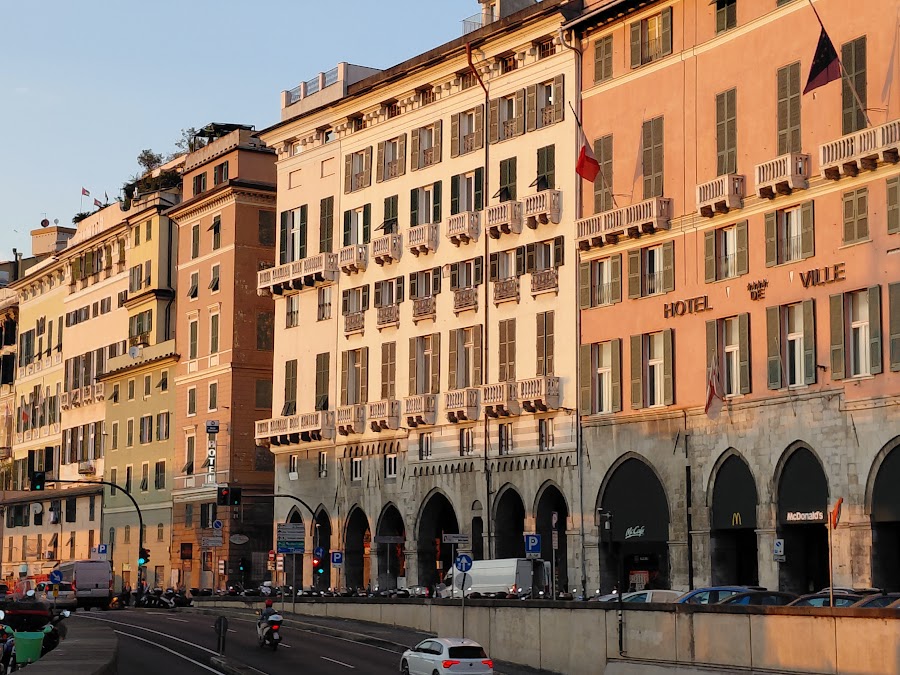
The pastel buildings across from the port are mostly hotels — on the main floor are porticoes (arcades) with all kinds of food and souvenir shops. The porticoes look like the ones in Bologna.
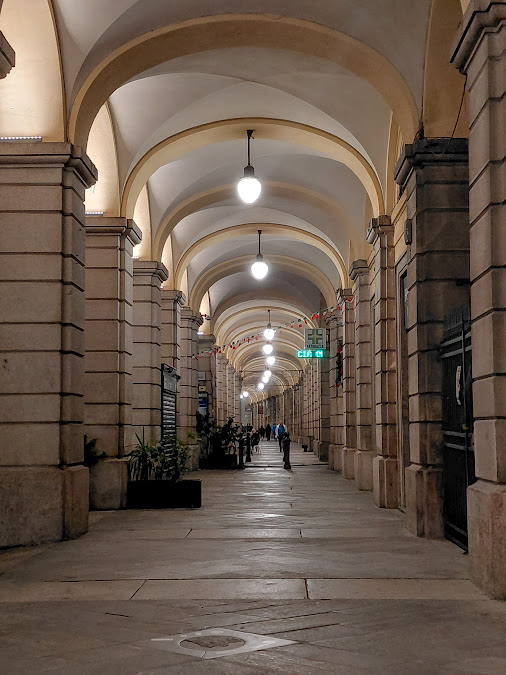
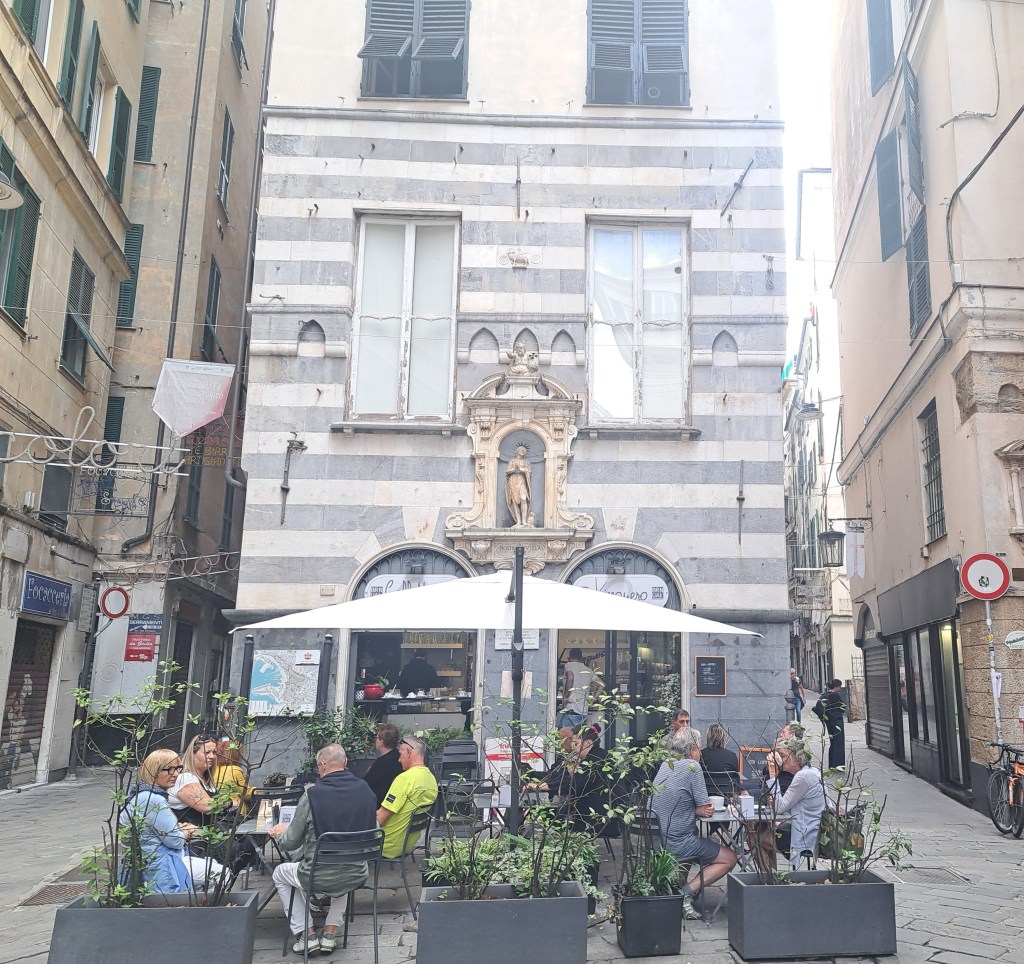
The streets inside around the port form the medieval centro storico, the UNESCO protected historical district. Be sure to look up to see the beautiful votive niches, devoted to Mary, the Queen of Genoa, set up by medieval guilds.
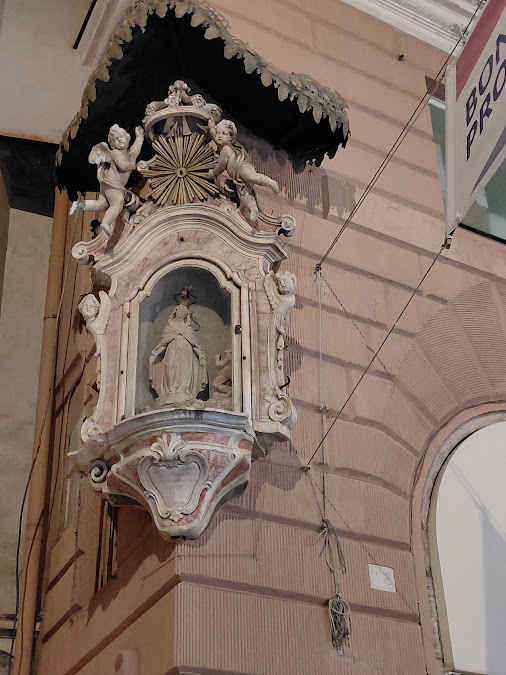
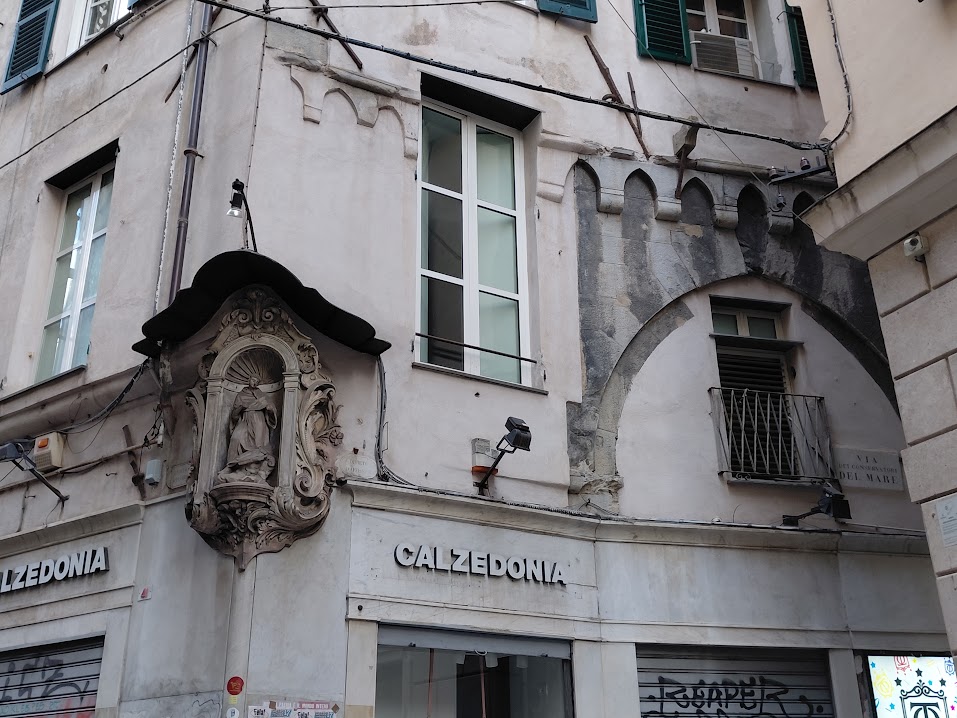
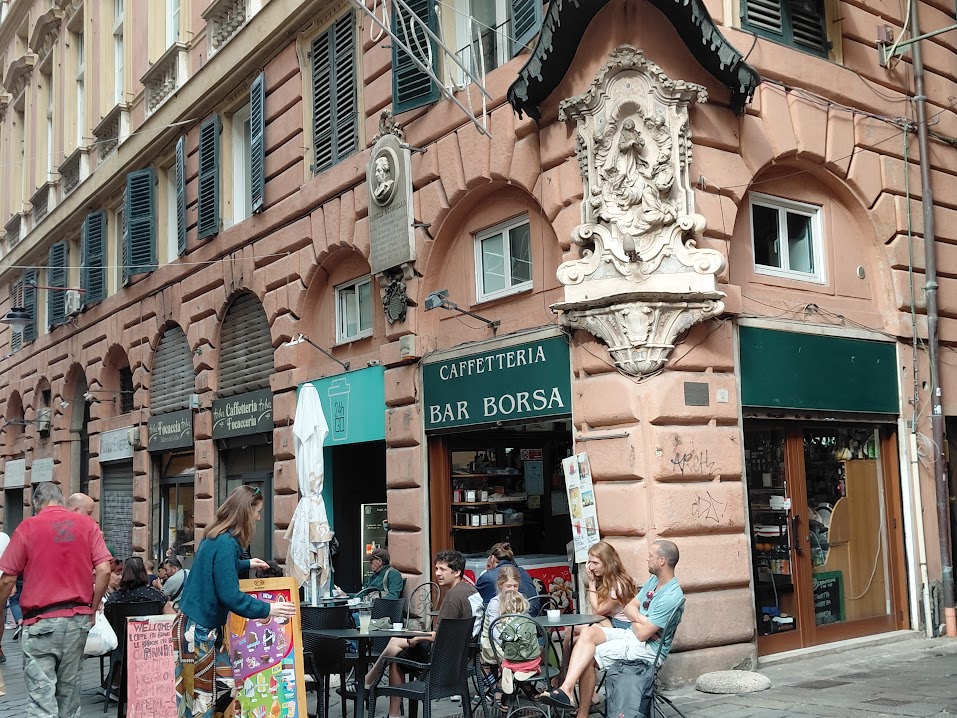
And not only votive niches. This incredible carving was found on a rather decrepit building
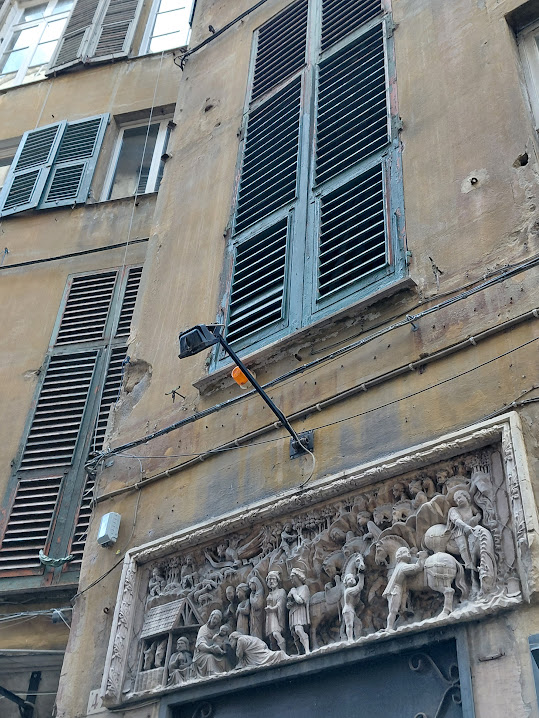
A plaque you can hardly make out tells us that this is the Adoration of the Magi, made in 1460, restored in the last century. If I only knew the story of this house and how it came to have this carving …
Caruggi
The many caruggi (alleyways) of Genoa near the port are shadowy and labyrinthine. Because they’re dark and mysterious looking, tourists are warned not to wander in them after dark. Women standing around on the corners and drug addicts were sights even in the daytime.
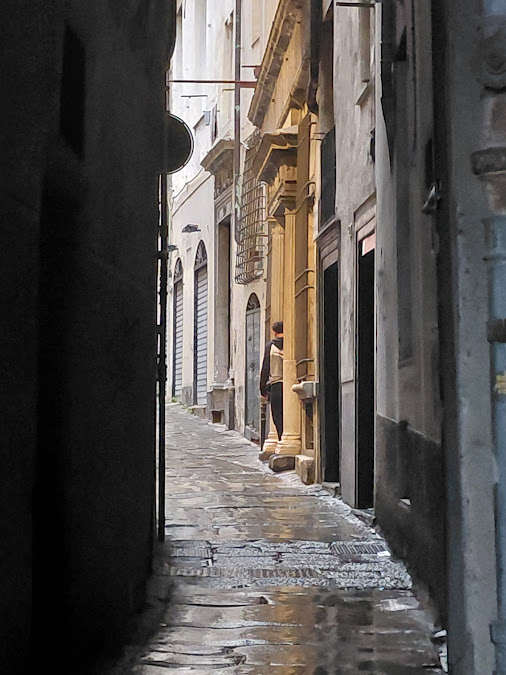
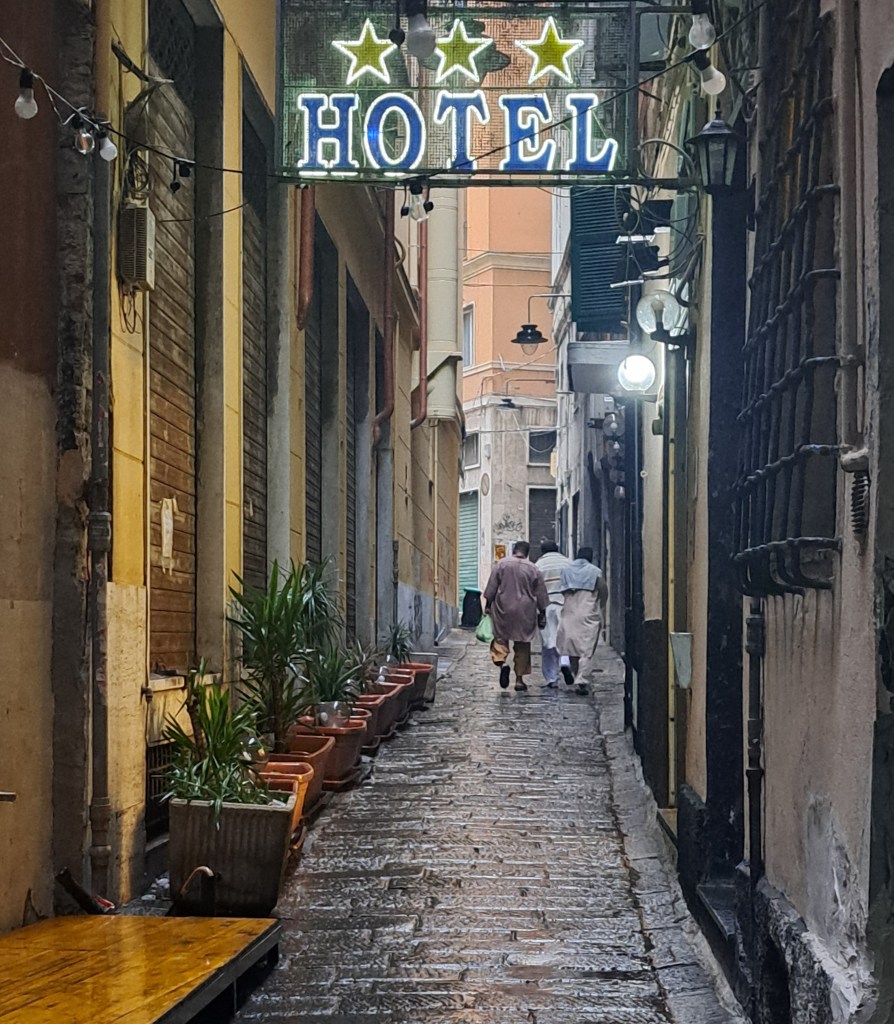
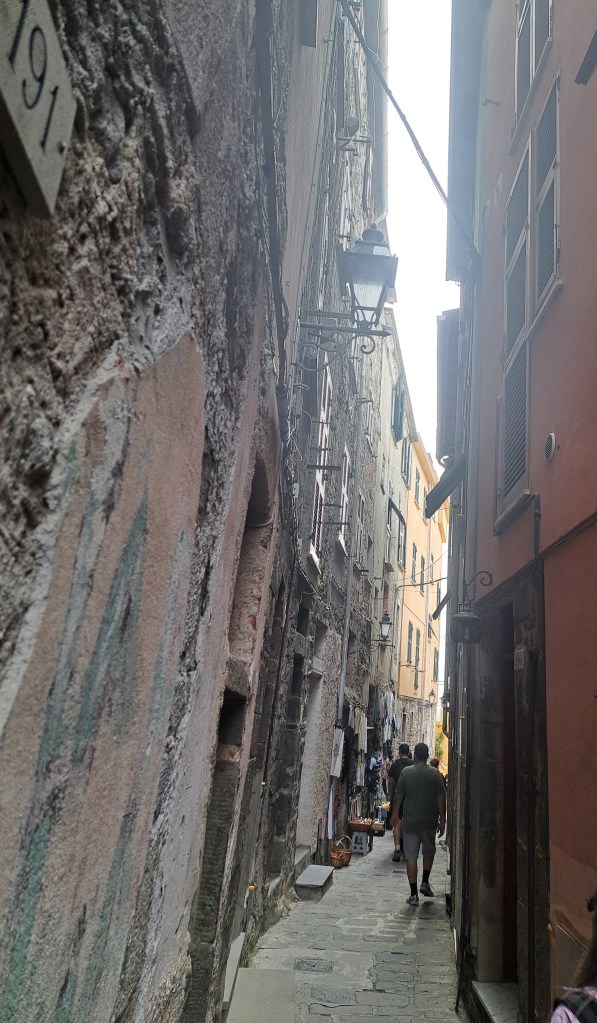
Some are really claustrophobic, with houses so close together you could reach out and fist bump your neighbor across the way..
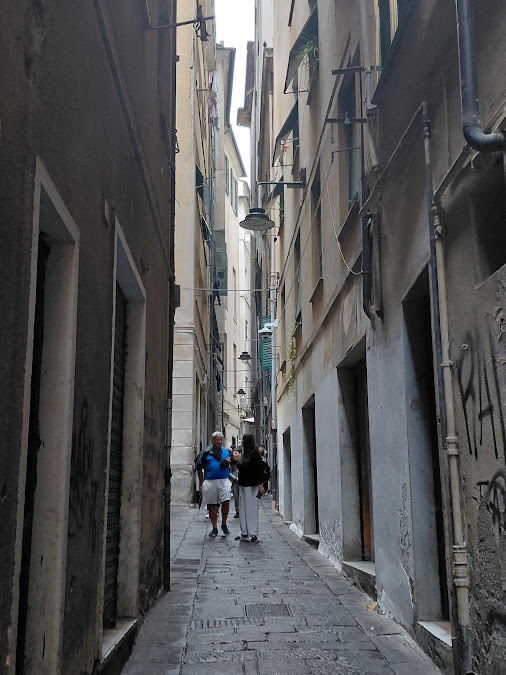
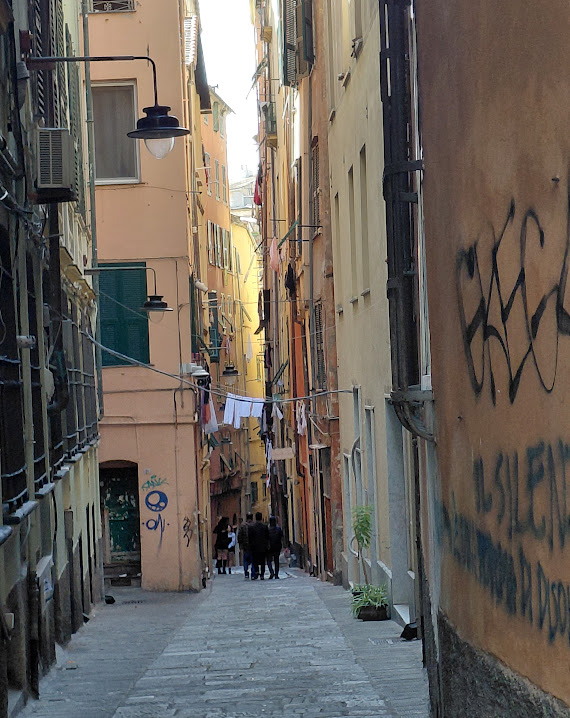
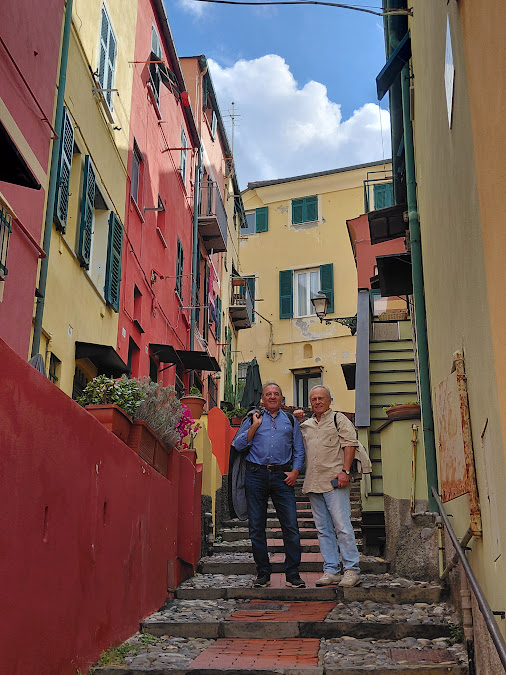
These are caruggi leading down to the port. Others are in more residential areas
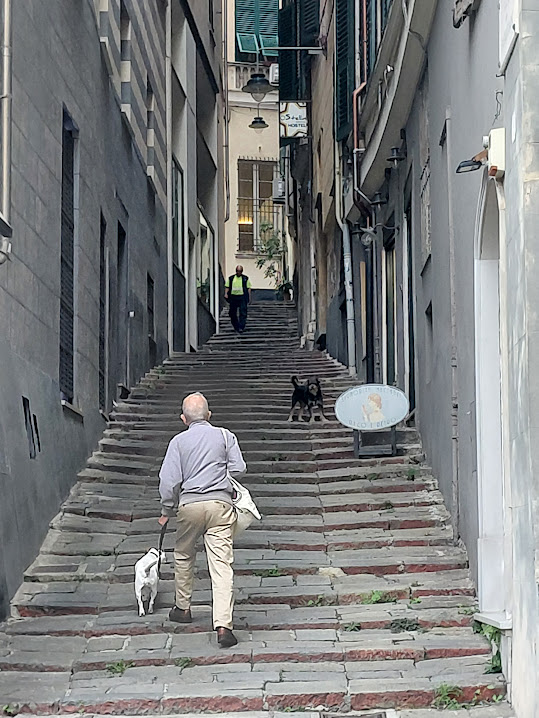
Compared to other cities in Italy, Genoa is not very touristic. My friend Diana who lived in Rapallo, outside the city, for about a year in the early 70’s, wrote in an article, “Genoa doesn’t give up its treasures easily.” It’s definitely not a place for package tour groups — we saw none except for one day the streets were packed with passengers from a mammoth cruise boat sitting in the harbor.
And so true about its treasures. “You have to track them down and pry them out,” writes Diana. We had with us in fact an “interpreter” to “pry them out.” Our good friends Sotiris and Olina that we were together with in Morocco and New York City/Washington joined us. Sotiris had studied medicine for 8 years in Bologna. Perfect for helping us ferret out information, often hard to get, about buses and trains and whatever. We needed him, way beyond my on-again mostly off-again Italian study…And Olina, who had really done her homework with pages of handwritten notes!
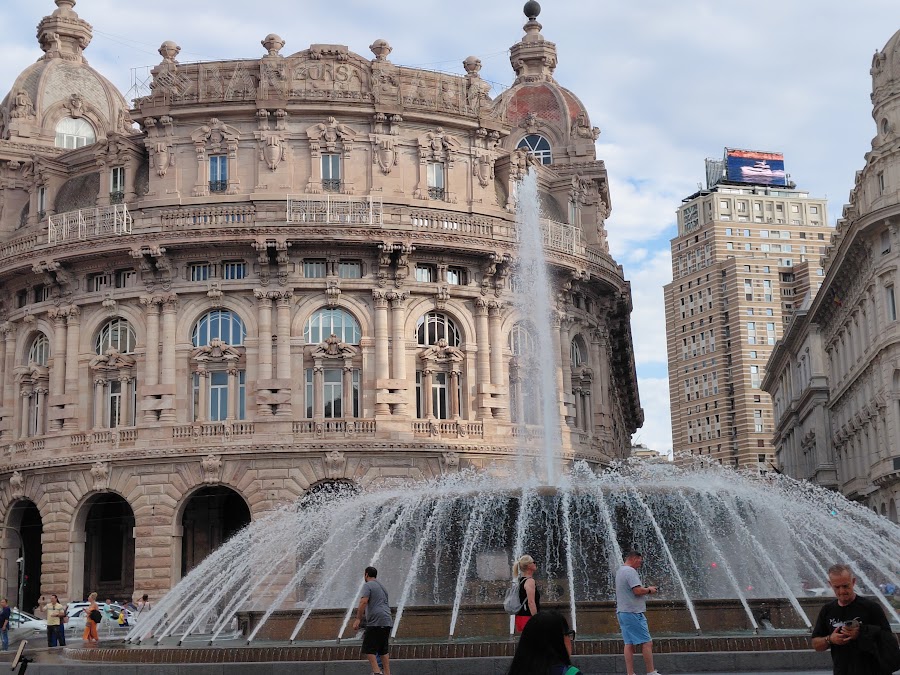
Piazza di Ferrari and Via XX Septembre
Genoa’s main square is named for Raffaele de Ferrari, a 19th century duke and one of the major benefactors to the city. The bronze fountain dates from 1936. And the beautiful art nouveau building behind the fountain, used for the stock exchange, was built in 1912..
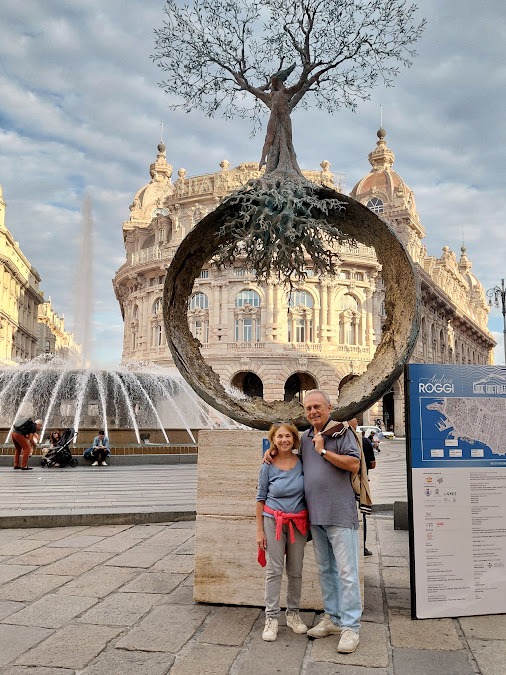
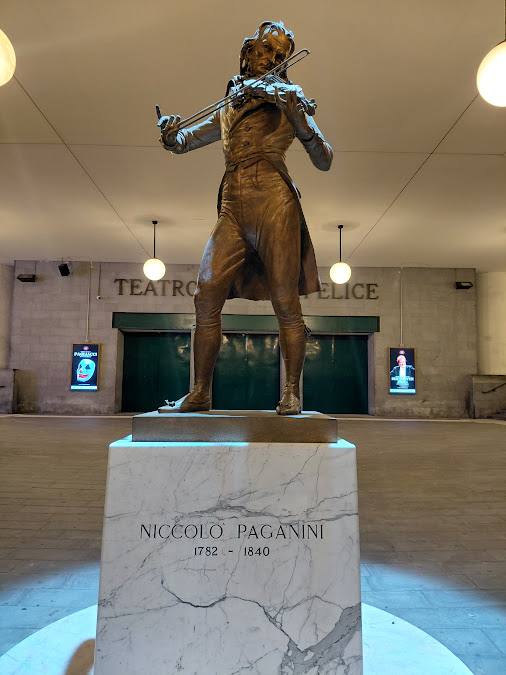
Near the square is the theater, Carlo Felice, planning for upcoming concerts.
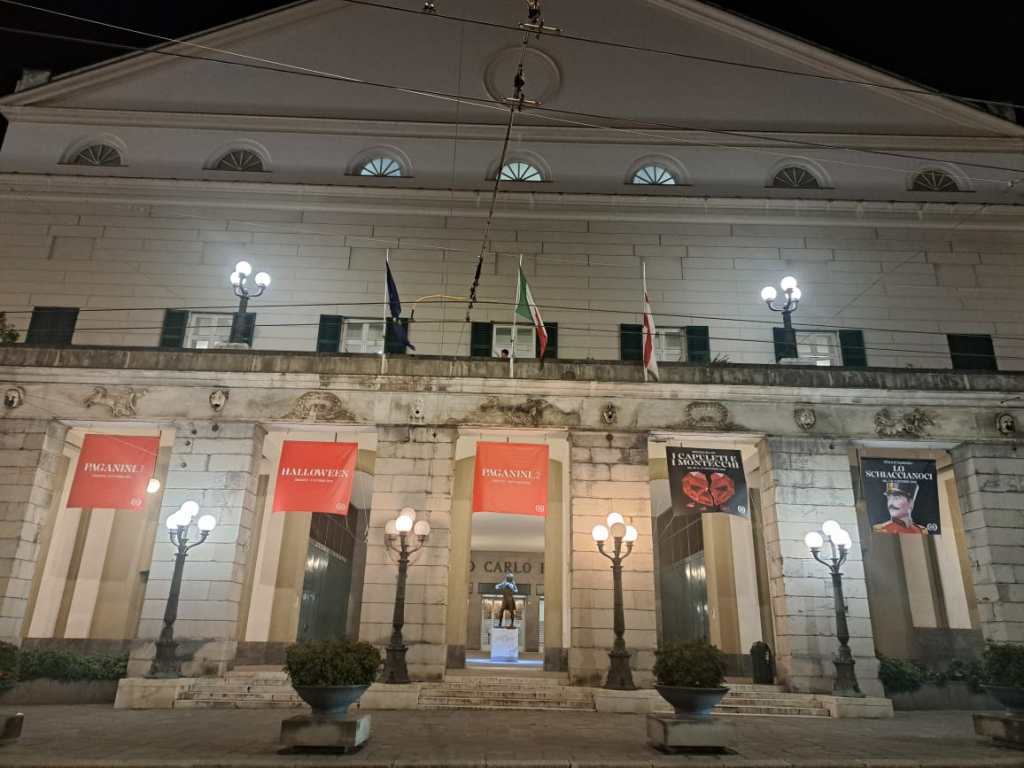
In front of the theater, stands native son Niccolo Paganini playing his violin.
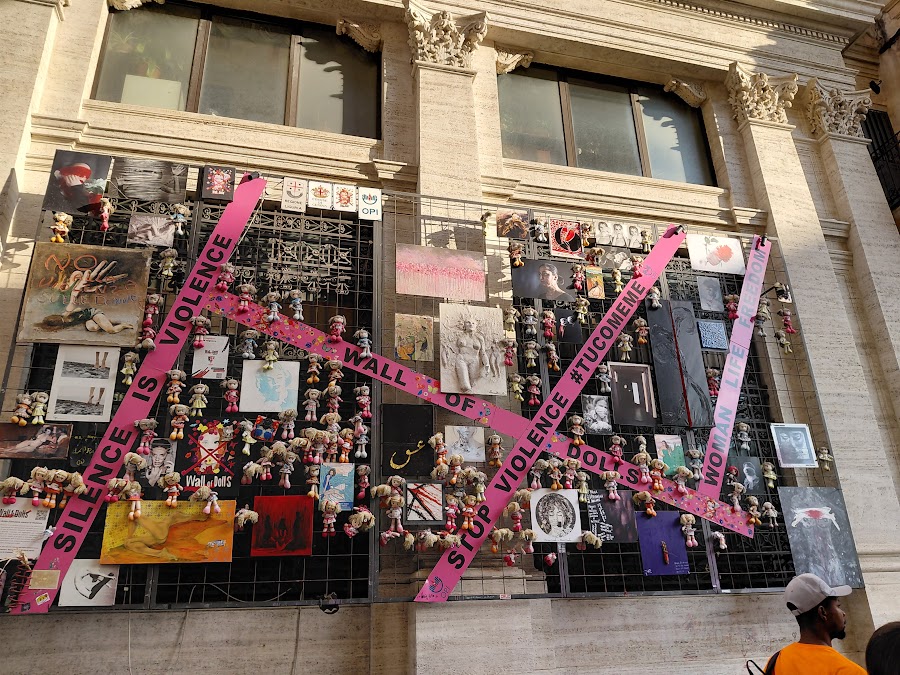
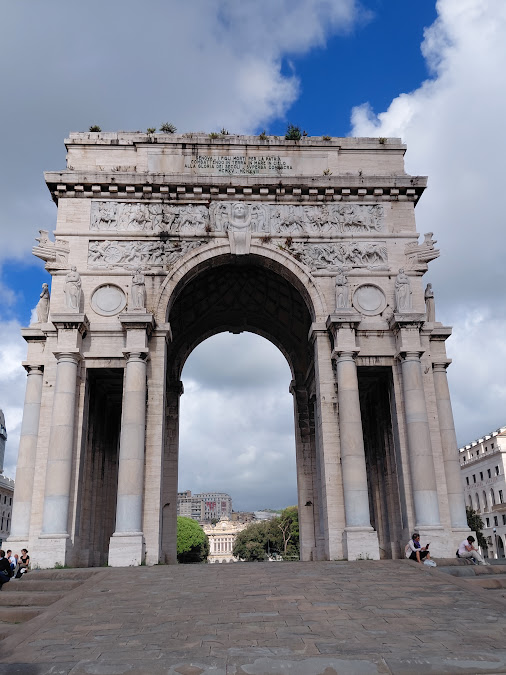
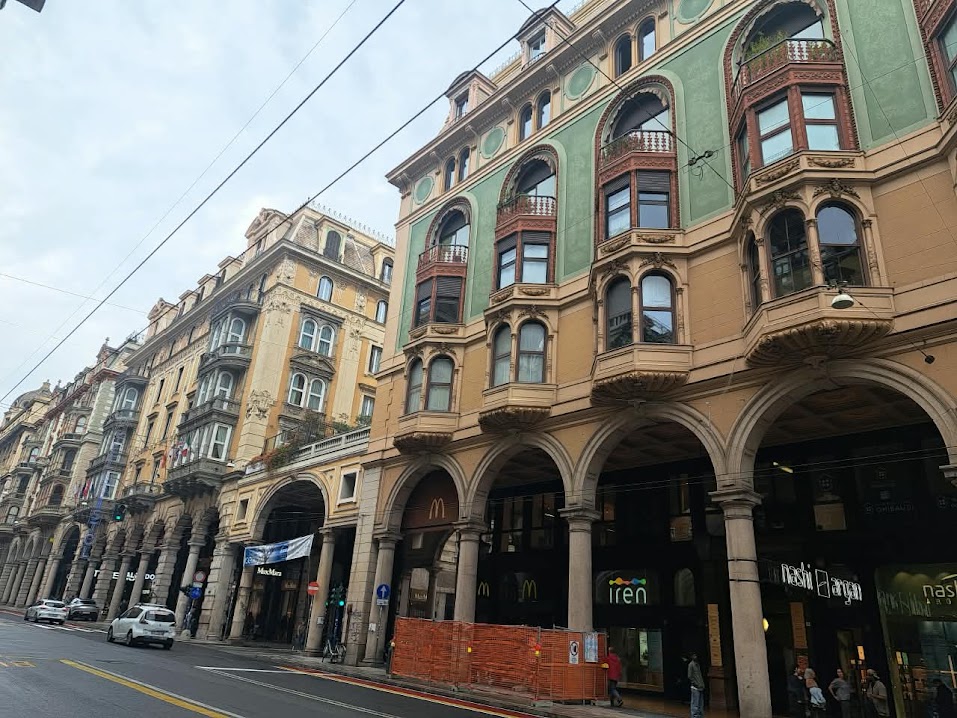
We’re taking via XX Septembre, the main shopping street that starts at de Ferrari and ends up at Piazza Vittoria. Here there’s an arch to the fallen in World War I.
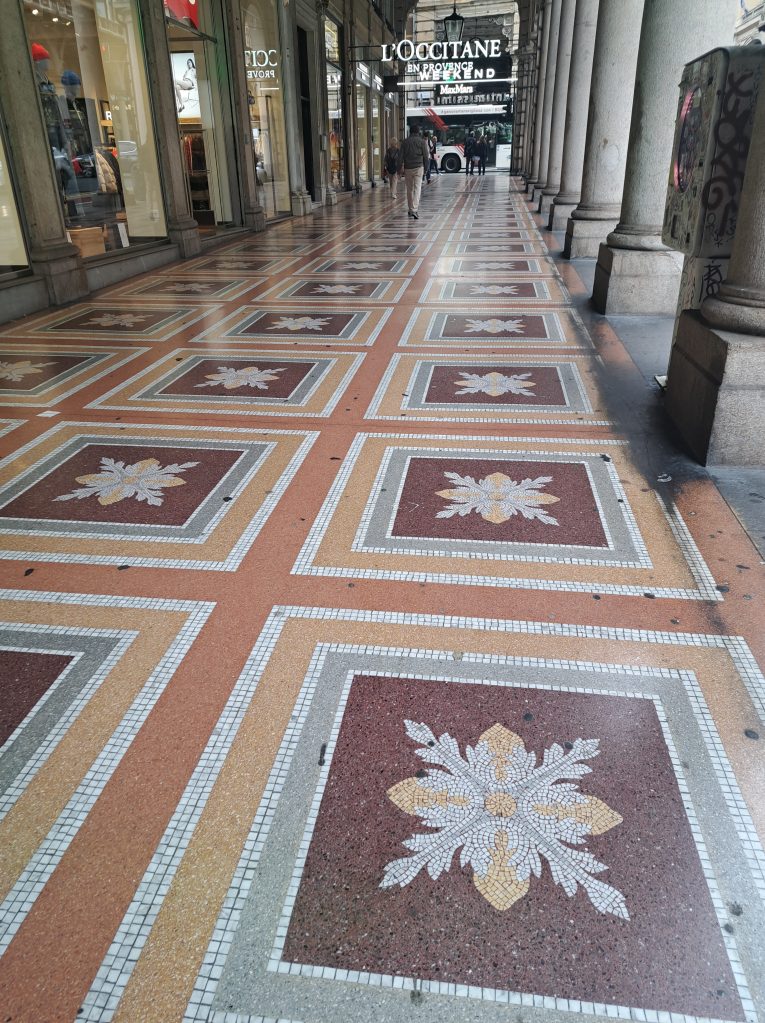
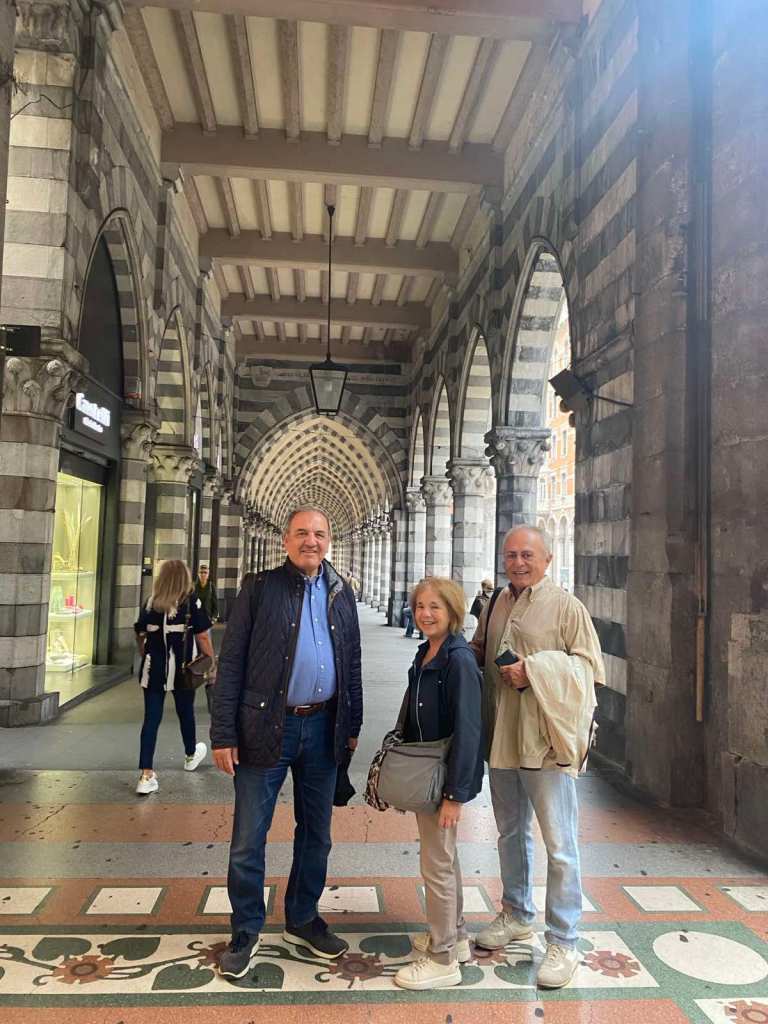
Along via XX Septembre, instead of looking up to find the votive niches, now you should look down at the exquisite mosaic floor. And it’s a good thing we’re under the porticoes as it’s started raining.
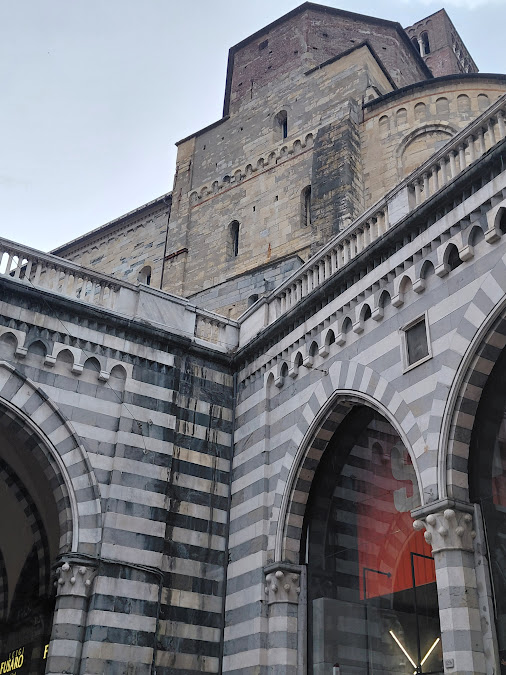
This very old church above the street is the 10th century Romanesque Abbey of San Stefano. Tradition says that here was Christopher Columbus’ baptism.
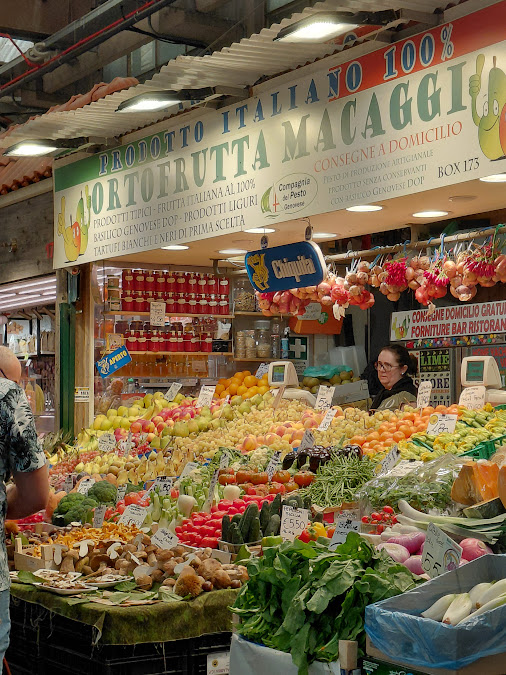
We’re on our way to the Mercato Orientale, or Eastern Market. What displays and colors! You have to walk around and look at all the fruits and vegetables. (Be sure not to touch anything.) I loved the giant porcini mushrooms.
We couldn’t make up our minds at the cheese counter — pecorino or romano? prosciutto or mortadella?
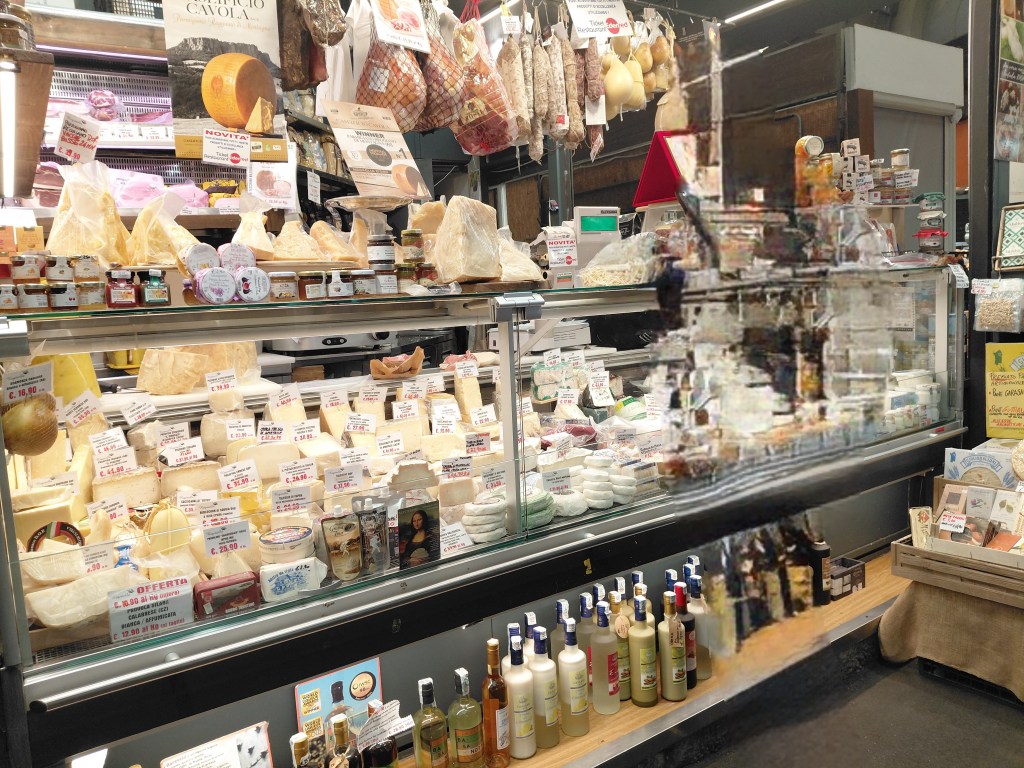
Upstairs we followed the smells to a cooking class. There were several places to eat but they were a bit desolate in the rain.
Via Garibaldi, Strade Nuove, Palazzi di Rolli
We were on our way to Via Garibaldi. With its palaces to the left and right, you feel like you’re part of a special world of the past, mostly 16th and 17th centuries.. On this rainy day. it was perfect to visit some of the palazzi.
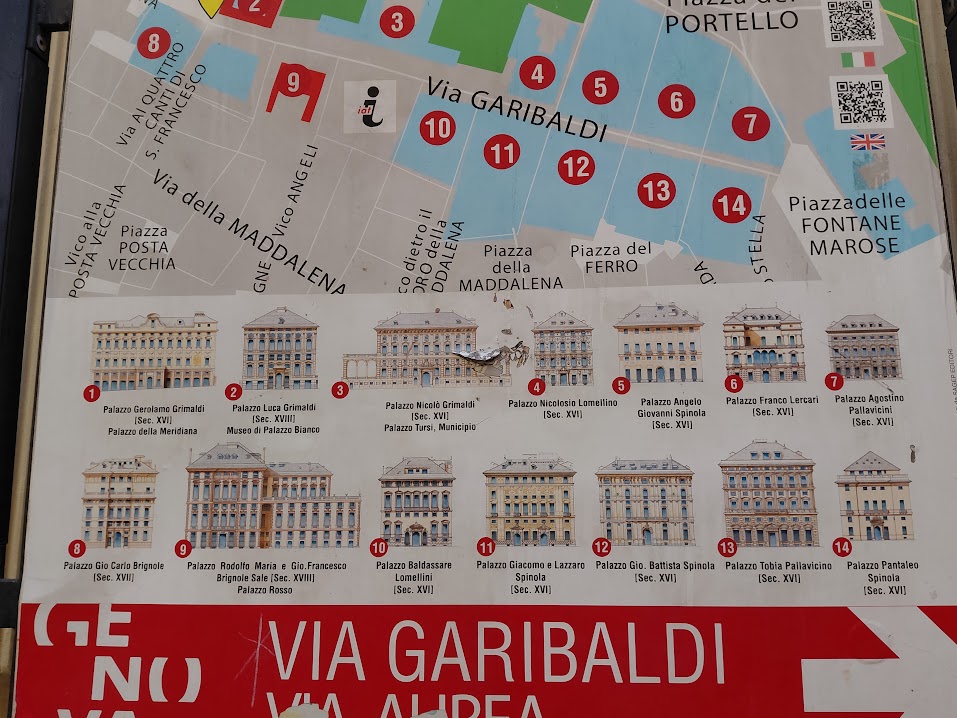
The palaces are known as the Palazzi de Rolli because during the Republic of Genoa, the Rolli were lists of Genovese families ‘ mansions. From these lists, the palaces that would have the honor of hosting important foreign dignitaries during state visits were drawn by lot.
The palaces are also known as the Museums of the Strada Nuova (new street) and included in UNESCO World Heritage list (42 of them)
For one ticket you can visit three palaces: Palazzo Rosso, Bianco and Tursi.
Palazzo Rosso (red named for the outside color) is more of a “house” museum, a 17th century residence that’s preserved through rich art collections and furnishings of the time. In 1874, the last remaining heir of the family donated it to the city of Genoa to celebrate her family’s history.
The day we went we were told the lift was not working and had to walk up the 4 to 5 flights (I had a feeling that it was never working…)
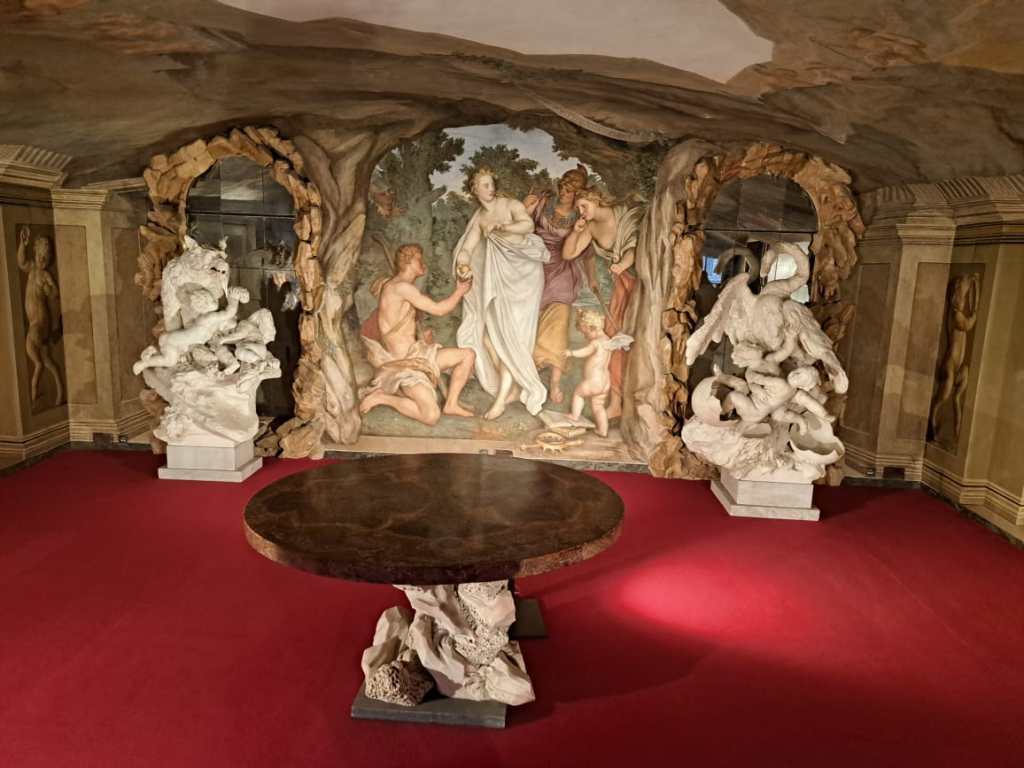
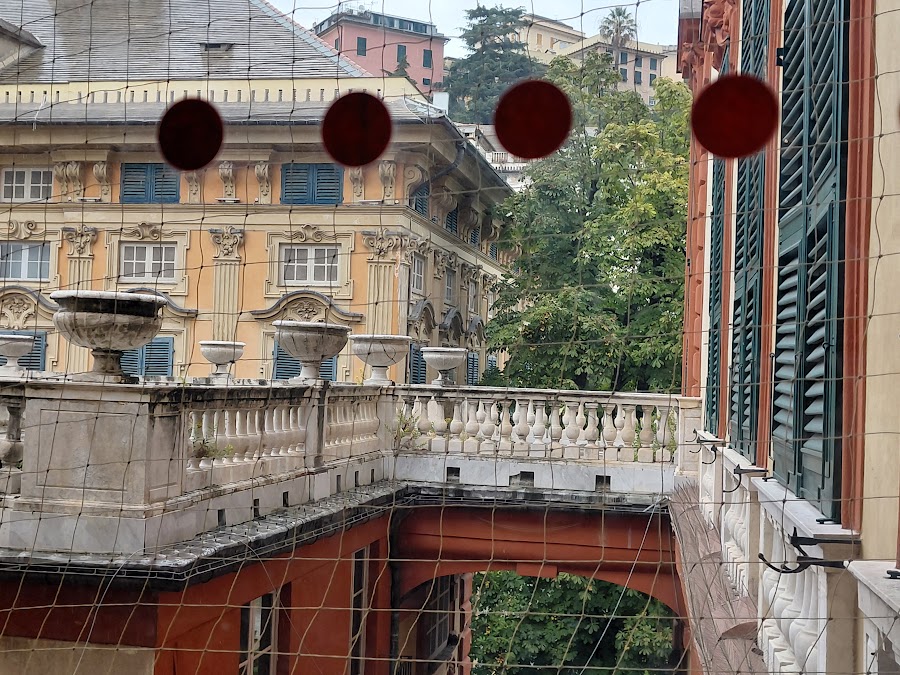
The Palazzo Rosso has a popular bistrot –so it seemed — on the ground floor. Outside are tables in a courtyard that would have been lovely in clear weather.
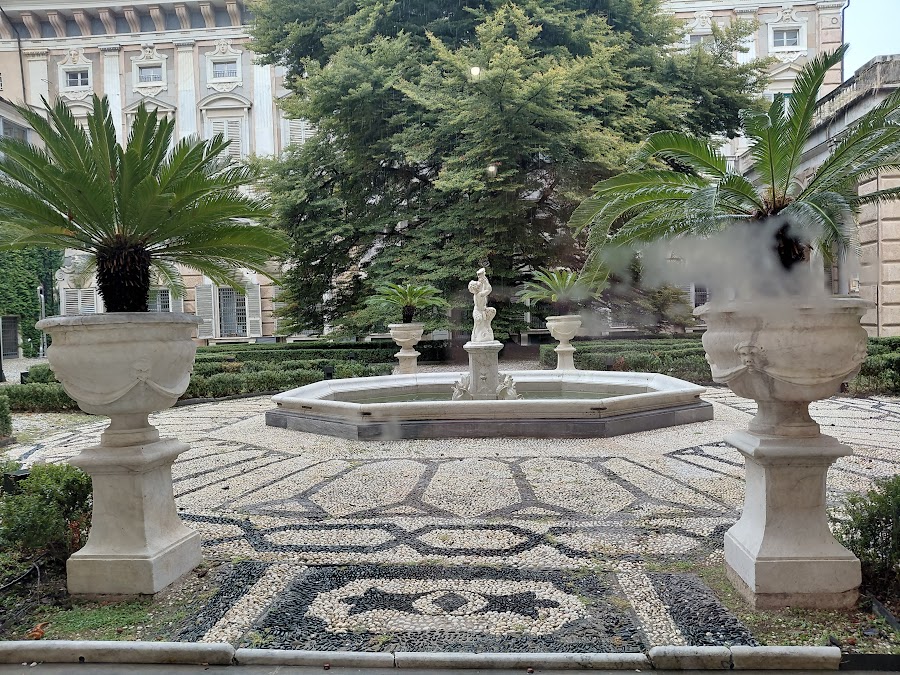
I found the Palazzo Bianco more interesting for several reasons, that it is really the main art gallery, with Flemish, Spanish and Italian painters, gardens and views of the city.
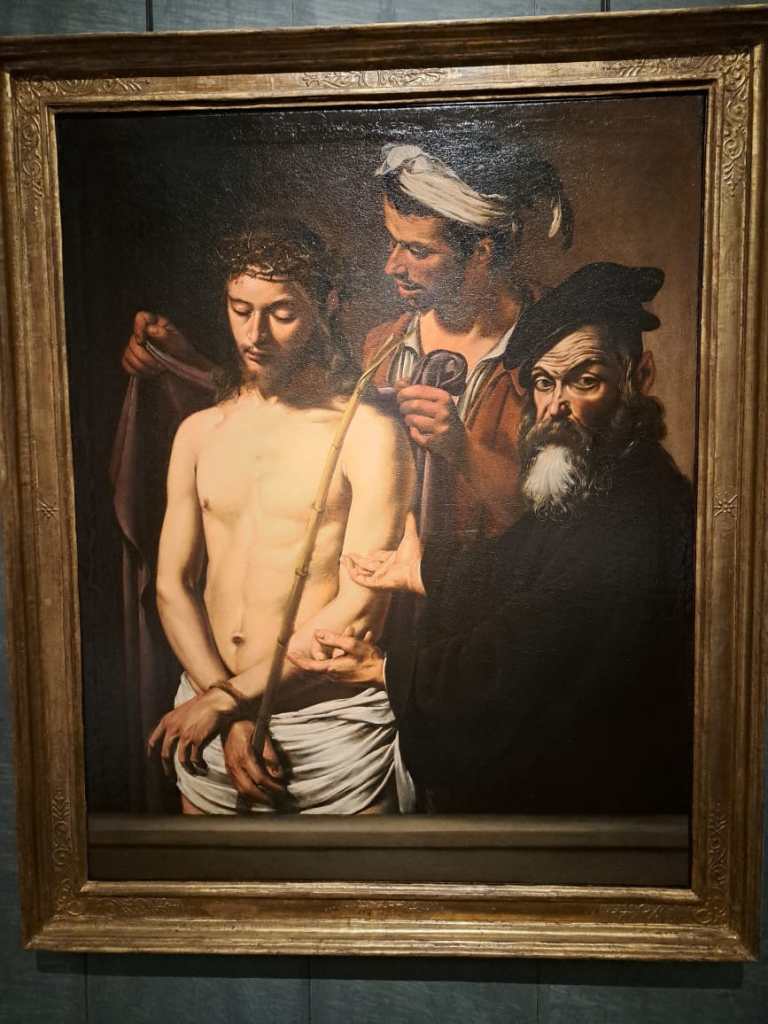
We had a leisurely visit. The guard was eager to talk and found a ready ear in Sotiris. In fact, wherever we went, we would find him in conversation with ticket collectors, guards, restaurant personnel, people on the street…
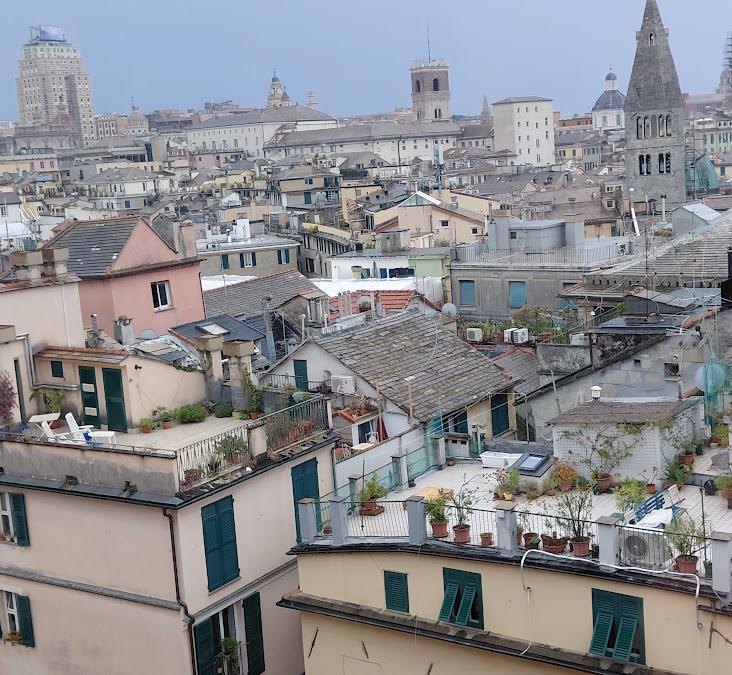
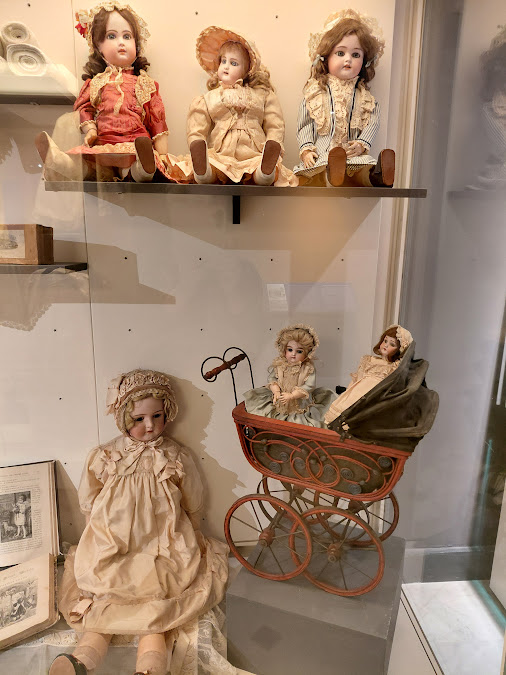
There was also a collection of men’s and women’s clothes to show how styles had changed from early 19th century to mid 20th as well as toys and dolls.
The Piazzo Bianco leads into the third Strada Nuova Museum, the Doria Tursi, which during the 16th century was the most impressive residence on the street. Today it’s used partly for the Town Hall, but in the upper galleries it has artwork.
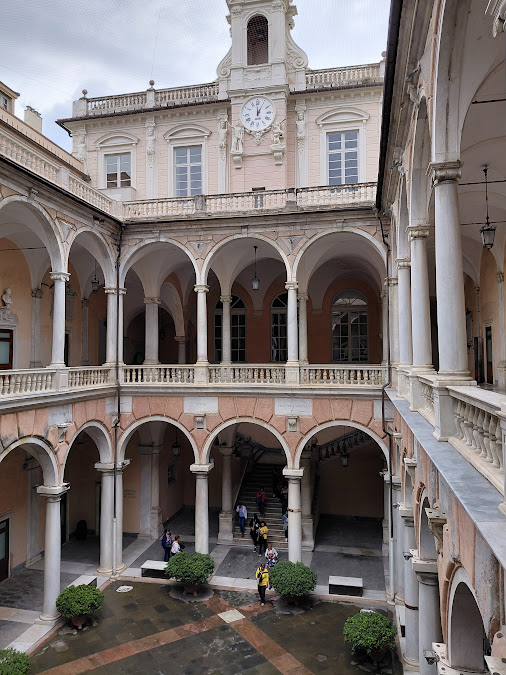
Its most famous display are the violins that Niccolo Paganini used. This is the one known as the “Canonne” violin that Paganini left in his will to the city of Genoa. It’s been in the Tursi palazzo since 1851.
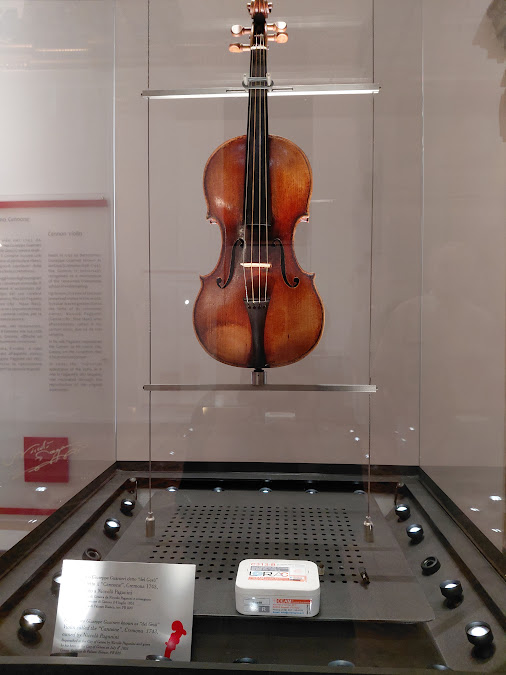
Many famous violinists have performed with the “Cannone” in Italy and abroad.The winner of the International Violin Competition (Premio Paganini) has the privilege of playing it on October 12th for Columbus celebrations.
Three palaces was enough for one day! The next day we visited the most impressive of all, the Palazzo Reale, the Royal Palace, away from the Via Garibaldi on Via Balbi, named for the original owners of the Palazzo. This UNESCO 17th century palace is full of what seems to us today as total (and unapologetic) opulence — chandeliers, furniture, decorations frescoes, halls of mirrors, tapestries and gardens.
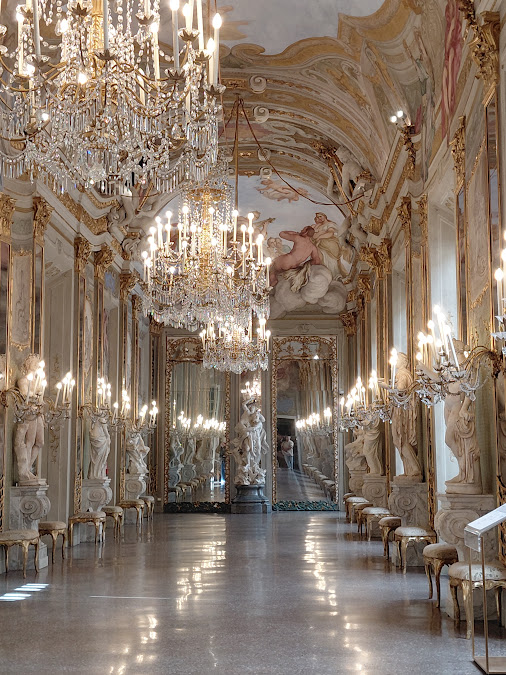
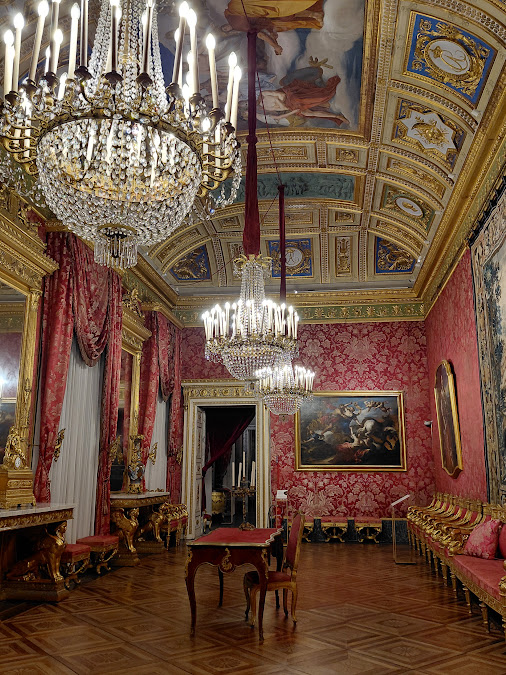
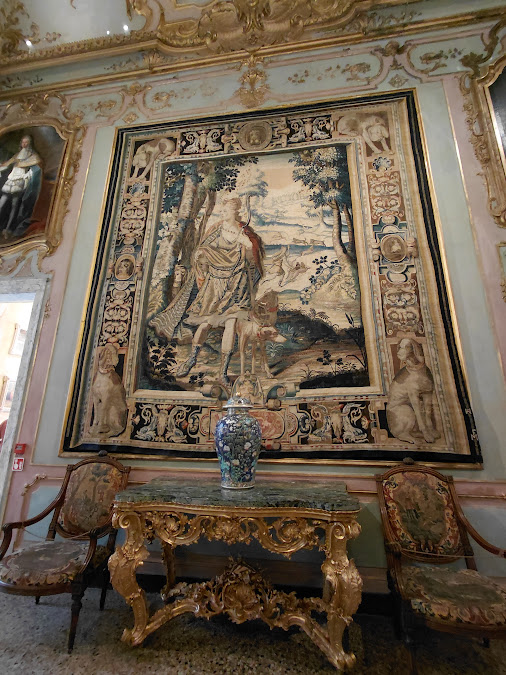
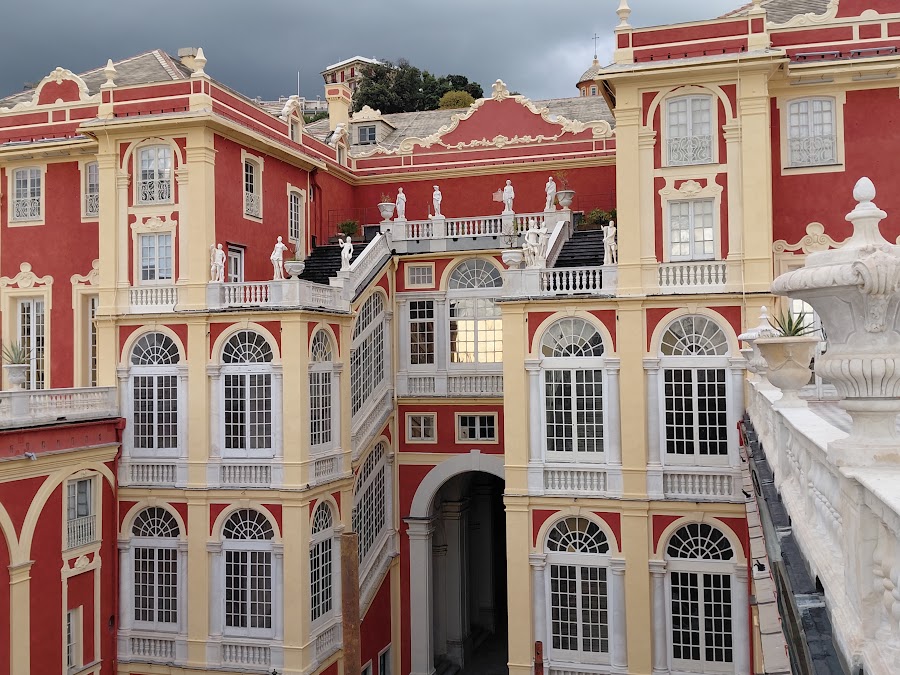
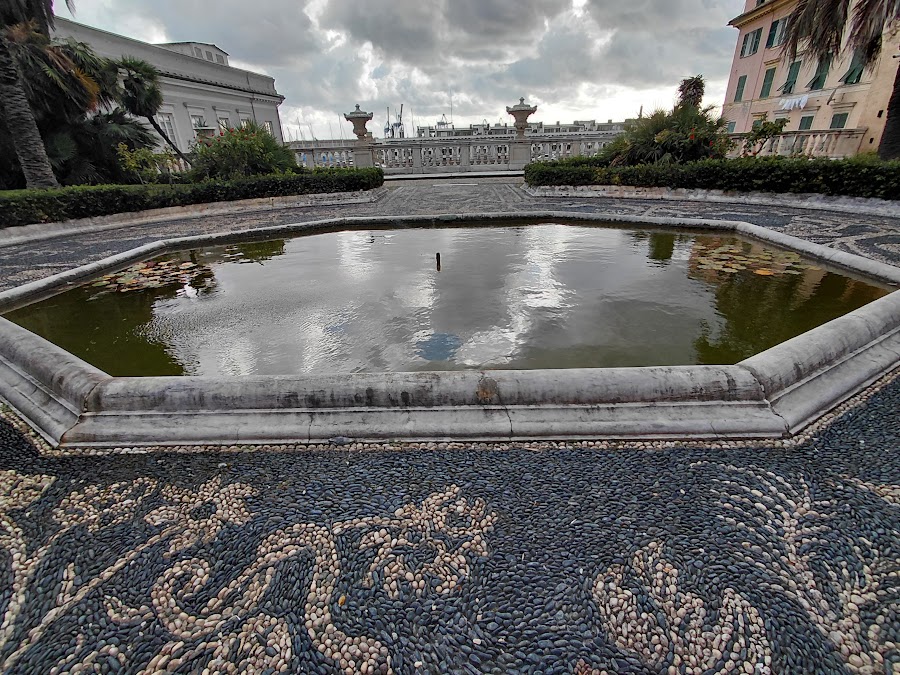
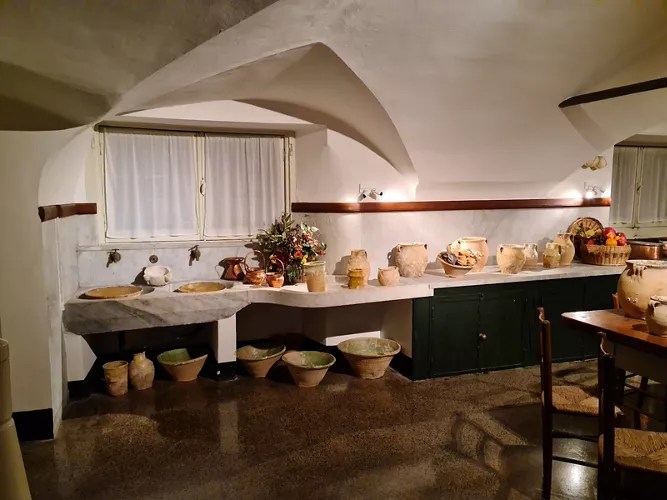
The ticket for the Palazzo Reale also gives you admission to the Palazzo Spinola which preserves all the original 17th and 18th century furniture, porcelain, silverware and books. An interesting thing about this palazzo, is that you can see a preserved 19th century kitchen, revealing the day to day operations of what was once a grand noble household.
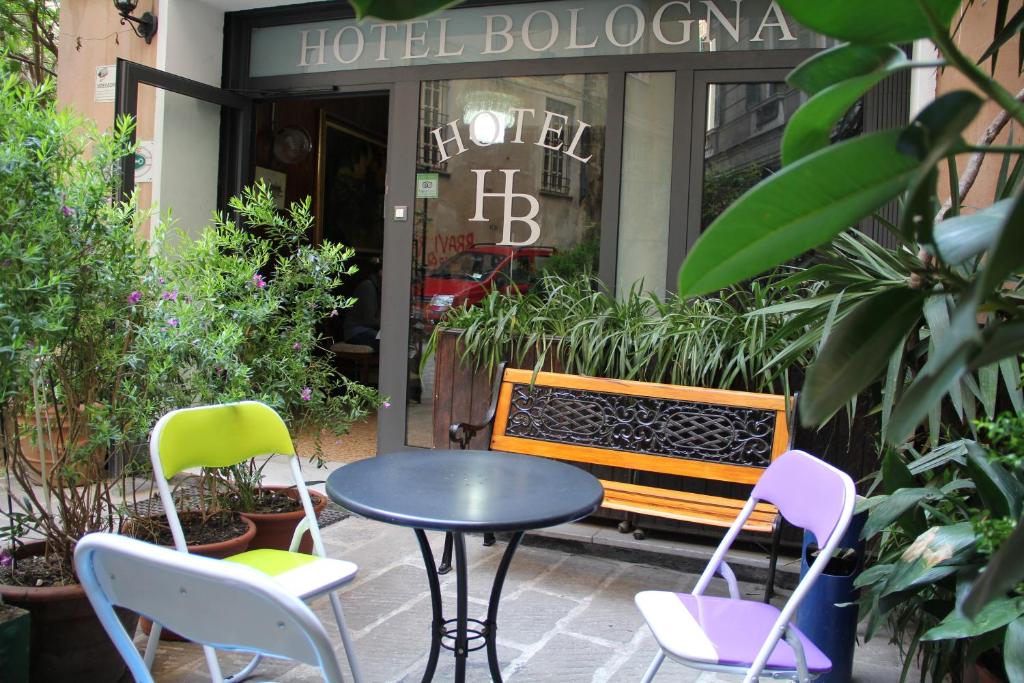
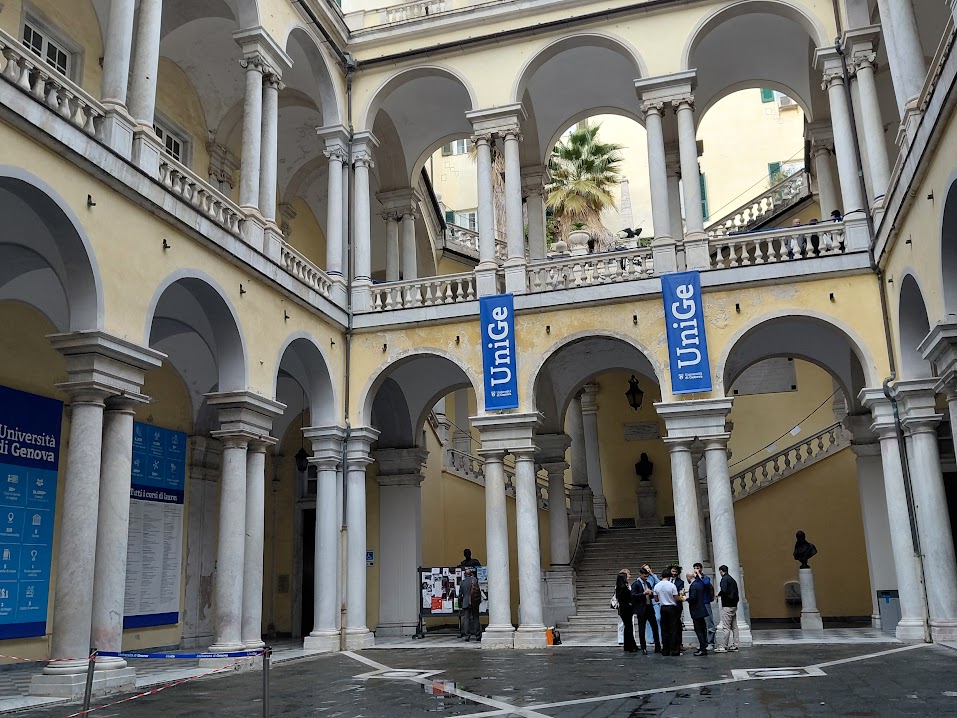
We were happy to stay at the Hotel Bologna, located practically next to the Palazzo Reale on the Via Balbi, across from the University of Genoa, and a less than 10 minute walk to the Principe train station. Certainly not “opulent,” but very pleasant. They had a very helpful staff, especially Anna, large rooms, all kinds of maps in the lobby and outside a pretty patio with a little jungle of plants.
San Lorenzo and Annunziata Churches
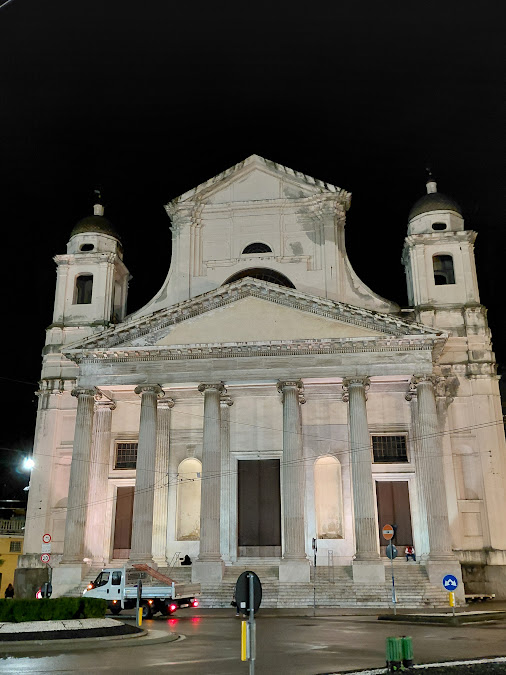
Besides the palaces, if you love Romanesque and Gothic churches, Genoa is the place for you. Some small ones are even in the Caruggi (alleyways) One of the most impressive is certainly the gorgeous Basilica della Santissima Annunziata, just down the street from us. Here it is at night, looking imposing but still rather plain on the outside.
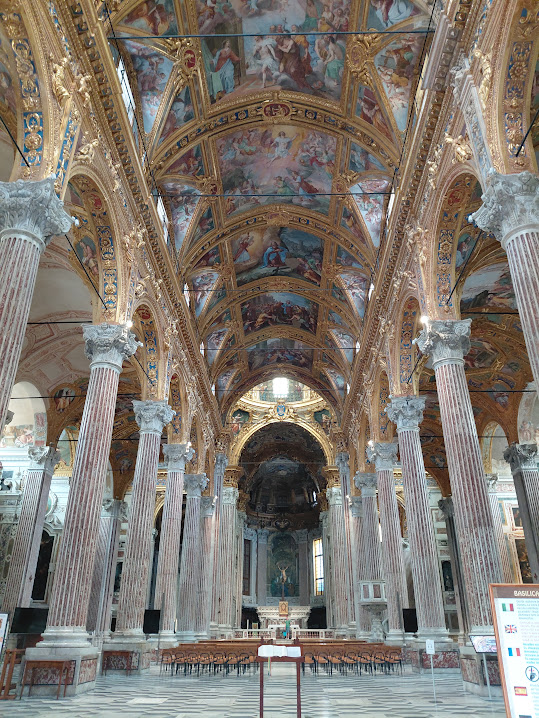
Inside though, the Baroque interior is extraordinary: gold, marbles, rich frescoes.
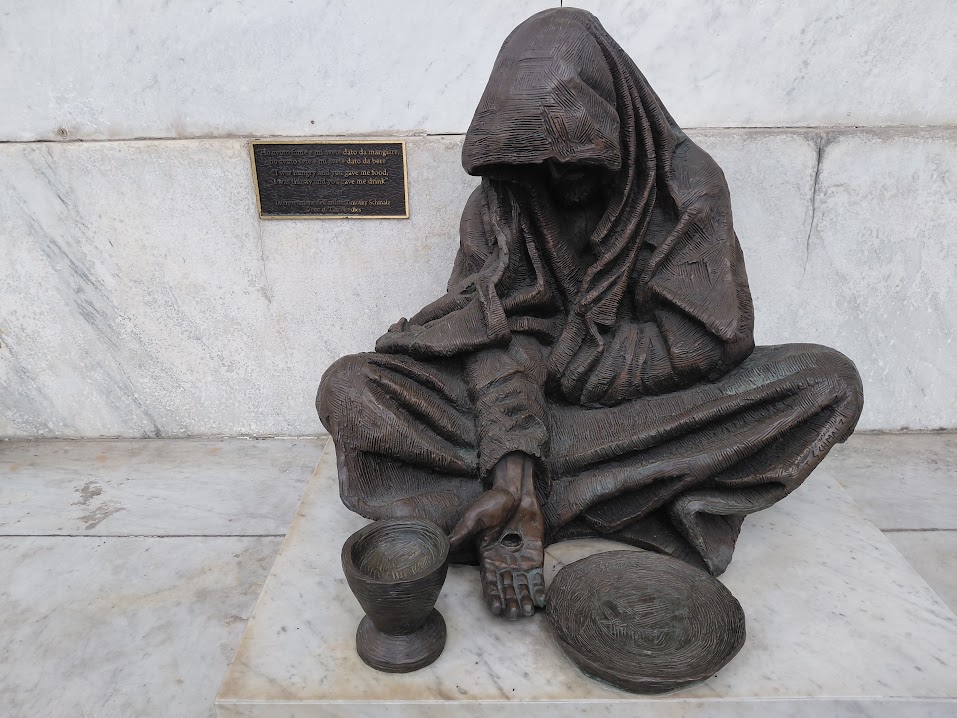
Outside the church, the plaque says “I was hungry and you gave me food, I was thirsty and you gave me drink.”
In contrast to the Annunziata, the main cathedral of Genoa, San Lorenzo, has a very rich exterior. In fact, when you turn the corner from a rather ordinary street going down to the Porto, with gelato, kebabs, fish in a cone and other shops, suddenly you’re astonished to see this magnificent facade of black and white striped marble.
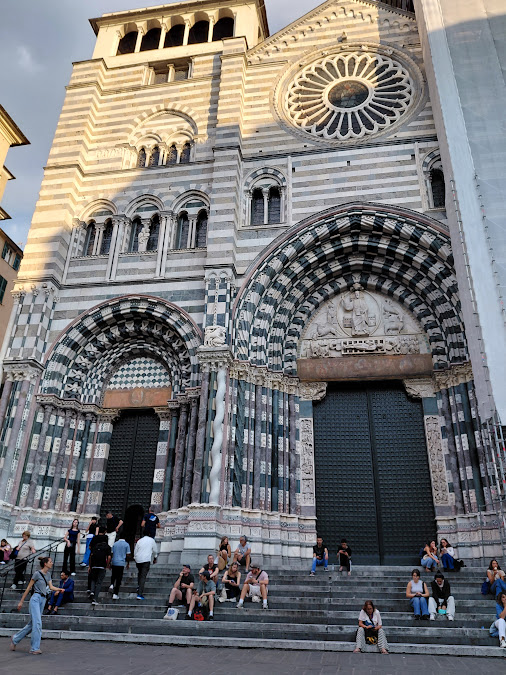
Unfortunately the bell tower was being renovated. The interior of the church dates from the 12th century, but the Gothic facade about a century later.
Fortunately for San Lorenzo’s existence, a British bomb in WWII bomb landed on it, but never exploded!
Porta Soprana, the monastery of Sant’Andrea and Columbus’ House
“If you come in peace you are allowed to touch these doors” is written on the medieval stone entrance gates of the Porta Soprana.
Whoever arrived in Genoa from the east had to pass through this 12th century gates.
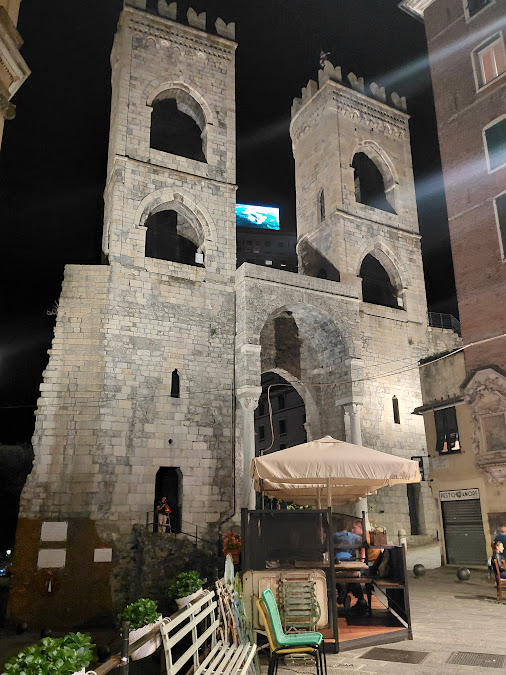
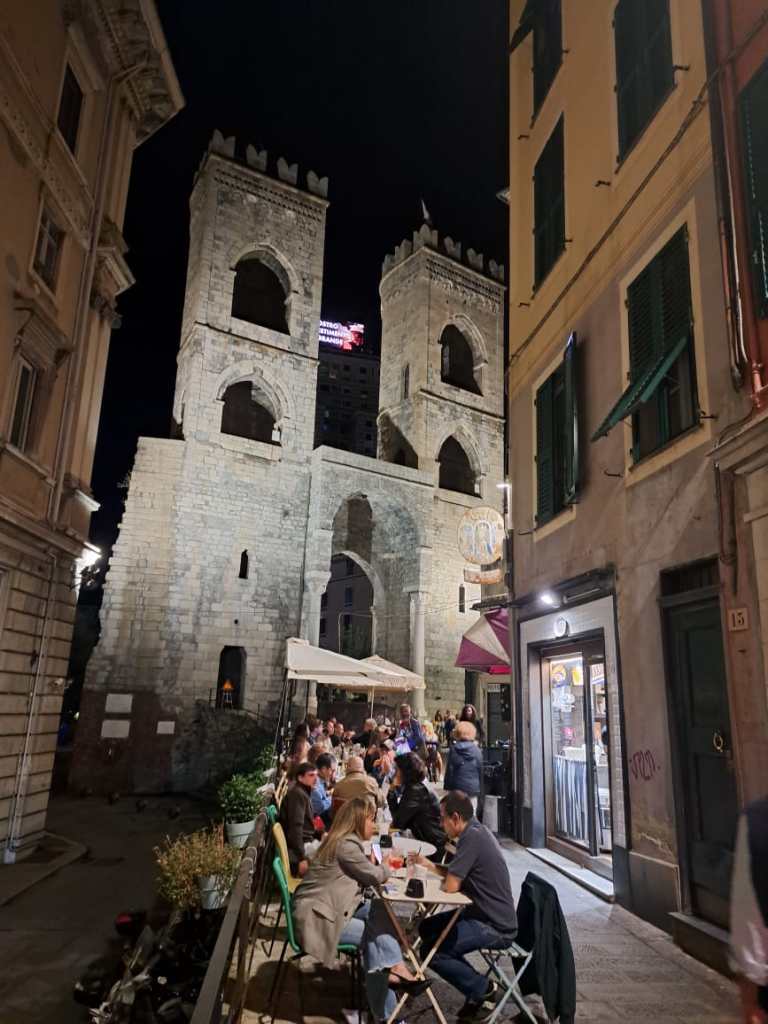
Around the porta is a popular place to sit and eat.
Right down the hill, outside the walls was the 12thc. monastery of Sant’Andrea. The columns are all of what’s still standing.
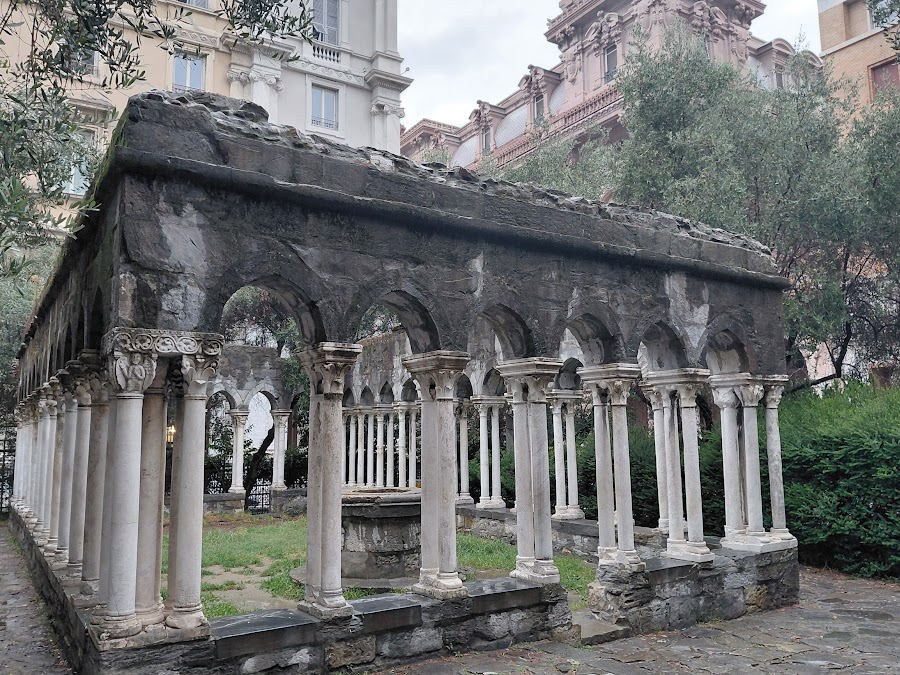
And right next to it is the house where Christopher Columbus lived for a while growing up. It was reconstructed in the 18th century.
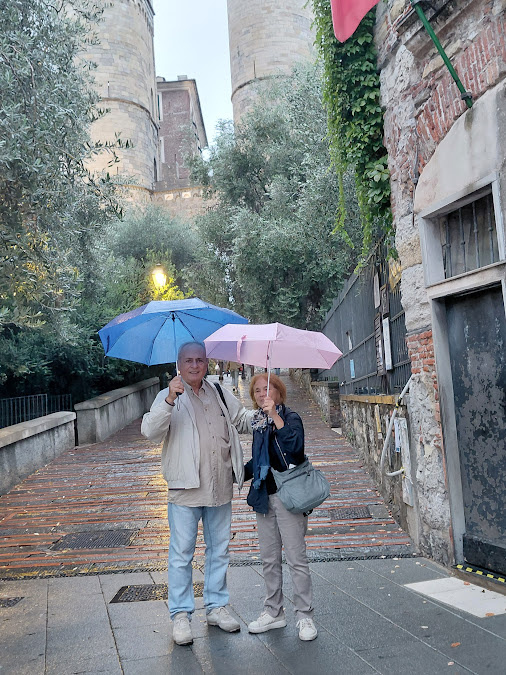
A better picture of the house. Here you can see the two towers of the Porta Soprana. Diana tells me that a mastic tree from the Greek island of Chios (which was one of Genoa’s colonies and where supposedly Columbus spent some time) was planted in front of the house, but it never grew It seems Chios is indeed unique in growing mastic.
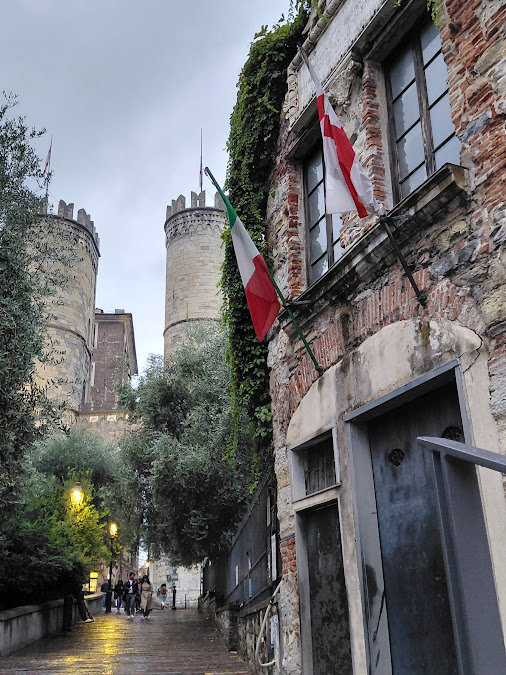
Castelletto
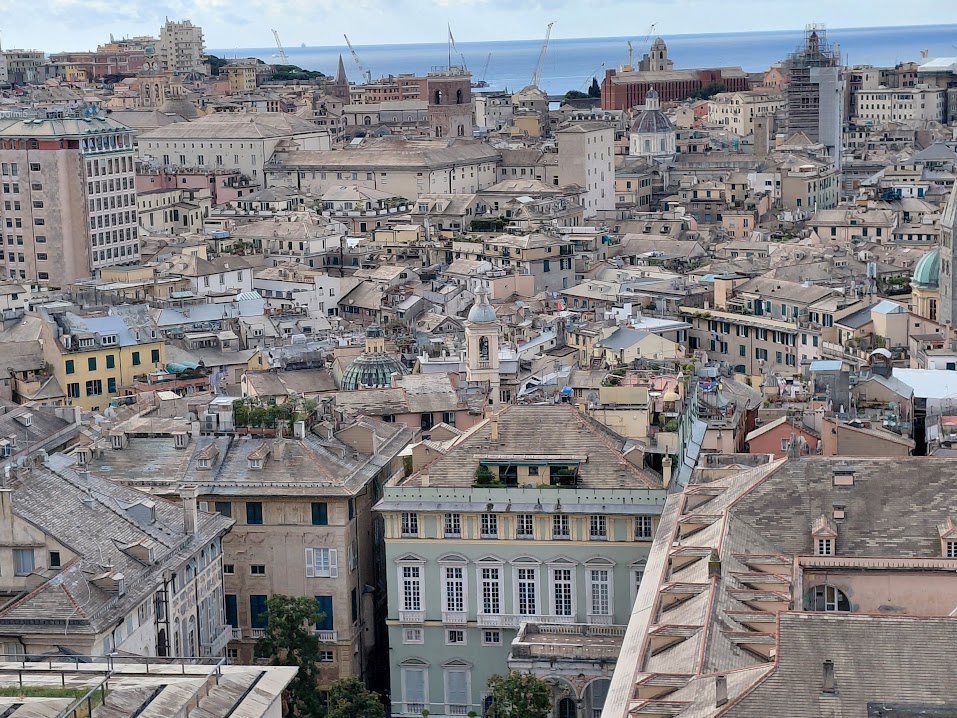
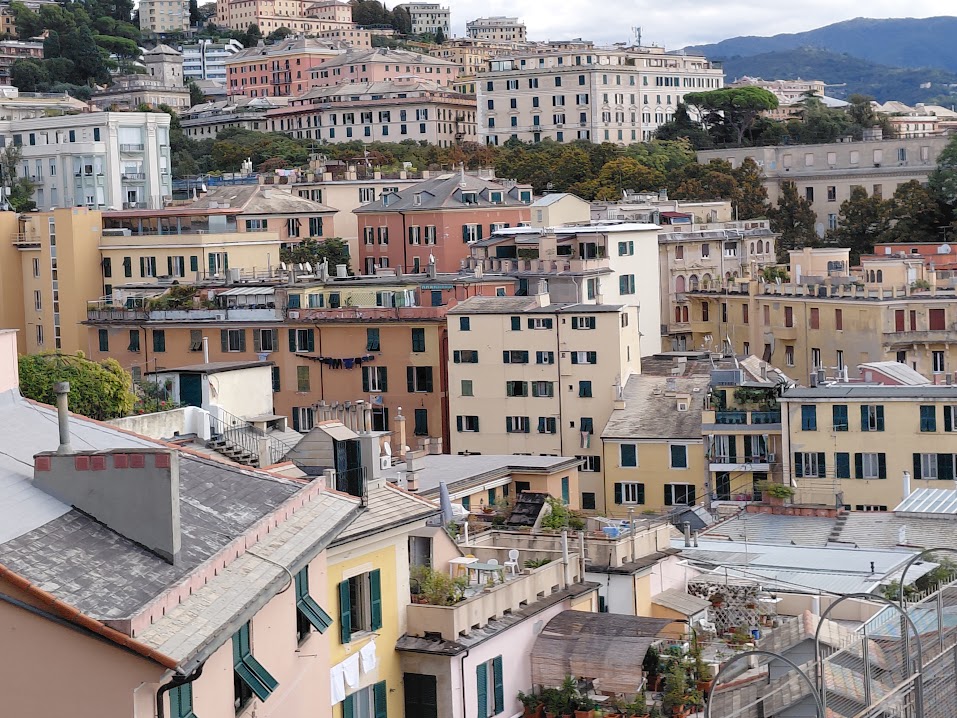
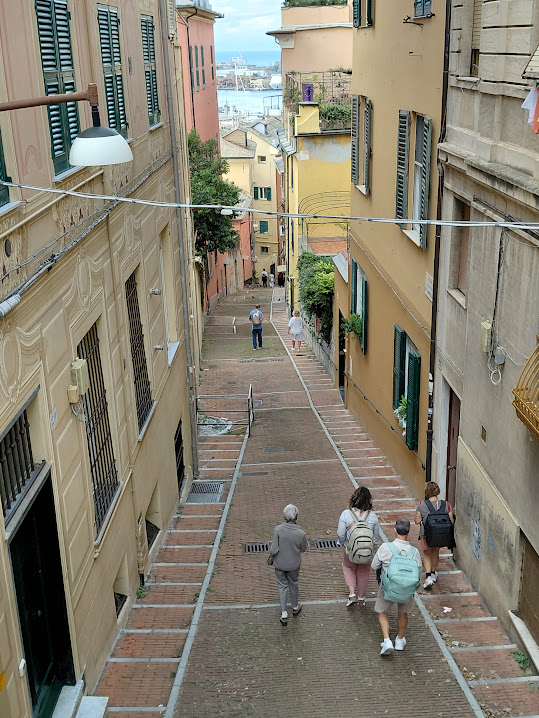
Genoa is very much a vertical city. The first thing you notice as you exit the train station are the houses and hotels up on the hillside. A series of lifts takes you up to neighborhoods with a great view below.
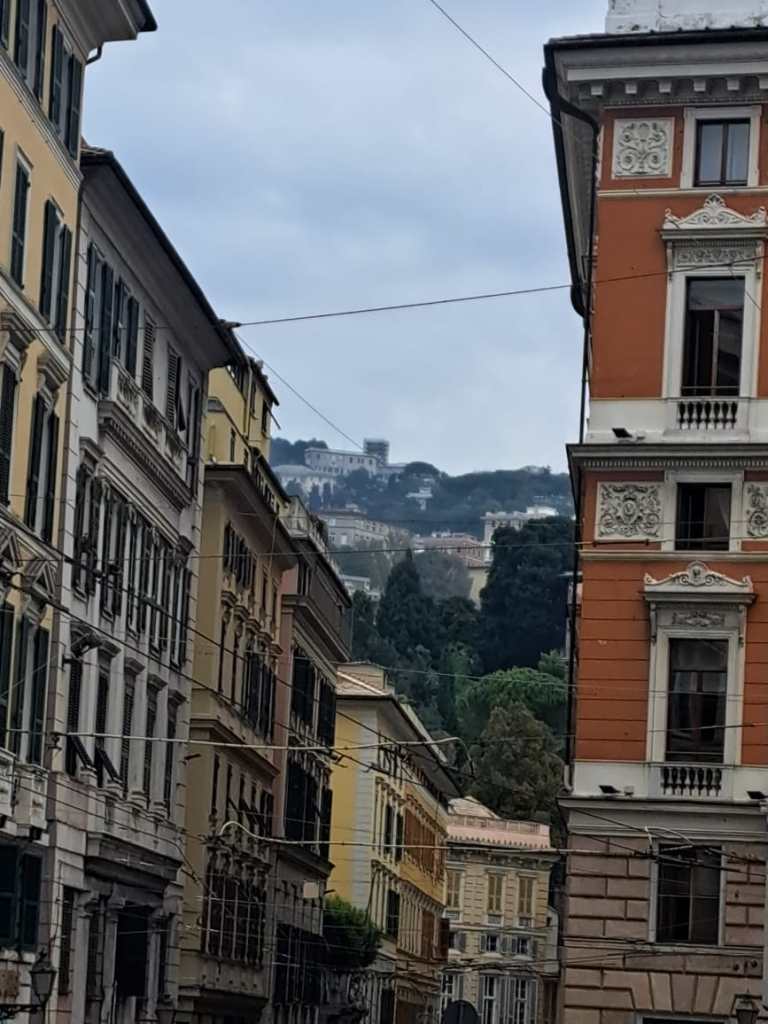
One area is Castelletto and as usual it was hard to find information on where was the lift…
We were actually looking for a place where Olina had read was a green park and waterfalls. When we asked a bus driver at the top, she looked at us like “Huh, waterfalls? You must be kidding.” We realized that this park was somewhere outside the city.
Colazione and other Food
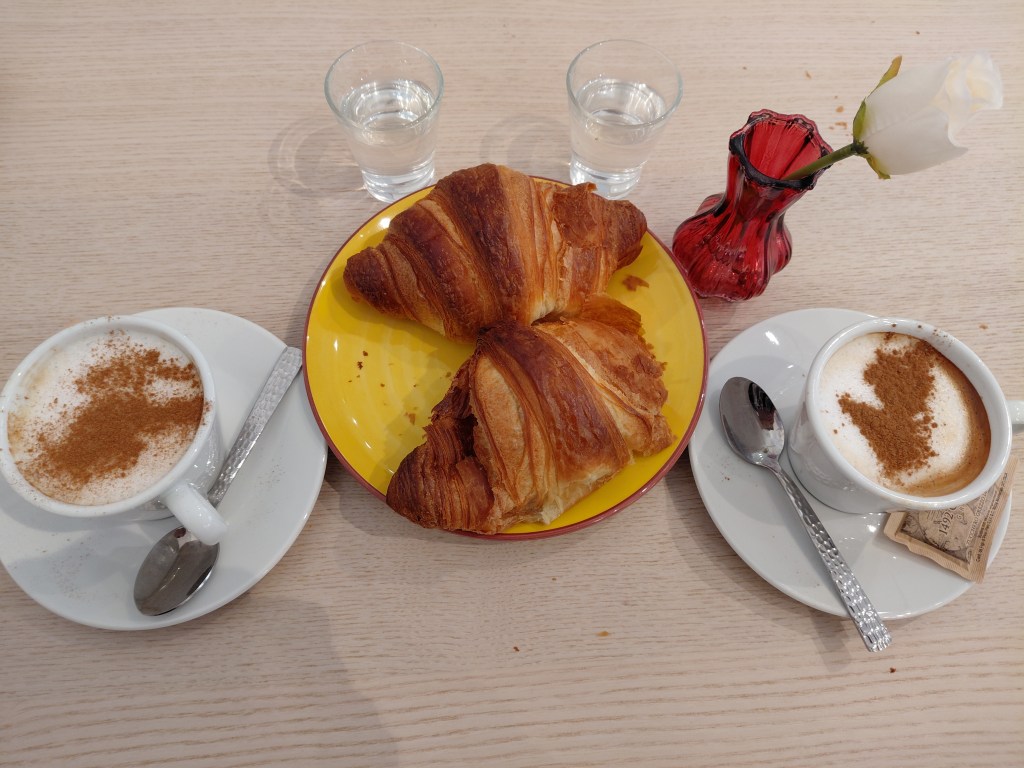
Colazione or breakfast at cafe bars is an Italian tradition. You order your cappuccino and either corneto (croissant)/ or your focacccio and you take it to your table (or it’s brought).
In our neighborhood off of Via Balbi, the nearby cafe (la Superba, appropriate name!) was full of students the first day, chatting away.
Foccaccio, a Genovese specialty, is a bread that’s baked with, besides flour and yeast, olive oil and salt in the crevices. You can have it plain or with olives, onions or cheese.
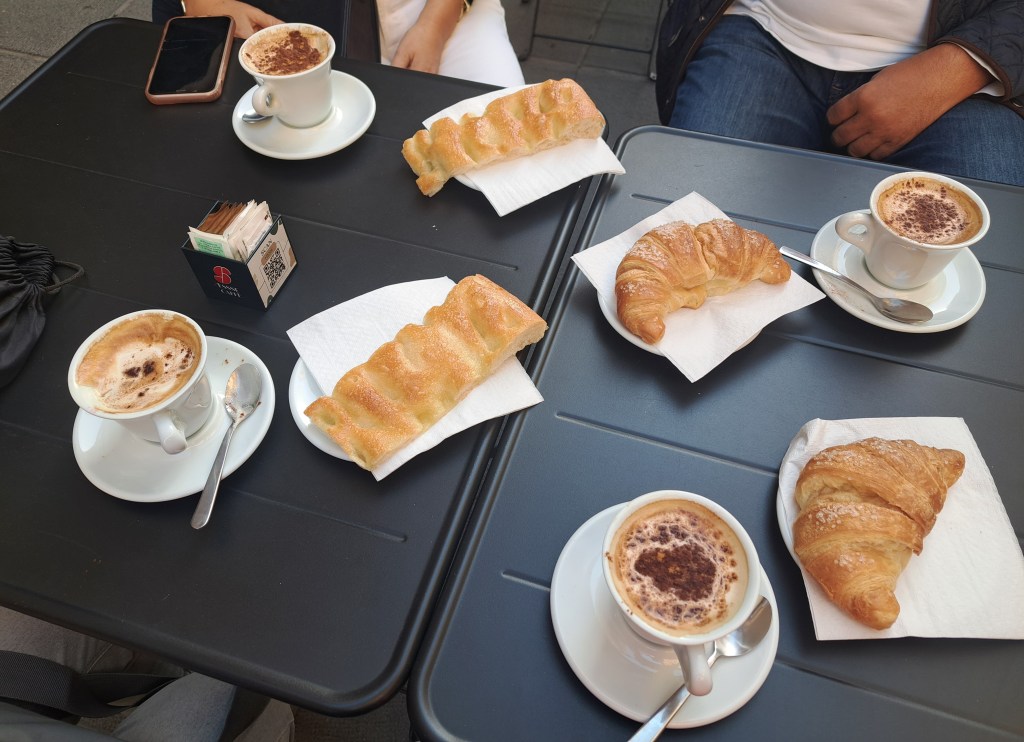
Dunking it into your cappuccino is a Ligurian (Genovese) tradition. Something about the salt reacting with the coffee flavor.
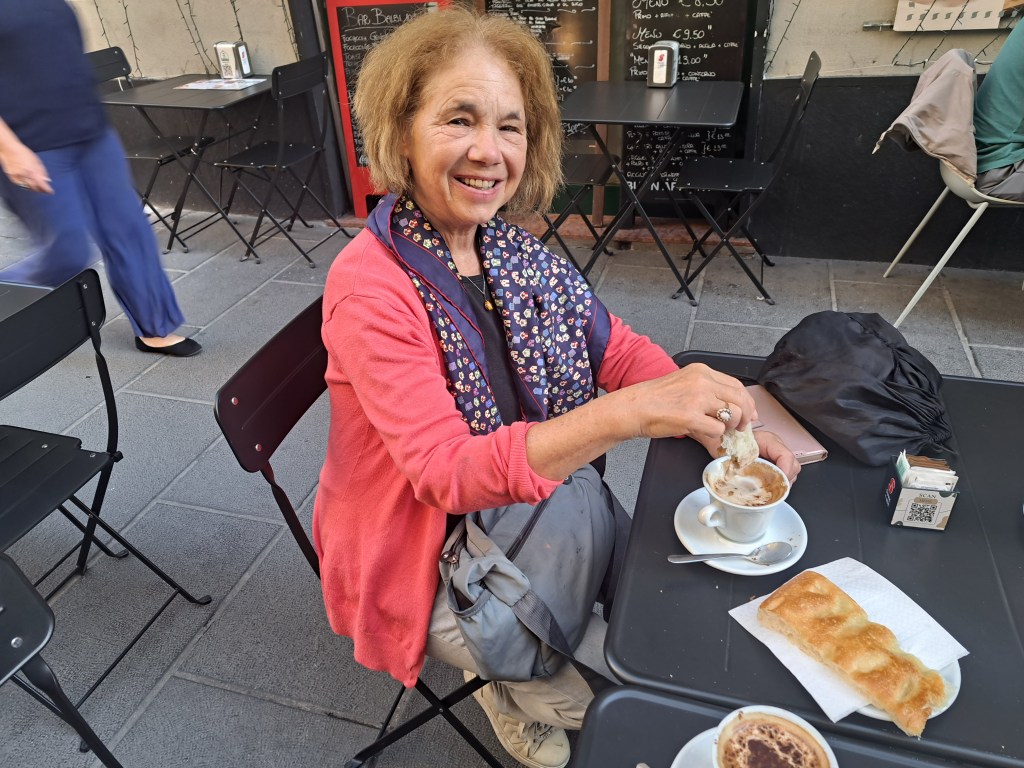
Drinking your cappuccino at a bar is taken seriously. It’s a social hour too. We didn’t see anyone walking around with a coffee in a paper cup. It’s just not done. Also, if you watch any videos on what not to do in Italy, asking for a cappuccino after morning hours tops the list. Italians only drink it in the morning, but one afternoon we asked for one and well the world didn’t come to an end!
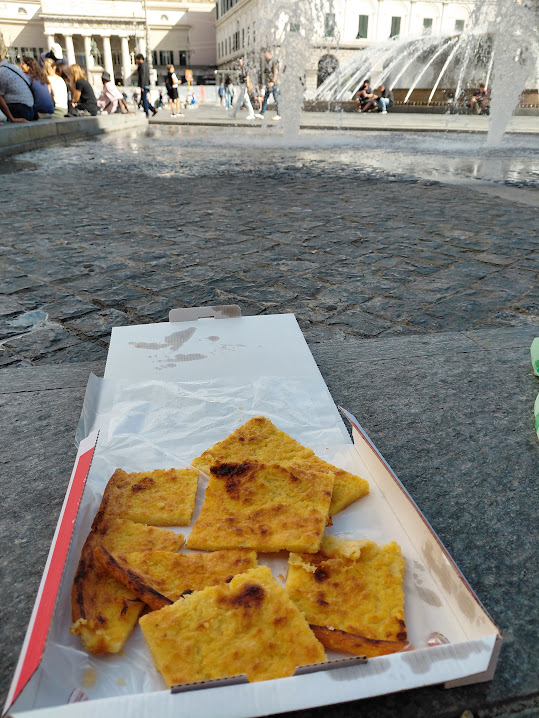
Another Genovese specialty is farinata, pancakes made with chick pea flour. When they’re hot, they’re tasty.
A popular snack is a cone (paper cup) of fried seafood that you can buy at a stand called a friggitoria.
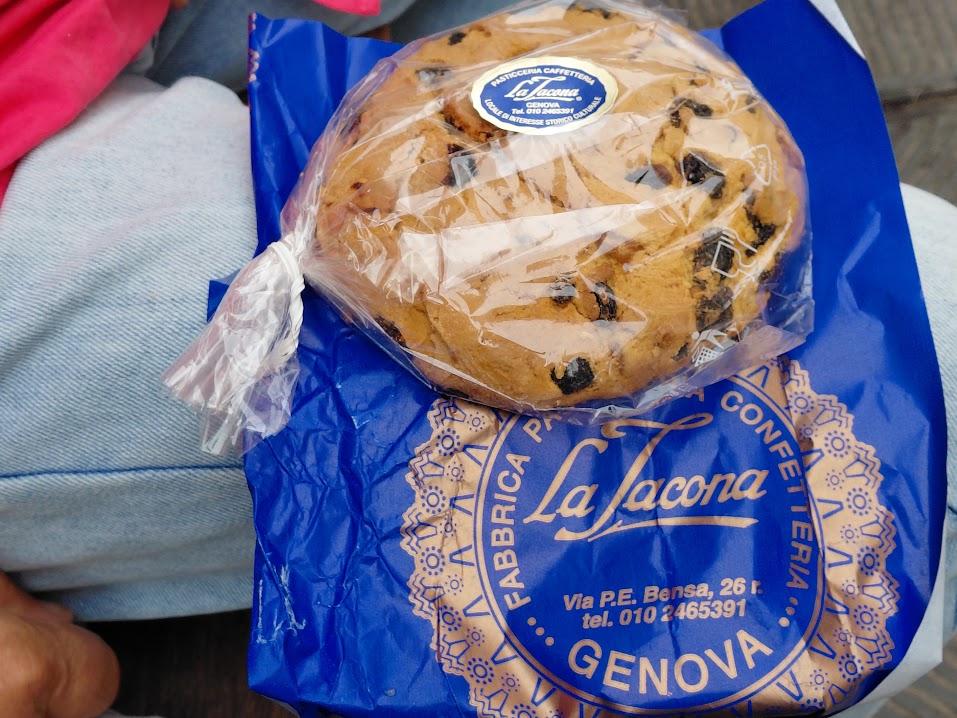
But if you prefer something sweet (but not too much), a popular Genovese sweet bread, similar to the Italian Christmas cake panettone, is pandolce, also filled with raisins, candied fruits, pine nuts and other nuts. It’s sold in the round and is a delicious snack.
Now, about pasta. Every region in Italy has its particular pasta tradition.
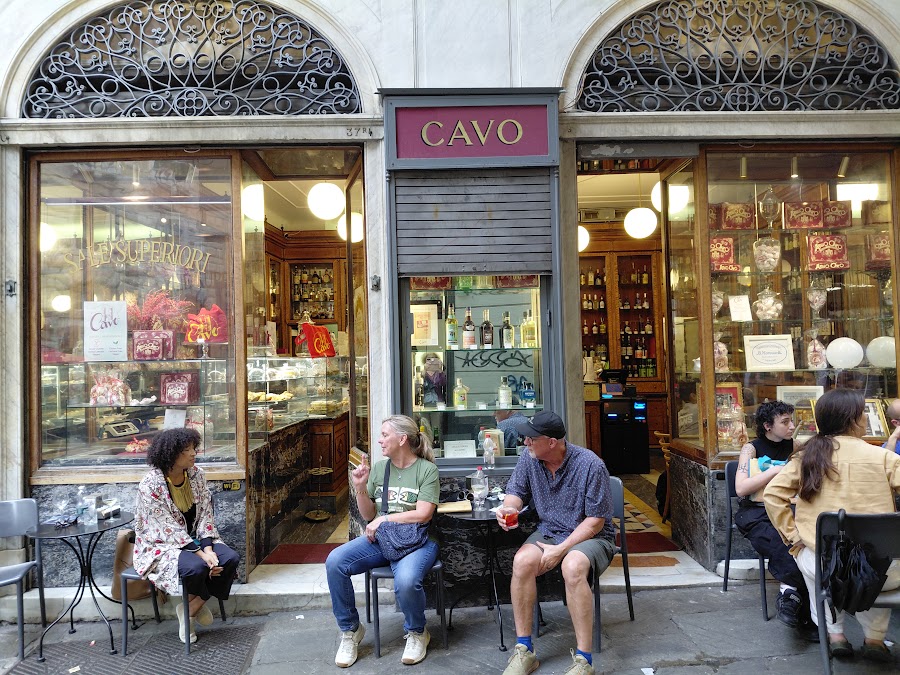
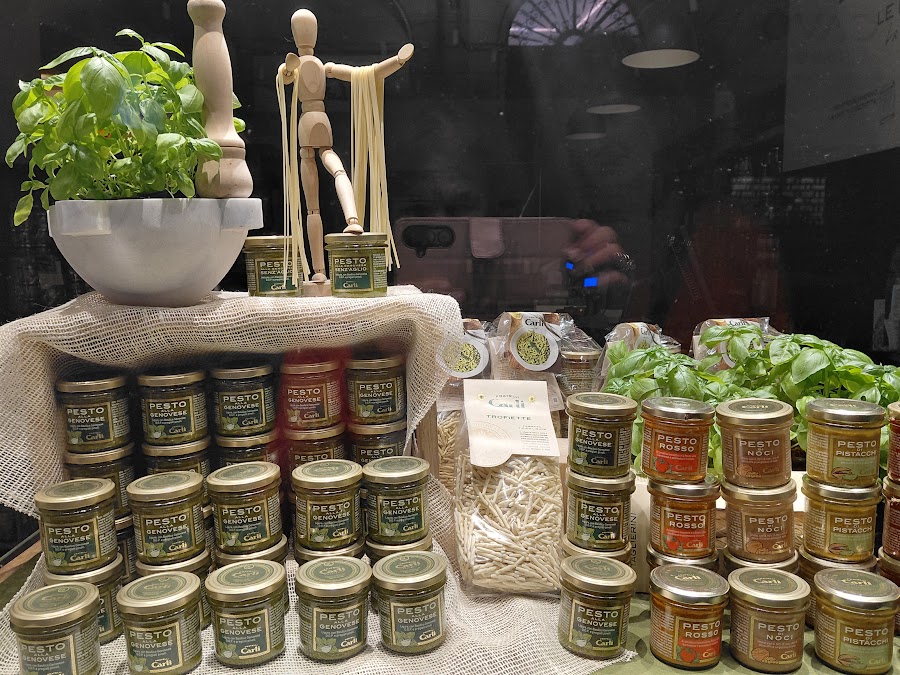
Genoa is the king (or queen) of pesto. I loved this display in a shop window: the healthy looking basil with mortar and pestle (which is how you’re supposed to pound the basil, not with a food processor) with different pestos, the classic genovese as well as “red,” with walnuts and with pistachios. (Check the end of this post for making pesto genovese.)
A traditional Ligurian pasta dish is trofie al pesto, often including potato and green beans, all boiled with the pasta together. Nowhere was this dish more delicious than at the Cavour 21 trattoria, at Piazza Cavour near the Porto Antico.
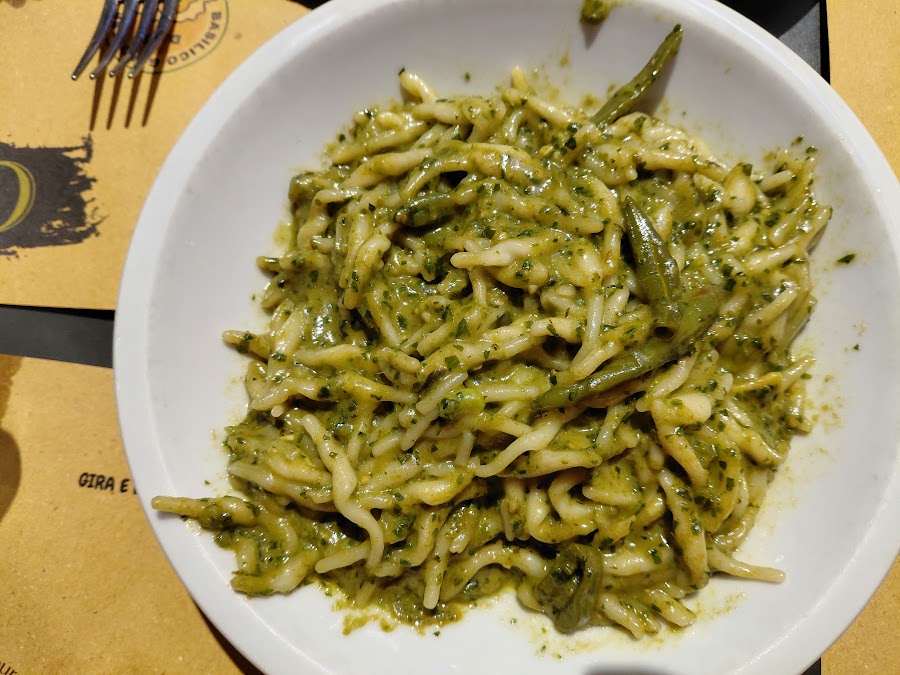
There’s always a line in fact at this well known trattoria, where we ate the first night outside up above the street. It’s actually across from the elevated highway at the port, not exactly beautiful, not exactly quiet. But somehow the evening softened, the traffic lessened and you could hear the chatter of happy diners. We ordered the trofie (above photo) after already eating four pasta dishes (we were starving the first night!)
Other dishes were lasagnette al pesto, spaghetti alle cozze with small mussels and another Ligurian specialty, pansoti (ravioli filled with herbs) in a walnut sauce. Heavenly.
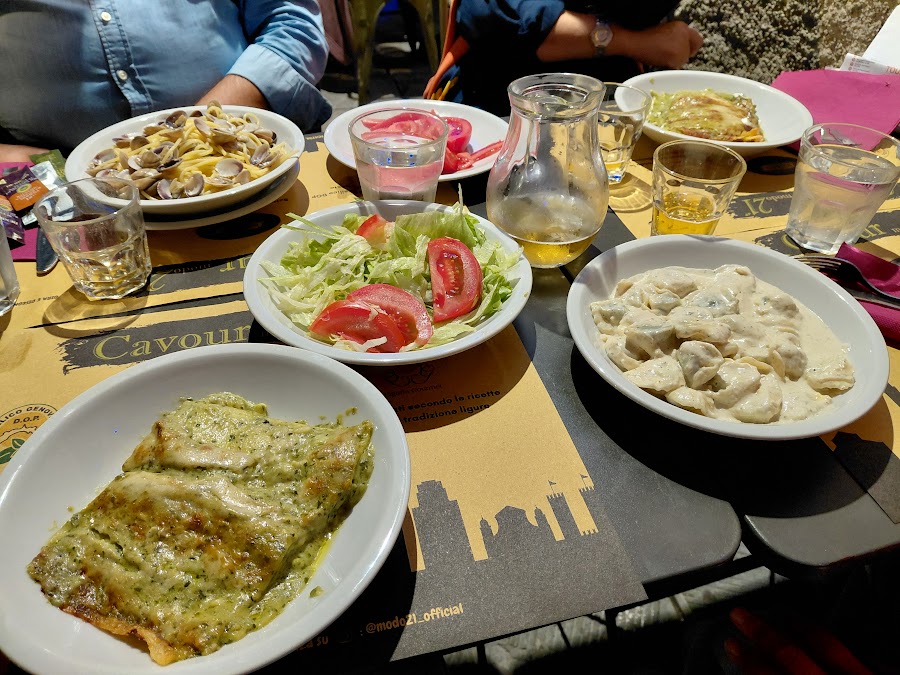
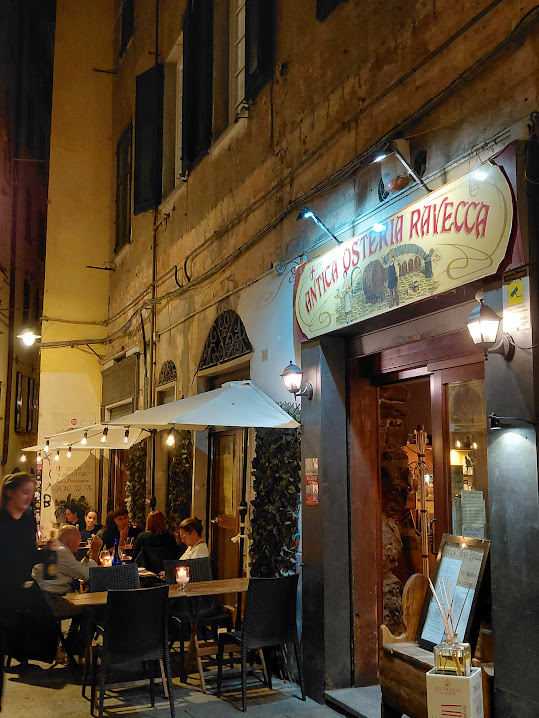
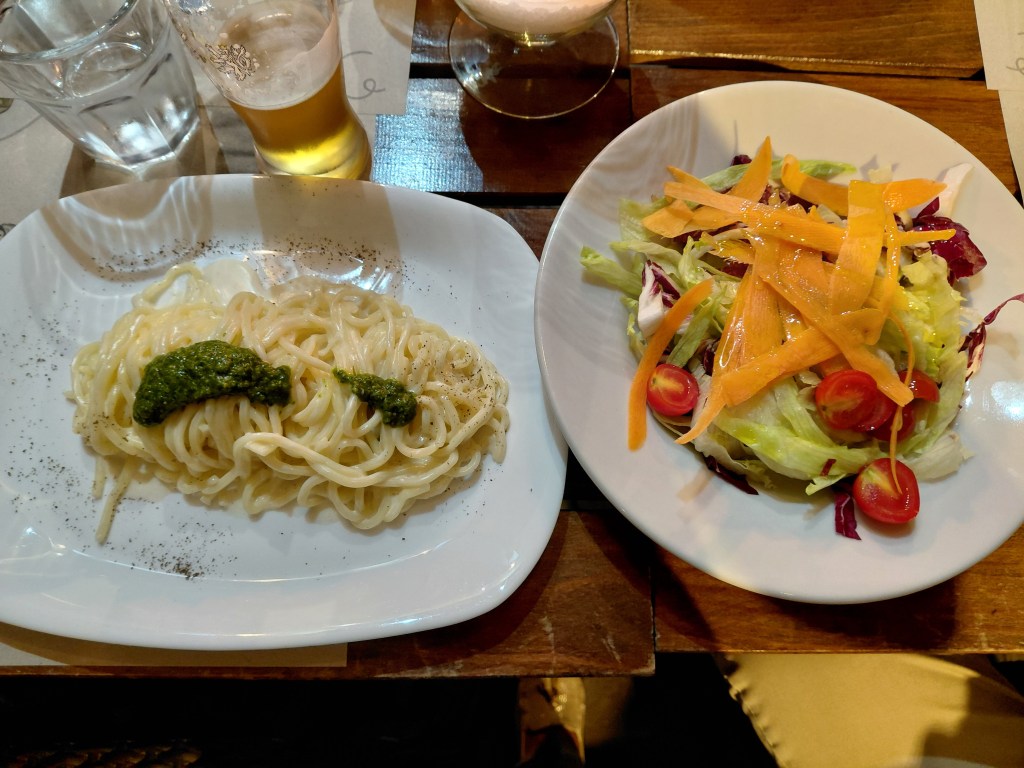
Around the Porta Soprana, trattorias fill the streets. At the Anticha Ostera Revecca we tried some other dishes.
In one dish, they combined cacio e pepe (the classic Roman dish of cheese and pepper) with a small covering of pesto.
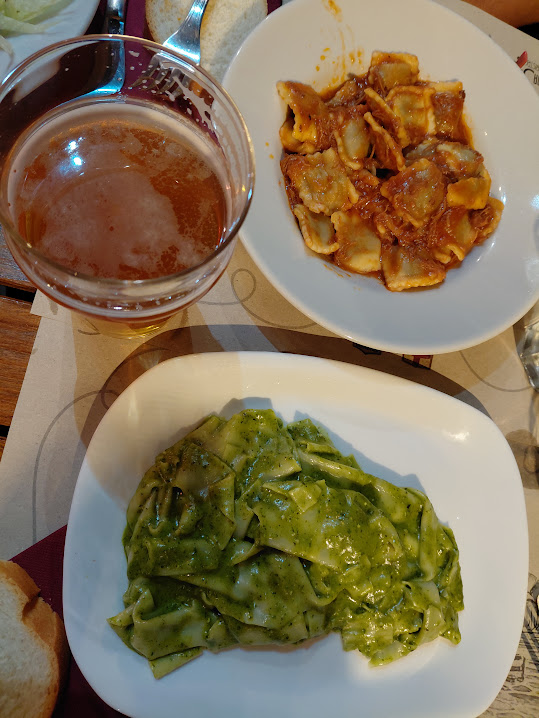
Mandilli (a kind of lasagna) al pesto is a house specialty and ravioli, filled with beef in a beef – tomato sauce. Everything fresh and delicious.
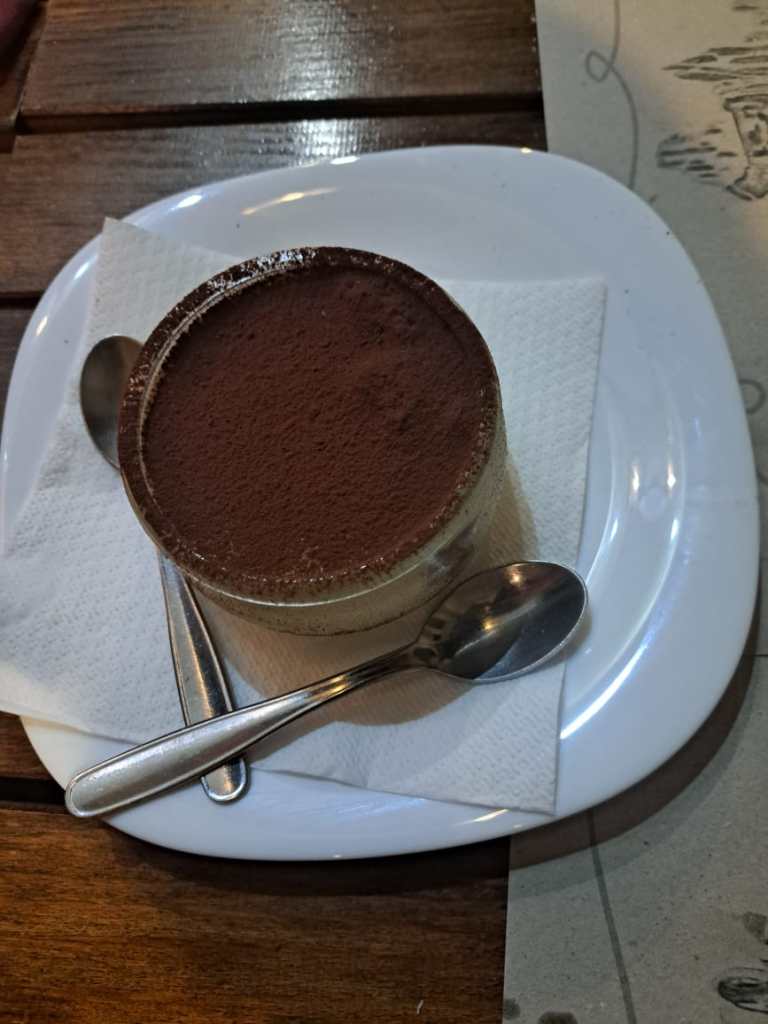
And to top it off, a scrumptious tira misu
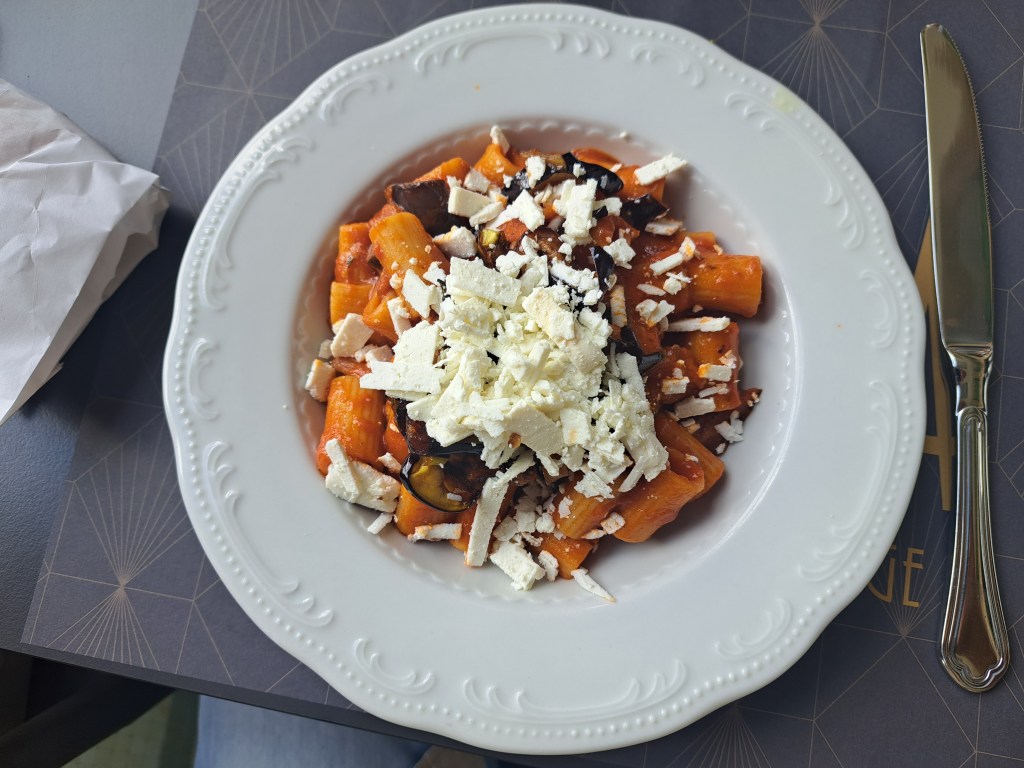
Near Piazza Vittoria, a tasty lunch pasta with aubergine
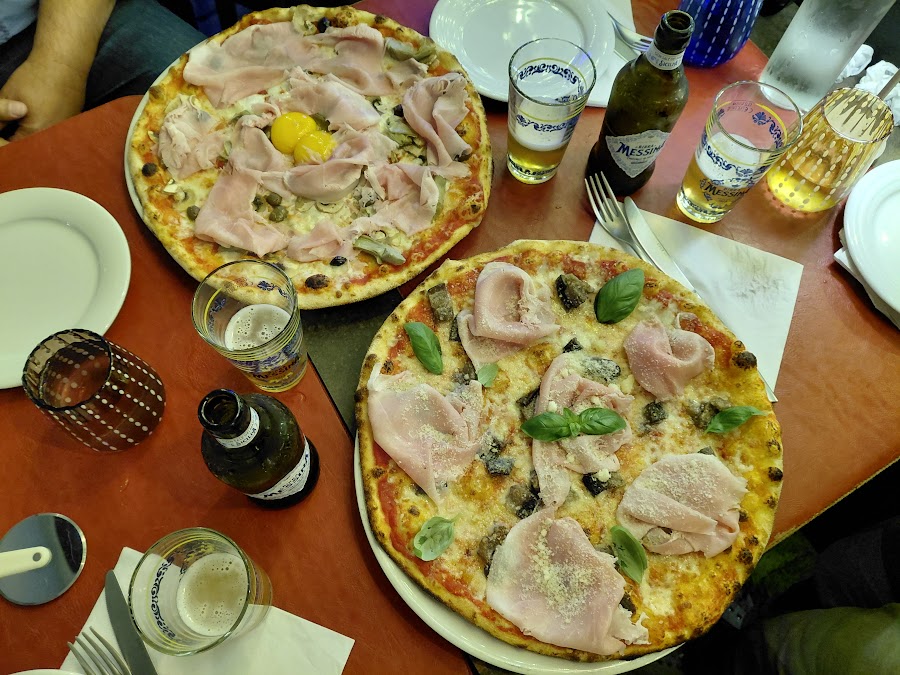
On the Piazza dell’Erbe in a downpour we found shelter under an awning at a gourmet pizza place.
The Sicilian brand beer Messina had its own special glasses. One pizza was the well known Quattro Stagione (4 seasons) to which Sotiris had added a couple of raw eggs (!), with tomato, fior di latte, artichoke, olives and prosciutto and the second, Porto Antico, with aubergine, tomato, prosciutto and gran padano cheese.
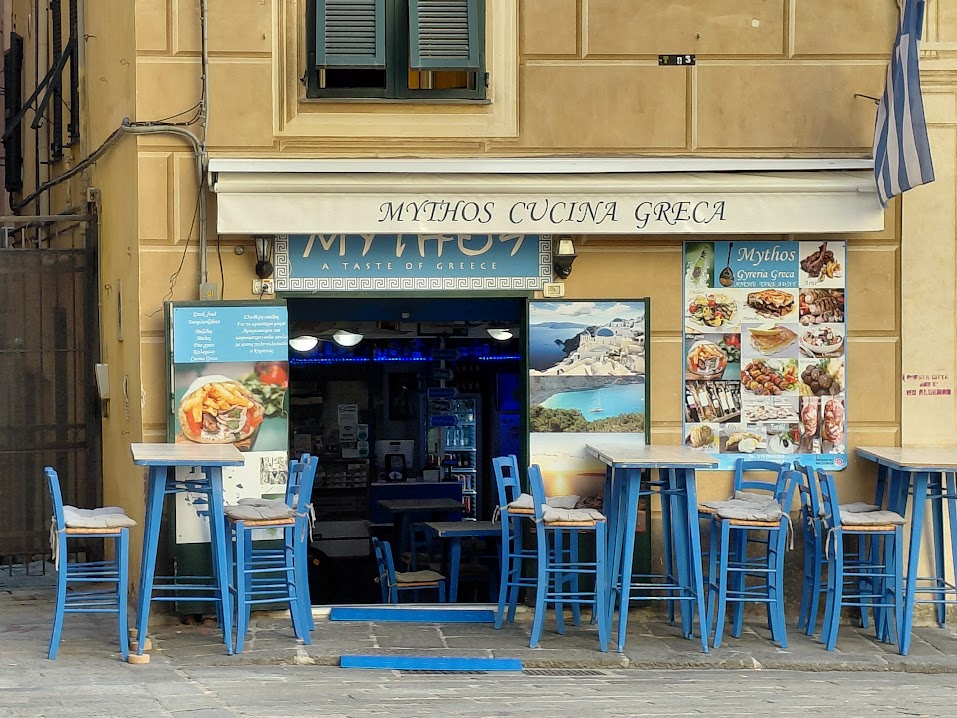
We were surprised to find only one Greek restaurant, near our hotel and the train station.. Sotiris was thrilled to talk with the owner.
Boccadasse and Nervi
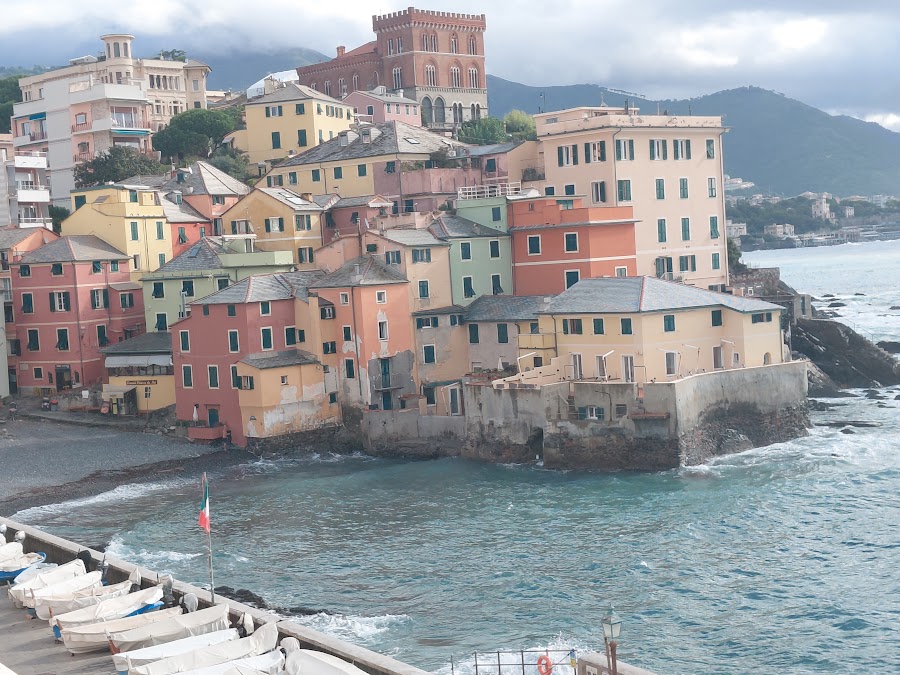
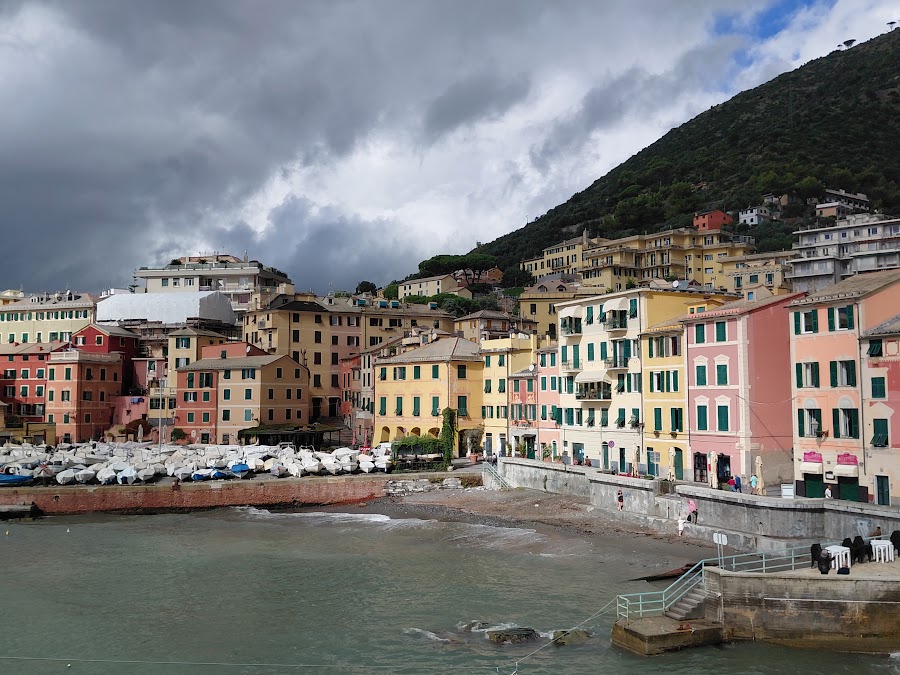
Time to get out to the sea and the weather was clearing.The bus going east takes you to the Corso Italia, and houses along the sea. Boccadasse used to be a fishing village area, now incorporated by the Genoa municipality. But it feels like you’re kilometers/miles away.
When you walk down the hill to an overlook, it’s like a fairy tale off in the distance with the little boats and the waves brushing up against the pastel houses.
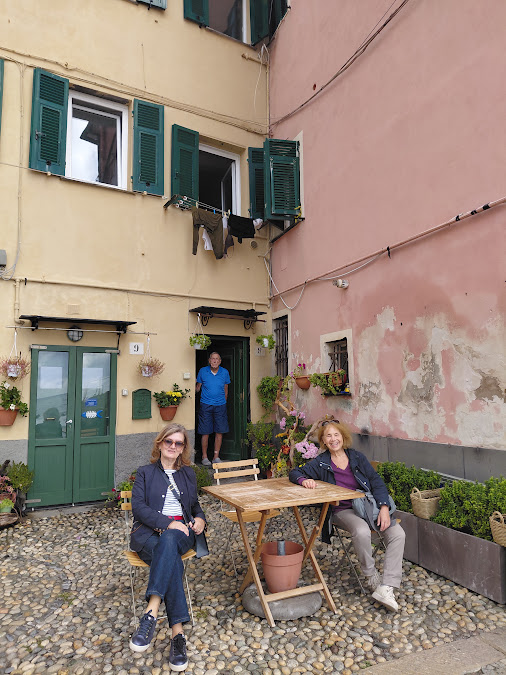
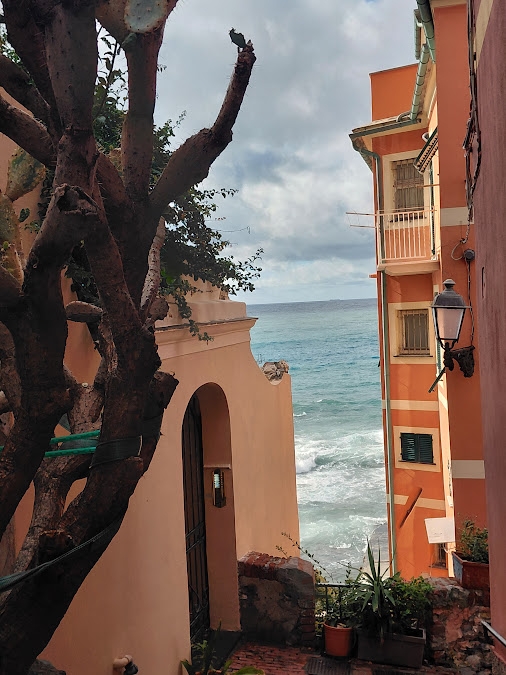
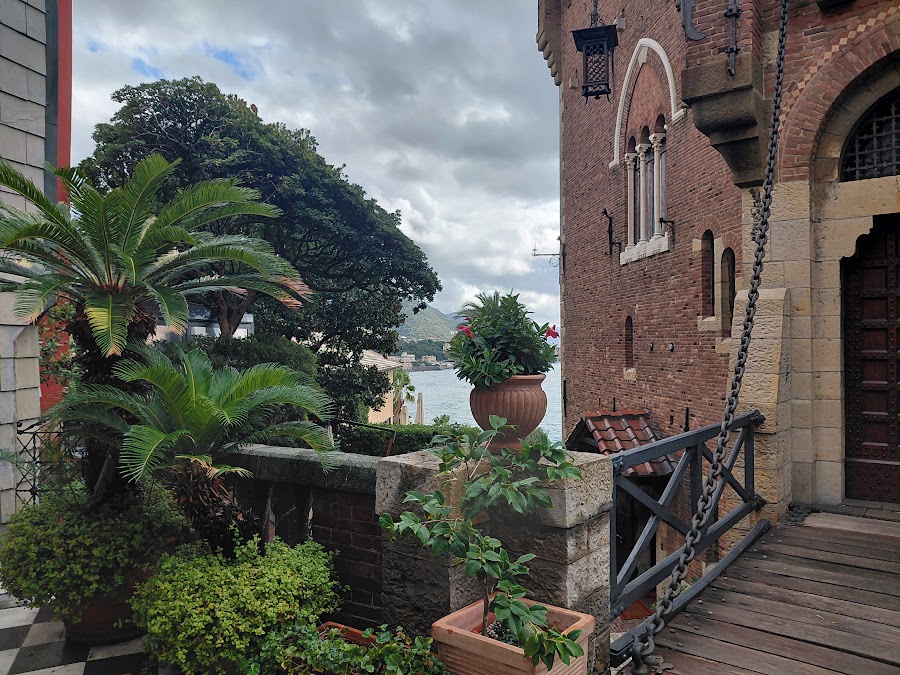
From Boccadasse we get a bus further out to Nervi, an elegant seaside district, traditionally known as where wealthy Genoans went to build their villas.
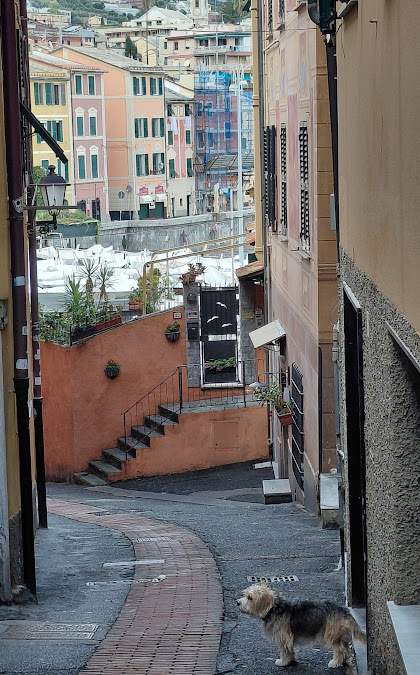
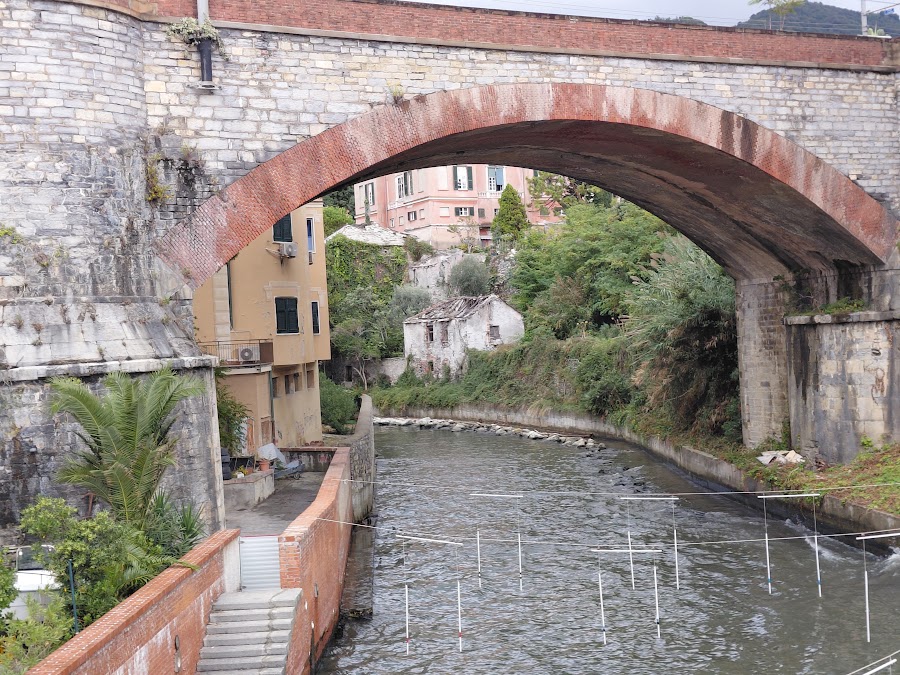
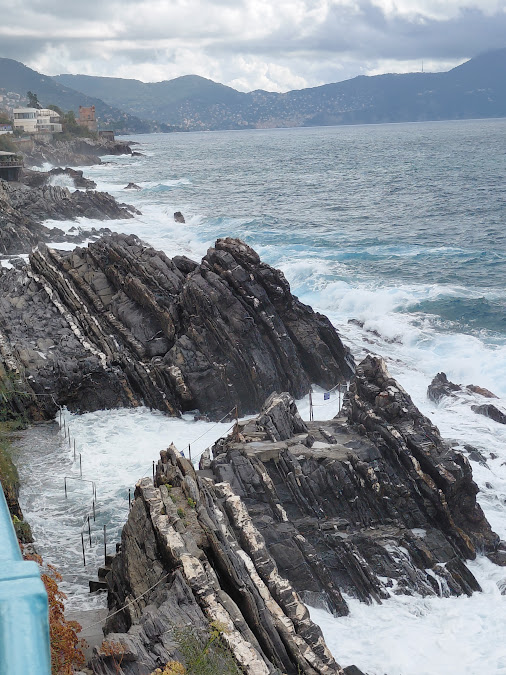
The clouds were building up again as we looked for the Passeggiata Anita Garibaldi (wife of Giuseppe), an ancient path used by fishermen, that stretches for 2 km along the sea.
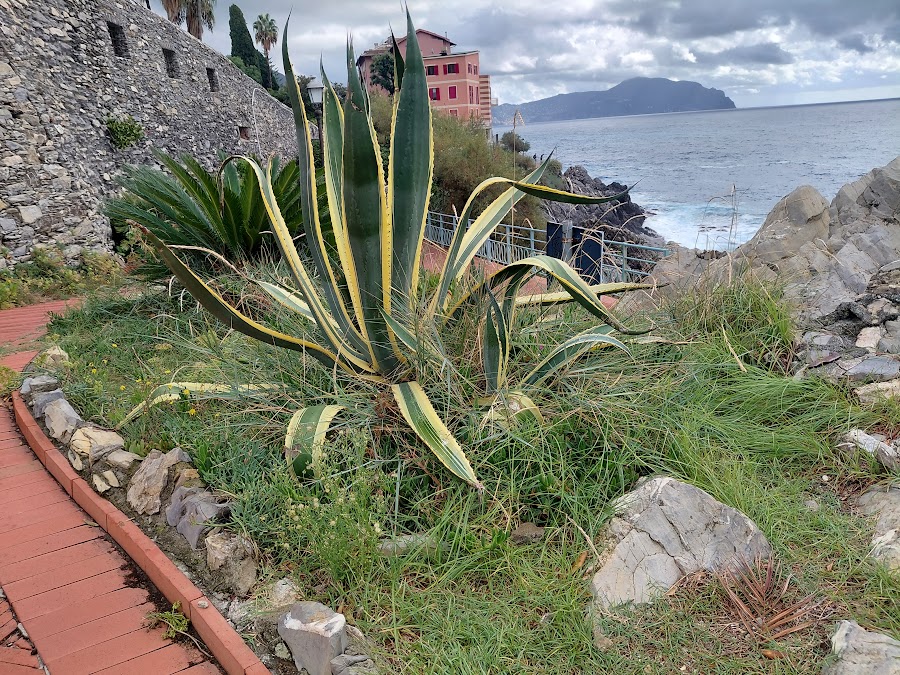
Up from the promenade a large green park is filled with 100 botanical species.
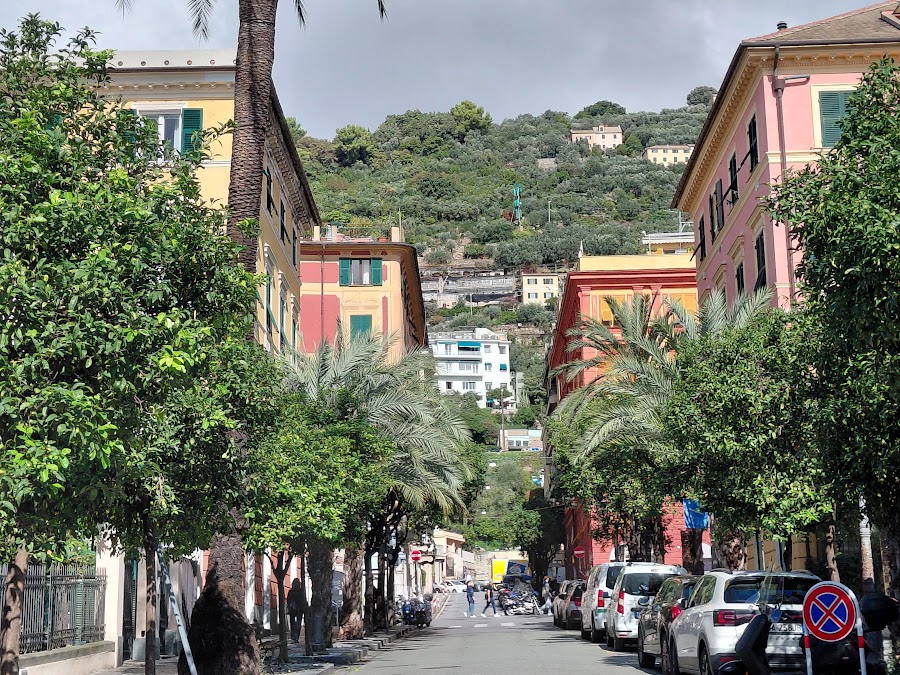
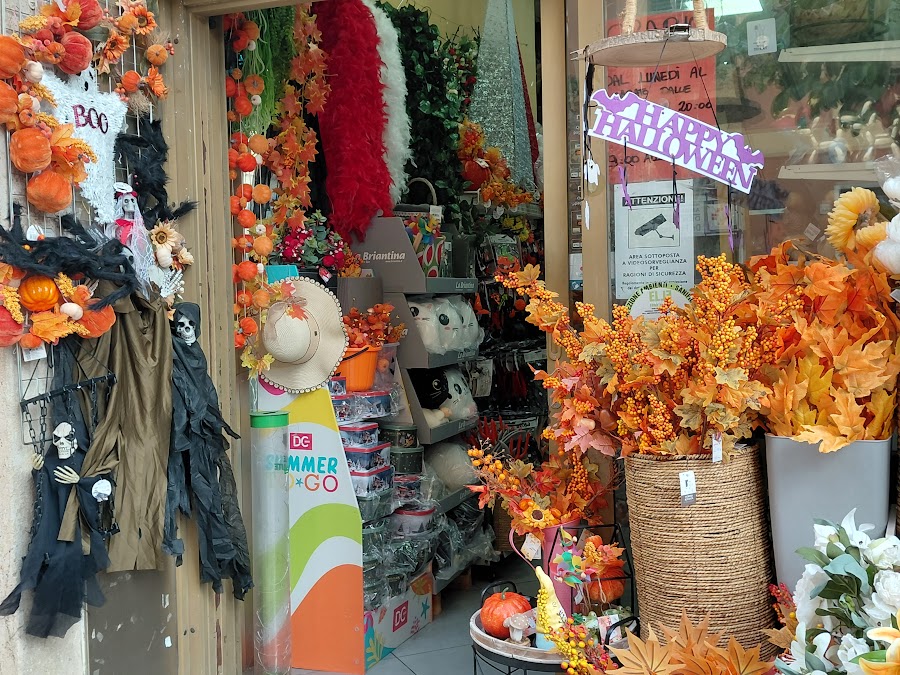
It was curious — one side of the main street had clothes stores with prices that made you gasp, but the other side had down to earth food and household items. This shop is getting ready for Halloween.
By the time we found out where we got the bus back to Genoa, school had let out and the bus was full of schoolkids. I started talking with a student sitting next to me, who, when I told her I lived in Greece, asked me in hushed tones, “do you live in a cool place like Mykonos?” (I was sorry to disappoint her.)
Portofino / Santa Margherita di Ligure
Dalida immortalized the once fishing village in her song “Love in Portofino” that she sings in three languages. Play it to get in the mood …
The train from Genoa goes to Santa Margherita di Ligure,
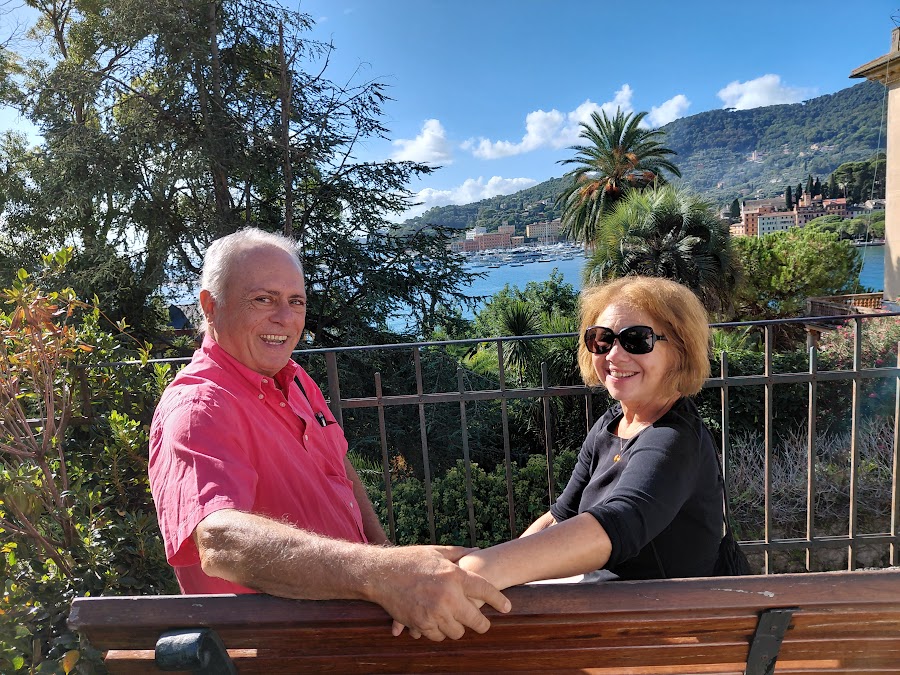
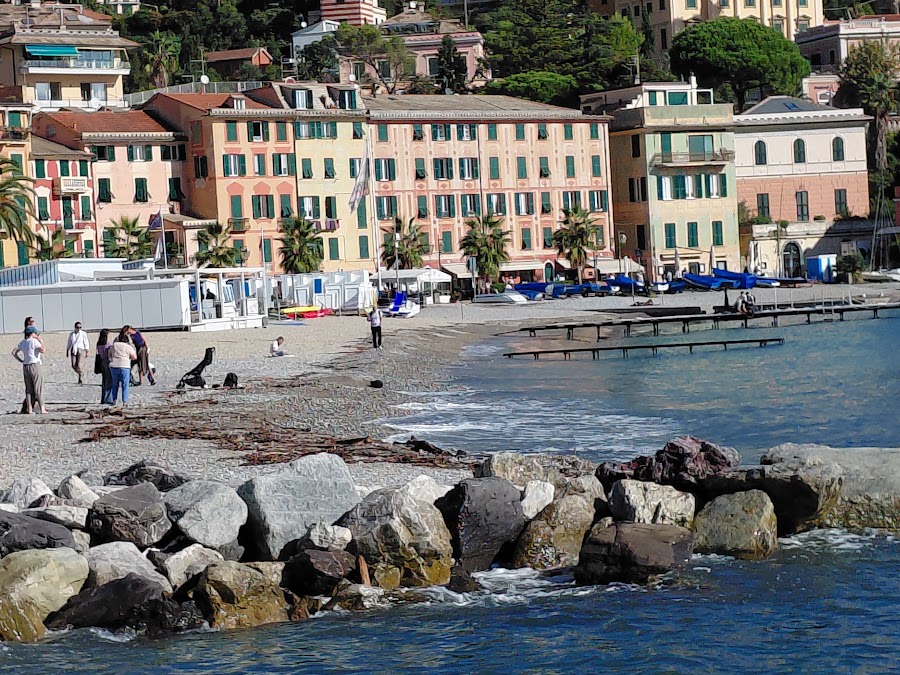
From Santa Margherita you go to Portofino, about 5 km away, either with a bus or boat. We decided on the boat to get our first view from the sea.
The boat was packed with everyone trying to get photos as we pulled into Portofino harbor.
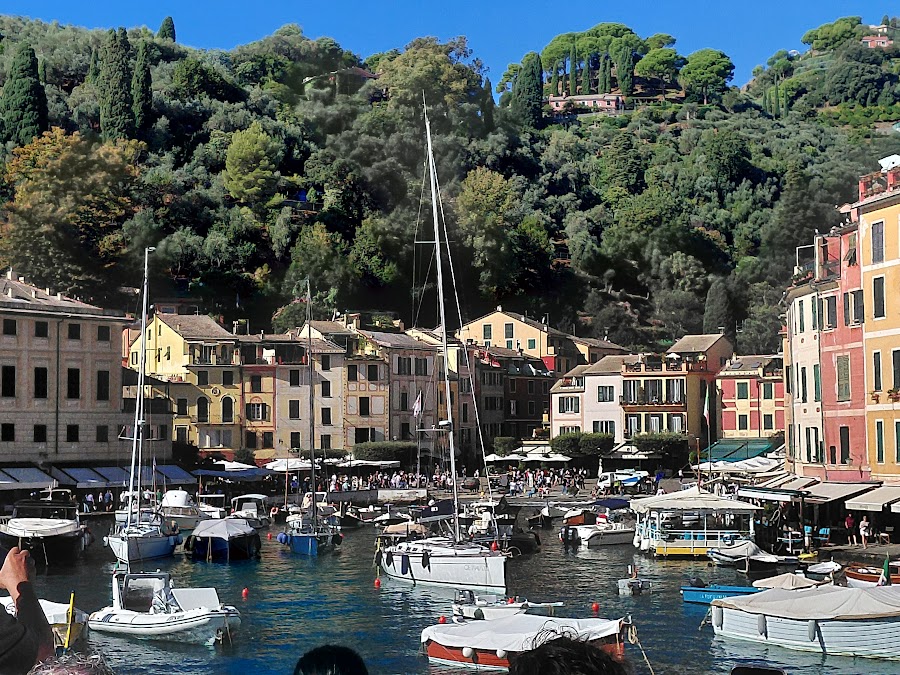
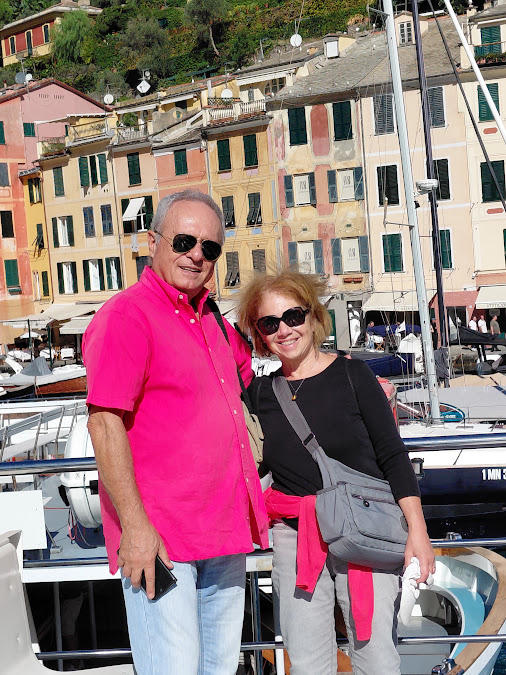
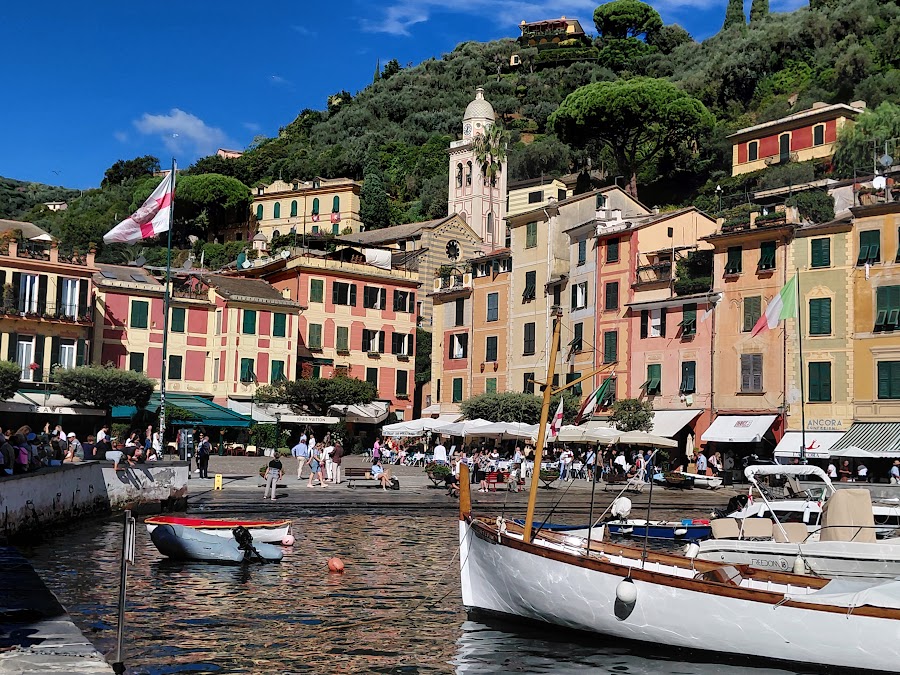
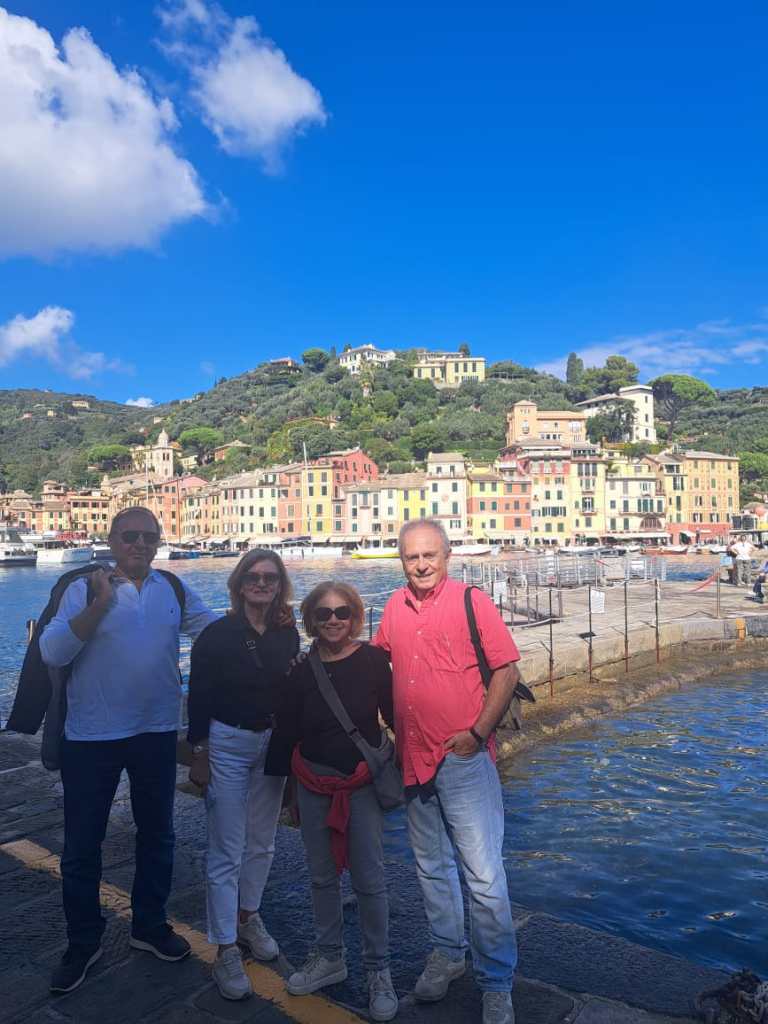
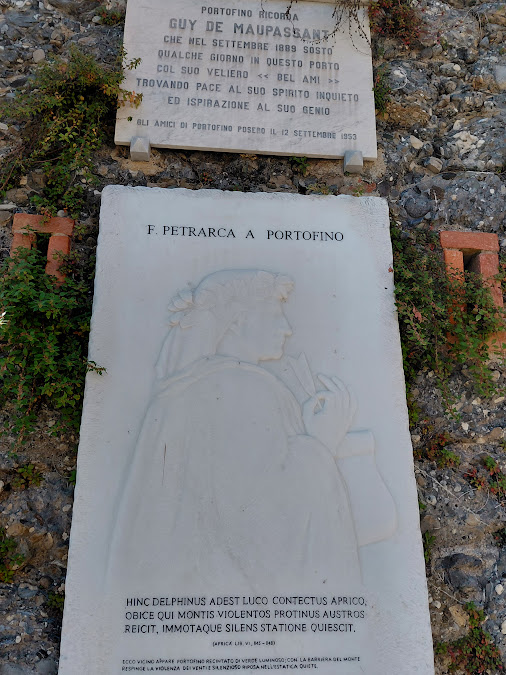
This plaque at the harbor pays tribute to two writers (totally different!) who were inspired by Portofino. One was Petrarch and the other was French writer Guy de Maupassant who called Portofino “a pause in the useless agitation of life” while he was visiting in 1889.
On the hill is the Castello Brown. My friend Karen tells me she once stayed in a youth hostel that used to be there near the castle.
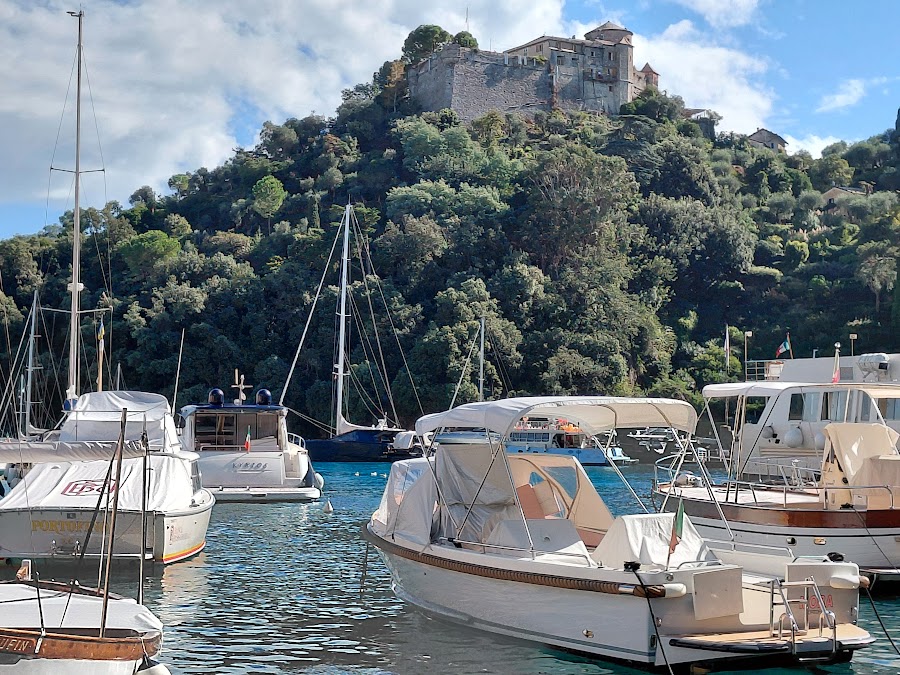
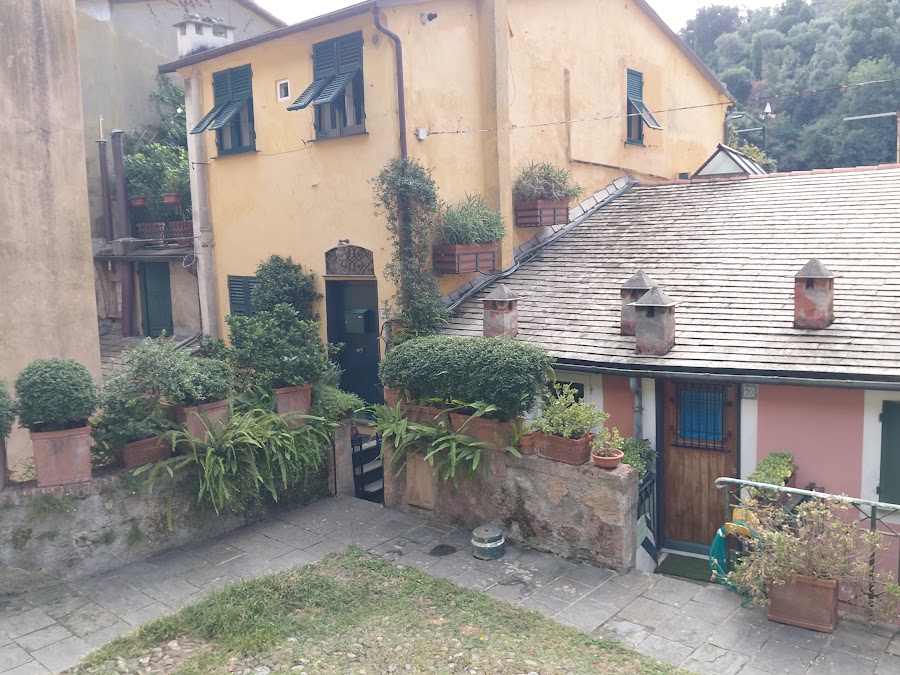
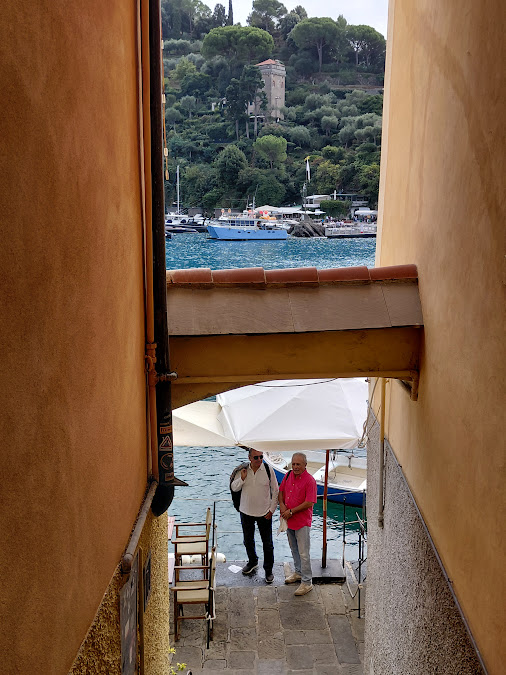
It was hard to tear ourselves away from the port, but we wanted to explore the streets of the old town.
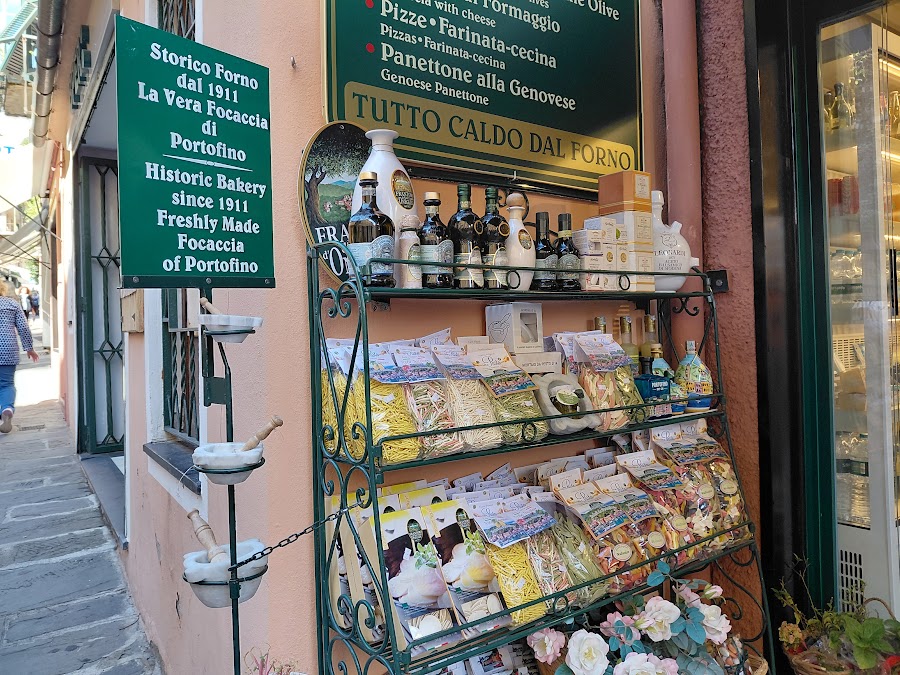
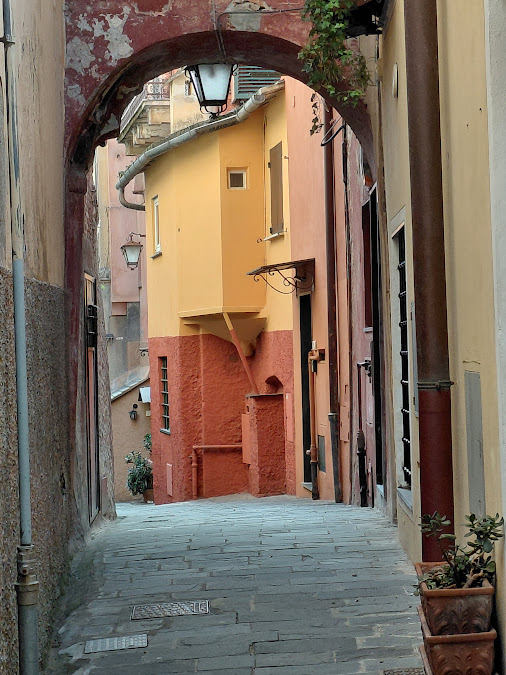
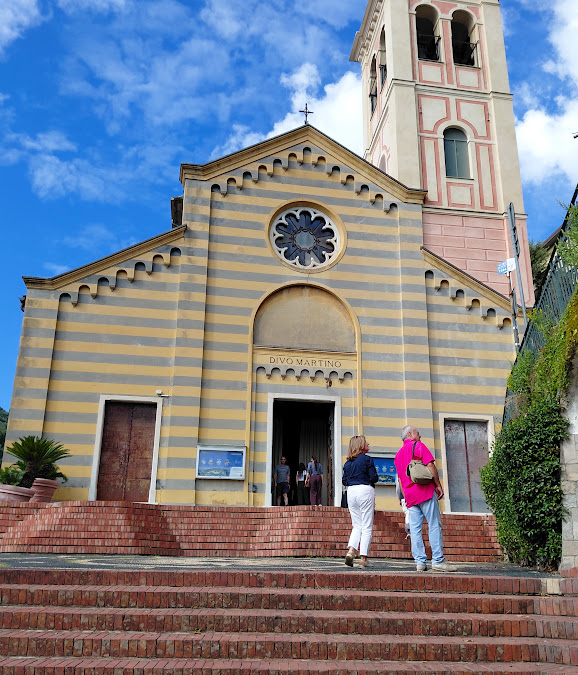
We didn’t want to miss the 10th c Church of San Martino with its yellow and grey striped facade and pink campanile.
We returned to Santa Margherita with the bus. But instead of seeing any scenery, we were packed together even more tightly than sardines. The one road is so narrow that the bus has to be small and hardly made a dent with all the people waiting. Fortunately it’s a short distance
Back in Santa Margherita:
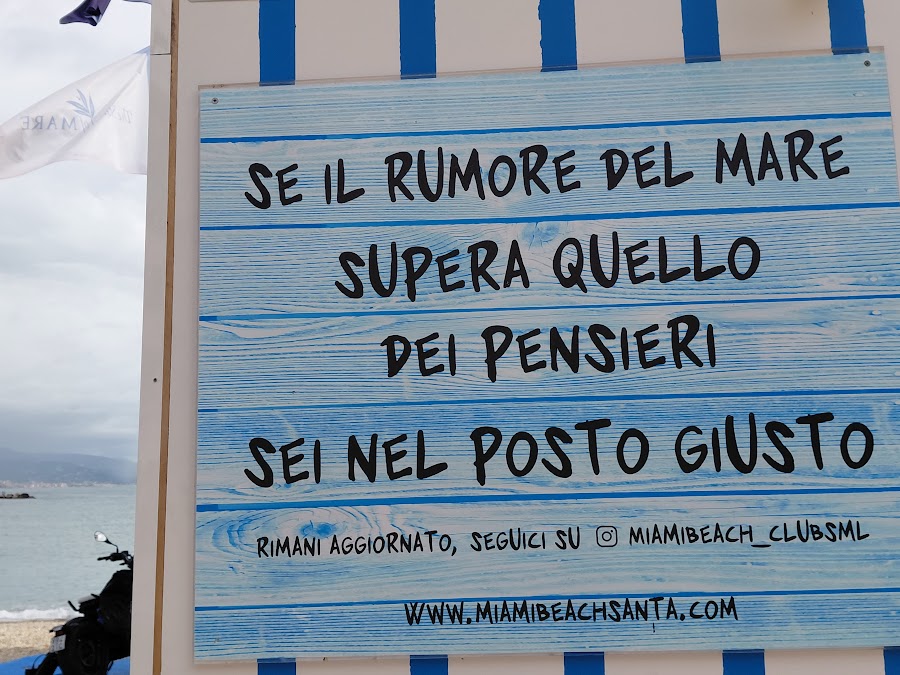
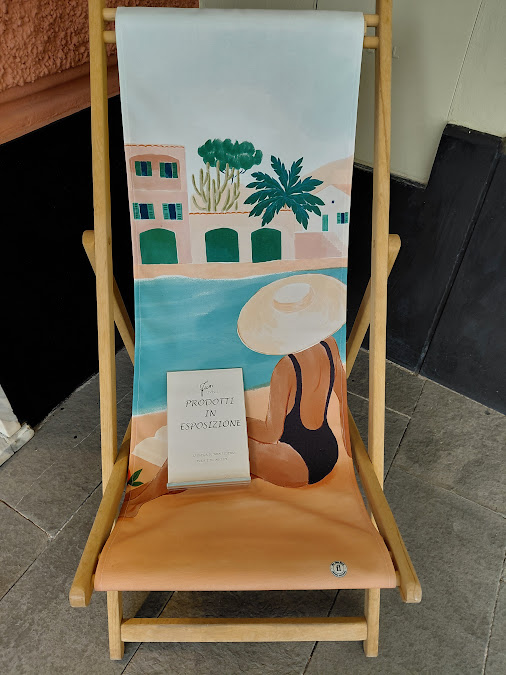
After feeling drops and eating gelato under a shelter, we slowly made our way up to the train station to return to Genoa.
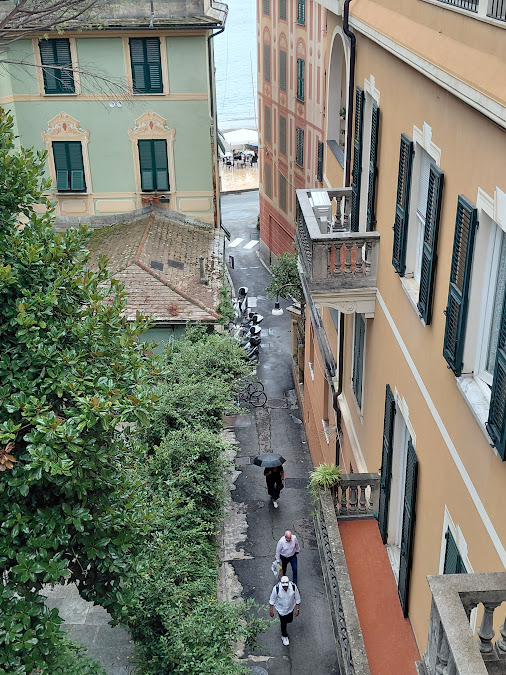
Somehow we mistakenly got on the faster intercity train not the local and the conductor almost pounced on us with glee, to make us pay more. No mercy on tourists!
Cinque Terre
In contrast to jet setting Portofino that’s been on the radar for many years, Cinque Terre remained a secret until well into the 1990’s. After Rick Steves wrote about it, well need I say more? Then in 1997, Cinque Terre made it onto the UNESCO World Heritage List.
This little map gives you an idea of where Cinque Terre is in relation to Genoa (and Portofino).
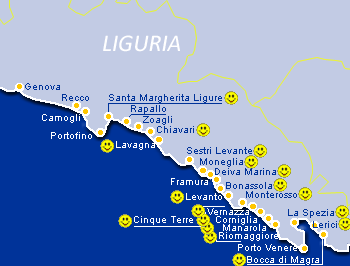
These five fishing villages (and fishermen still go out and fish) made famous with photos of their pastel houses on the rocky cliffs of the Ligurian sea are now one of the most crowded parts of Italy in the summer months.
As we discovered, even in October it was packed. By the end of this month, the train service between the villages decreases dramatically.
We took an early train from Genoa so we could have time to explore all the villages, a direct train to Monterosso al Mare, the northernmost village.
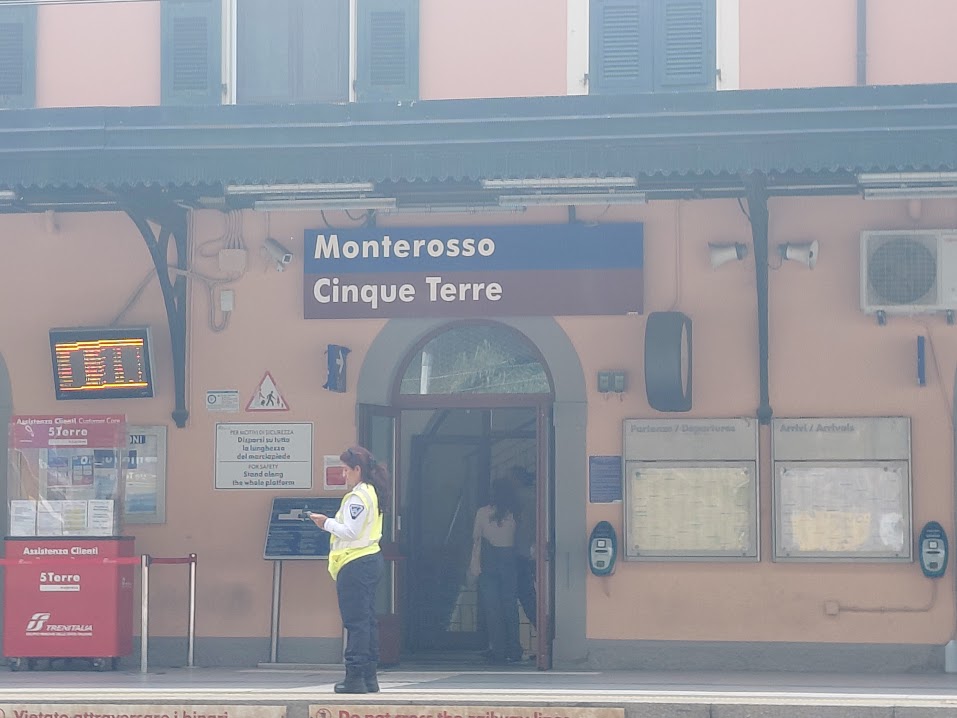
Out of the train station, we walked right along the sea. On a small cliff are the remains of a 14 m high giant Neptune, built in 1910, that suffered bombing in WWII.
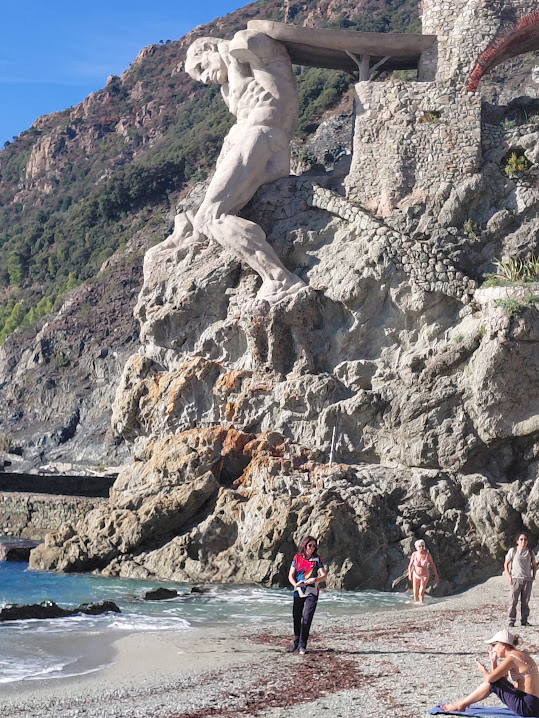
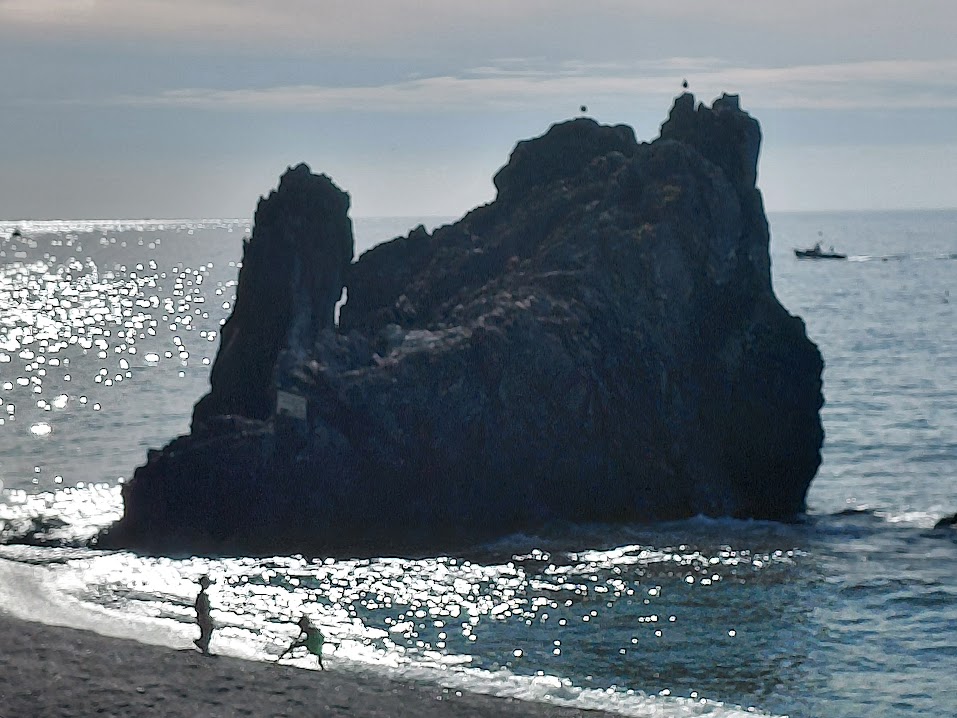
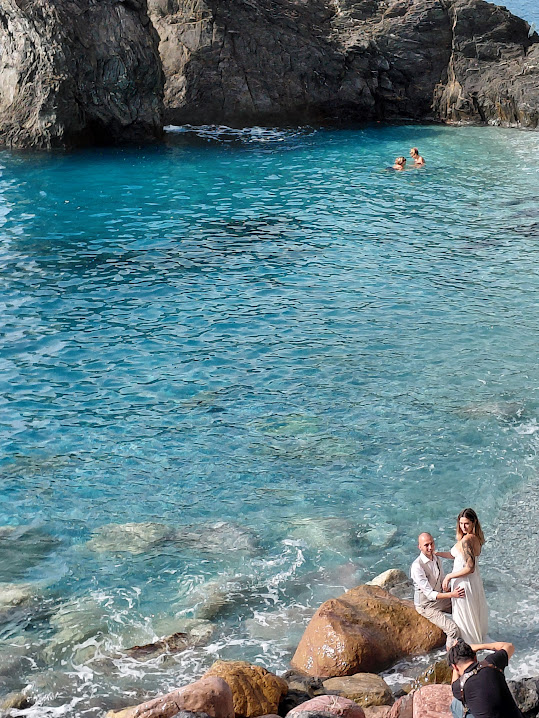
For a while, the sea was shimmering in the bright morning sunlight. Some swimmers were already in the water, while these kids were playing on the beach..
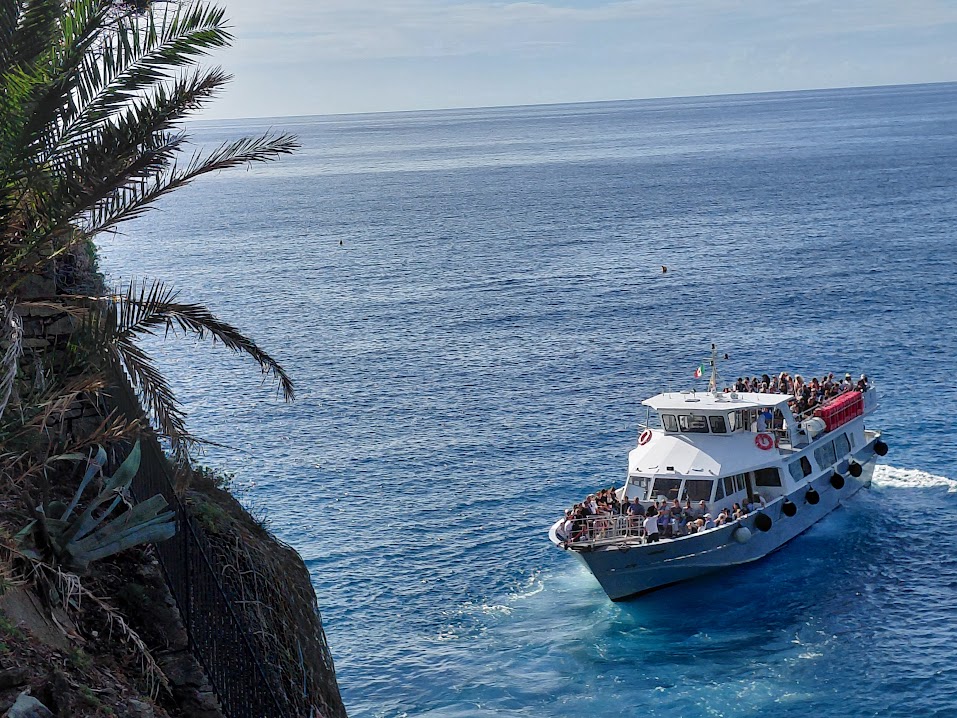
A boat bursting with passengers was leaving to go probably to the next village,Vernazza.
To the left of the train station, after a walk along the sea, a short but steep path will take you high above to the 400 year old Convent of the Capuchin Friars. Or you can just walk through the tunnel to take you to the old town.
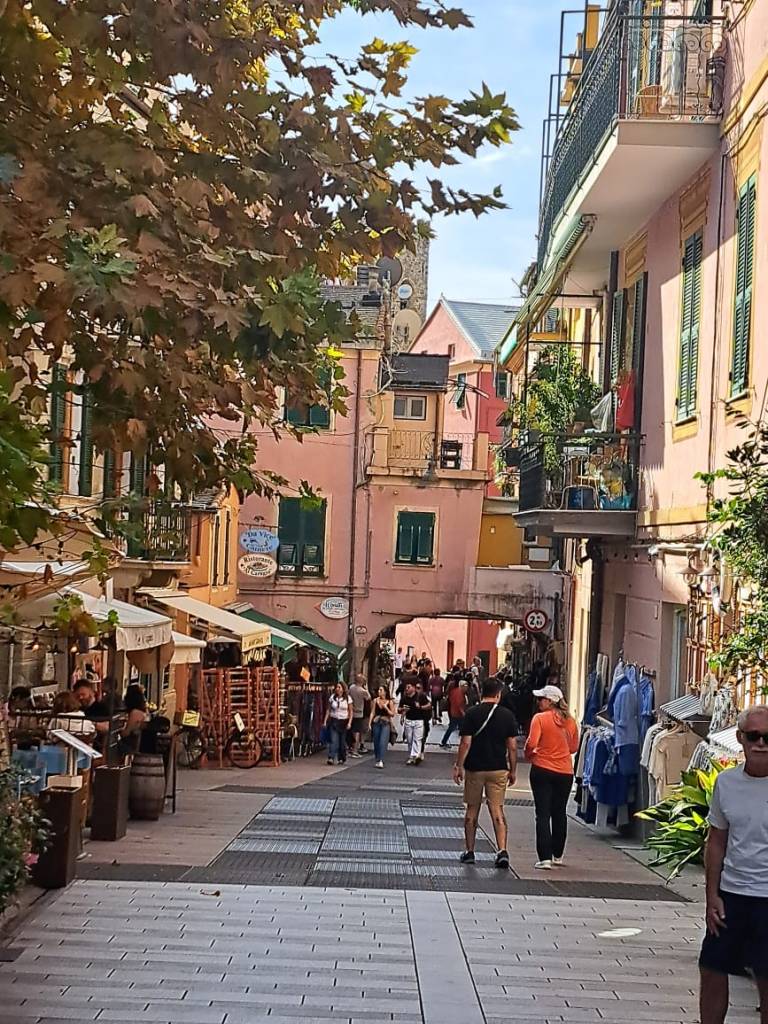
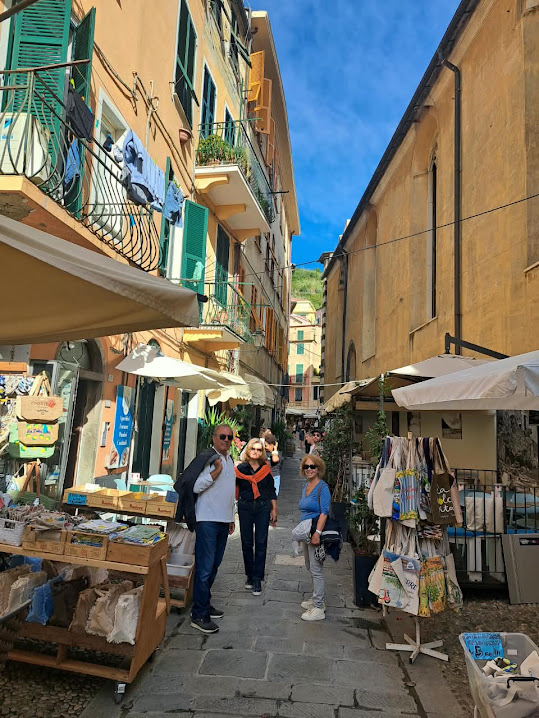
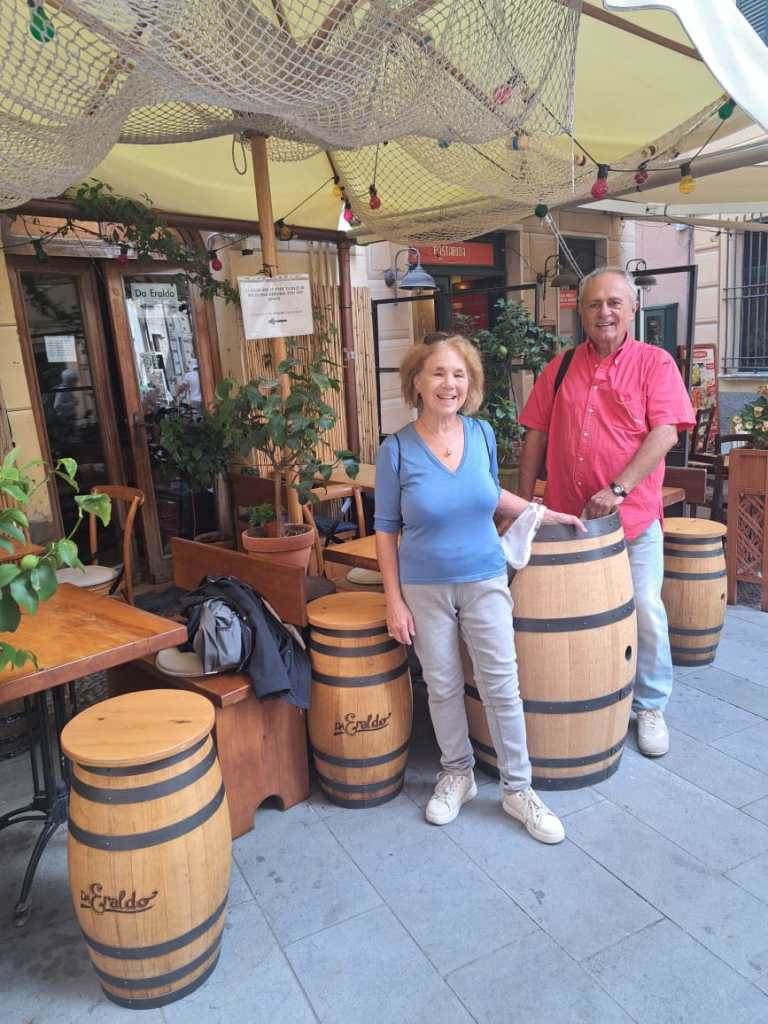
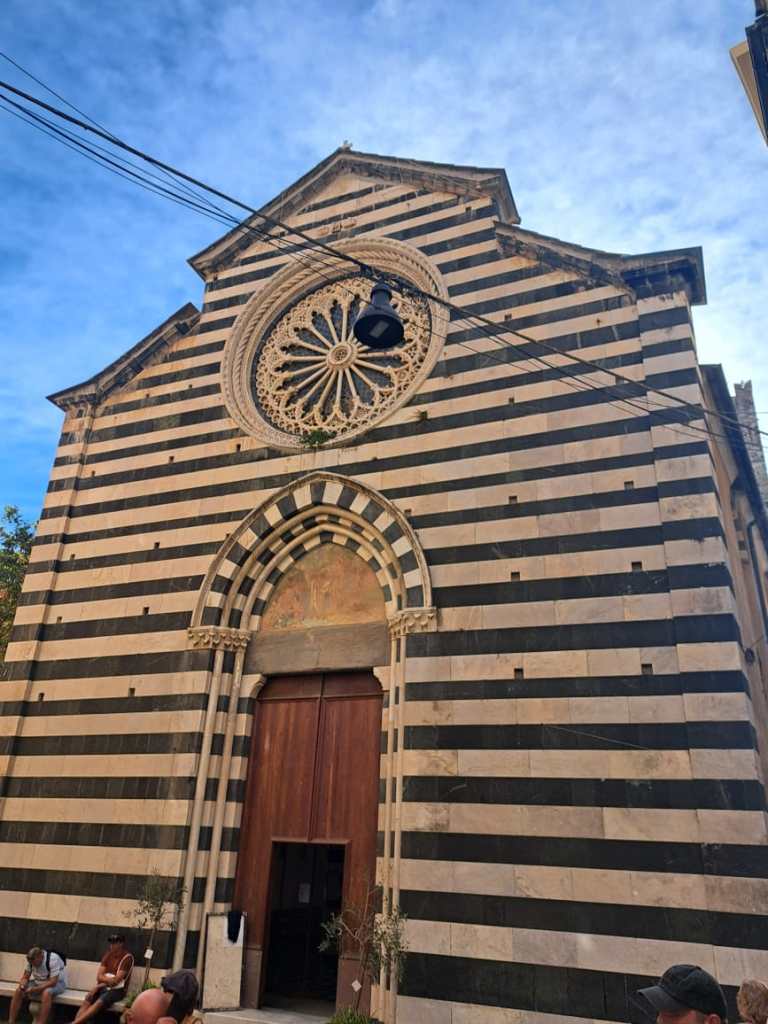
In the center sits the 13th century church of St. John the Baptist. It should look familiar — it’s that popular Genovese Ligurian Gothic style with the stripes.
Since we were going to take trains to all the villages, we opted to get a Cinque Terre pass ticket. It’s also good for hiking trails, the shuttle bus to Corniglia and using the bathrooms at the train stations!
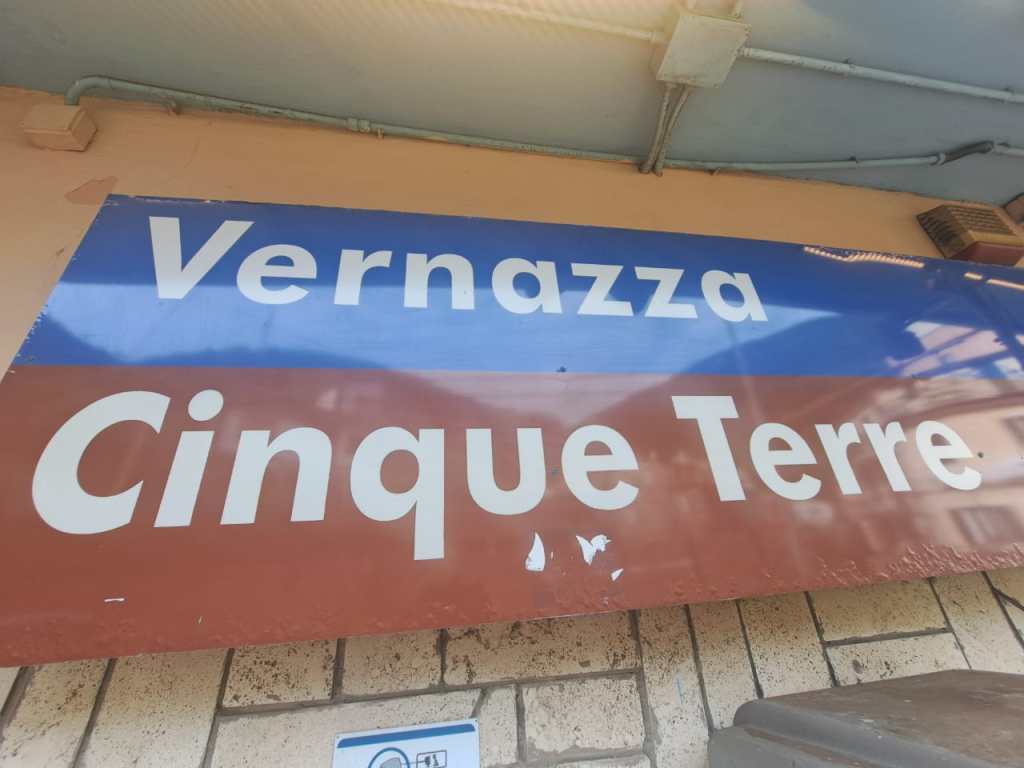
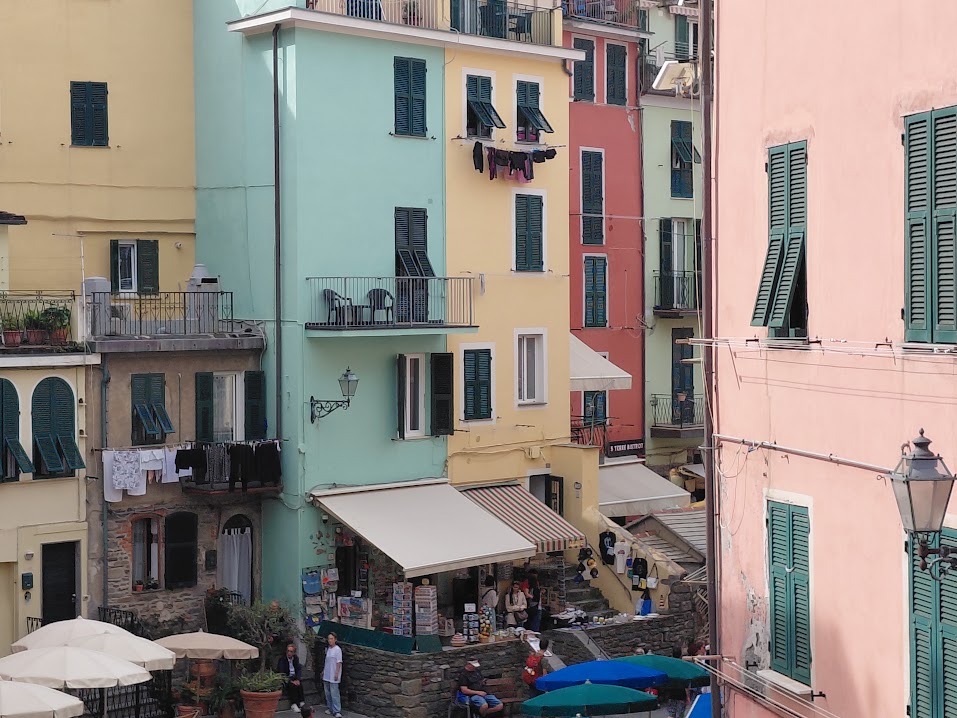
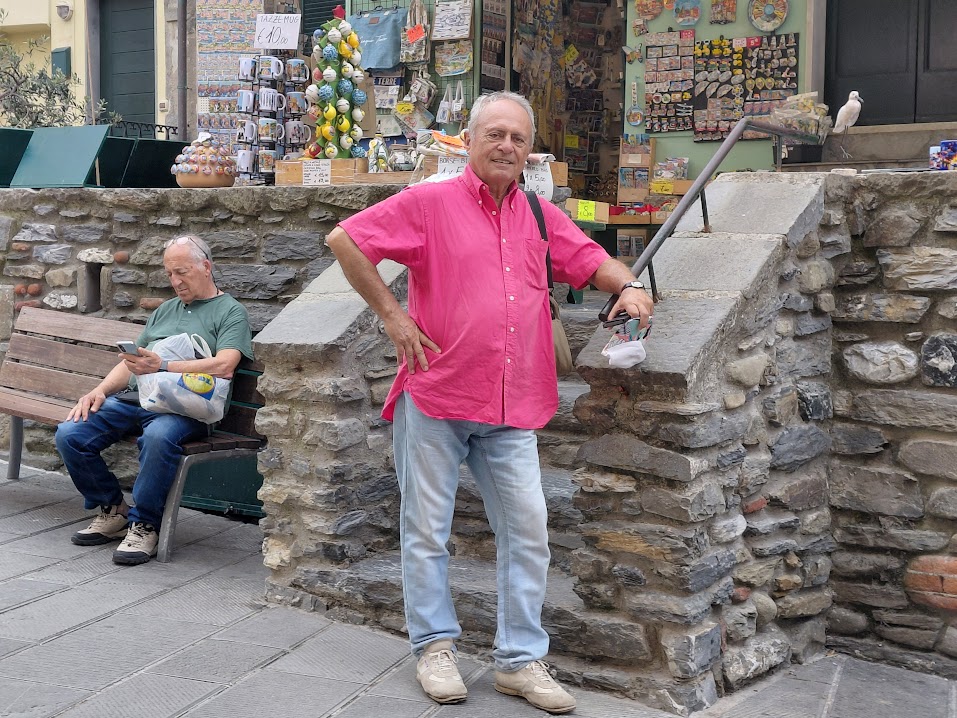
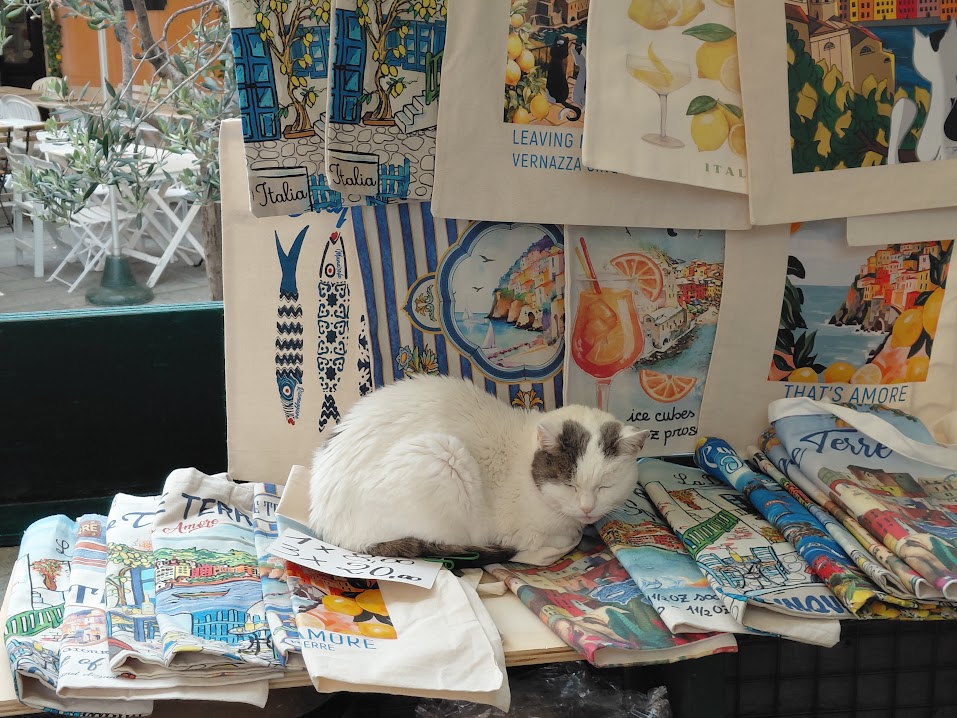
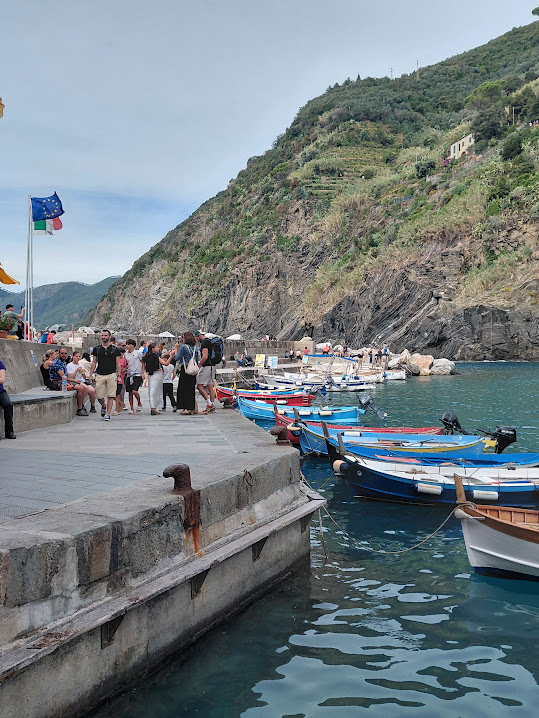
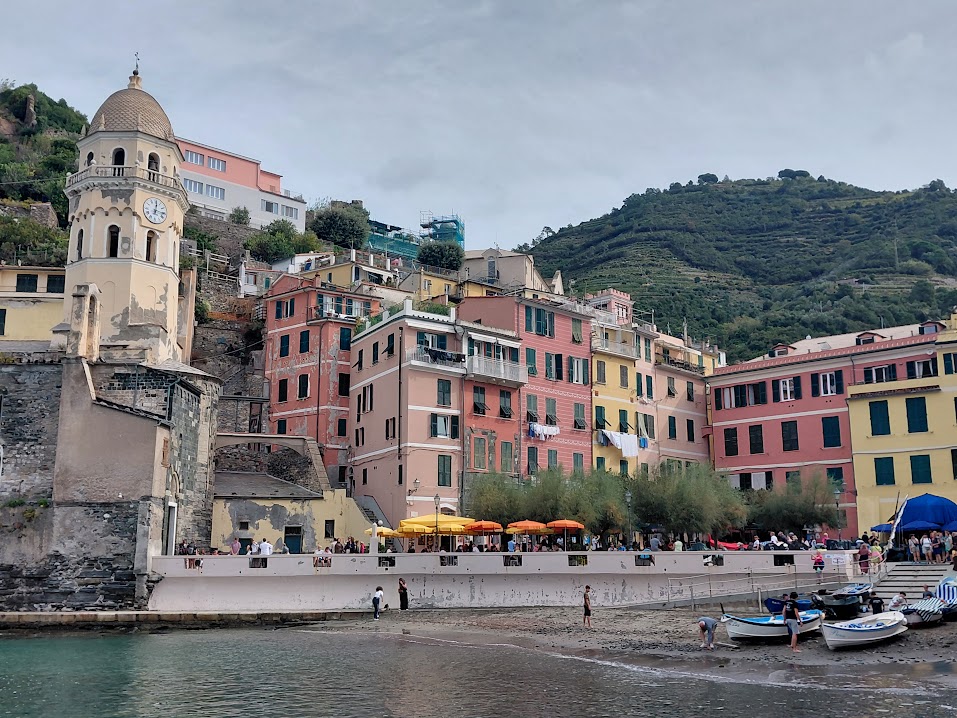
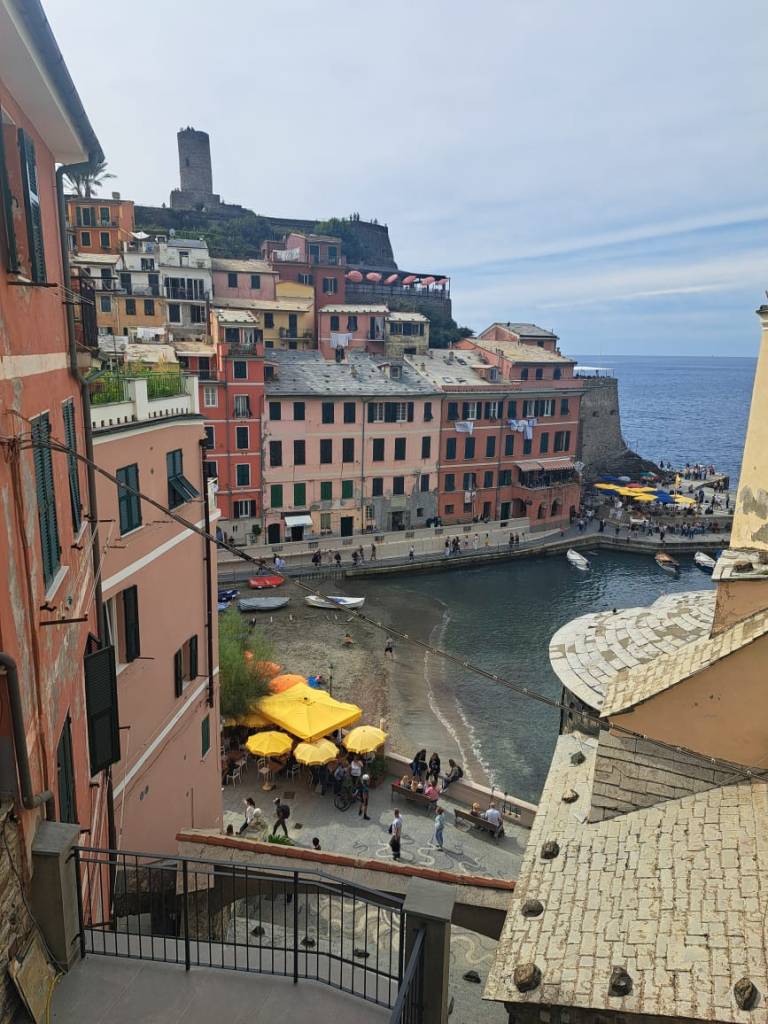
Vernazza’s medieval church is near the small sandy beach.
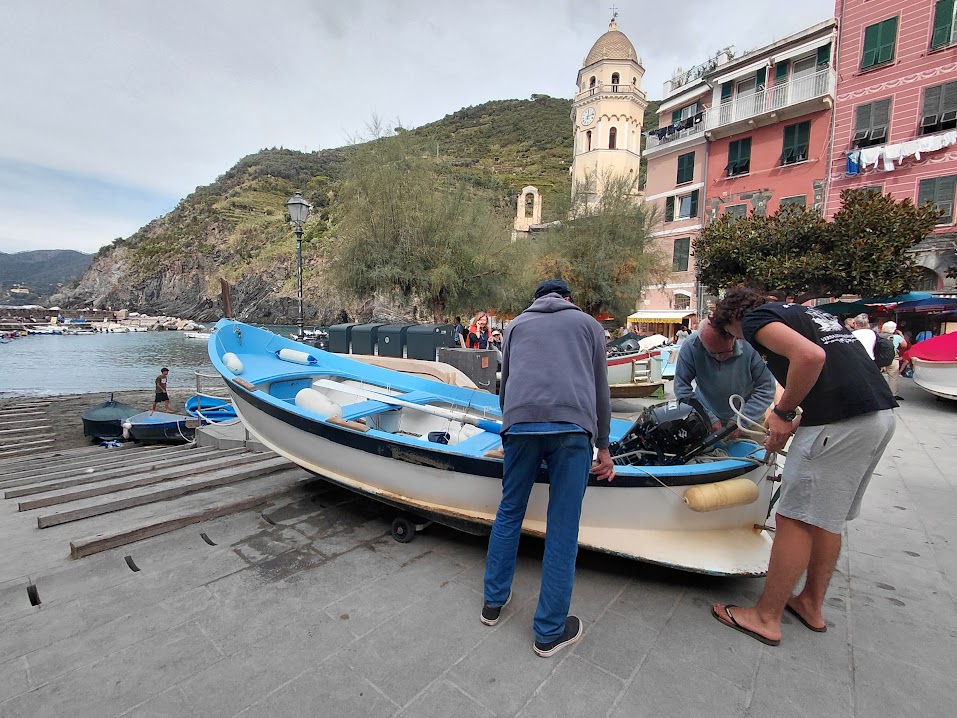
Known as Santa Margherita d’Antiochia, it differs from other Gothic churches nearby with the facade and also with its octagonal tower and dome.
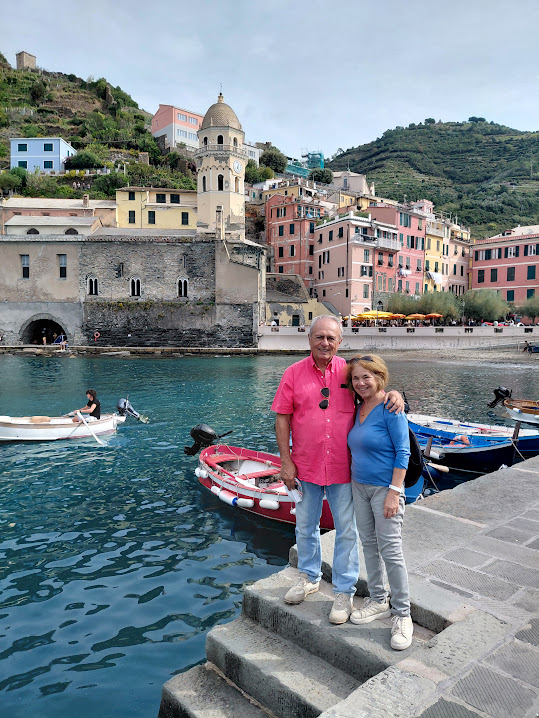
You can take some trails up above the village. If you’re really energetic, you can walk to Monterosso or onto the next village, in the order we’re going, to Corniglia.
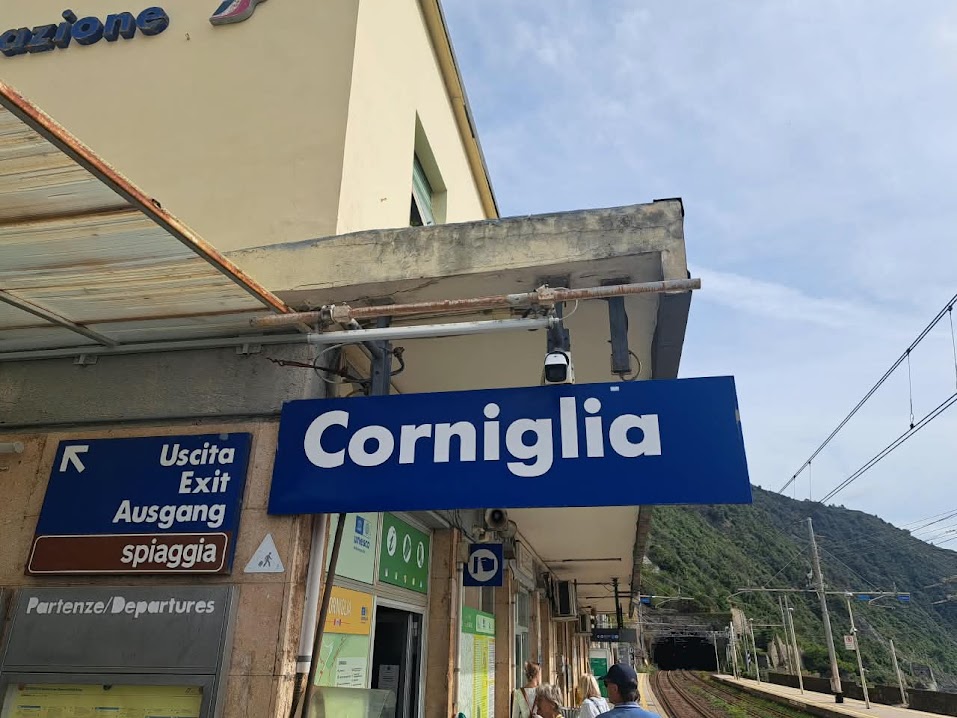
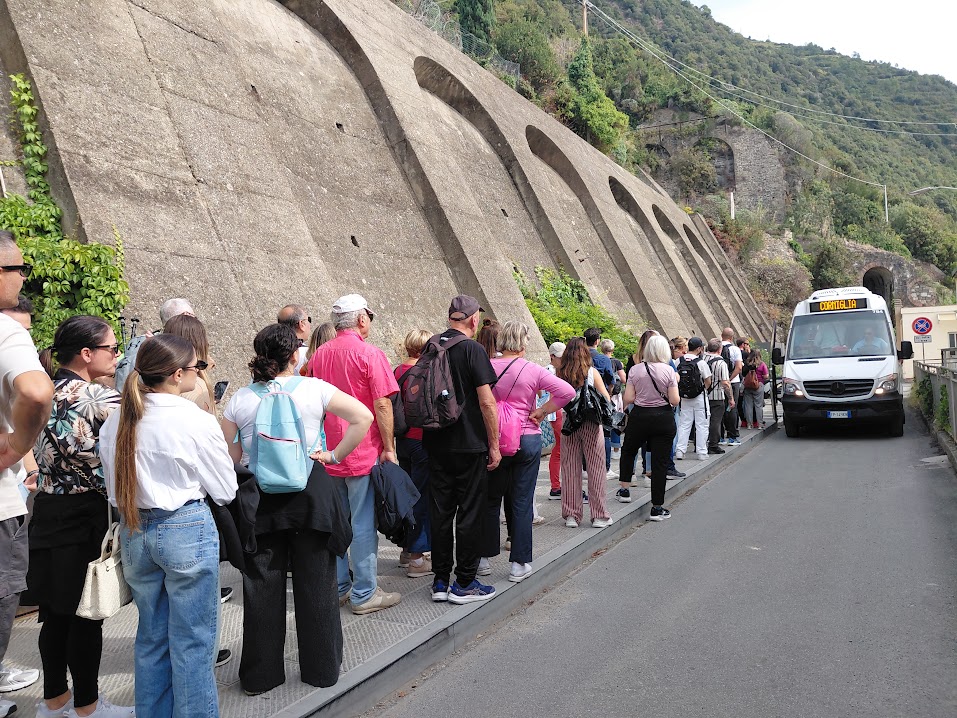
The only village that’s not by the sea but has great views of Cinque Terre. Ready to walk from the train station up to the village? It’s close to 400 steps on a switch-backing brick stairway, but yes there is a shuttle bus, a small one like we saw in Portofino. And here’s the line …
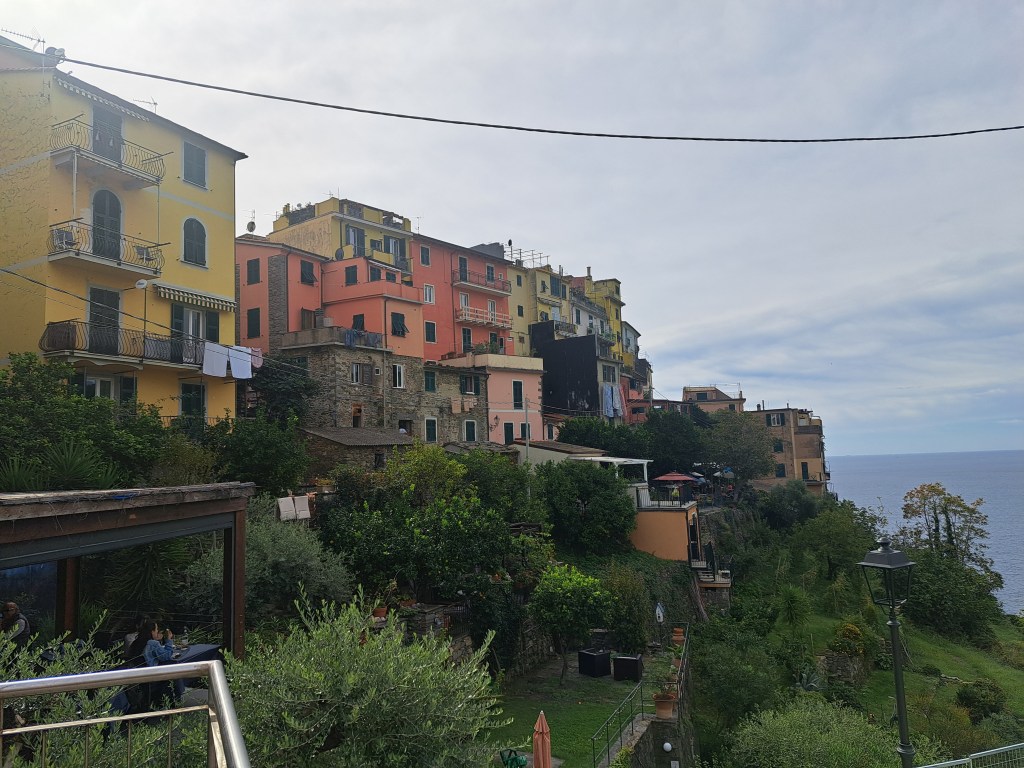
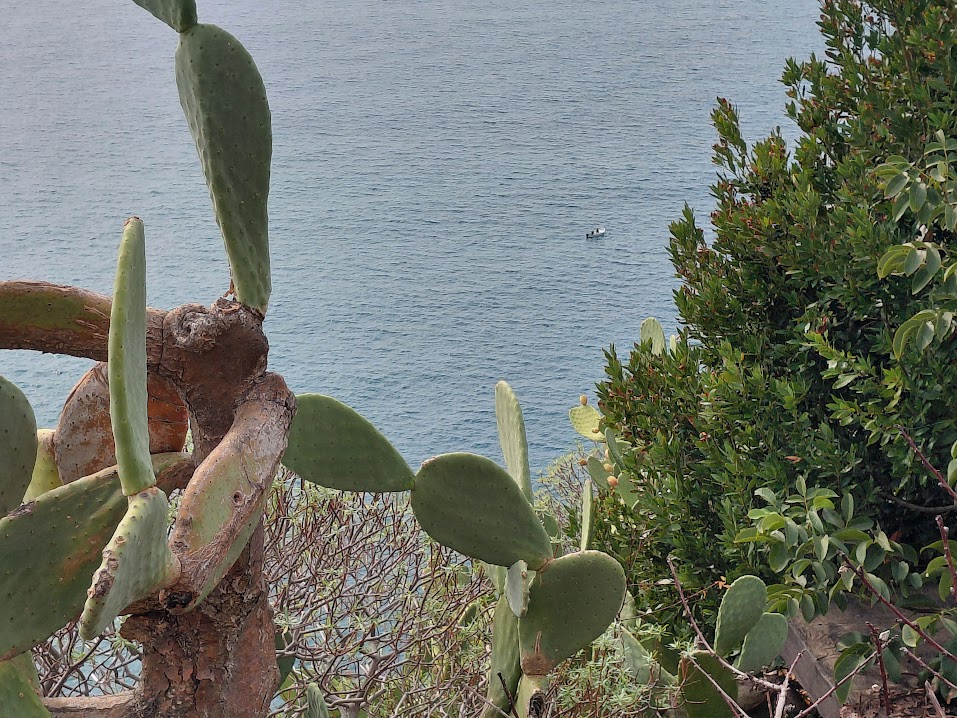
A lot of the hills are terraced for wine. The fame of the wine goes back centuries. In his 14th c. Decameron, Boccaccio writes of an Abbott plagued with indigestion. How is he cured? With some toasted bread and Vernazza di Corniglia wine.
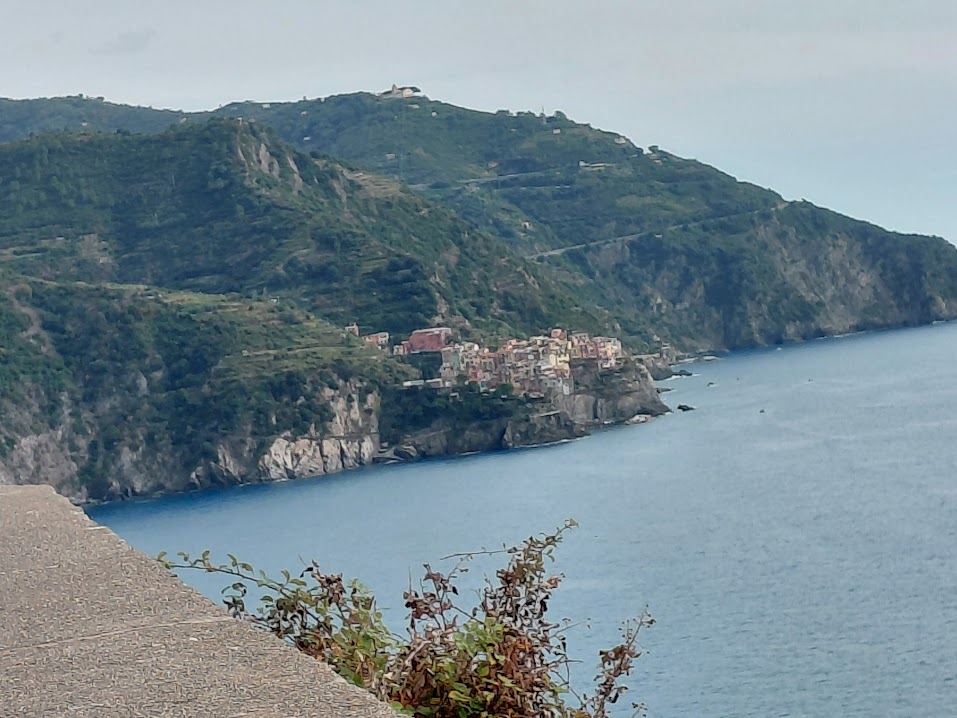
The wine fame goes back even further. (Roman amphora with the name “Cornelia” were found in Pompeii, showing the Cinque Terre wine was traded for centuries.)
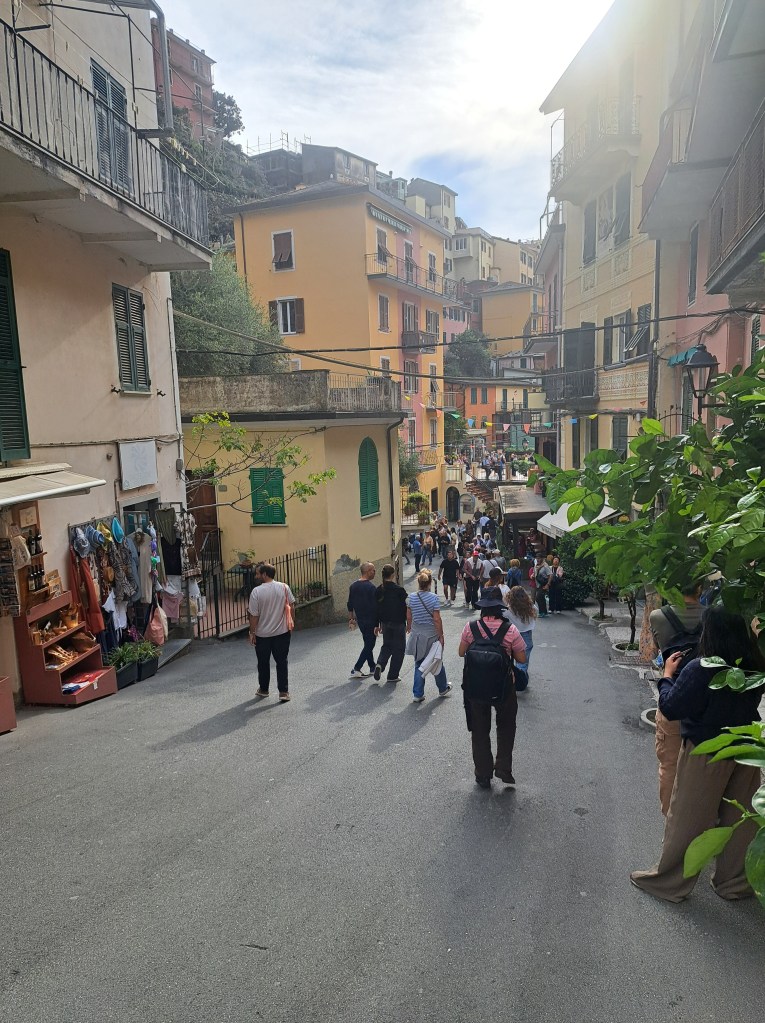
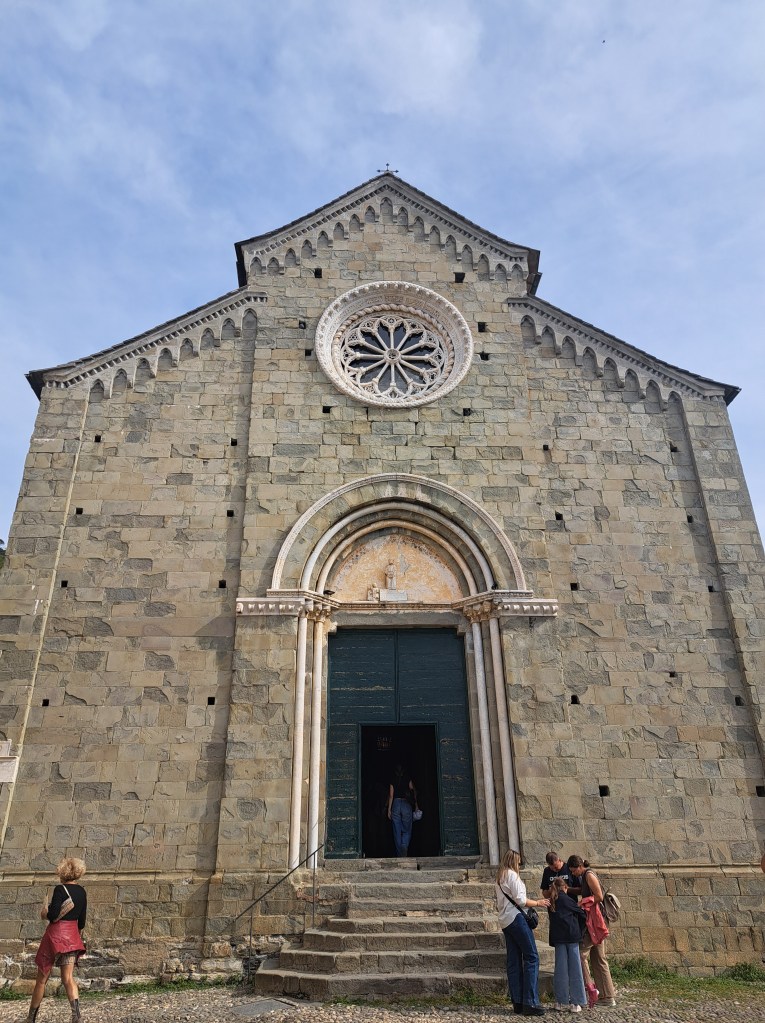
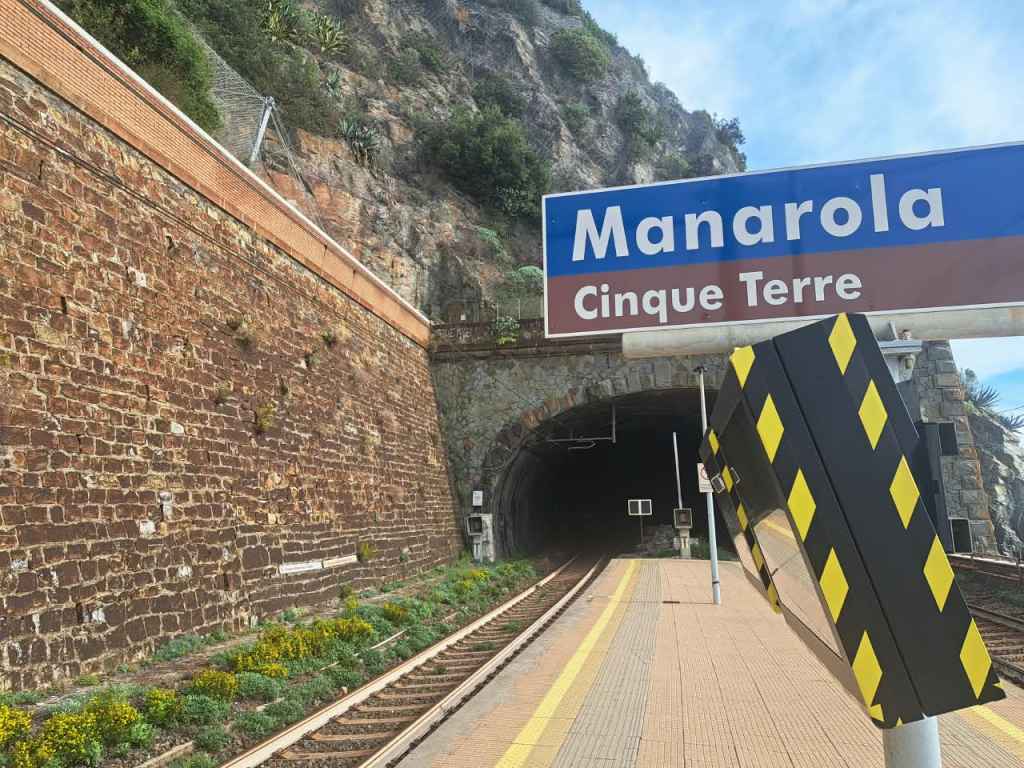
The oldest village in Cinque Terre, it is most known for its wine and certainly if you look up you can see lots of terraced hillsides for growing wine, also olives.
Time for a tira misu gelato break!
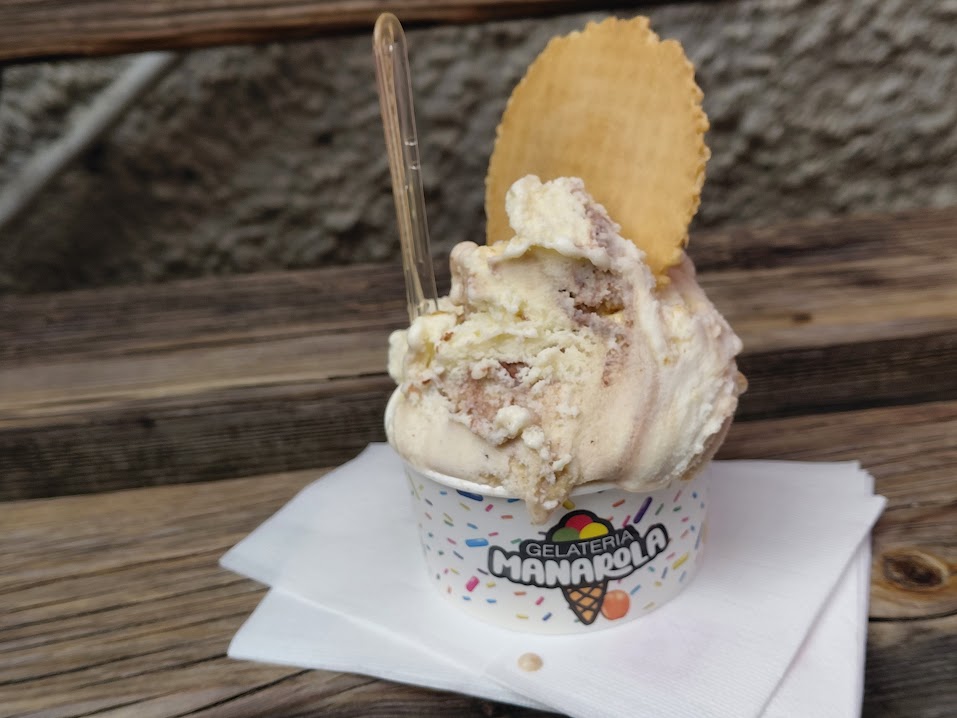
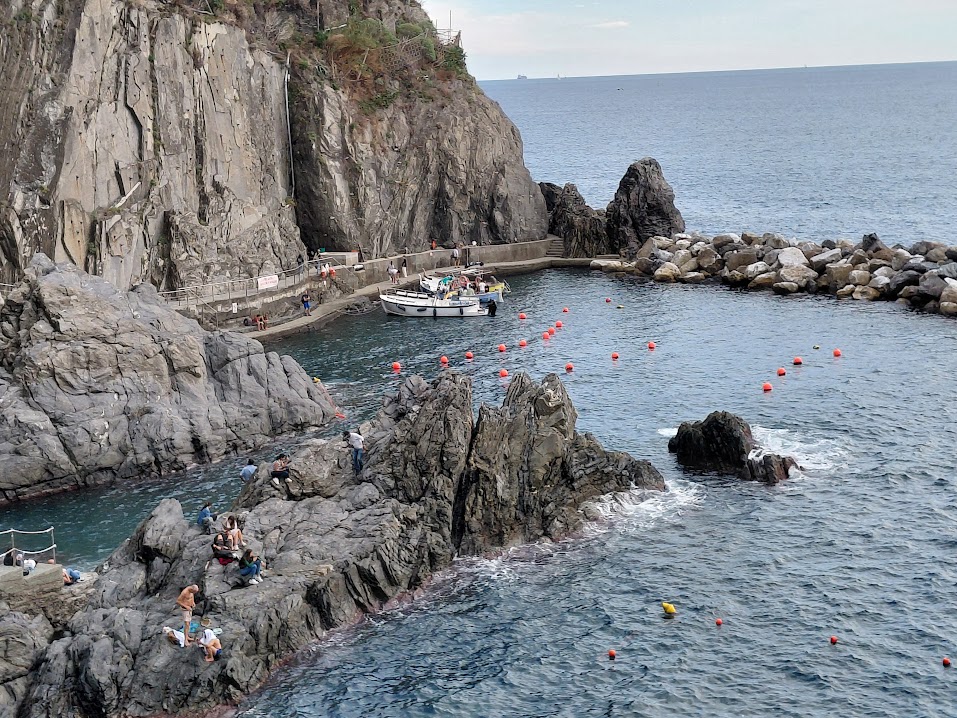
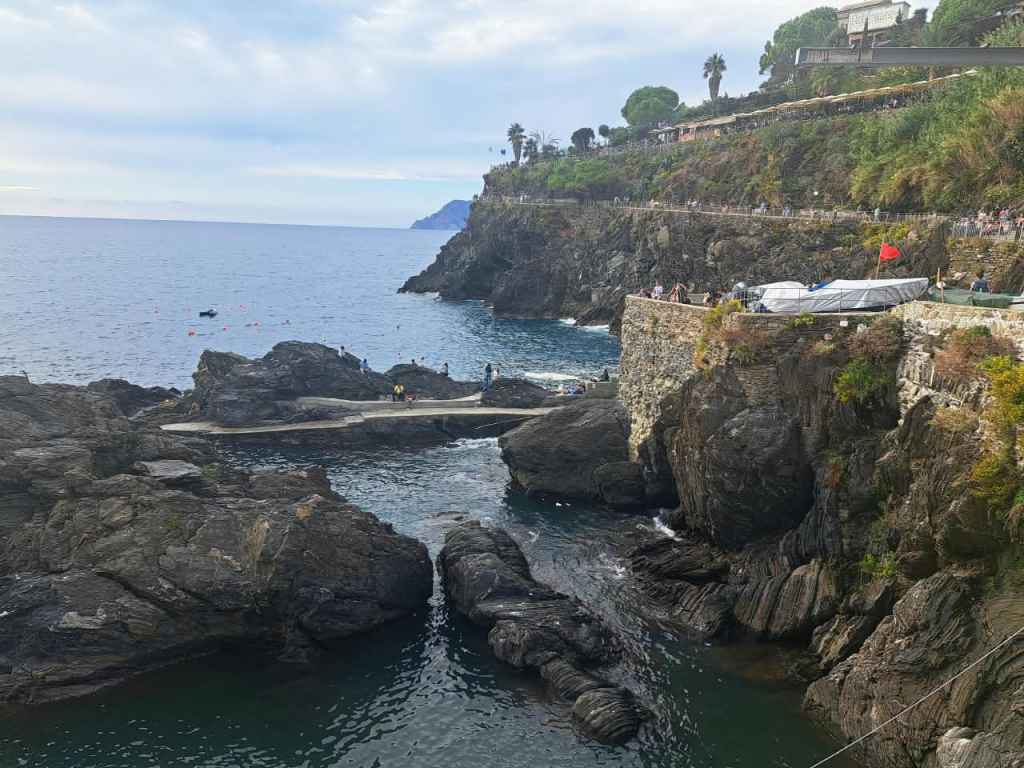
You’ve got to take the walk up from the port and little swimming area to see how picturesque it is.
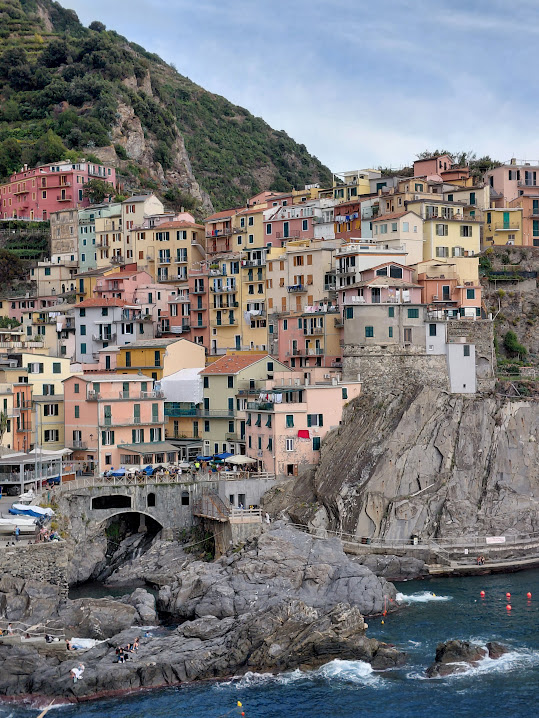
And here it is, the quintessential cinque terre photo of Manarola — turquoise sea, rocky cliffs, pastel houses all grouped together and hills behind.
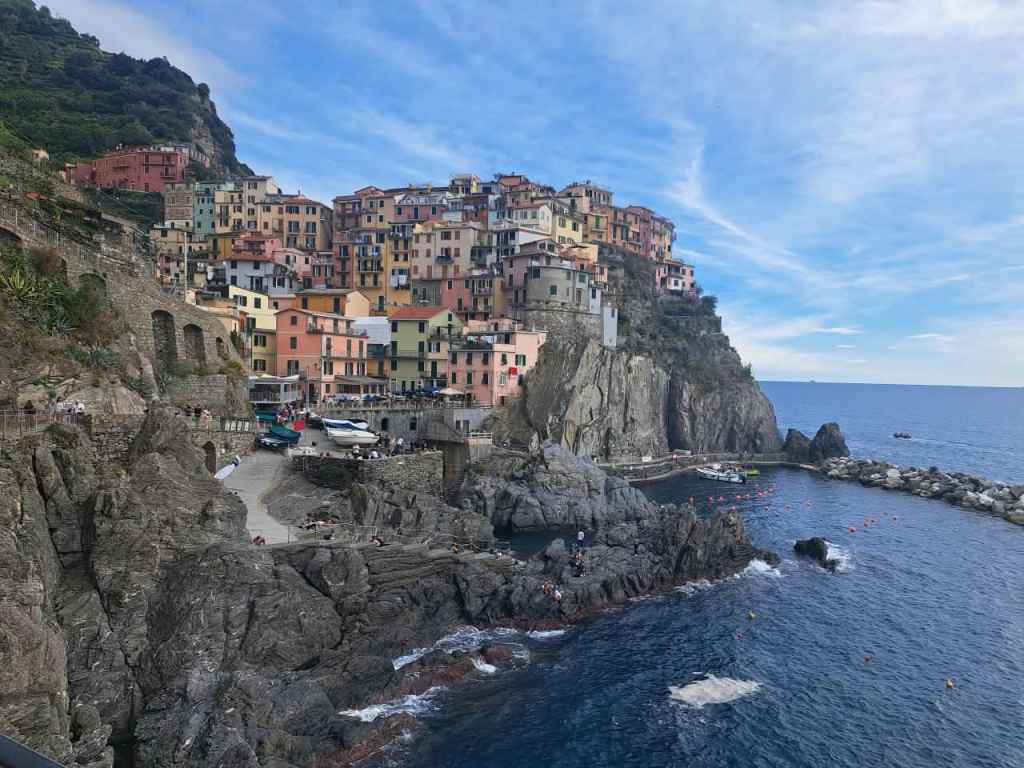
If you continue, you reach the Via dell’Amore which is supposed to go to the 5th village, Riomaggiore, but we were only able to take part of the path it as it was closed, perhaps because of recent heavy rain. In any case, I also read that you can take it only FROM Riogmaggiore to Manarola.
Manarola also has another claim to fame. Between early and mid December, it has the largest Nativity scene in the world, which is set up in the vineyards above the village.
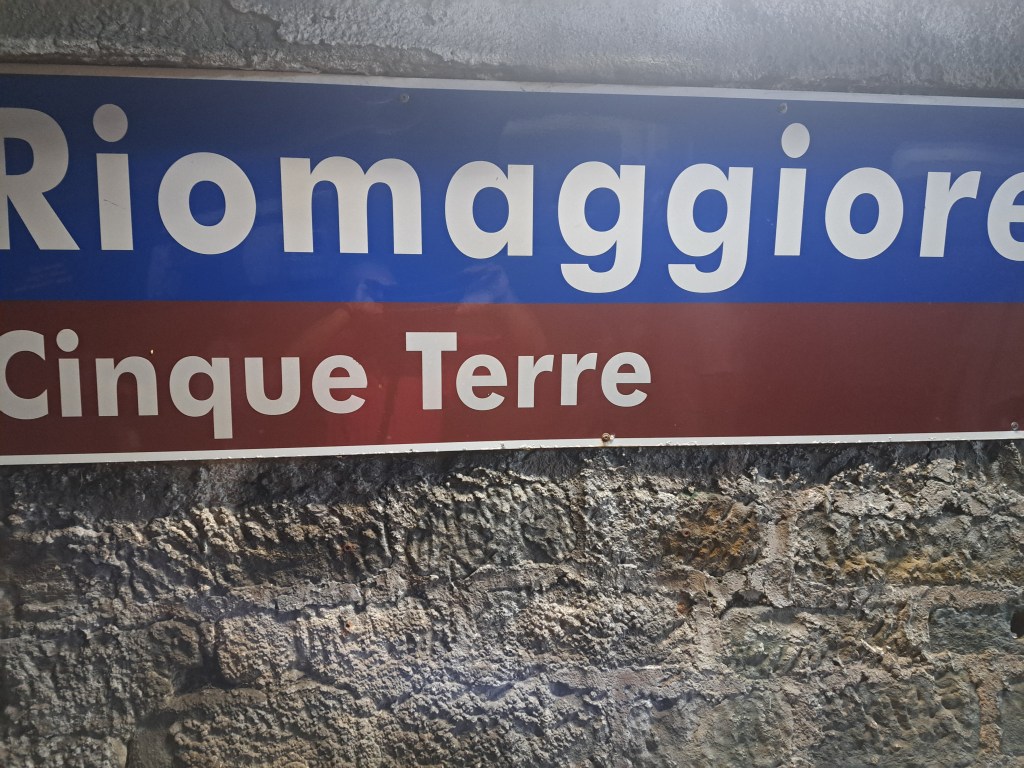
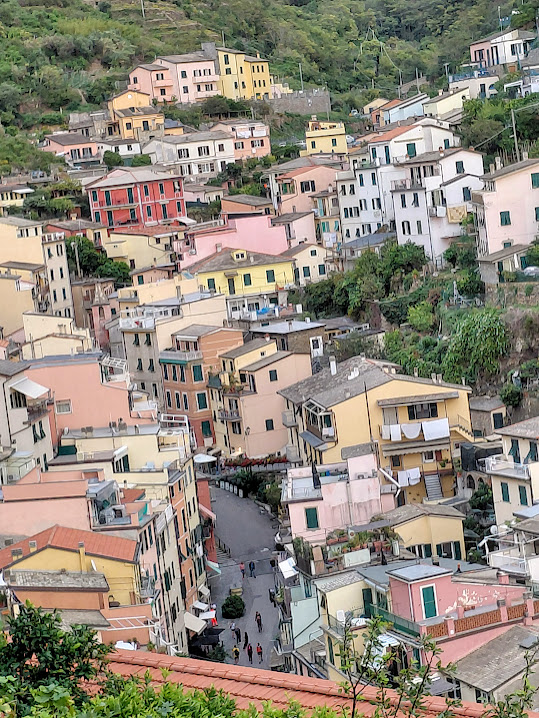
Riomaggiore is the largest of the villages and even more hilly than Manarola.
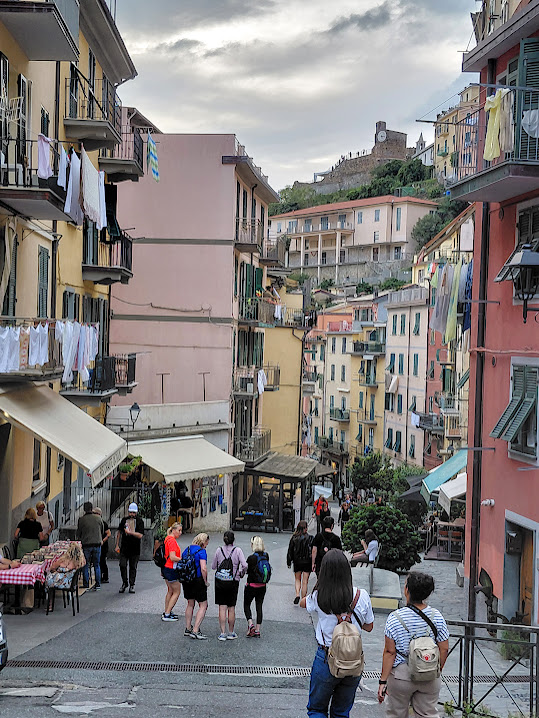
Wherever you go there’s wash hanging on the line! Locals I think, not airbnbs.
We took the steep walk up Via Colombo, the main street, up to the castle remains and next to it, the church of San Rocco, built as a place of gratitude in 1480 after the plague epidemic in the village.
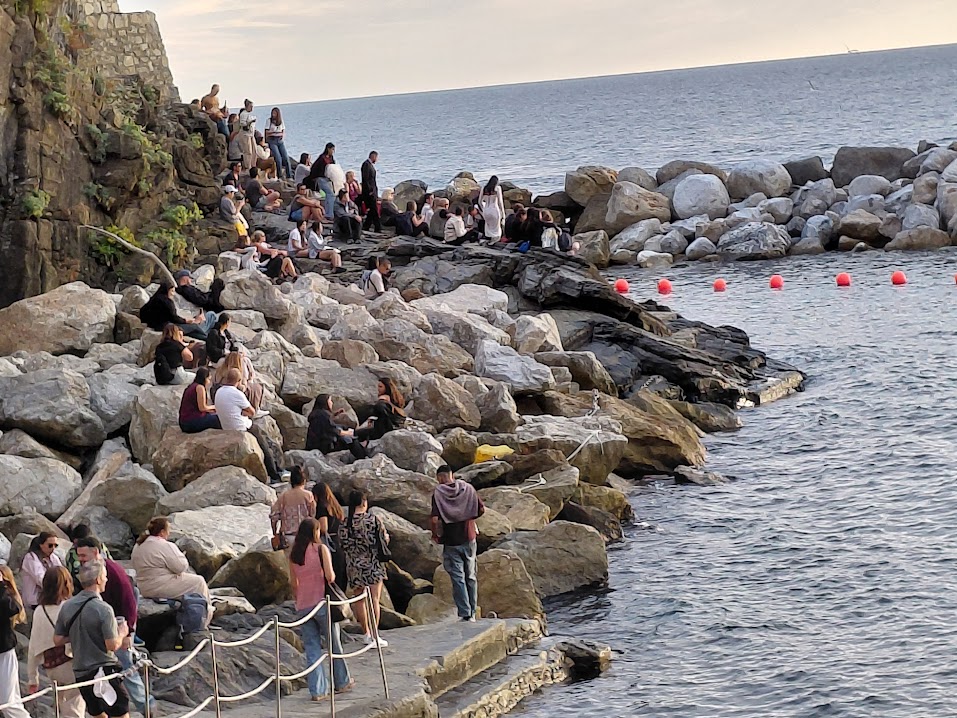
Walking down to the harbor is a must. It was getting late in the day and the sunset seekers were staking out their places on the rocks.
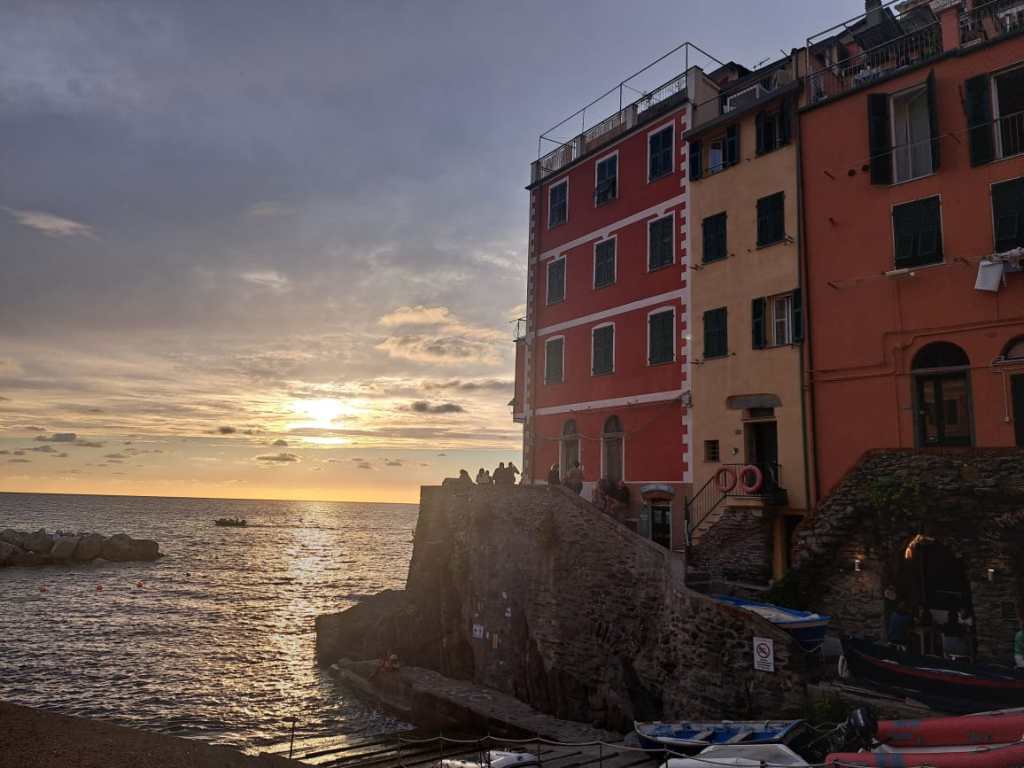
As we were now in the southernmost village, we took the train to La Spezia and decided to take a walk and have dinner there.
The sea around the town is known as the Gulf of Poets, as Lord Byron and Percy Shelley, as well as D.H. Lawrence, were frequent visitors..
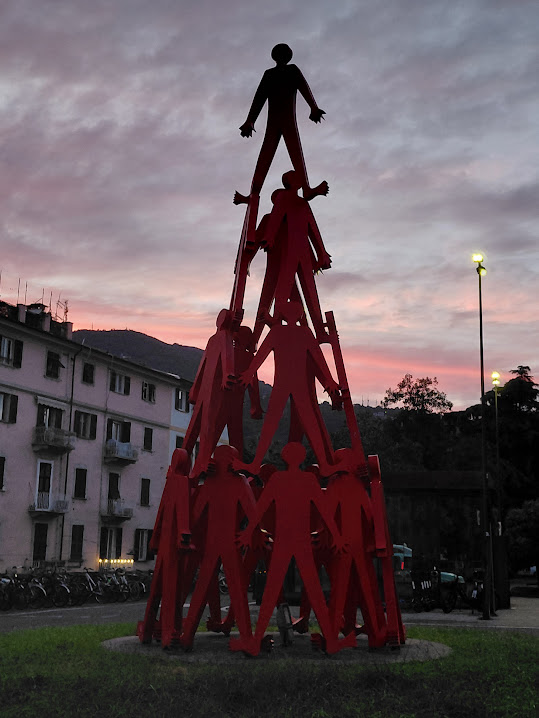
The main street near the station, full of trattorias and pizzerias, leads down to the port.
Back to Genoa and our last day. Ciao ciao Italia!
***********
Some tips: If you have a regionale (local) train ticket, without a certain time and not your name, you must be sure you validate it at the train station. Very important. Conductors are merciless and don’t care if you’re a tourist or not.
The coperto (cover) is what you pay for your place setting and bread. It should be around 2 to 2 1/2 euros per person (at this time) but it can be more. In any case, it should be clearly stated on the menu somewhere (in as small print as possible). As for water, you shouldn’t be charged for water that’s filtered, but not bottled, as we were charged in a place (that was clearly extortion!) With the coperto, there’s no reason to give an extra tip, it’s certainly not mandatory, but if you’re really happy with the service, by all means. In one trattoria (Cavour 21) they had a system where the tip was greeted with a bell and an announcement to the staff!
Last, from Athens, unfortunately no direct flights go to Genoa. You have to go to Milan, take the bus to the train station (1 hour) and from there the train is about 1 1/2 to 2 hours to Genoa.
So, Olina and I both got our trofie (here trofiette) and tiny jar of Pesto Genovese, waiting to put it together.
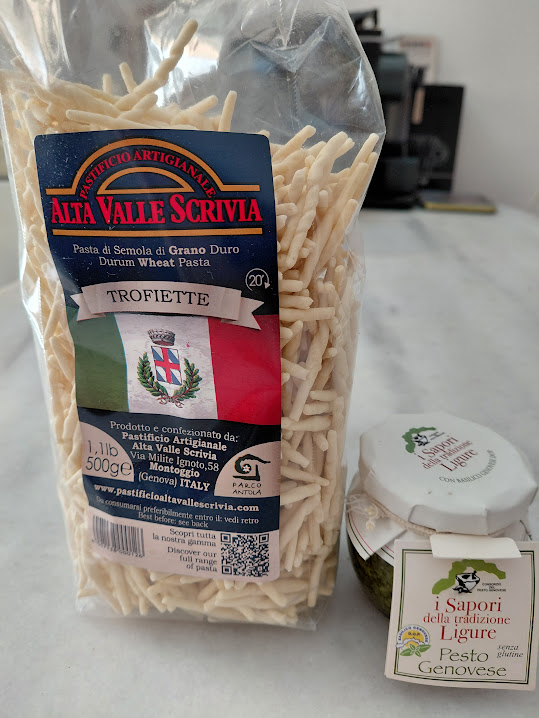
If you want to make pesto yourself from scratch, here’s the Genovese way:
Genovese Pesto
First get out your mortar (marble if possible) and (wooden) pestle and your strong arm muscles. (If you want to use a food processor, I won’t tell anyone)…
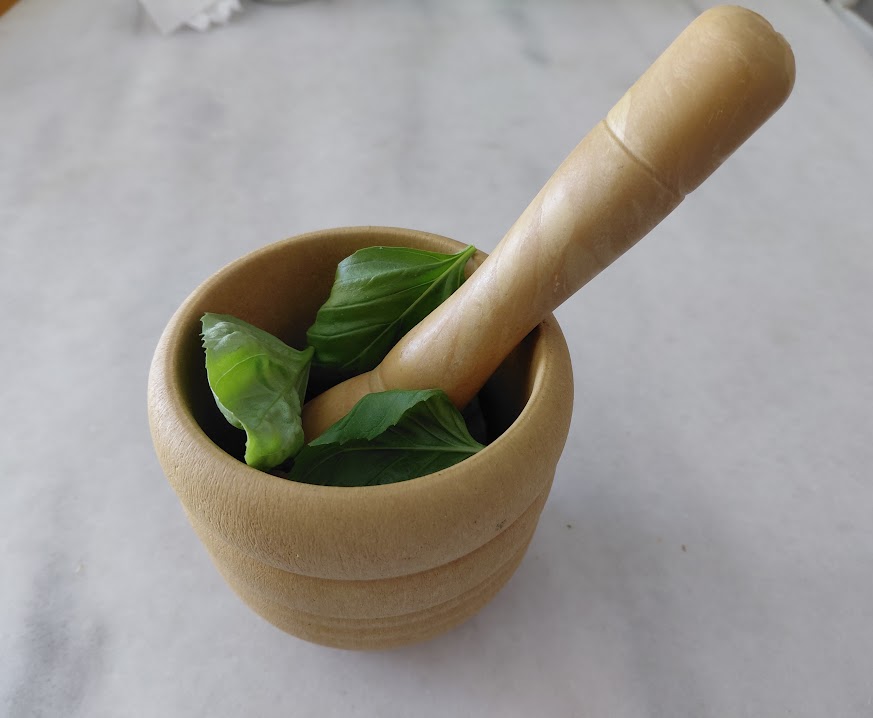
1) Grind 1 – 2 cloves of garlic with a little coarse rock salt and work together to smash until you get a smooth paste.
2) Add pine nuts to the garlic salt mixture and grind them to a beige paste.
4) Add fresh basil leaves a small handful at a time. Press the pestle against the leaves and roll them in a circular motion against the walls of the mortar. The salt acts as an abrasive to help the basil release its bright green oils without tearing or oxidizing them. Repeat this until you work all the basil into a rich green paste.
5) Add a few tablespoons of finely grated cheese – you can use Parmesan and Pecorino a little at a time. Stir and press them gently into the green paste with the pestle until they’re mixed and slightly sticky.
5) Finally, add olive oil and stir in a circular motion with the pestle until it blends.
*****
Let me know if you try this… Thanks for reading and please share your comments below!
If you like what you read, hit the like button and subscribe. Please share with your friends and social media. I’d love to hear your comments below.
There’s no need to log in to leave a comment. Just give an email address and your name.
Subscribe to become part of the olivesandislands community! Get new blogs and occasional newsletters delivered directly to your inbox. It costs nothing to subscribe. Olivesandislands does not share email information.
Note: Be sure to click on the confirmation email after you give your email address.

Sherri Moshman Paganos is a writer and former educator, inspired by her life in Athens, where she and her husband are happily retired and enjoying their travels in Greece and abroad. You can check out her writing — fiction, non-fiction, poetry and articles here.

