I. Historical, geographical background
480 BC. Persian King Xerxes sits on a hill across from the island of Salamina, shaking his head in disbelief as he watches his huge fleet of ships get destroyed by the much smaller Greek fleet. Here in the straits between the mainland and Salamis (Salamina) in the Saronic Gulf, this may well have been the largest naval battle of the ancient world. This was a monumental Greek victory, for after the battle the Persians gave up their control of certain areas of Greece and retreated from the country …

You would think that there would be a big site celebrating this victory, but there’s only this statue made in 2006 commemorating the site of the battle. And no any other information. No sign on the statue, no marker for the battle site, except for a number of road signs pointing you to the shipyards and the tumulus or mound, where Greek soldiers who fell in battle were buried.

I assume this gate is often locked so we were in luck that we found it open the day we visited.

Try to find any other traces of ancient Salamis in the site of the present day town of Ambelakia, and you’re met with quizzical looks. A resident who gave us directions to the ancient theater, then told us, ‘look it’s really not worth your time, there’s nothing to see’ and about the walls, no one seemed to know, but we just stumbled on this ancient wall not far from the main church.

It seems that if you want to learn more about Salamina’s ancient history, you need to visit the Archaelogical Museum, where you can see finds from the late neolithic period up until the Roman/Early Christian. There’s a Folk Art museum too in the town.
Salamina was the major area where the triiris were constructed, the triple decker oar powered warships in the 5th c BC. In Ambelakia, I saw this cheerful mural on an elementary school of an ancient ship.

There were pleasant views in the direction away from the tumulus.

Near Ambelakia is the pretty town of Selinia. This is what it looks like from the ferry boat.

And one winter afternoon from the ferry, the sun was turning golden the waters and sky of Selinia.

It’s directly across from Piraeus from where there used to be a small pedestrian boat but now most of the boats go from Perama. It’s only a 10 to 15 minute ride, enough to stretch your legs, go up to the top deck where you might see sea gulls swooping and doing turns around the boat.
Salamina is the home of the Hellenic Navy. These are abandoned Navy houses that you see from the boat.

There are periodic proposals of building a bridge from Perama over to the island, but problems always hold back the construction. Taking the ferry of course slows down the trip but on the other hand, it forces you to slow down and enjoy the short ride to the island. Some boats have descriptive names like “Salaminomachos” (Salamina battle) or Protoporos (pioneer ) or Athina with its perky dolphins.

A new boat with the huge green letters on the side “THINK GREEN” has large plants on the deck, among the passenger benches, even small olive trees! You feel like you’re in a little forest.

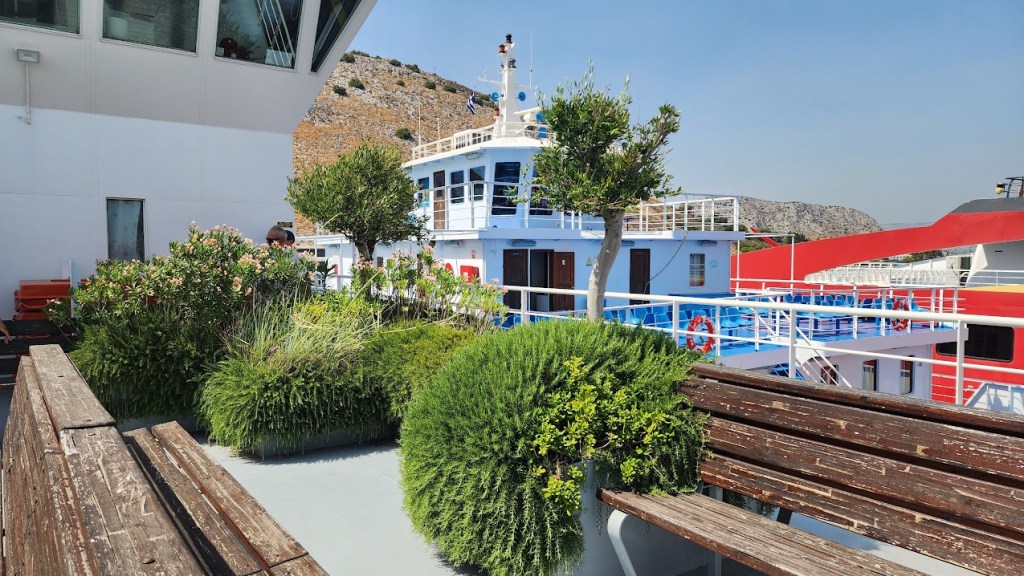
At least the boats are now more efficient, opening at both ends. Years before, there was only one exit and you had to be good at maneuvering.

Salamina, largest and most crowded island in the Saronic Gulf, often gets a bad rap, as it’s across from industrial Piraeus and Perama. But if you move away from the port area, Paloukia, and east side generally, the beaches are lovely and the water crystalline.
If you’re dreaming of a freddo cappuccino, a few blocks from where you exit the ferry is a coffee place named appropriate To Steki (the place) — with a huge sign: coffee 1.70! And that’s with a bottle of cold water thrown in. Not only is the price amazing but the coffee is one of the best I’ve tasted.
There’s another way of getting to the island. From the northwest coast, a smaller ferry goes from/across to Nea Peramos, Megara near Elefsina, which we took a couple of years ago when visiting the ancient Elefsina site. This is literally 5 minutes, no sooner on, than off.
From the 13th to 19th century the island was called “koulouri” for its round shape like that of a koulouri (a sesame coated ring of bread, a quintessential Greek street food). In modern times it was changed again to the ancient name, which probably comes from the nymph Salamis, mother of the legendary first king of the island.

II. Faneromeni Monastery / Sikelianos House
The north coast ferry leads you to a beautiful wooded pine forest and olive tree groves on the road to the monastery of Faneromini, meaning “Revealed.” Today, it’s used as a convent for a small number of nuns.
Inside they were getting ready to close the access to the 17th century church, so we had to move quickly.


The walls and ceiling of the church are an amazing sight, with over 3,000 hand painted figures.

The monastery had an active role in the Greek revolution, used as a hospital for the fighters and a sanctuary for the civilians. There were days when thousands of people were fed here.
Below is the tomb of a revolutionary figure, Captain Ioannis Gouras.

After WWII, the monastery was transformed from monks to nuns.
The grounds are very bucolic looking with goats around, that probably supply milk and feta cheese.

It might look peaceful now but come around on August 23rd, when “Faneromeni” celebrates its name day, and there’s a big “paniyiri” or fair, selling all kinds of food, kitchen objects, tablecloths and clothes, with music, as well as the religious service. Some people even camp out on the grounds the night before and after.
As you exit the Faneromini monastery, you can’t help but notice a white house with blue shutters, in Cycladic island style, down by the water.
Up close a marker tells you that in this house with its enchanting location right by the sea next to a large pine tree, lived poet Angelos Sikelianos, in the 1930’s. It was a boathouse really, used by the monastery and given to him by one of the monks.

Sikelianos was a lyric poet and friend of writer Nikos Kazantzakis. Like Kazantzakis, he was an inveterate traveler around Greece and seeker on Mount Athos. Sikelianos is also known for his Delphic festival in 1927 that he started with his first wife Eva.
Upstairs there’s a small house with two plaques. The close up of the one on the left is of special interest for my Pierce College, American College of Greece former colleagues. Here a student of Sikelianos and of a certain Koralia Krokodeilou remembers them and thanks them for their teaching. Krokodeilou was a legendary figure in the early years of the College.


If you want to see the inside, which has objects belonging to the poet and his wife, you can visit only on request at this number: 213 2027316.
Outside a bust of the poet.

III. Main Town / Promenade
Moving west from the main port (Paloukia) you reach the main town and promenade. One of our favorite spots there, the ichthyagora or fish market offers delicious fresh fish which they’ll clean for you while you wait. Just don’t use the word ichthyos in conversation — it’s the ancient Greek for fish, while psari is the modern Greek. In the same manner, oinos is the ancient Greek for wine where it’s sold, while krasi is the modern word.

Next to the market, a drawing of the battle.

And another monument to those who died in a battle of the Acropolis in the 1821 Revolution.

Along the promenade:


Need something to read? This small case houses a few books that you can help yourself to. (I assume you should leave a book of your own in return.)


Little places to swim as you walk further along.

Off of the promenade area Agios Dimitris, a church also active in the 1821 Revolution, with a bust of 1821 hero Giorgos Karaiskakis. Gravely injured, Karaiskakis asked to be taken from Athens to Salamina to pray to his favorite saint Dimitris, but on the way, he died and is buried there.


Up this hill that has a summer theater and cafe, you can look across to the hill Profitis Ilias, (Prophet Elijah) always the name given to the highest hill in an area.

IV. South Beaches: Aias, Kolones / Cave of Euripides
Over the years of going to Salamina, we’ve loved swimming at Aias Club beach named for Homeric hero Aias (Ajax), said to be from Salamina. Twenty years ago the small pebbly beach on the south side of the island across from Aegina was pristine and known only to a few. But as it became more and more “discovered,” a taverna and cafeteria cropped up and sea beds were added with sometimes too-loud music. but it’s only over on one side.

The tamarisk trees provide shade and the water is still crystalline — that hasn’t changed. As it’s on the south side, it’s nearly always calm, except for mostly rare occasions when there’s a south wind.
The waters are full of fish in varied shapes and colors — perfect for snorkeling. Divers also use these waters to look for octopus near the rocks.


East of Aias Club, Kaki Vigla and Yala also have fine beaches.
But we’re going west along the south coast now to Perania, Saterli and Kolones. Facing the island of Aegina, these, along with Aias, are some of the best beaches in the island.

Up on a hill in Kolones, sits a large 4th century BC round funerary monument with four tombs inside. Archaelogists are pretty sure this belonged to one wealthy family.

From the monument you can see the 1901 Koghi lighthouse, restored in the 1980’s and a historical landmark. A dirt path leads you there.

Bushes of levanta grow wild, along with dendrolivano (rosemary).
Near Kolones, in Peristeria, a Gaudi looking like house suddenly catches your eye, with even a sign for rooms in front. I couldn’t find any information about it. It seems to be an attraction where cars stop to look and take photos.


In Peristeria too is the Cave of Euripides, another native son of Salamina. A sign points the way up a pleasant side street with a few houses and a place to leave your car in the midst of the pine trees. When you get out of the car, breathe deep to fill your lungs with the pine scent.

If you had any illusions about just driving up to the cave, forget it. It’s a good 20 minute hike uphill. Of course you get amazing views of the Saronic Gulf as you trudge up the stony path.


Euripides certainly had peace up here to write his plays. I doubt he went down to the sea too often, with this climb, nor would he have many visitors.
Soon before you reach the cave is a sanctuary devoted to the god Dionysos. This was a cult sanctuary during the Hellenistic period (3rd to 2nd c. BC) that was joint worship for Dionysos and for Euripides. Why both? Besides being the god of wine and revelry, Dionysos was also the patron saint of drama. (In his comedy “The Frogs,” Aristophanes has Dionysos in the underworld judging a contest between Euripides and Aeschylus and decides in favor of Aeschylus.)

This 10 room cave was discovered only recently in the 1990’s by archaeologists from the University of Ioannina. Numerous finds inside the cave have pointed to it being used in six periods of Greek prehistory and history: late neolithic era (5,300 to 4,500 BC), a burial place in Mycenean times (14th to 12th c. BC), as a retreat and “poetic workshop” of Euripides (late 5th c BC) as a “tourist attraction” and place of pilgrimage for Euripides in Hellenistic and Roman period (3rd c BC to 3rd c AD) and finally as a refuge site and “treasure” in the Frankish period (14th c AD)
How do we know Euripides lived there? According to the archaeologists, what makes it pretty sure is the find of a skyphos (cup for wine) dating back to 430 to 420 BC with his name on it.
Many of the finds from the cave can be seen in the Salamina archaeological museum.


Although the map shows an inner road that goes to Kanakia on the far western side of the island, we’re told that the road was destroyed in heavy floods a few years ago and never redone. So we have to retrace our steps a bit. It’s a little past a 2,500 year old olive tree, possibly seen by Euripides himself!

V. Kanakia
Tucked into the pine forest that leads out to Kanakia, is a monastery dedicated to Agios Nikolaos, also known as Lemonion. During the 1821 war of independence and Ottoman rule generally it was a place of refuge and hospitality.

Above the beach in Kanakia is a Mycenean acropolis palace complex from the 13th century BC. We chose not to visit it as every pore of my body was yearning for our first swim and the feel of the cold sea, certainly our reward for climbing up to Euripides’ cave.


The sea might look inviting but I didn’t notice that it was full of baby jellyfish, maybe just born. Something with the way the wind was blowing brought them out. We leave Kanakia to find another beach.

VI. Aiandio
So we drive through the pine forest again and out to Aiandio. If you go left, you get to the area of NATO (not named for the organization but for the Greek expression “na to!” meaning “there it is!”) very pretty but super crowded on summer weekends, full of bars on the beach. We continue on the main road past the large and noisy beach bar “Hot Island” where waiters and waitresses cross the road precariously carrying trays of glasses. We’re approaching our favorite fish taverna, Peri Orexios (‘about food’)
Up the hill about a 10 to 15 minute walk is the house that my in-laws bought in the early 1970’s where they enjoyed spending time in the summer. Here, my father in law would ride his bicycle loaded with mask, snorkel and traps that he put down in the sea to catch clams and mussels, which we loved eating at lunch after our morning swim.
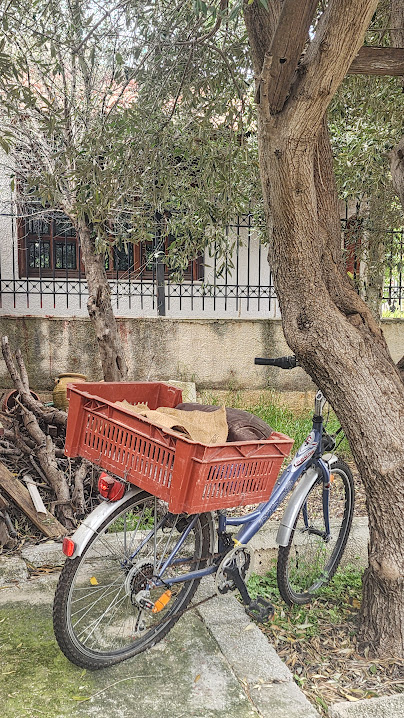
Afterwards, a long siesta and an evening swim. Then laden with food Yiayia gave us to take back to Athens, we’d take the ferry back. Often the later we left, the more crowded it was, for everyone wants to prolong the dry pleasant summer nights…
Warm dry summer nights in fact are the best time to eat at Peri Orexios. You’re right above the water, and you watch the sunset colors change as the sky turns from deep blue to black. There are still a few swimmers as it darkens.

A classic Greek scene. A mother has waded into the sea to feed her little boy — it’s probably fried potatoes.


If it’s drizzly but not too cold, you can be inside but by the wide open window, so you’re practically outside.

The fish couldn’t be fresher, the house white wine is light and fruity and the prices are great.
We always order the freshly made potatoes, grilled eggplant with a smoky flavor and lots of garlic and a plate of koutsomoures (red mullet).

The green salad has lots of fresh dill and the gavros marinatos (marinated anchovies) on the left is delicious too. You need plenty of crusty fresh bread to sop up the sauces and olive oil.

The owner’s house is on top of the taverna and if you look up, you can see his dogs sometimes wandering around the roof!

A little further along the Aiandio road is the small community beach of Aivali with a better sunset, as it falls between the two mountains.

Here, there’s another amazing taverna right above the beach with the unusual name of Boukourimiza. We had a veritable feast with shrimp saganaki (cooked in tomato sauce and feta), mussels in a mustard sauce, grilled sardines, tzatziki, fried zucchini…


The hill in the background is Profitis Ilias (Prophet Elijah, a church which is always on a hill).

Some more swimming suggestions: right across the bay from Aiandio are the lovely beaches of Resti and Heliakti, also facing south, so there are usually calm and lovely waters.

A “VIP” ice cream truck with Bollywood sounding music (!) makes the rounds above the sea.

VII. North side / Psili Ammos beach
But to complete the swimming suggestions, while visiting this past week, we didn’t want to miss Psili Ammos on the northern side, a long expanse of beach near the pine forest near Faneromeni. Even though the name means “fine sand,” the beach is a mix of sand and little pebbles, characteristic of most of the Salamina beaches. There was no wind so it was smooth like glass, but for sure colder than it was in Aiandio.

The water is very shallow so it seems good for families with kids. In summer, like at Aias, part of the beach is used for umbrellas and sunbeds.

Since we’re on the northern side, we drive past the Sikelianos house and monastery, return by way of the 5 minute ferry, and then the highway home, which is actually faster than going through Piraeaus.
As we reached the small port, this dog that seemed to belong to the ferry, nearly flew to the front and then leaped onto the landing.

VIII. Bounty of the earth
After Pappous died, gradually, we learned to appreciate the bounty of the earth and its seasons, that before we had just taken for granted. I always think of the Byrds’ song, “Turn Turn Turn,” based on a verse from Ecclesiastes: “There’s a time for every season and a purpose under heaven.” So we keep busy every season with our few trees.
In the fall, it’s walnuts, then olives and in the winter oranges and also lemons which are pretty much all year.


Now in the spring it’s mousmoula (pronounced musmula). Small orange fruit, they look like apricots but with a sweet – tart taste together. But once you pick them, they bruise easily. We’re trying to eat about ten a day so they don’t go bad…


In early August it’ll be time for the grapes. Although we do nothing now, we’re still rewarded with bunches and bunches of them, mostly green but some purple.

Grapes mean grape leaves and now in May they’re nice and tender. If you wait to pick them, they’ll very soon get too tough. We picked around 100 of them.
You can also get them now in the fruit and vegetable market.

The leaves are used in making dolmadakia, little “dolmas.” As my friend Diana pointed out to me, the word comes from the Turkish dolma or stuffed. A dolmus is in fact the name for a shared taxi in Turkey, often “stuffed” with passengers.
Recipe for Dolmadakia (Stuffed Grape Leaves)
Here’s a recipe that I just used for about 35 to 40 dolmadakia:
Rinse the leaves to get off the dust. Boil them for a minute or so, then with a slotted spoon, transfer them to a bowl of ice water for a few minutes. Careful, they’re fragile… When cooled, strain the leaves and pat dry. Set them aside flat on a couple of plates if necessary. Their bright green color turns to a paler green. Cut off the stems.

Clean and chop plenty of fresh dill, parsley and mint (and basil). In a saucepan or skillet, saute some onion in olive oil, then add scallions cut up and the herbs for a few more minutes.
Add about a cup of rice and salt and pepper, cook for a couple of minutes, then add about 1/2 cup of water to soak up the rice. Add juice from a few lemons and cook for 10 minutes (maybe less) Watch it carefully, then adjust seasoning. I might add some cumin — you can’t go wrong with cumin.
When cooled, place a spoonful of the mixture in the middle of a leaf — it should be rough side up. Then fold the sides over to make a shape like a little cigar. Keep doing for all the leaves. In a large pot, place all the dolmadakia around on the bottom with some olive oil. (You might put some torn leaves on the bottom first).

Add boiling water, more lemon (adding lots of lemon is really the secret to their success), more oil and salt if necessary. Put a plate or smaller pot cover over the dolmadakia to keep them in shape. Boil, then cover and simmer the mixture for 30 minutes or so. And here they are! Kali orexi! Bon appetit!
If you try it, let me know how it goes!

You can make a dip for them of yogurt, fresh mint and dill with salt and lemon.
****
So, pack your bathing suit, take the ferry from Perama for a one day excursion to Salamina. If you have time, visit some of the historical areas; if not, just head for one of the beaches, north, south or west, depending on the wind. And if you can find it, eat at Peri Orexios in Aiandio or at one of the fish tavernas along the promenade in the main town.
Have a great time and discover for yourself the beauty of the landscape and sea in an island that lies so close to Athens.
If you like what you read, hit the like button and subscribe. Please share with your friends and social media. I’d love to hear your comments below.
There’s no need to log in to leave a comment. Just give an email address and your name.
Subscribe to become part of the olivesandislands community! Get new blogs and occasional newsletters delivered directly to your inbox. It costs nothing to subscribe. Olivesandislands does not share email information.
Note: Be sure to click on the confirmation email after you give your email address.

Sherri Moshman Paganos is a writer and former educator, inspired by her life in Athens, where she and her husband are happily retired and enjoying their travels in Greece and abroad. You can check out her writing — fiction, non-fiction, poetry and articles here.


What are your thoughts? Leave a comment below