Not even Aphrodite, goddess of love, who was born as the myth says, out of the sea foam on Cyprus, can heal the conflict in this divided island country between Greek Cypriots (82% of the population) and Turkish Cypriots (18%). We’ll see how the island came to be divided in the last 50 years.

I. Larnaca
This year the “laiko panepistimio” (people’s university) of Agia Paraskevi that we attend decided on five days in Cyprus for the final excursion, in a trip custom-designed by Kalidoni Travel in Athens. From the Larnaca airport along the road to the city, our guide Maria first pointed out the alikes, the salt pans that extend for kilometers.They’re formed when the lake water evaporates, leaving behind a deposit of salt. Tiny shrimp grow here; they’re not gathered though, but mostly left for the population of flamingos and other bird species.

Larnaca’s main street along the beach is the finikoundes, street of the palm trees, that skirts the long beach along the town.

The statue of the Winged Lion of Venice (Lion of St Mark), at the end of the Finikoudes promenade was a gift to Larnaka from Venice to mark the twinning of the cities in 2010.

Nearby sits the 12th century Larnaca Castle, built as the first Byzantine area fortification. In back of the castle is the Dzahami Kebir Mosque and minaret.


If you stroll past the castle it’s a lovely walk, as you see the city’s old houses with their painted shutters of blue and green.
Probably the most famous landmark in Larnaca is the Church of St. Lazarus.

This late 9th century church is dedicated to Lazarus, who the story goes, Jesus raised from the dead. Later Lazarus came to live In Cyprus and became a bishop.

The plaque tells us the church was built under Byzantine emperor Leo the Wise.


We’re impressed by how clean the city is, but like Greek towns, cats linger everywhere. Apparently Eleni, mother of King Constantine, in the 4th century AD, sent shiploads of cats to combat the problem with rodents that she noticed on her visit to Larnaca. It seems the cats have multiplied through the generations…
Outside of Larnaca next to a pleasant cafenion in a tree shaded area, we visited a 6th century church, Aggeloktistis, meaning “built by angels.” It looks very stark on the outside but inside is a historic mosaic of the time, in the same style as found in Ravenna and Sinai.


As always, the Romans left aqueducts, this one with 15 arches. Lanarca and Cyprus in general has always had a drought problem.

On the road to Limassol is a Camel Park. You might think there are camels on the island — there used to be — today however they’re “exported” from the Middle East and there seemed to be at least 50 of them wandering around, some with ancient Greek names like Aphrodite, Hera and Achilles! They were obviously trained to expect visitors to feed them.

Besides the camels you can see lemurs, emus and wild goats. But the big attraction for kids is the pool, despite the strong winds sending ripples over the water, making the trees sway and sending plastic cups flying.

II. Limassol (Lemesos)
The Greek name of the town (Lemesos) is from “nemesis,” not the god of avenging wrong, but with a meaning of “giving a reward.”
The road leading to Limassol passes through many greenhouses, and products like artichokes, watermelon and row upon row of small olive trees.

In contrast to Larnaca, a town of one family houses, Limassol has some apartment buildings reaching up to the sky. They’re owned not by Cypriots but mostly Russians (who make up 40 to 50,000 of the 250,000 population of Limassol). Lately, Chinese and Arabs have stepped in as real estate investors.
A view of downtown Limassol from the hotel:

These houses in fact (along with the boats) are owned by the Russian community and except with a special permit, non-Russians are not allowed to visit!

A walk down by the old port:


In the castle below, Richard the Lion Heart married his fiancee, Berengaria, and she became queen. Today it hosts the Medieval Museum.

Richard the Lion Heart? You may be wondering what he had to do with Cyprus. It seems that on his way to Jerusalem in the 3rd Crusade, a storm shipwrecked his ships near Limassol. The current despot of the island took the crew prisoner and confiscated the English treasure. Richard tried “diplomacy” to get it back but when this failed, he beseiged Limassol and captured the city, and became ruler of the island! However, he had no interest in it — he just wanted to get to Jerusalem. So he sold the island to the Knights Templar…
Our hotel is a ways from the downtown port area but it faces the sea, just a hop, skip and a jump away.

One night the hotel had a “Cypriot night,” which seemed very much like a “Greek night” with a band of bouzouki and guitar and dancers.

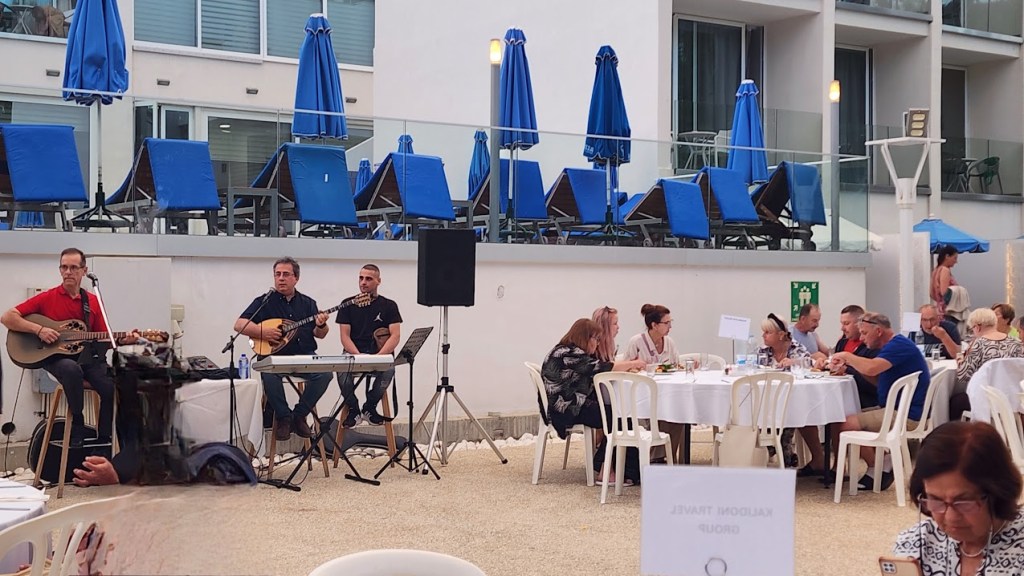


Hard to resist getting up to dance!

III. Nikosia (Lefkosia)
In Nicosia (Lefkosia in Greek, lefko and theia, meaning from the “white gods,” is a name from the Hellenistic era. Here is where we learned more about modern Cyprus’ stormy history from 1878 when the British took over the island, to its independence in 1960.
In July 1974, the Greek military junta at the time, engineered a coup to try to unite Cyprus with Greece and also to assassinate the Cyprus leader, Archbishop Makarios (he managed to escape) Five days later the Turkish army invaded the island, “to protect the Turkish Cypriot minority,” and took over part of the island, while with a second invasion succeeded in taking 38% of it, in the northeast part. A few years later Turkey declared the occupied territory a state under the name of the Turkish Republic of Northern Cyprus, which up until now is recognized only by Turkey.
From the invasion, it’s estimated that 5,000 people were killed, close to 2,000 missing and 200,000 who became refugees in their own land.
During the invasion, Greece sent five planes on a secret mission to help with the crisis, but one was shot down by the Cypriots by mistake. One of the planes sits in back of this cemetery of soldiers who were killed in various battles.


The 1950’s was a difficult time for Cyprus. There was a strong feeling for enosis, i.e. union with Greece and for independence from British rule. The Greek Cypriots started a resistance organization known as EOKA, Ethniki Organosis Kuprion Agoniston, National Organization of Cypriot Fighters.
British writer Lawrence Durrell, who lived and worked in Cyprus in the mid 50’s, writes beautifully about the people and the land, as well as the events in his memoir “Bitter Lemons of Cyprus.” Supporting enosis but deploring violence just didn’t seem possible. The political climate of the time forced him reluctantly to leave the island.

The British held resistance fighters — for them terrorists — in this prison in Nicosia.


Over the course of 1956 to 1957, nine EOKA fighters were hanged, despite an international outcry. (Albert Camus sent a letter to appeal to Queen Elizabeth, but in vain.) The fighters were buried, but according to our guide, the British were terrified of this group and feared them even in death, to the point of throwing acid on the bones so no trace of them could be found.

In 1960, Cyprus gained its independence from Britain, and the first president chosen was Archbishop Makarios, whose statue is seen here in front of the central offices in downtown Nicosia inside the city walls.

On the left side, you can still see bullet holes from the aborted coup.

Around the corner is the church of Agios Ioannis, Saint John, originally 14th century. It’s very plain outside but inside has gorgeous gold leaf carvings.

We passed by the Pancyprian Gymnasium, oldest high school in Cyprus, built in 1812 when it was still under Ottoman occupation. Many statesmen and politicians have passed through its doors.
It was here where Durrell taught English, one of his jobs, to supplement his income.

Also in the downtown area is the Porta Giulia, named for the engineer in Venetian times who designed the walls. Later it was known as the Famagusta Gate because it led to the harbor town of Famagusta.

The Liberty Monument was built in 1973 to commemorate the Greek Cypriot struggles for liberation in the years 1955 to 1959, and as a plaque nearby says, “as a reminder for future generations of their obligation to fight for freedom.”

As Nicosia is a divided city, the same way Berlin once was, our next stop was to see the checkpoint in the UN Buffer Zone where you can cross over to the occupied side. (From 2003, each side can freely cross over the “line” if you just show your passport.) What do you find on the Turkish occupied side? Shopping mostly. Good deals on brand name clothes.
The UN zone and the Green Line dividing the two communities was established not in 1974, but eleven years earlier in 1963 after violence had erupted.

Next to the checkpoint is a statue dedicated to human rights.

The major street that leads you to the checkpoint is named for Ledra, the first kingdom of Cyprus. From an observatory and tower along the street, you can see Nicosia in all directions. From the north, the occupied side, is a good view of Agia Sofia, once the oldest church in the city, which has been used as a mosque since Ottoman times.

These white tanks on the roofs are used to gather water. As noted, the island has severe water shortages.
The Leventeio museum in Nicosia traces the whole history of Cyprus from Neolithic times, 2000 to 3000 BC to Mycenaen settlers in the Iron age, 1050 BC, up to modern times.


The museum had maps and artifacts from other invasions along the way, the same invaders of other countries of the Levant: Egyptians, Romans, Byzantines, Franks, Venetians and Ottomans. The Ottoman invasion in the 1500’s formed the backdrop for Shakespeare’s tragedy Othello, who in fact goes to Cyprus to fight “the Turk” during Shakespeare’s own lifetime.
IV. Paphos
Back to the sea road again, along the southwest corner of the island to Paphos, known for both its holiday spirit and its Roman mosaics, maybe in equal measure.
On the way to Paphos we pass the Kolossi Castle from the Frankish period, built in the 13th century by the Knights (Richard had already sold the island then.)

Symbol of the empire, the coat of arms, was the fleur de lys, as shown on the side of the fireplace.


Nearby are remains of a water mill and sugar refinery. The Frankish invaders had large sugar cane plantations.


On our way we pass by one of the two British bases that were retained on the island after 1960 (part of the agreement reached for the independence, that 3% of the island would be given to the bases). It’s a huge area, with many houses and agricultural products like walnuts, pecans and grapes for wine.
Besides medieval castles, there’s the archaeological site of Kourion, from the Hellenistic, Roman and Early Christian periods, so we’re talking about 310 BC to 7th c AD, each side as always, adding to the other. Kourion was an important city state at the time.
Discovered there was a mosaic floor for a Roman bath and on the left, a tub using cold water (this room was the frigadarium — the other rooms were the tepidarium (warm room) and caldarium (hot water).

There were also ruins from various houses. On one such house was a welcoming inscription: “Enter to thy good fortune and may thy coming bless this house.”
An ancient theater was found on the site, that could seat up to 3,500 spectators, built at the end of the 2nd c BC (Hellenistic) but took its current shape in the 2nd c AD. The Romans just couldn’t keep it a theater — about a century later they transformed it into an arena to watch, what else, fights with wild animals.
Today, with its great acoustics and beautiful setting, it’s a popular place for singers and actors to perform.

We’re nearing one of the major tourist attractions in Cyprus, the Petra Romiou, the “rock of the Roman,” or the stone next to where Aphrodite (Venus) rose out of the foam. It’s a lovely myth. You can see they’re giant rock formations all in a line.

Part of the myth says that if you swim around the rock three times, you’ll have various blessings, including eternal youth and beauty, good luck, fertility and true love. Unfortunately as it was a cool drizzly day, we didn’t put this to the test…
This myth of Aphrodite rising from the foam has of course inspired many artists. The first painting below is Alexandre Cabanel’s 19th century “The Birth of Venus” and the other, more well known, is Botticelli’s from five centuries before Cabanel. Cabanel’s Aphrodite is more sensual, but Botticelli’s looks a little more ethereal.


In the name of Aphrodite, goddess of love and beauty, a whole institution grew up of “sacred prostitution,” as described by historian Herodotus. Paphos was one of the centers, along with Corinth, where prostitution flourished, all as a dedication to the deity of Aphrodite.
We found it interesting how the myth of Aphrodite’s birth connects with how Cyprus was actually formed geologically — 1,800,000 years ago, due to the mixing of volcanic plates, the island rose from out of the sea.
Not too far from Aphrodite’s birthplace sits the Monastery of Agios Neophytos, named for 12th century monk Agios Neophytos, who taught himself to read as an adult.

The frescoes amazingly still had their color.

Christianity came comparatively early to Cyprus. One reason was the persistence of the Apostles Paul and Barnabas, who visited the island around 45 AD. They faced many difficulties and at one point before the Roman governor, Paul was tied to a stone pillar and received 39 lashes. This is St. Paul’s pillar, the site where he was flogged, in front of what became the Panagia Chryssopolitissa church, containing ruins of an early byzantine basilica.

We’re practially in Paphos now, down by the water.
It’s a pleasant promenade with a lot of restaurants and cafeterias and at one end a castle.

But it doesn’t seem to have a strong identity to offer to all the tourists that pass by. And even if the store owners are Greek speaking, when you walk into a shop, they always address you in English and are even surprised if you speak Greek. It’s hard to find someone speaking the sing song Cypriot dialect — if shopkeepers are Greek speaking, they tend to be from somewhere else.


The big attraction in Paphos, besides the promenade, is the archaeological museum and the Roman mosaics. This is what I remembered most from my visit to Cyprus in 2001 on a school trip. On our way up to see the mosaics, we pass the lighthouse.

The mosaics were discovered in Roman houses of the area, particularly the House of Dionysos. With a garden pool and about 40 rooms (!), all of the communal rooms and halls had mosaic floors, most done from the 2nd to 4th century AD. The house was named for the Dionysus circle, which decorated the reception hall.
Mythological scenes were the most common theme.


Another popular theme was animals and hunting, or just animals in a geometric pattern.


This beautiful mosaic was quite unusual in its nine panels and its portrayal of the four seasons.

As today we use rugs to cover our floors, so the Romans did with mosaics…
After a brief stop in the village where some of the group bought loukoumia, (Turkish delight), some of us explored the unusual 9th century church with the domes I didn’t see anywhere else on Cyprus.

V. Troodos Mountains
Much of the island appears flat along the sea coast, but there’s the Troodos mountain range a couple of hours from Limassol, so called because of “three roads” that lead there, one from Limassol, one from Nicosia and one from Paphos.
On the way to the mountains, the land becomes more green and it’s an area of wine production of the Cypriot Kommandaria, a sweet, dessert wine made of white and red grapes. The area has mostly small family run wine operations.

The air was bracingly cool in the town of Platres, on the southern slopes of Mt. Troodos, about 1200 meters (3,937 feet). Giorgos Seferis, Greek Nobel winning poet, wrote in his poem “Eleni” about Cypriot struggles in the 1950’s: “The nightingales don’t let you sleep in Patres.” (I noticed a small hotel nearby called “The Nightingale.”) Not only Seferis, but the English writer Daphne du Maurier (author of Rebecca) apparently loved the town, having visited it twice in the 1930’s.
This is lavender area too — it grows everywhere along with other herbs, and every year in July there’s a lavender festival.
It’s also full of carob trees, ancient trees of the Mediterranean area, with their myriad uses, their fruit pods as natural sweeteners and substitute for cocoa, for animal feed, and for medicine, to name a few uses.

The mountains are full of Byzantine monasteries. As in Greece, they’re a rich source of history and beauty, and often have preserved a religious, cultural and architectural heritage throughout the centuries. (The northern occupied area also has a great many of them.) Religious tourism is alive and well in the Troodos area, as I saw in a poster.

We’re on our way first to visit a convent with the very colorful name of Trikoutiotissa meaning “three pits” (The Greek name sounds much nicer!) Pits in the meaning of fruit pits — the area is rich in mousmoula trees (in my Salamina blog I talk about this fruit, small and orange like an apricot). Apparently there are several varieties — one pit, two pits and three pit mousmoula. This area has the three pits…
The nuns were very gracious in putting out a table with tea, sweet wine and local delicacies.

The shop sold homemade products like plum wine, lemon liqueur, cherry and apple vinegar, along with items like hand knitted baby booties in different colors!
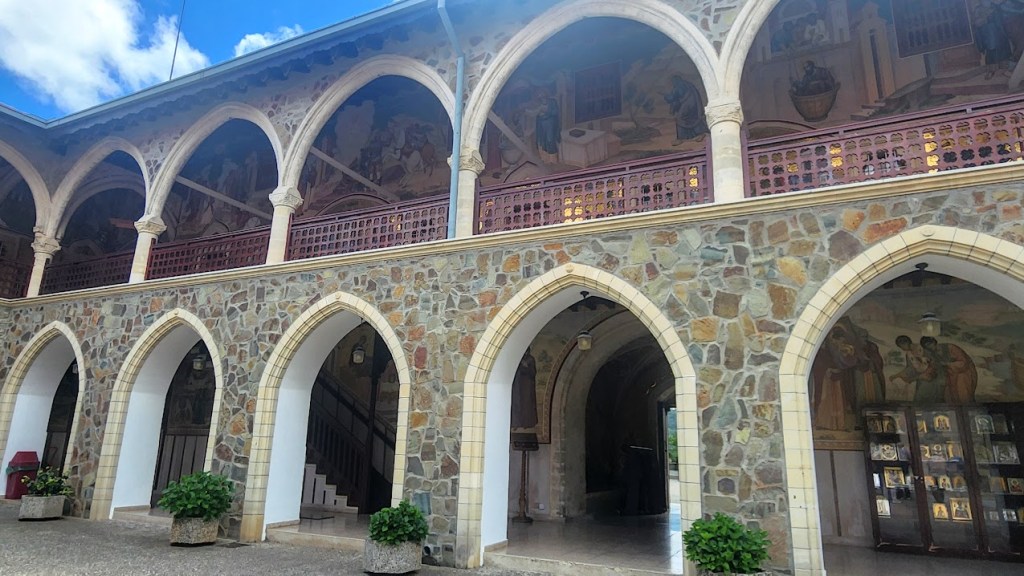
Our next stop is the Monastery of Kykkos and like so many monasteries, is dedicated to the Panagia (Virgin Mary). First we’re visiting the “Throne” of the Monastery, an uphill walk nestled in the pine forests. It’s called a “throne” because in Venetian times (16th century), when there was a drought, they used to take the icon of the Virgin of Kykkos and climb up to the top of the mountain, place it on a wooden throne and ask for the drought to end.

It’s quite lavish inside and here you can see on the floor, a bee, symbol of the monastery. Our guide Maria noted that the icons showed a Russian influence, with the subjects having a more rounded face and holding their head up and not looking down.


The throne is the final resting place of Archbishop Makarios. He expressed the wish when he died to be buried so he could “look over all of Cyprus.”

A giant statue to him lies in front. I’d say he’s the most revered person in Cyprus.

From the throne, you can see down to the Bay of Morphou in the northwest part of the island.

We’re descending to see the Monastery itself. I hear Russian being spoken; apparently a number of Russian tourists visit here, one of the wealthiest and best known monasteries.


Our last stop after lunch is in the pretty town of Omodos, where its Church of the Holy Cross attracts a lot of “religious pilgrims” with its various relics.


We try a special kind of very tasty local biscuit from the bakery, arkadeno, made with chickpea flour before heading back to Limassol.
VI. Eastern tip of Cyprus: Famagusta, Ayia Napa
One of Cyprus’ well known products is haloumi cheese, and our first stop is at a factory where they sell haloumi. It’s a tasty white cheese, a bit salty, good both raw and fried to make saganaki or eaten in salads.
Speaking of food, the Cypriots indeed eat a lot of grilled meat, like tseftalies, grilled sausage, or other meats, always served with pita and hummus. (Vegetarians might have a difficult time.)

On the way we’re skirting the green line and see a lot of Turkish outposts.

We pass through small well tended villages


but also abandoned villages like Achna, which appropriately means “without a trace.”

The town of Pila is unusual in that there live both Turkish and Greek Cypriots, each with their own school, hair salon, cafes, restaurants…
We’re on our way to Famagusta or as the Cypriot Greeks call it, Ammohostos. In one explanation, both names mean “rising from the sand.” Another theory is that Famagusta was named by the Venetians and means “important city.”
Before 1974, Famagusta/Ammohostos was the major port on the island; here most of the goods were traded. It was also a resort with large hotels along the beach. Cypriot Greeks abandoned the city which is now in Turkish Cypriot hands, and this is how it’s stayed ever since, empty, a ghost town. Limassol then was slowly built up to be the major port and resort of the island.
At least the Cypriot Greeks who left Famagusta were more fortunate than the ones who stayed in the port town of Kyrenia on the north coast. They suffered terrible violence.
From the cultural center of the village of Deryneia, right near Famagusta, we were shown a video of the tourist area, known as Varosha, before and after the invasion. It was sad as if we were watching all over again losing Smyrna in 1922.

From the center roof, you can see that Varosha is abandoned and never rebuilt. It was fenced off and is a no man’s land, a military restricted zone. Every so often U.N. resolutions and talks are proposed to try to resolve this issue, but it always stays under dispute.

In the field below you can also see craters from shells fired during the invasion.
The monument commemorates those who fell in battle and the missing.

Several years ago on Greek and Cyprus television a series called “Famagusta” was aired that showed the events of 1974 through the eyes of a journalist as he interviews island residents. It was slated to be shown on “Netflix,” but Turkey protested vehemently and the show was pulled. (It’s still available on Greek netflix.)
Near Ammohostos along the south coast we’re approaching one of the country’s biggest resorts, Ayia Napa, which is 12 km from Larnaca.
From the eastern side of the town, the first thing you see is an amazing sculpture park with small and large sculptures. Over 50 artists from around the world have participated in this ongoing project, continually being added to. You really need some time to explore it!


Around the port:


It’s early June and not as crowded of course as I imagine it must get in July and August. We drove by a lot of kitschy themed restaurants like the Bedrock Cafe with its huge dinosaurs, where the tables are made of large stone slabs, and you expect to see Fred and Wilma at the next table! The Jungle Mania restaurant is decorated with elephants, rhinos and Tarzans, and another place has a big sign “Welcome to Paradise!” with an enormous restaurant in blue and white Cycladic colors. All part of the fun…
There’s more sculpture to see along the port.


The most beautiful of all. No sign but clearly a tribute and wish for world peace.

There’s hope for the future in this Cypriot village proverb: “Next year’s wine is the sweetest.”
Enjoy your summer —
If you like what you read, hit the like button and subscribe. Please share with your friends and social media. I’d love to hear your comments below.
There’s no need to log in to leave a comment. Just give an email address and your name.
Subscribe to become part of the olivesandislands community! Get new blogs and occasional newsletters delivered directly to your inbox. It costs nothing to subscribe. Olivesandislands does not share email information.
Note: Be sure to click on the confirmation email after you give your email address.

Sherri Moshman Paganos is a writer and former educator, inspired by her life in Athens, where she and her husband are happily retired and enjoying their travels in Greece and abroad. You can check out her writing — fiction, non-fiction, poetry and articles here.


Amazing. What an account!!! So enjoyable! We recently got back from Ireland.
How’s your mom?
Joshua Schor MD
LikeLiked by 1 person
Thanks Josh…I was glad to learn about the situation there, and enjoy the trip of course! Yes I heard you guys were in Ireland — send some photos when you can.
LikeLike