Carnival is a fun time to be in Athens. While you’re mamboing, you might not think about the origin of the word “carnival.” From the Latin carne (meat) and levare (removal) it means “away from or removing meat” the same as the Greek equivalent Apokries, apo (from) and kreas (meat). Eating meat during Lent, the 40 -50 day period between Carnival and Easter, in Byzantine Greece was actually a serious offense! Violating this meant you might even be ostracized, banished for a time from the community.

During the 3 week Carnival period, many kids love to wear their costumes for the entire time. Superheroes are always popular for the boys. When my kids were little, it was Power Rangers and Ninja turtles, and for the girls, a popular costume was Neraida tis nixtas, Fairy of the night.

How about this pint-sized policeman I saw one day.

Carnival is a holiday for kids above all but who says older ones can’t join in the fun.

And of course there are parties

as well as going out to tavernas.

Athens is full of music in the plateias and streets and under the Acropolis.


A couple of Athens neighborhood municipalities have parades, like Moschato near Piraeas, and Rendi.


Every town celebrates. This is Kalavrita, in the Peloponnese:

Near Corinth, Agia Theodora.


My neighborhood, Agia Paraskevi, had a little bit of samba this year along the main street.

Moving outside Athens again, although cities everywhere have parades, the grandest of all is in Patras, 3rd largest city in Greece, after Athens and Thessaloniki. The Patras carnival is famous for its huge floats and amazing kefi, good spirit.

As soon as this year’s carnival ends, in the same way that New Orleans does for Mardi Gras, Patras is already planning next year’s and working on the impressive floats.
You might say some people live for this annual Apokries celebration. To experience it for one day is fun, as we did some years ago, but to get the real flavor, you need more time, or better yet, take part yourself, as my friend Sophia did from 2010 to 2019. She told me about what an amazing experience it was:
“I discovered that the Patras carnival is a very strong tradition where almost everyone takes part in one way or another! We saw entire families dressed up parading joyfully in the streets, mothers with babies in prams, fathers with masked children on their backs, people in wheelchairs honking, young men with whistles leading huge numbers of people in the direction of the harbor, where they ‘burn’ the carnival king.

On the way to the harbor, you can stop at any bar or café not just for something to eat or drink, but to do a little dance to show off your costume in front of TV cameras rushing madly about. Whether it’s in your nature or not, the carnival brings out the adventurous spirit in most people. There is an air of complete freedom — I could now even understand the “Dionysic” tendencies of the younger generation under such euphoria! That’s not to say that you don’t need to take care of your purse while parading, human nature will show some of its ugly face wherever it can, but the general atmosphere is friendly and easy-going, where you can make new friends, party till dawn, and have lots to laugh and smile about. For shyer types, you can even meet families and people from all walks of life.
I think by participating I could see how people can be when given the chance to forget their prejudices, wariness and mistrust of others. Some might say, ‘this sounds too utopian,’ but my answer is I dare you, try it out once- go to the Patras carnival with an open mind, I am sure you will return with an open and fuller heart.”

Other cities too are known for their parades like Rethymnon in Crete, and Xanthi and Naoussa in northern Greece.
It’s a given that men are dressed like women and women like men. A group from Kozani in northern Greece dances in front of the Goulandris museum in Pangrati in Athens.

The song lyrics can be pretty raunchy and it’s all part of the carnival vibe.

Carnival traditions date back thousands of years to pagan times and are rooted in ancient Dionysian festivals, where Dionysis, god of wine and ecstasy, led a procession of satyrs and followers accompanied by instruments like bagpipes, flute and percussion. In the palliphoria procession phallic symbols were carried, symbols of fertility. This year, a palliphoria paraded in front of the Theater of Dionysos near the Acropolis.
Each part of the country has its own customs. Another one dating back to pre-Christian times includes people dressing in sheep and goatskins and bells. Having a flour war is a tradition that dates from Ottoman rule, which was a raucous way to celebrate despite restrictions on public festivities.
These celebrations really differ from the stately festivities in cities like Venice, where Carnival time focuses more on beautiful masks and “propriety.”

Greece has two unique celebrations within the Carnival or Apokries time. One is Tsiknopempti, meaning “grilled” or “smoky” Thursday. Traditionally, this is the last meat day before starting the meatless time. It’s traditional to go out to a taverna, often with music. But besides celebrating out, if you walk around the street during the day you might smell grilling on the street, see wine flowing, and maybe dancing. Across from the central Varvakeio market, Athens offers grilled meat as you listen to music.


Inside the market are some popular tavernas.

At the stands, they’re all promoting their meat and some are preparing to grill.

This particular stand is not for the squeamish! These are the ingredients that go into the soup patsas that’s known for its calming qualities after a night of drinking. Intestines, stomach…

Especially in the area of Psyrii, there are impromptu street celebrations. Oh that graffiti …


The other unique celebration is Kathara Deftera, literal translation “Clean Monday.” This is the end of Apokries and beginning of the Lent, or Sarakosti. It’s kind of the time to purify yourself after all the “sinful” attitudes during Carnival time.
It’s a day to eat kalamaria, cuttlefish, octopus, mussels and shrimp. The market stays open all night on Sunday. So even at 3 or 4 am you can get your shellfish!

Besides shrimp and other delicacies, dolmadakia, stuffed grape leaves, is a delicious side dish.

The day isn’t complete without halvah, made of tahini, sesame paste combined with sugar and olive oil. Fom the Arabic “halwa,” it’s popular throughout the Middle East and Turkey. You can see below different varieties, some adding nuts, some chocolate.

This day the municipalities celebrate by offering a “box” including other traditional fasting foods like pickled vegetables and olives, along with fasolada (bean soup), and lagana, a traditional sesame crusted flattened unleavened bread (but not as flat as Passover matsah). This is an ancient tradition; a bread called laganos is mentioned by Aristophanes.

And not to forget taramosalata, a luscious dip made up of fish roe mixed with olive oil, lemon juice and bread crumbs that can be creamy beige to pink, depending on the roe. Homemade is the best naturally. (From the supermarket, if it’s dark pink, that probably means food additives.) And wine of course. With such tasty fasting foods, who needs meat! These foods last one day, then most people return to their usual eating patterns.

Though if you want to continue your fasting and eat out too, you might see on menus the label nistissima, which means fasting foods — meatless, eggless and no dairy products.
While you’re enjoying your dolmadakia, you can do a little dancing.

Fish tavernas are usually packed.

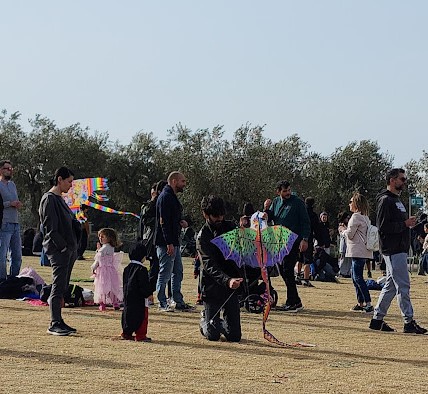
It’s a tradition on kathara deftera to have picnics and fly kites, probably a symbol of purification and approach to the divine, as you watch your kite going up up up (and hope it doesn’t get tangled in the trees).
There are kite making workshops but most people buy their colorful kites from kite vendors on practically every corner.

From sea to forest, the challenge is to keep the kite flying.

Philopappou Hill across from the Acropolis is a popular place to fly your kite and have a picnic.

What’s a gathering without a salepi seller? What’s in this drink has always intrigued me (it’s made from orchids) but I’ve never been brave enough to try it. It’s considered a winter drink and served warm.

Another popular place for your kite flying is at the Great Lawn at the Niarchos Foundation.

Outside the Niarchos library this year kids were drawing and designing kites.

Kathara deftera is often known as the unofficial start of spring. So, kali sarakosti! Spring is on its way!
If you like what you read, hit the like button and subscribe. Please share with your friends and social media. I’d love to hear your comments below.
There’s no need to log in to leave a comment. Just give an email address and your name.
Subscribe to become part of the olivesandislands community! Get new blogs and occasional newsletters delivered directly to your inbox. It costs nothing to subscribe. Olivesandislands does not share email information.
Note: Be sure to click on the confirmation email after you give your email address.

Sherri Moshman Paganos is a writer and former educator, inspired by her life in Athens, where she and her husband are happily retired and enjoying their travels in Greece and abroad. You can check out her writing — fiction, non-fiction, poetry and articles here.


Sherri, Great post! What an eyefull!
LikeLiked by 1 person
Thanks Starry — indeed colorful!
LikeLike
As always, informative in the right measure and great photos, Sherri! Thank you!
LikeLiked by 1 person
Thank you so much Katerina!
LikeLike
Colorful and informative.
Thank you, Sherri!
LikeLiked by 1 person