Whenever I return to Athens from abroad, I always see it as a return to light. And not just the sunlight reflecting on the sea, but on the mountain summits. From cities where no hills break up the flatness of the land, I long for the view of mountains surrounding Athens: Parnitha, Penteli and Ymittos (Hymettus).
From my living room balcony, I look directly ahead to Parnitha, in winter with its often snowy peaks. About 30 km northwest of Athens and 1,413 meters (4,635 feet) it’s the highest mountain in Attica. Ancient Greeks believed that the god Pan came here to play his flute and dance in the forest.


Parnitha, as a national park, in addition to its numerous mammal and bird species, has 800 plant and herb species, which is 17% of the country’s flora. It’s lovely in spring and fall. but it’s mostly in winter, when it snows on the mountain (and probably not in Athens) that it floods with visitors, eager to get out and enjoy the snow. The abundance of fir trees makes for a magical looking landscape.

When I first came to Greece, I noticed mountain visitors fashioning little snowmen and putting them against their windshields like a trophy, although back in the city the snowmen would usually melt in a few hours. During the pandemic/lockdown, when we weren’t allowed to drive anywhere, I was puzzled to see this little snowman on a car when there was no snow on the ground. How did they do it? Mystery unsolved.

From the National Road outside Athens, you get off at the Parnitha exit, but you have a lot of road and turns ahead of you. When you get to the rustic looking tavernas with names like the Gold Deer or the Spruce Tree Taverna, you’re finally getting to the foot of the mountain. From here you can take the winding road up to Mount Parnes, the hotel and casino, or you can leave the car at the teleferique (cable car) parking and take the free 7 minute ride up to the casino.
You can see how crowded it gets, especially on snowy weekends, but the line moves fast.

Inside the casino last year they were greeting the year of the dragon. If you want to test your luck, you need a formal outfit and a valid passport.

From the casino where the teleferique takes you, you can walk up to both shelters, Bafi and a little further on, Flambouri, along a snowy path or the road.


At the shelter you can warm yourself with hot chocolate, fasolada (bean soup), along with eggs and sausage.
Once I was in Parnitha on a school excursion in October when it was unusually warm and sunny. Even so, the fireplace was going inside the shelter, as we rested before we set out on a hiking path. Too warm to walk in the middle of the day. I much preferred walking in the snow and cold!
But many visitors go to Parnitha in spring and fall to do hiking and mountain biking. There is also an equestrian center and horseback riding trails.
Under Parnitha is Tatoi, the former royal palace and estate of the former Greek royal family. With its densely wooded forest, it’s a beautiful place to walk. The government is working on restoring the gardens and the palace, which will open as a museum.
In July of 2021, from our balcony we could see a dark orangy sky –and Parnitha in flames. It was heartrending, so much forest burned before it was brought under control. Every summer it seems there are more and more fires all over the country.

II. Penteli
After Parnitha, the 2nd highest mountain is Mt. Penteli, 1,109 meters (3,638 feet), which is famous for its Pentelic marble and quarries used from ancient times.
Penteli in many areas looks particularly bleak in the snow as it doesn’t have the pine and spruce forests that Parnitha has. Very atmospheric…

It’s only a 15 minute drive from my house up to the main square of Palia (or old) Penteli, and then you can take a right turn to go up the mountain.
After the summit, as you start to go down, you get a great view of Nea Makri below and across to the mountains of Evia (though the clouds here are obscuring them)

Back to the plateia, we see the Asteroskopeio, the Penteli National Observatory a little in the distance. I visited a couple of times with school trips and the students enjoyed looking through the Newall Telescope which at one time was the largest in the world. Fridays and Saturdays from 7:30 pm, the observatory hosts a presentation about space and the universe — you can check out http://www.astro.noa.gr if interested.w

We’re trying to find the Daveli cave. To get there, you have to move to Nea Penteli and follow the road as it takes you along the mountain. When you get to a crossroads, where to the left is the monastery Agios Panteleimona, you take the right and drive until where the road becomes a difficult to maneuver dirt road and you leave the car. The view down is of the whole city of Athens.

Then you walk around 10 to 15 minutes on the path to the cave. Are you following that? There’s no sign! The GPS tells you approximately where it is. (But why isn’t it marked? It’s supposed to be well known!)

Although there were some snow patches, what you see in the photo below is not snow, it’s pieces of marble from this area used as a quarry.
The cave was discovered in the 5th century BC when marble was being quarried to use in building the Parthenon. It certainly wasn’t easy to transport the stone — it was moved down to the city with an intricate network of carts and pulleys.
As you approach the cave you first notice a church built right into the rock. There are many such “rock” churches in Greece.

But this 12th century church is quite unusual. It’s dedicated to two saints, Saint Spyridon and Saint Nicholas. It was used by Christian hermits associated with the Gnostics, a so-called heretical Christian sect. There are two entrances, the main one where you can enter, and another to the left side with the green door. Two churches in one.


Now you’re ready to walk into the cave,112 meters long and 45 meters wide.

From down in the cave, in ancient times, as in Parnitha, the god Pan was worshipped. Artifacts showing Pan and his nymphs excavated from the cave are on display at the Archaeological Museum in Athens.


Who is the cave named for? Christos Davelis was a mid 19th century brigand, a kind of Greek Jesse James, who used this cave as a hideout. He and his bandits robbed travelers, villagers and shepherds and kidnapped too. Handsome and a “ladies man.” he was supposedly a lover of the Duchess of Plaisance (Doukissis Plakentias) who had a villa on the slopes of Penteli. The story is that he visited her through an underground tunnel beneath the cave.
It was inevitable that his end would be violent and after he was killed by some gendarmes who were after him for years, legend goes that his head was displayed in Syntagma Square in Athens!
Besides the legend of Daveli, there are stories of metaphysical phenomena about the cave, like water rolling up instead of down (!) and cat-like creatures walking on two legs…
The only creature we saw there was a rock climber (upper left of photo) who was cleaning the rock (?) and seemed to be putting in hooks to aid climbers. Climbing this rock is not for the faint hearted.

From outside the cave, you can see why Daveli thought this was such a great hideout. You can see down to the Saronic Gulf.


Near the cave entrance, you can try to find the Lithagogia track, the old marble road that workers used to transport the Pentelic marble to Athens. I think this is worth another trip (!) to walk along the old road and also to try and find some of the waterfalls around the mountain.
Going back we checked out the Agios Panteilemona monastery. It’s still used today — we could hear a soft chanting inside from the monks.


We stopped to admire the view and also noted a hiking trail that begins from the monastery and goes up the mountain.


Back to Palia Penteli Square and a stop at Kystallis Restaurant, one of the best of the tavernas/restaurants on the square, to take out a few dishes. Unfortunately we were short on time and couldn’t sit in the cozy interior. The food is also highly recommended!

Besides its winter coziness, Kyrstallis is a wonderful place to escape summer heat waves and its outdoor garden area is always cool.
Driving down from Krystallis, you pass the villa of the Duchess of Plaisance (mentioned earlier) who was supposedly involved with the suave and irresistible bandit Daveli. The Duchess indeed was a very colorful figure and “free woman” of the time. The front of the palace, built mostly in marble, is a lovely venue for summer cultural events.

III. Ymittos (Hymettus)
Parnitha and Penteli are popular places to lose yourself in the beauty of nature. But Mt. Ymittos, or Hymettus, is Athens’ most beloved mountain. It’s like the backyard of the city and from many parts of the city, you can easily walk to it.

Stretching16 km to the Saronic Gulf and 1,026 m (3,366 feet) it’s full of hiking trails.

It’s sometimes called the “trello vouno” or crazy mountain. Why crazy? Fun fact, it got that name because in the past, French travelers described the mountain as “très long.” The local inhabitants heard this as “trello,” or crazy.
During the pandemic/lockdown we were happy that we had the mountain next to us to explore, and we took countless walks in spring and fall.


You never know what you’re going to find along the trail, like this Madonna and child etched into the rock and this shrine.


One of the hikes we did often goes up to the 12th century Byzantine monastery, Ai Yianni or St. John the Hunter.

From here you can enjoy the view.


There’s a rather uphill path that you can take as one community follows into another, with beautiful views of the sea below.

The heavy snows of 2021 and 2022 caused many trees to fall over on this path.

A rare sight of Ymittos covered with snow, looking up from the unploughed entrance to the Attiki Odos, the ring road.

Like Penteli, Ymittos has many Byzantine monasteries, especially in the area around Kesariani.
The Kesariani monastery, nestled in the Aesthetic Forest, was built around 1100 AD, but it stands on a church site from around 500 years earlier, which in turn sits on a site during antiquity dedicated to the goddess Aphrodite.

When it’s open, you can go inside and see the kitchen /refrectory area and a bath house used as an olive press during the Ottoman occupation. There was a heating system like the Romans used in bathing, so they could have both hot and cold water.

The monastery had a renowned library of ancient documents and was used by visiting monks and scholars. Unfortunately (of course) its collection was destroyed in various invasions and during the 1821 war for independence. Ancient manuscripts were even used to ignite fires during the siege of the Acropolis…
Nearby, the monks tended the olive groves around the monastery, made wine from the grape vines and honey from the bees they kept. Ymittos honey, made mostly from thyme and from other wildflowers, is well prized today.
Nearby stands a monument to soldiers who sacrificed their lives for their country from 1944.

The path going to Taxiarchis Hill takes you to some intriguing ruins like an early Church basilica.


Apparently, early Christian sects used the mountain to set up places of worship. Perhaps in Ymittos they felt it was a good hiding place if need be.

The church has the name, Agios Markos Monastirioy (Saint Mark of the Monastery) and nearby is a smaller church. You can see some marble that was carried here to use as a building material with the brick, primary building material of the Byzantines. Marble and limestone were also integral in Byzantine construction, marble usually more for decoration.

This trail near the ruins beckons you with its cypresses.

One walk nearby is the Botanical Forest, where the trees and bushes are labeled in both Greek and their Latin names by elementary school children.

There are some rare plants and flowers on Ymittos, like this tiny orchid that blooms biannually. The pictures are courtesy of Dahlgren Economides.


We were following a path with a sign pointing to the Analipsi, the Chapel of the Ascension, down some slippery stone steps (be careful walking if it’s rained recently) and it was fascinating. It didn’t look like a church at all, but a cave, filled with icons and other religious artifacts.

This circular walk took us back to the Kesariani monastery. A short way from the road is the Krinos fountain, a marble fountain of a ram. A spring from the Ilissos River, it’s still flowing after centuries, though a sign tells you that the water is not drinkable.

Next stop after all this walking is Kalopoula, the refreshment area. There’s a fairly easy path from the monastery. or back on the road, you can drive to it, heading north on the left. Besides drinks like coffee and ouzo, there’s a small menu with fasolada (bean soup) or gigantes (giant beans), also spetsofai, a spicy sausage winter mountain dish, keftadakia (meat balls), tiropita and spanakopita and salad.
As it was a cold raw day with a persistent drizzle and sudden strong winds, nobody was sitting outside at the picnic tables, only inside.

The beauty of Ymittos is not to be taken for granted. There are a number of groups that work to protect the mountain, for example in the sign below. (But 1969?)

This monument with its faint lettering memorializes Katie Argyropoulou, president from 1946 to 1976 of the Philodasiki (Friends of the Forest) organization of Athens, a group that started back in 1899, and through the 1920’s made efforts to preserve the forests. The pines, cypress, oak, carob and plane trees that we see today in the Aesthetic Forest are a result of their reforestation efforts. In 1946, they planted 3 million plants, started the botanical walk and replanted the historic olive grove around the monastery.

Today various groups work to preserve the natural habit of the mountain, at the same time making it accessible to residents and encouraging a feeling of community support and protection, such as the group SPAY, that sponsors tree plantings around the mountain. I wonder if this was an effort of the group that we saw one day on a mountain path.

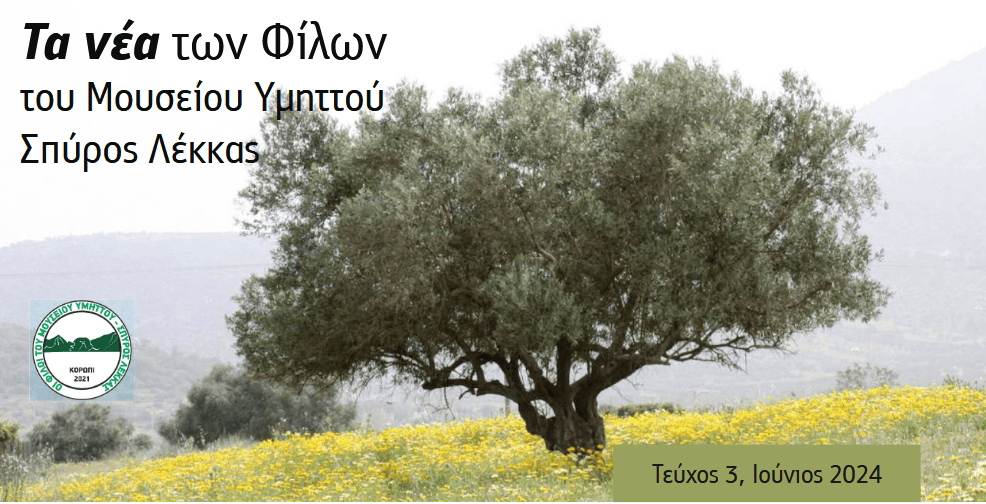
In the last few years, a new organization has been established, known as the The Friends of the Hymettus Museum Spyros Lekkas. Lekkas was a geology professor at the University of Athens, who lived in the area of Koropi and loved the mountain.
The organization has the goal of setting up a museum in Koropi to honor Lekkas and present educational programs on Ymittos (Hymettus) for the community. Since funding is crucial for such a museum, they’re working on this in stages: first an online museum, then a physical space. Long range goals include having an app to provide information for visitors about the interesting sites of the mountain. In the meantime, the group has been given a space in the Liapi Building, a renovated mansion in Koropi, where they plan to host environmental workshops for children.
I find it heartening to see that so many volunteers are devoting hours to the mountain so connected with the city of Athens.
This past October the Friends… sponsored a two day conference with the purpose of presenting, mostly academic, papers on research and information about Hymettus. They hope that this collection of knowledge will serve as a basis for future research on the mountain. Knowledge is always the first step. As the group wrote in their newsletter, “Ymittos, our friend, know it, enjoy it and protect it.”
If you’d like to contact them, their email address is filoimymittousl@gmail.com
I’ll give the last words to John Muir, late 19th century naturalist, environmental philosopher and early advocate for preserving the American wilderness. “The mountains are calling and I must go,” he wrote. “In every walk with nature, one receives far more than one seeks.”


If you like what you read, hit the like button and subscribe. Please share with your friends and social media. I’d love to hear your comments below.
There’s no need to log in to leave a comment. Just give an email address and your name.
Subscribe to become part of the olivesandislands community! Get new blogs and occasional newsletters delivered directly to your inbox. It costs nothing to subscribe. Olivesandislands does not share email information.
Note: Be sure to click on the confirmation email after you give your email address.

Sherri Moshman Paganos is a writer and former educator, inspired by her life in Athens, where she and her husband are happily retired and enjoying their travels in Greece and abroad. You can check out her writing — fiction, non-fiction, poetry and articles here.


Wonderful! Congratulations! P.I.Karafotias
LikeLiked by 1 person
Thank you!
LikeLike
Thank you, Sherri, for another wonderful tour – this time right here ‘at home’!
LikeLiked by 1 person
And thanks Katerina for your information!
LikeLike
Again, great pictures.
LikeLiked by 1 person
Awesome!!!! Amazing and informative article regarding our mountains. Bravo Sherri
LikeLiked by 1 person
Thank you so much Katy!
LikeLike
Congrats on capturing and sharing such intriguing cultural and historical detail about the fascinating and environmentally significant spaces which surround those of us living in Athens. Your choice to focus on these areas is greatly appreciated and proof of how essential these terrains are in offering/contributing to a superior quality of daily life.
Dahlgren
LikeLiked by 1 person
Thanks Dahlgren and for the amazing orchid pix. I think just as we feel the ancient past in Athens, the mountains also enhance our lives
LikeLike
Lovely article, Sherri!
LikeLiked by 1 person
So close to us and so much to learn from. For many, a walk in nature is an awakening.
Once again, great work, Sherri!
LikeLiked by 1 person
Thank you Stella. Yes a walk in nature is definitely an awakening for me! And I’m sure for you too…
LikeLike