Elefsina /Eleusis
Happy are those among mortals who have seen these mysteries — the uninitiated will never have the same (good) fortune once in the darkness of Hades. 7th c. BC poet/initiate in “Hymn to Demeter,” earliest mention of the Mysteries
In the ancient myth of Demeter and her daughter Persephone, all was green and growing. One day though while Persephone was gathering flowers, she was abducted by the god Hades and taken with him to the underworld. For 9 days Demeter searched for her daughter. When she finally learned where she was, she demanded her return, but because Persephone had eaten 6 pomegranate seeds, she could be reunited with her mother for only 6 months, the other 6 months throughout the winter, she had to be with Hades. The myth explains the agricultural seasons, as Demeter is the goddess of agriculture, the harvest and fertility.
From the Kerameikos, the ancient cemetery in Athens, the Iera Odos or Sacred Way led to Elefsina or Eleusis, the site of the Eleusis mysteries. Pilgrims/initiates followed this 22 km. road to get to these most famous of secret religious rites of ancient Greece. There were two Kerameikos gates: one led to Elefsina and the other to the Panathenaic Festival at the Acropolis.

To feel the holiness of the way, Henry Miller wrote in 1939:
“One should not race along the Sacred Way in a motor car — it is a sacrilege. One should walk as the men of old walked, and allow one’s whole being to be flooded with light.”
Even then, the Iera Odos was anything but sacred looking. Today it takes even more imagination to see it as a holy thoroughfare, with its gas stations, factories used and abandoned, Chinese wholesalers, stores selling marble and its bouzoukia, kitschy Greek music nightclubs.
As far back as 1600 BC at Elefsina, was the worship of the cult of Demeter and “Kore,” (daughter) as Persephone was always known. The mysteries were officially established in the late 8th c./early 7th BC and the nature of worship changed to include the promise of happiness after death.
It was here in Elefsis or Elefsina that Demeter found her daughter and the cave where Persephone makes her ascent and descent.
In the Broadway musical ‘Hadestown,’ Orpheus sings of the story of Persephone, and in the modern telling, Hades always comes to get her “too early,” as he senses that over the years she’s lost her enthusiasm for him and her life in the underworld. She is sitting around on earth, enjoying her time and in a modern take on the myth, she drowns her sorrows in having to return to Hades, in drinking. But a bargain is a bargain and you don’t cross Hades.
Winter’s nigh and summer’s o’er
Hear that high and lonesome sound
Of my husband coming for
To bring me home to Hadestown
Elefsina, the modern town that grew next to the ancient ruins, was much in the Greek news last year as it was one of the three cities chosen for the 2023 European year of culture (along with Timosoara Romania and Vezprem Hungary ) and it sponsored a series of events, many containing the theme of the “mysteries.”
Approaching this large archaeological site on a warm cloudy winter carrying-your-coat kind of day, we noticed a number of buses parked outside the site. I was surprised to see it so crowded. Before its choice as European city of culture this year, the site was pretty much visited by schoolchildren and stray cats (of course, they love all the ancient sites).

Although today it’s easy to get to Elefsina with the Attiki Odos (ring road), most people might think “yes I should go sometime” but never actually get there. The first thing you see inside the gate is this unmarked giant Doric column on its side, most likely from the Temple to Demeter.

You start your actual visit at the Roman Court, where you find the Kallichoron Well (well of the Fair Dances), where Demeter, looking for her daughter, sat down next to it to rest and wept. This was the site where the maidens of Eleusis performed dances for the goddess.


From the Roman Court, initiates went through two propylaia (gateways or entrances). Each gate contained a caryatid holding on her head a cista, a box with the sacred objects used in the ceremony. Cult symbols decorated the box, like sheaves of wheat and poppies. These cista were taken to the Kerameikos gate, then carried by the initiates along the Sacred Way to Eleusis. One of the lovely caryatids is in the Eleusis museum.
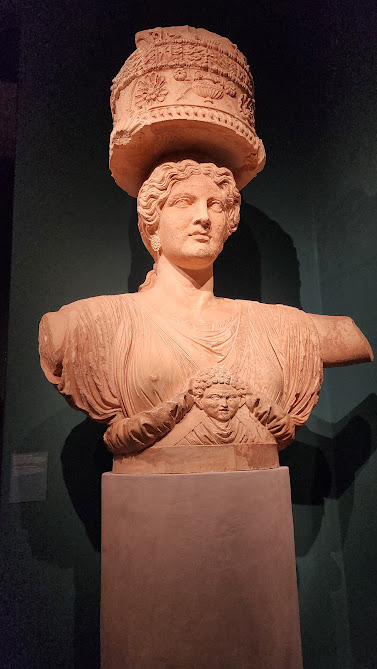
And the second caryatid? In a sadly familiar story, it was taken in 1801 by Englishman Ed Clarke, (by one account a clergyman, another a Cambridge University professor) with a bribe to the Ottoman governors and carried off despite villagers’ opposition…Clarke shipped the statue home, along with some other items he looted. However in 1802, off the southeast coast of England, the ship sank! The statue though was recovered and is on display at the Fitzwilliam Museum in Cambridge.
The Propylaia led up to the Ploutonion, the cave where Hades (Pluto) kidnapped Persephone. It was only up to here that 2nd c. AD Greek traveler and geographer Pausanias was allowed to go, but no further, as he was not an initiate.

The festival took place in the ancient month of Boedromion (September – October). Who could participate? According to a note in the museum, it was open to all, regardless of gender, social status and financial situation. Even slaves could take part, if the initiation expenses were covered. Murderers however were excluded, along with non-Greek speakers because they wouldn’t be able to understand what was happening.
After going through the gates, initiates entered a great hall called the Telestirion; in the center stood the Palace (Anaktoron), built of ruins dating back to the Mycenaean Age, Here on the 6th and 7th nights, the myth was reenacted, with the descent, the loss, the search and the ascent and reunion, the initiates were shown the sacred objects and listened to sacred things being said, the mystical indoctrination. Repeating any of these so-called “irrepeatables” to others could result in death.

Before entering the Telesterion, the initiates would recite, “I have fasted, I have drunk the kykeon….” This special drink of barley and pennyroyal has led to speculation about its chemicals having psychotropic effects from ergot, a fungus that grows on barley, containing psychedelic alkaloids similar to LSD.
A “forest” of 42 columns were spread out in the Telestirion, and a temple to Demeter.

Tour leaders use the area to give explanations about the site,

Among Greeks, Plato participated in the Mysteries, and Aeschylus, who in fact was accused and put on trial for revealing secrets of the rites in his plays, but fortunately for him, he was acquitted. Aeschylus was actually a native son of Elefsina and every year, at August’s end, the town holds the Aeschylia festival.
Past the Telestirion leads you up to the Archaeological Museum. Outside a beautiful 3rd c AD Roman marble sarcaphogus shows the hunting scene of the Calydonian boar, a legend told and retold in antiquity. From here you get a view of the modern town of Elefsina, right beyond the hill, leading down to the sea.


The museum has beautiful figurines, vessels and small offerings, as well as some large amphorae.


This handsome statue is of the emperor Hadrian’s lover Antinoos, who drowned in the Nile on a trip to Egypt.

Fleeing Kore, the name of this early 5th c. BC statue, refers to Persephone.

These poles represent torches — the ceremonies were carried out under torchlight at night.

Back near the entrance, a contented visitor.
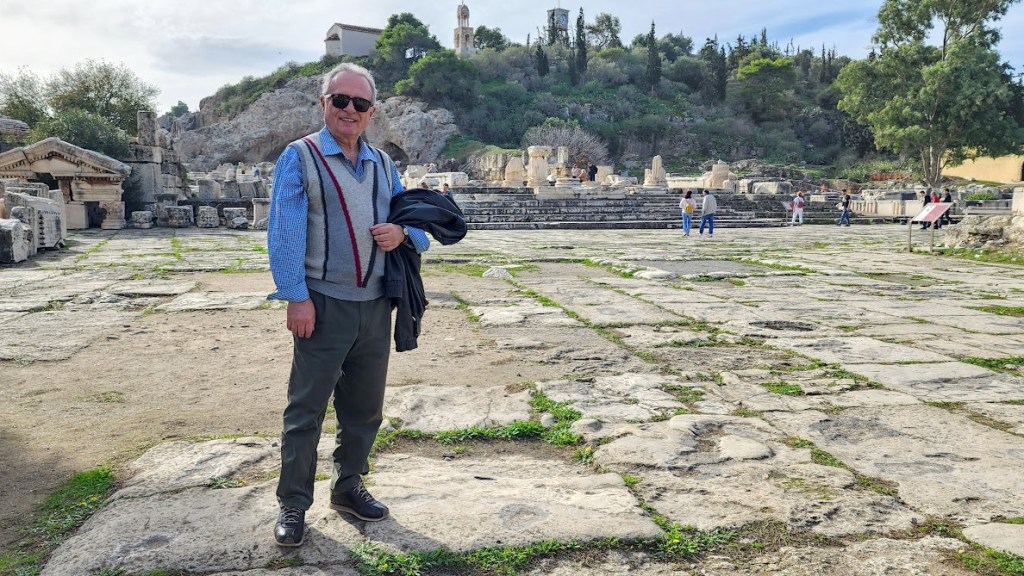
Over the centuries, why did so many “ordinary” people along with artists, writers and leaders, take part in the Elefsinian Mysteries? Curiosity of course for the “secret” rites, but more than that, this special experience somehow elevated a person above the human sphere, into the divine, and whoever was initiated would certainly be rewarded in their afterlife.
The Romans, during their rule in Athens, as we have seen, embraced the mysteries. Cicero, Roman statesman, wrote:
For among the many excellent and indeed divine institutions which your Athens has brought forth and contributed to human life, none, in my opinion, is better than those mysteries. For by their means we have been brought out of our barbarous and savage mode of life and educated and refined to a state of civilization; and as the rites are called “initiations,” so in very truth we have learned from them the beginnings of life, and have gained the power not only to live happily, but also to die with a better hope.
So, both a hopeful death and well-being in life. Participants were feeling optimistic as they prepared for their long return journey to Athens.
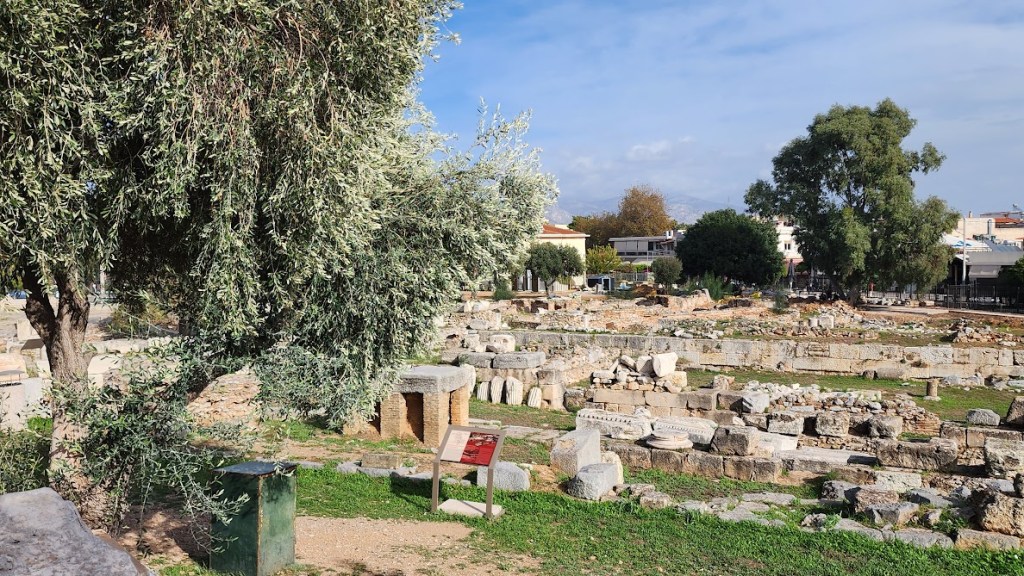
In 392 A.D. the ceremonies came to an abrupt halt with Emperor Theodosius’ decree against idolatry, and the town lost its significance.
In the 19th century, a Sicilian archaeologist wrote of Elefsina: ”50 poor fishermen’s huts and the corrupt name of Lepsina instead of its ancient name.” By early 20th century, the first industrial plants were created and the way of life changed from agriculture and fishing to industry.
We left the world of the Elefsinian Mysteries to find the ferry that goes across to the island of Salamina. On the way, you pass shipbuilding graveyards, once in use. There are still steel refineries and factory chimneys but being made the cultural city of Europe last year has helped shed some of Elefsina’s purely industrial reputation. The road to the ferry skirts by pleasant quiet small towns by the water.

Vravrona
From Elefsina, in west Attica, the largest mystery cult in ancient Greece, we move to a much smaller cult in east Attica, the sanctuary of Artemis Vravona (or Brauron), goddess of hunting, agriculture, wild nature and chastity. In addition she was the protector of women in childbirth and of infants.
This very old site, inhabited from Neolithic times, and grounds for worship from the 9th century BC, was unusual in ancient Greece, as it was almost a completely female dominated place of worship.

The myth goes that Artemis, angered by the killing of two small female bears, caused a plague in Athens. To appease her, the Athenians built a temple to her. Five and ten year old girls known as “arkti” (she-bears or bear cubs) acted as her attendants, doing sacred dances for her, and undergoing some sort of initiation rite. A procession went from the Acropolis to Vravrona, about 30 km. The Acropolis also had a small temple dedicated to Artemis, a kind of “city branch” of the main temple in Vravrona. The procession was known as the ‘arkteia festival (arkouda the Greek word for bear), and included poetry readings as well as dances.
As you pass into the small site, with remains mostly from the 5th c. BC, and excavated in the mid 20th century, you notice a P shaped stoa that you can walk along. This faced the Doric temple to Artemis.

This agricultural area near the sea is full of olive trees as well as vineyards.

It was a glorious day in late September when we visited, with early fall sunshine. Checking the map of the site, I’m looking for the stone bridge, the only known example of a classical period bridge in Greece, and the sacred spring over the Erasinos river.


Centuries after Vravrona had fallen into disuse, this little church dedicated to St. George was built in the 15th century.

The site in fact was pretty much abandoned already by the 3rd c. BC, with tensions between Attica and the growing power of Macedonia under King Philip, Alexander’s father. Another theory says the abandonment was due to flooding by the river.

Also at Vravrona is allegedly the tomb of Ifigenia, daughter of King Agamemnon. As written by Euripides in Ifigenia in Tauris, she went to Vravrona, became priestess of Artemis, and died there. A note at the site tells us that she was worshipped as a chthonic heroine associated with death, and clothes of women who had died in labor were dedicated to her.

The museum might be small, but it has an impressive collection of pottery, sculpture, statues and reliefs from the sanctuary as well as votive offerings:


In the following reliefs, Artemis is greeting pilgrims who have come to worship her. Note the deer that’s usually associated with her.


This relief shows a group of gods: Zeus, Leto, Apollo and Artemis.

This pyxis kept jewelry or other objects inside and had handles made of horses or other animals.


Each of the arktoi who participated in the rites had her face immortalized.

Some had complete statues made of them like the sweet looking girl in the front left who is holding a rabbit in her hand.

Sun and sea were beckoning … Vravrona is just a few hundred meters from the sea. We practically had the beach to ourselves on this warm sunny day at September’s end.
Now we’re moving out of Attika to Samothrace, an island in the northeast corner of the Aegean, where Secret Mysteries, known as the Great Gods of Samothrace, were practiced nearly on a scale as in Elefsina. With the great gods, the initiates were also sworn to secrecy under threat of death and the participants were promised well being and a blessed afterlife.

An exhibit several years ago at the Acropolis Museum, explained about the Great Gods. Who were they? In earliest times, they were known as Kabeiroi and were fierce and mysterious gods of the Underworld. Later there were references to Persephone, Hades, Hermes and Demeter and still later, the Great Mother Goddess, seen below, had more of a role.

Although we don’t know what went on in the ceremonies, we do know the structure of the sanctuary and we can see remains on the northern coast of this rugged mountainous island. Here there was no road or procession; they came by ship to this isolated windswept spot.
At the entrance a stele forbade entry to the uninitiated. The participants would pass into the Hall of Choral Dancers, that was dedicated by Philip II, Alexander the Great’s father. It was here that Philip met his future wife Olympia in his own initiation in the mid 4th century BC.

Then they would enter the Rotunda, the largest enclosed circular structure from the ancient Greek world. Here the initiate was blindfolded and all around him, cult attendants danced ecstatically. From the Rotunda, you entered the Hieron, where the highest level of Mysteries occurred. In the background of this beautiful urn in the Hieron note the winged victory statue.

Four Victory statues (or Nikes) stood here, one on each corner of the roof. These were different Victory statues from the famous “Winged Victory of Samothrace,” probably the island’s most recognizable symbol, found on the edge of the site in 1863 by a French archaeological team and taken to the Louvre. As seen by visitors all over the world, many might be unaware that Samothrace is actually the name of the island where it was discovered.
A stone outside the sanctuary catalogs the names of initiates. As in the Elefsinian Mysteries, participants ranged from kings to government and religious officers, citizens of different cities, freedmen, women and slaves.

The exhibit also displayed finds from the cemetery on the site: glass vessels, gold jewelry and red and black figure urns.

This object with a tiny gold Persian lion, was dedicated by a soldier on his return from the campaign under Alexander the Great.

The cult, which peaked in Hellenistic times, lasted 1,000 years until the 4th c. AD when, as mentioned, Emperor Theodosious banned pagan cult religions.
Legend has it that the Argonauts, Hercules and Agamemnon all participated. In the 5th c BC, famous initiates included historian Herodotus and King Lysander of Sparta. Plato mentioned the Great Gods in his dialogue “Euthydemus.” The emperor Hadrian also participated several centuries later (he really got around!)
“Noimata” (Meanings)
We are used to seeing ancient gods and goddesses represented in human form. (how else could we understand them?)
But in the ancient world, and not only, it wasn’t only gods presented in human, and sometimes animal form, but also nature: rivers, oceans, seas, even cities and countries, as well as abstract qualities like freedom, health, even sleep, and and virtues and vices like kindness, fortune, discord and envy. A fascinating exhibit at the Acropolis museum (running to April 14) called “NoHMATA (Noimata), Personifications and Allegories from Antiquity to Today” looks at representations through time with art. (I’d say that this use of personification and allegory for abstract qualities was prevalent in medieval literature as well. In the 15th century morality play “Everyman,” he is joined on his journey by such characters as Beauty, Death, Strength, Knowledge and Good Deeds.)
The exhibit name plays with two words: “Noimata” (meaning) but also “Nimata,” (threads), i.e. threads across four periods: art representing ancient times, Byzantine, Renaissance and modern.

The first section is appropriately called Time, given by Chaos during the creation of the universe and the way it’s divided. In Peter Paul Ruben’s frightening 17th century painting, Kronos, the god of time, (Saturn) is devouring his son because it was forecast that he would be dethroned by one of his children.

The four seasons, as seen in this black and white mosaic, is a popular motif from antiquity:

These (three?) seasons also include the god Pan.

And a modern take on the four seasons by Greek artist Yiannis Tsarouhis.

The 2nd section, Nature, deals with celestial bodies and bodies of water. In this beautiful vase , we see Selene (the moon) crossing the sky in her flying chariot.
Another later depiction in marble of Selene. who later became associated with Demeter.


This 2nd c. radiating head of clay of sun god Helios is found in the Rhodes Palace of the Grand Master.

And this metal animalistic sheet from the 5th c. BC represents the Acheloos river, or rather the river god. (In one version of the Persephone myth, the cave where she ascended from the underworld is here) and a head representing Boreas, the north wind.


The 3rd section, Dieties, has an exquisite marble statue of Nike (Victory) from 421 BC untying her sandal.

In this amphora Aphrodite is weighing how heavy the love is between Eros and Anteros.

Human and Human Nature presents stages of life, and virtues and vices like politeness and sloth, envy, gluttony, as we see in this 16th c. painting of the 7 deadly sins.

These figures represent hygeia, eudaemonia and pandaisseia (health, well being and celebration/feasting).

Institutions gives us areas of communal living, like Justice, shown here with Nemesis, goddess of retribution, with her scale and wheel.

With the final section, Allegories, we have Theodoros Vryzakis’ painting on the Greek revolution, “Defense of the Homeland at any Cost.”

It reminds me of the allegorical figure of liberty in Delacroix’ painting of “Liberty Leading the People,” similar 19th century romantic and patriotic representations.
Always a popular allegory on death was the menento mori, a warning to remember death, as in this beautiful Roman mosaic

These are just a few of the many pieces on display in “Noimata.”
At exhibit’s end you come face to face with a statue of a Chimera from 400 BC. This mythical beast, a fire breathing female monster (the worst kind — in the Anglo Saxon epic Beowulf the monster Grendel’s mother was much worse than him), with lion’s head, goat’s body and serpent’s tail, represents something evil. But a chimera also has the meaning of something hoped for but illusory or impossible to achieve. Perhaps like peace and other yearnings we have for the world we live in.

So, Time: we have journeyed way back in history to the Mysteries in Elefsina and Samothrace and looked at the cult of Vravrona. What happened in these rites might be lost in the fog of time, but stirs our imagination. And we’ve looked at meanings and threads in history, in personifying gods, time, nature, celestial bodies and abstract qualities. Whether recent or ancient, the search is timeless, for as human beings we need to understand how to live our life, figure out who we are and how we fit into the world.
I don’t want to end with the chimera though, but with an almond tree, in full bloom this past week. In the heart of winter, this tree very slowly starts filling out with its lovely pink and white blossoms, giving hope that it will soon be time for Demeter to bring on more green with the harvest of spring.

If you like what you read, hit the like button and subscribe. Please share with your friends and social media. I’d love to hear your comments below.
There’s no need to log in to leave a comment. Just give an email address and your name.
Subscribe to become part of the olivesandislands community! Get new blogs and occasional newsletters delivered directly to your inbox. It costs nothing to subscribe. Olivesandislands does not share email information.
Note: Be sure to click on the confirmation email after you give your email address.

Sherri Moshman Paganos is a writer and former educator, inspired by her life in Athens, where she and her husband are happily retired and enjoying their travels in Greece and abroad. You can check out her writing — fiction, non-fiction, poetry and articles here.


Congratulations for another impressive endeavor!
LikeLiked by 1 person
Thank you Sue!
LikeLike
Bravo Sherri! Some of the sites you visited here can be quite overlooked but well worth it. I will revisit the Acropolis museum to see “my” painting; I have a signed print of that Tsarouchis picture! Samothraki is on the list.
LikeLiked by 1 person
Thanks Roz. Impressive about your Tsarouchis print! Yes, the exhibit is worth a visit. Would love to hear about Samothrace if you get there!
LikeLike
I think Eleusis is one of my favorite sites. Lovely.
LikeLiked by 1 person
It’s lovely, large and well kept, really worth a visit.
LikeLike
Interesting how even from those times they would walk tens of kilometers to the holy sights as a pilgrimage, initiating the ceremony while getting ready physically and mentally on this first challenge. Also, fascinating how the democratic sentiment of that place and time can be reflected in these mysteries. Anybody could be initiated, all men and women were equal facing death and the gods.
LikeLiked by 1 person
Like the Santiago da Compostela road that pilgrims still walk today. Yes the equality among participants actually surprised me.
LikeLike
Truly a great piece, Sherri! Bravo! I like how you endeavoured to link everything together so that we, now, can ponder our role and place in all this wonder and greatness.
LikeLiked by 1 person
Thank you Stella. All that wonder, yes it should make us pause from our everyday life and think of how we fit in to a grander scheme
LikeLike