Leaving days of warm sunshine in Athens, we entered the grey rainy Belgian world. (But we brought the cold back with us on our return to Athens.)
Surely just as Eskimos describe snow with different words depending on if it’s snow that’s falling, snow already on the ground, etc., there should be different words for the rain we felt: steady rain lasting from sunrise (though there isn’t any) to sunset (though there isn’t any), start-stop rain, rain that dribbles into your boots and soaks your socks, rain with wind gusts that snaps your umbrella in two…

So, although the sky was many “shades of grey,” i.e. milky whitish grey near the horizon, ashen grey in the middle, and smoky grey clouds at the top, I adored the towns and cities on the trip, the artwork and the exquisite medieval and Renaissance architecture so well preserved and so pleasing to the eye.

Bruges, or Brugge in Flemish, a UNESCO World Heritage Site, is the main stop on our tour. It’s a city that lives 12 months of the year in tourism, with about 8 million tourists a year! Weekends especially the town is packed with visitors from all over Europe and not only. It has a fairy tale look, as many have commented, as we saw on the first night.

Wherever you turn in this medieval city, it’s a pleasure, from the Belfort (Belfry) in the Grote Markt (Grand Place) to the 16th and 17th century brick Gothic houses to the winding canals. For this reason it’s known as Venice of the North (along with Amsterdam and St. Petersburg).
Bruges flourished especially in the 12th to 15th centuries with the trade of wool and the cloth industry. It was here that the first book was printed in English by William Caxton in 1474. But after 1500 or so, the city became just one more medieval town like so many others, until the 2nd half of the 19th century when it was redeveloped and actually became one of the world’s first tourist destinations for the wealthy. Bruges fortunately was spared destruction in both world wars, and really took off on the tourist map after the 1960’s.
From our hotel on place t’ Zand, a walk down the main street of Steenstraat (Stone Street) puts you in touch with a number of 16th and 17th century buildings. Many have a particular style of Gothic brick with this step roof style. Owners included their name on the outside, as you can see in the photo from this house built in 1567, not so beautiful but well preserved! Many houses have statues in niches and as regards the street level parts of many buildings, upscale stores rent them.


The 16th century building below, which belonged to the shoemakers’ guild, and features a shoe in the middle and a cobbler (shoemaker) on top, houses a discreet looking McDonald’s on the main floor with a small “m.” You could practically walk by the fast food and not notice it’s McDonald’s unless you peek inside.
Note that glorious blue sky we had for a couple of hours.

Before reaching the “discreet” Mcdonald’s, you pass by the 13th century San Salvador church with its characteristic red door. I think inside it’s surely the most beautiful in Bruges with the tapestries and the seats where the leaders of each group of knights sat. There are also religious paintings of the Flemish school.


A little further on Steenstraat is a Christmas market (along with one on Grote Markt) but it seems that after New Year’s, most stalls selling gifts are closed and the emphasis is mostly on food and spirits. And what food, we see people carrying gingerly with both hands, foot long sausages, and the ever present cone of frites (fried potatoes) with mayonnaise. At this market and the one on the square, you can join the crowd drinking glutwein to warm up or beer.


Everywhere is the sweet smell of waffles, that immediately carries me back to strolling on the Ocean City boardwalk.
At a few stands I saw signs that the waffles could be dipped in Belgian chocolate. And of course besides waffles, the aroma of chocolate is in the air. The chocolate industry is amazing in Belgium. Every town we visited is dominated by chocolate stores. Inside a window in Bruges:


In the 19th century, chocolate, considered a cure for a whole list of diseases, in fact was sold in the pharmacy. This idea of chocolate as therapy and a mood booster continues today and not just supported by the chocolate industry. Apparently, dark chocolate (more than milk chocolate) has tryptophan, an amino acid that creates serotonin, the neurotransmitter that helps elevate our mood. So you can justify your chocolate consumption!
The Grote Markt or Grand Place, the main square, contains one of the main landmarks of Bruges, the 13th century Belfort or belfry. Inside, as our guide Emmanuella tells us, is a mechanism with a carillon of 47 bells that is operated by a special bell ringer, who every so often rings them in lovely sounding patterns. Besides the carillon, the belfry was used as a lookout tower. You can join the line to climb the 366 steps to the top (or just admire it from below).


At the Burg Place nearby you can find the 13th century Bourse (stock market) which seems to be found in every town we visited, and the striking Bloedbasilek, the Holy Blood basilica, in a 12th century Romanesque style and a later Gothic revival.

The church is famous for its relic of “holy blood,” i.e. a cloth with blood of Jesus Christ that as legend says, was brought to Bruges from the Holy Land by way of Constantinople during one of the Crusades. Climbing these stairs, you can view the glass phial with the relic. The woman sitting behind the case, dressed like an angel in her white robe, smiles beatifically and hands you a little prayer written in 10 languages.

The third main cathedral, the cathedral of Our Lady, is known for the Madonna of Bruges, the only statue by Michelangelo which left Italy during his lifetime, taken to Bruges by a rich merchant in 1501. It’s the only Madonna statue where the baby Jesus is standing up instead of sitting in the Madonna’s lap.
Besides beer, frites and chocolate (products that each have their own museums), Bruges is also known for its fine lacework. Back in 1500, poor girls made a living outfitting the wealthy ladies who wanted to dress finely in lace woven from silver, gold and silk You can learn more about lace making from the lace museum.
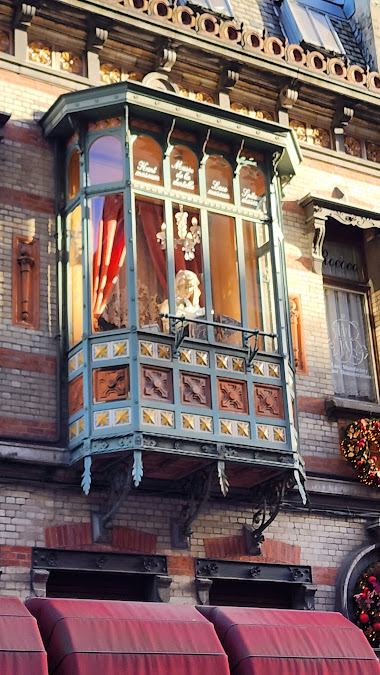
As a child, I remember I had a Belgian doll of a lacemaker my father had brought me from his travels. I can picture it, a tiny old woman wearing a lace cap, tiny spectacles, in a velvety blue dress, sitting with the lace spools around her. In this store window, you can see examples of lace and in the left corner, the wooden lace spools, known as bobbins used in making lace by hand. Apparently, lacemaking is still very much handmade, and valued. There are no lace factories.

For a small country, Belgium has an amazing variety of beer (hundreds of different kinds are brewed) and it’s actually cheaper to buy than water, like in other Central European countries. Here’s the wall of a beer store. Can you choose one you want?

Along the wall, there are some doubtful quotes, such as “Beer is proof that God loves us and wants us to be having fun” (Ben Franklin) and this even more dubious one, “He was a wise man who invented beer” attributed to Plato. All in good fun. This motorcycle was parked out in front.

This passage, which takes you out to the canals, is known as the “blind donkey,” where goods were carried by donkeys to the canals and transported back and forth (perhaps it’s that the donkeys knew the way so well even blinded).


The weather was perfect for taking a boat ride so we joined the line for this lovely ride. The boatman asks us all what languages we speak and he goes from one to the other effortlessly.
For a moment you wonder how in the 2008 movie “In Bruges,” Colin Farrell jumps into a boat from his hotel room window!


St. Bonifacius Bridge has a lovely legend that if you kiss on it, your relationship will last forever!

Everywhere you hear the clop clopping of horse hooves on the cobblestones, a sound that fits in with the medieval feeling.


At night, the canal is lit up in magical colors in a light festival known as Wintergloed.


One exhibit was called the circle of life.

Fortunately we were able to enjoy the light show before it started raining again!

If you’re homesick for Greek food, we did find one place, the Olive Tree, offering three options in its pita wraps menu: eat like a Greek, eat like a Greek king and eat like an ancient Greek.

While Bruges lives only on tourism, other Flemish cities, besides tourism, have industry as well, such as Antwerp, second largest city and third largest port in Europe.
The Antwerp grote markt provides a good example of houses with guild signs at the top. Guilds were associations of craftsmen or merchants, like hatters, carpenters, bakers, blacksmiths, weavers, masons and shoemakers, as we saw in Bruges, that united to protect their interests. Flourishing in the 11th to 16th centuries, the guilds were an important part of European economic and social life.


On the square, this statue shows an Antwerp legend of a giant who cut off the hands of people who refused to pay a tax he collected to enter the city, until a young man did the same to him…

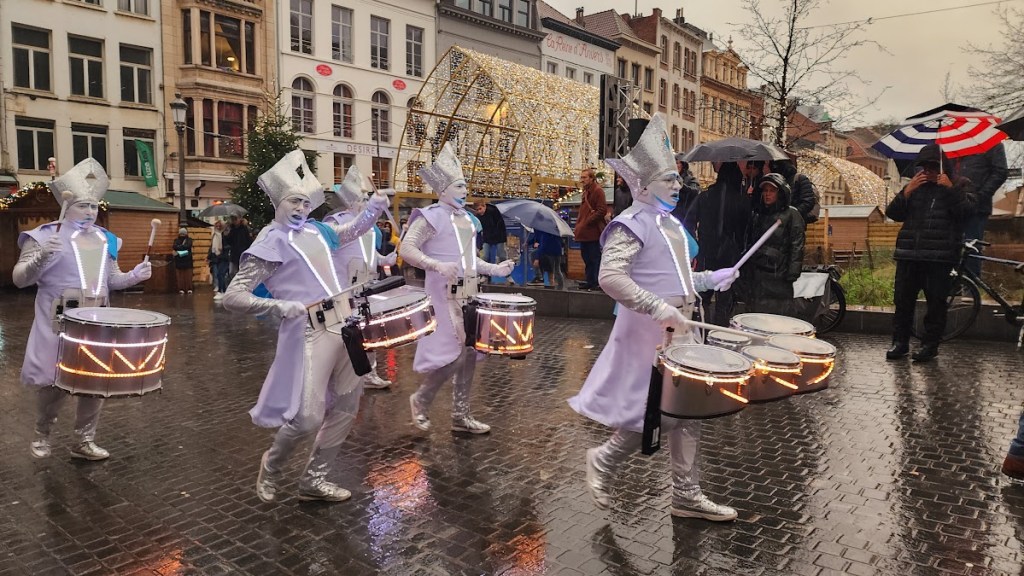
A group of drummers suddenly appeared out of nowhere to entertain the crowd huddled under umbrellas.
Right off the square sits the impressive Gothic cathedral of the town. As in other cathedrals we saw in Belgium, there’s a “free section,” but if you want to see famous artwork (like the Madonna of Bruges), then you’re charged for that. In this cathedral it’s paintings by Rubens.

There’s a Royal Academy of Fine Arts in Antwerp, one of the most important academies in the country to study visual art and fashion, an industry Antwerp is well known for.
This touching statue near the cathedral is based on an 1872 novella “A Dog of Flanders” of an orphan boy Nello and his dog Patrasche. In the book the boy and his dog are discovered frozen to death inside the cathedral (as the boy, who wants to be a painter when he grows up, likes to study Rubens’ paintings.) The statue shows Nello’s last moments with Patrasche, covered by a cobblestone blanket, forever together.

A walk down Meir, the main shopping street, will take you to the train station, an architectural gem, as it is in many towns. Next to the station on Pelikanstraat is the famous diamond district of Antwerp. This is the largest diamond trading center in the world and possibly the oldest, going back to the 15th century.

We retraced our steps to the Grote Markt. Since the rain had stopped, we crossed over to the castle, the oldest preserved building in Antwerp, originally a settlement from the 9th century that developed into a fortress. Today it acts as a tourist information center. If you walk through you can have a look at the port off in the distance.


After Antwerp, Ghent is the third largest city and often compared with Bruges because of its medieval character and canals. Actually Ghent has one large canal running through the city. Our first stop is on St. Michael’s Bridge, so -called because of the 11th century church of the same name. On a lamp post perches St. Michael the Archangel, winged and in full armour, ready to pierce through the dragon.

This bridge is the site of an infamous event. During one of the endless Protestant – Catholic skirmishes, as Emmanuella told us, Protestants burned an astounding 80,000 manuscripts and books belonging to Catholics.
After you get over the bridge to the Grote Markt, if you turn around, you can see St. Michael’s church on the left and in front, the belfry. The low church in the middle is St. Nicholas, used as a stable in the French Revolution!

And a close up of the Royal Dutch Theater.

These strange looking shapes on the top of this house are trolls or gnomes, like the Greek kalikantzaroi that are said to come out on Christmas and disappear on the epiphany (Jan. 6) Note the lower floor is a tacos restaurant.

The most important cathedral in Ghent is Sint Baafs or Saint Bavo, beloved saint of the area. Besides the beautiful vitraux (stained glass) and wooden carvings,

the cathedral has what’s known as the Ghent altarpiece, or the “Adoration of the mystical lamb of God,” a giant early 15th century 12 panel polyptych, known as the oil painting that bridges art from medieval to Renaissance, painted by brothers Hubert and Jan Van Eyck. If you want, you can opt for the virtual reality experience with headsets and holograms that lets you zoom in on the amazing details in the painting. (You usually need to book in advance.) You can see below how the altarpiece is structured.

If you like medieval castles, you can visit the 12th century Gravensteen on the Liege River, that was used as a residence for a couple of hundred years by the Counts of Flanders.

Saturday mornings are wedding mornings at the city hall. This bride is walking away after descending the city hall steps to much applause.

Walking around, again you admire the well preserved medieval and Renaissance houses. This architecture is always a source of wonder compared with Greece, where so much of what you see is concrete and cement, where unfortunately so many beautiful neoclassical 19th century buildings were torn down to make way for needed housing and put up quickly with little sense of past. See blog, The Face of Athens (with a nod to New York).


On this street a number of flea market stores were selling everything from moose antlers to gramophones to cooking pots to oil paintings of Ghent. We peeked in and it looked as if ‘locals’ were sitting around a table warming themselves with coffee.


Along with the beautiful is of course the kitsch.

A street given by the city, known as “Graffitistraat” is where you can express yourself, but only here, nowhere else.

Our tour of Belgium also included Oostende or Ostend, a popular summer resort on the North Sea. Here by the sea fell the heaviest rain and blew the strongest wind, so much that we couldn’t walk along the boardwalk. Most of the little canteens that sell seafood you carry by hand were closed. (I thought I might finally try ‘moules (mussels) et frites,‘ mussels and fries but didn’t get my chance. Actually from what I saw in Bruges, it didn’t look too appealing.) Ostend looked like a pleasant town with some attractive new buildings among the old.
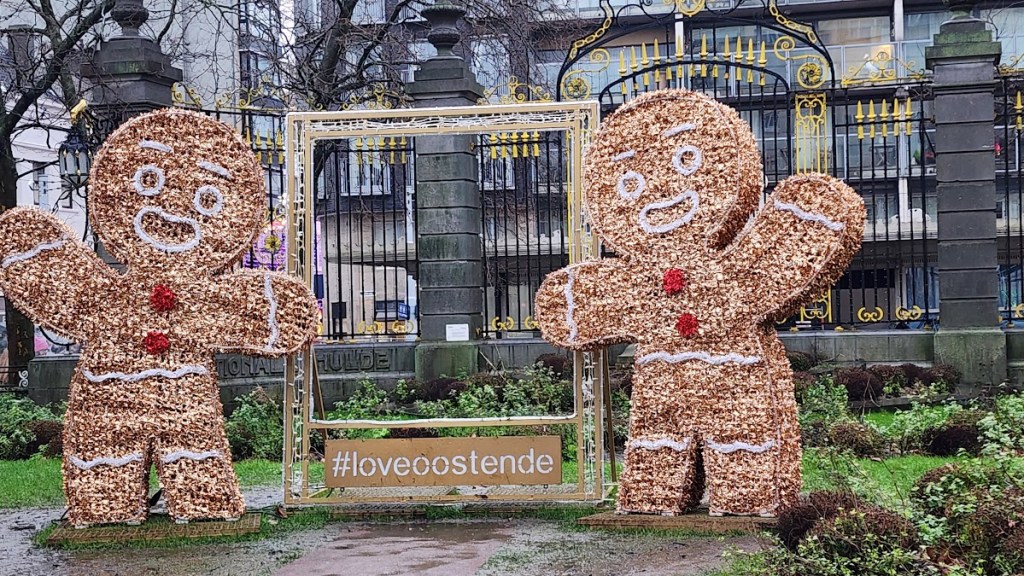

It reminded some of us of the beach town of Loutraki, especially with the casino.

Our guide pointed out the statue of the unknown sailor and some of us brave souls actually tried getting near the sea.


Bye Ostend! Hope to see you in better weather some day.
The countryside is flat and green with forests of birch trees and beech, with their white papery bark. There’s been so much rain this year that the land just can’t absorb it all, creating lakes in the earth.
And still another place on our tour was Lille in northern France near the Belgian border. With the European Union countries in Schengen, you can go from one country to another just like that. In contrast to the Flemish cities seen up to now, Lille was affected more by the Industrial Revolution. In addition to its cloth industry, it was also at one time a coal mining area.
The train station used for trains to Flanders, is the first thing you see as you enter Lille, on foot, as the bus has to park quite a while from the center. Like other cities, the station (gare) is quite beautiful and this one has something unusual, an enormous yellow bust of late actress Romy Schneider, facing the entrance. Her connection with Lille I couldn’t get.

Walking toward the main squares, we notice again the 17th century Flemish Renaissance houses.

On Grand Place or also known as Place Charles de Gaulle, as he was born in Lilles, is the beautiful building of the 16th century Bourse, or old stock market.

In the courtyard of the Bourse, old books, magazines, watercolors, gravures and maps are sold. You can also play chess and buy flowers.

Note how the belfort (belfry) towers in the background.

We decided to visit the Palais of Beaux Arts in its 1892 Belle Epoque building.

It has a wonderful collection of Flemish and French artists, religious and secular paintings, as well as sculpture. I found this Bosch painting, “le concert dans l’oeuf” (concert in the egg) interesting. It’s a satire on alchemy, which must have been a thing in Bosch’s day (late 15th century). The philosopher’s egg was a vessel that alchemists used in their work where they combined the ingredients for transmutation. Note too that the monk who’s singing and pointing to the book is unaware of being robbed by the lute player!

We’re going to stay with French speakers now and move to Brussels. Just a tease and a taste! A movie years ago entitled “If it’s Tuesday it must be Belgium” made fun of these whirlwind tours. Especially with Brussels, I want to taste more.
One of the city landmarks is the ‘atomium,’ built in 1958 for an exposition. It’s nine bronze spheres with a restaurant at the top you can climb up to.

The atomium is on the land of the Royal gardens, which have greenhouses growing all sorts of exotic plants and a pagoda that the King bought from China for an international exhibit.

Of course Brussels is the home of NATO and the seat of the European Union. Something like 35,000 people are involved. But of course many of the million and a half population in Brussels have nothing to do with European government or the North Atlantic Treaty. There are many immigrants first of all, making it indeed a multicultural and diverse city, beyond the two official languages of French and Flemish.
The mural below has an optimistic sign about Europe.


My friend Athena, who moved to Brussels nearly 40 years ago from Athens, and now divides her time between the two cities, tells me that after the “hustle and bustle and unpredictabililty of life in Athens and Greece in general,” that she finds Brussels “restful and soothing” with beautiful Art Nouveau and Art deco buildings, interesting museums and a vibrant music scene. “And when the sun comes out — and it does!” she insists, people can enjoy the numerous gardens, lakes and parks and green spaces, and the place is transformed.”
About the Greek community in Brussels, she tells me that the community is made up of not only Greek EU officials but also Greeks that had emigrated to Belgium looking for employment. “Many of them worked in the mines,” she tells me, “south of Belgium in the Mons – Charleroi area, others started restaurants that still exist and are popular with expats and locals alike.” And there are churches and also a Greek school.
Part of Brussels is actually quite hilly, in contrast to the flatness of the land in most Belgian cities. The bus parked outside the Matisse museum (note the green apple) and we took the steps that lead down to the Grand Place.

I was not prepared for the grandeur of this square that started to be used in the 11th century with farmers bringing their food wares to be sold, and in the 13th century it was used as a market for cloth and material. Around 1500 the merchants and artists began to build in the square.

As usual, the Hotel de Ville or City Hall dominates the square. Its Baroque façade has an incredible 137 stone statues, a Gothic tower and at the top, Saint Michael, protector of the city.


We’re told that on this square Victor Hugo lived for a while after being exiled from France, and where Karl Marx wrote “The Communist Manifesto” (ironic surrounded by this cradle of capitalism).
A number of excellent restaurants are on or around the square, some with Michelin stars. It seems that quite a few French chefs have moved to Brussels to operate restaurants, putting the city on the gastronomic map, so to speak. This pub nearby caught our eye.

You can’t miss Brussels’ famous Manneken Piss a block from the Grand Place (various legends try to explain why he became a symbol of the city, the most popular being that in a 13th century fire, he peed and put out the fire.)

Hard to believe, but Belgians love to dress this little statue in various costumes and 400 of them (!) are kept in La Maison du Roi – across from the Hotel de Ville on the Grand Place. A couple of years ago for the 200 year anniversary of the Greek revolution, he was dressed in the Greek foustanella (pleated skirt of the Revolution). He’s been dressed in everything from Mickey Mouse to Elvis Presley to a coal miner to an astronaut.
This lively street off the Place is full of touristy shops – the Mannekin Piss in different color plastic forms, magnets of beer, frites and chocolate, and chocolate stores with baskets of free samples and bargains.
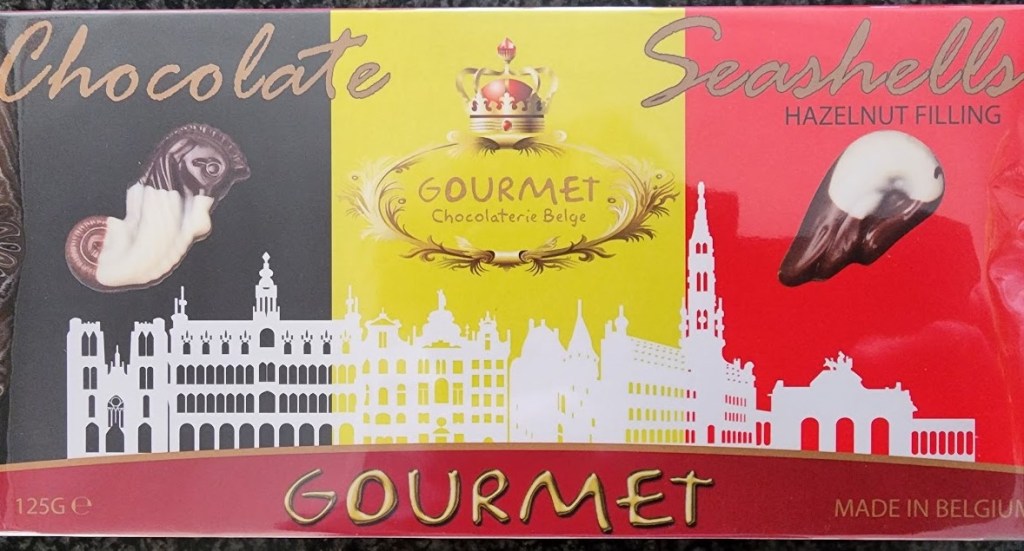
Gaufres and waffles for sale. Hot chocolate everyone seems to be holding to try to warm up. This giant mural with the comic of Tintin seems fitting, as Belgium is famous for its comics, like cowboy Lucky Luke and the Strumpfs (Smurfs).

If you want more upscale chocolates, along with Antwerp diamond stores and quirky art stores, visit the arcade near the Place, similar to the one in Milan.


Climbing back up to the Matisse Museum, we could see the spire of Hotel de Ville lit up.


We were enthused about another trip to Grand Place after we got settled in the hotel in the European Quarter but fatigue won out and we found a delicious Indian restaurant nearby (A taste of Asia) with finally Belgian beer (Gordon’s blond).
We’re grateful that our guide Emmanuella told us of the exhibit in the Royal City Park of “le chat,” so our last morning, under the usual cold grey skies, this time with some wet snow falling in our eyes, we walk down to the park.
As Athena commented, the parks and green spaces are wonderful in the city. Sunday morning with a few joggers and cyclists out in the cold. The exhibit includes 22 monumental cat sculptures by Philippe Geluck, a Belgian newspaper cartoonist and comic artist, also a radio and TV comedian and known for his long running comic strip “Le Chat.” We toured the delightful exhibit, which will be in the park until February 2024. Here are a few of my favorites, that will surely make you smile. A great way to end our trip.


I’ll leave Geluck’s cats to wish to all a happy healthy new year with peace. This photo is from Athens, from the lanterns that we lit on Christmas eve at Plateia Kotzia and sent into the sky to make a wish. May your wishes come true in 2024!

If you like what you read, hit the like button and subscribe. Please share with your friends and social media. I’d love to hear your comments below.
There’s no need to log in to leave a comment. Just give an email address and your name.
Subscribe to become part of the olivesandislands community! Get new blogs and occasional newsletters delivered directly to your inbox. It costs nothing to subscribe. Olivesandislands does not share email information.
Note: Be sure to click on the confirmation email after you give your email address.

Sherri Moshman Paganos is a writer and former educator, inspired by her life in Athens, where she and her husband are happily retired and enjoying their travels in Greece and abroad. You can check out her writing — fiction, non-fiction, poetry and articles here.


Wonderful!
You are a treasure to your friends and readers!
Your posts are so excellent! Photos and text, as well as sentiments, truth and life experiences flooding out of them, make us readers travelling and living it with you!
Happy New Year!
Keep posting, traveling and enjoying life!
John
LikeLiked by 1 person
Thank you so much John for your kind comments — you made my day! Happy new year to you too!
LikeLike
Sherri, you’ve outdone yourself with this particular cultural reportage! I enjoyed your post immensely! I feel as if I had gone on this trip with you!
Thank you!
LikeLiked by 1 person
Thank you Stella, I’m glad you enjoyed the “trip” soggy as it was!
LikeLike