In the heart of the noise and congestion of Athens lie some pockets of serenity and contemplation. One such place is the Gennadius Library, part of the American School for Classical Studies at Athens, on Souidias Street in Kolonaki. Perhaps you’ve looked through the gate and wondered at the story behind this beautiful neo classical building, what it is exactly and how it came to be here.
Once through the gate, you might want to stroll a little in the manicured gardens.


The origins of the Gennadius Library, leading research center for studying Greek history, literature and art, date back to 1922, when Joannes Gennadius, diplomat, collector and bibliophile, donated his personal library to the American School of Classical Studies. Gennadius (1844-1932), who lived most of his adult life in London, had the largest private collection of books about Greece in the world, with 30,000 volumes, including early editions of Homer’s Iliad and Odyssey. He gave his collection with the proviso that a library be built for it with the name Gennadius or Gennadeion, actually to honor his father George Gennadius, supporter of the Greek revolution, scholar and founder of the University of Athens and the National Library. It was from his father that Joannes inherited his passion for books and scholarship, but that love of scholarship had been in the family for generations. Joannes Gennadius’ great grandfather, Ioannes Benizelos, wrote a manuscript “History of Athens,” detailing life during the 18th century, in this period of still-Ottoman rule. The Benizelos family mansion, parts of which date to the 16th century, can be visited on Andrianou Street in the Plaka. Today it’s a museum.
The building of the library, funded by the Carnegie Corporation, was completed in 1926. Because it was in the time immediately following the Asia Minor catastrophe and subsequent exchange of populations, much of the construction was done by refugees from Smyrna and other parts of Asia Minor.
It was a pleasure to meet with Dr. Georgopoulou, library director since 2004, in her office, surrounded by bookshelves and cases of books, both old and new, a veritable bibliophile’s paradise.

You recently gave a talk at the Grolier Club in New York with the charming title “Bibliophile delights from the collections of the Gennadius Library in Athens.” What are some of your favorite ‘delights’ in the library?
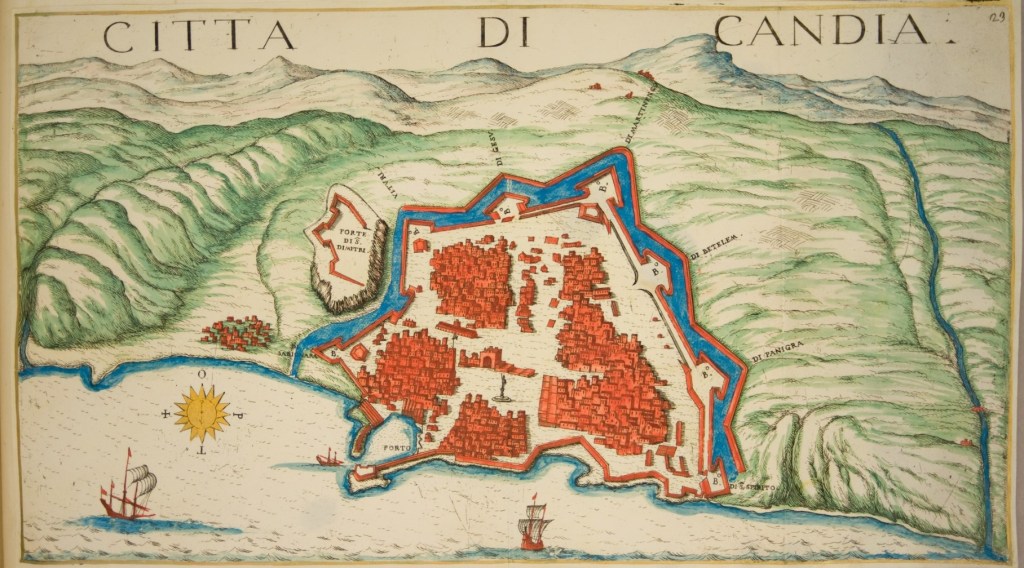
It depends on who you are of course, we all have different preferences, but well for me, as a historian with an area of specialty in Venetian Crete, what brought me here initially is the world famous collection of maps. They are truly works of art. The library has thousands of maps of the region and other places in the Mediterranean and they’re beautifully done. Besides labeling cities and countries, sometimes they had decorations like sea monsters along with other pictures. The one below is a 17th century Venetian map of the city of Heraklion or Candia as it was known then.
But surely one of my delights are the miniature books. These quaint objects are almost like jewelry and I can understand why Gennadius wanted to collect them. They are not the rarest of our books but their value rests on their format and oddity. (Getting up and opening a showcase, Dr. Georgopulou took out a few of these books, no bigger than your thumb and spread them on the table, including a small bible, dictionary and almanac, and a small magnifying glass to be able to read them).

These are exquisite. You say they’re not considered rare books however. What goes into the classification of a book as “rare?” Various factors. These are mostly 19th century books first of all. So one factor of rarity is the date of course. A second factor is the number of copies that were made, and a third consideration is the provenance. Whose library was this book a part of – a king? a Prime Minister? A famous collector? These are all important factors and another is the binding of the book. Original bindings of the 15th and 16th century were of animal hide and they were simple and not decorated. The printers didn’t give much attention to the cover which was there to protect the book itself. In Gennadius’ time, it was the fashion to have ornate bindings and he rebound many of his books in the same binding, unfortunately replacing the original.

How does the Library expand its collection and get new acquisitions? What ‘s your latest acquisition?
We buy about 1500 new research books per year through our dedicated budget, rare materials either come as donations or we raise money through our Board of Overseers and the Friends of the Library. One of our latest rare book acquisitions is a Jewish prayer book translated into Greek, printed in Corfu in 1885.
Generally, what is the makeup of people who use the Gennadius Library?
University professors, researchers. But it actually depends on the season. During the year, it’s mostly the local population, but there are also scholars from abroad who spend several months here doing research. In the summertime we’re actually very busy with visitors from all over the world.
Is the Gennadius the main library for the American School of Classical Studies at Athens?
We’re part of the American school but we’re the second library. The original library of the school is the Blegen Library, which has mostly classical volumes, while our collection is not only classical, but goes into Byzantine, Ottoman and modern Greek studies. There are books and diaries written by travelers and explorers and a number of memorabilia of philhellene Lord Byron, including portraits and the laurel wreath that was placed on his tomb by the Greeks. We even have musical archives — a special archive we have is for composer Dimitris Mitropoulos..
But we do have many early editions of classical works that Joannes Gennadius collected, everything from Aristotle to Aristophanes. We have 300 editions of Homer’s Iliad and Odyssey, and about 400 studies that have been published on Homer. We displayed some of them in the library after the Potamianos lecture with Emily Wilson [noted classicist and recent translator of the Iliad.]
3) Those were beautiful. In three years, 2026 will be the centenary of the opening of the library. Is it too soon to ask if anything is planned? What are your thoughts as the centenary approaches?
We’re planning an exhibition to accentuate the collections that have come into the library based on Gennadius’ vision of 100 years ago. We’ve expanded the collection to 150,00 volumes. We’re working on three areas: the collections / scholarship and fellowship / encouraging outreach programs and dissemination of knowledge.
We’re what I call a “boutique” library, a small institution with a focused collection and a specific public. So we have to create projects that fit our scale.

Gennadius collected works about Greece or rather about Hellenism with a capital “H.” We like to think that everyone that uses the library has some knowledge of Greek but it might not be true. So, one of the challenges we’ve had from the beginning is keeping our bilingual character, of providing resources in both English and Greek.
That is a challenge in many cases. Can I ask, what was your background of study and where?
I studied history and archaeology at the University of Athens, then received my master’s in archaeology and art history at the Sorbonne and finally my Ph.D. in art history at the University of California at Los Angeles.
5) And then you stayed in the States and taught Byzantine and Islamic art history at Yale University for 12 years, from 1992 to 2004. Between your studies abroad and teaching, that’s many years away from your birthplace. How did you feel about assuming the directorship of the G.L. and returning to Athens, your native city?
Well, it was a dream to return to Athens. I loved my students at Yale, but I was happy to come back. And for my children to experience Greece. I was especially gratified to be able to work within the framework of an American institution.
6) Yes it’s certainly like an oasis here in the heart of the city. What do you like most about your job? What are you proudest about during your directorship?
Well, I love what I do. It’s very creative, I love dealing with scholars and students and creating exhibits. What am I proud of? Many things, for example, that we’ve digitized so much material, we have a flourishing fellowship program and sponsor exhibitions and many public programs throughout the year.
Before 2018, when we inaugurated a new exhibition space, we had exhibits inside the library. My favorite was not really historical; it was called “Flora graeca” and it was on all the flora – plants and flowers – found in Greece. As a city person myself, it was a fascinating way for me to learn about and experience “monuments” of a different type!

7) Speaking of exhibits, I’ve enjoyed many sponsored by the Gennadius Library . Can you tell us more about the latest, “In the Name of Humanity,” American Relief Aid 1918 to 1929, that you curated with two colleagues, on U.S. relief efforts from World War I throughout the 1920’s. What do you want viewers to take away from this exhibit?

Well, the idea was to commemorate 100 years after the Lausanne Treaty and the Exchange of populations. The title comes from a letter written by one of the protagonists of the relief aid at the time. In the exhibit you could say we emphasize the subject of how to alleviate pain and suffering of refugees. We highlight the aid efforts 100 years ago, an issue that unfortunately remains topical today. We hope the visitors to the exhibit will appreciate the events and learn about the selfless workers who came to Greece to help the refugees — not only from Asia Minor, but also Armenian, Syrian and even Persian. We highlight those who came and left archives: missionaries, doctors, nurses, school teachers. It’s a very touching story. The other main thread we touch on are the role of educational institutions during this great time of upheaval.
Thank you very much. I’m eager to see it.
*******
Entering the exhibit, which runs until February 2024, in the spacious Makriyannis Wing, the first thing you notice, are the posters created to urge Americans to give to the relief effort.


As Dr. Georgopoulou remarked, the exhibit focuses on those figures instrumental in aid. Relief organizations like the YMCA, American Red Cross, and Near East Relief appealed for aid, first to help the Armenian refugees after the 1915 Genocide in Turkey, then Syrian and of course the Greek refugees from Smyrna and other areas of Asia Minor. Ottoman Greeks (Greeks from Asia Minor who immigrated to the U.S. – this was the name they were given at Ellis Island) were instrumental in raising money.
We see the volunteer work of little known organizations like the American Friends of Greece and the American Women’s Hospitals. Giving money at the beginning for charity was one thing but then the goal was to raise the self respect of the refugees. After a while, the Near East Industries was formed and refugee women used their embroidery skills in making beautiful purses, as you see here.

Later in the 1930’s, the Near East Industries got involved with making and selling dolls –there were 20 varieties of dolls in traditional costumes.

Among the documentary films, letters, articles and artefacts, this Singer sewing machine was found in the director’s basement that had been used in relief efforts of the time, by refugee women.

A small display, arranged by musicoethnologist Christopher King, contains a collection of 78 rpm recordings of rembetika, music brought by the Asia Minor refugees. (For more on rembetika, see blog post https://olivesandislands.home.blog/2022/09/21/the-destruction-of-smyrna-and-the-asia-minor-catastrophe-100-years-later/.)
A small digression or parenthesis: King gave a presentation to a full theater in the school’s Cotsen Hall auditorium a few days later. He played a collection of rare early 20th century 78 recordings, along with a live group of two violins and a laouto (Greek lute) performing. The lecture title “When Violin was King” refers to music of the region of Epirus in northwestern Greece. Just mention Epirus traditional music and immediately we imagine the reedy sound of the clarinet but 80 years before, the violin ruled, and that was for a couple of hundred years.

In an interesting observation, King spoke of cultural exchange with Epirus melodies and a mix of musical styles, as of melodies anywhere. Ioannina, main town of the region, and once a “polyglot” city, had visitors and influences from not only Ottoman music but also Romanian, and from Ukrainian klezmer music, songs of Ashkenazi Jews that combined with music of the Romaniote Jews in Ioannina. This similarity was especially found in wedding music or music calling villagers together before the wedding.
The musical lecture ended with the “fiddlers” descending the stage and walking among the audience. Some found it irresistible not to get up and dance!

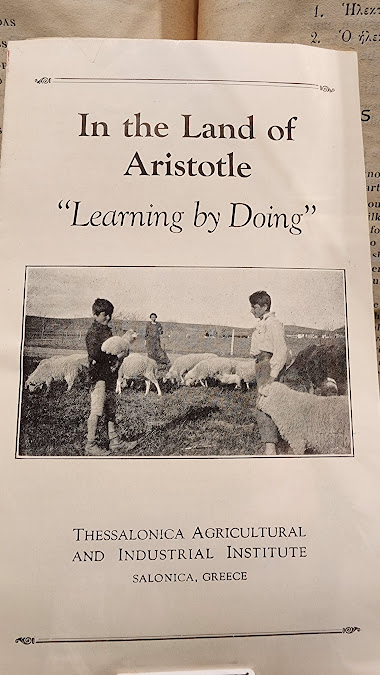
(End of digression!) Back to the exhibit, which as Dr. Georgopoulou noted, also highlights educational facilities. Both the present American College of Greece and Anatolia College have their roots in Asia Minor, founded by missionaries in the late 19th century. Both the American Collegiate Institute, as the American College of Greece was known then, and Anatolia College, were invited to relocate in Greece by Prime Minister Eleftherios Venizelos who gave them land concessions and tax incentives. The third institution, the American Farm School, formerly the Agricultural and Industrial Institute, was founded in 1904 in Thessaloniki, still part of the Ottoman Empire (until it became part of Greece in 1913). Note how the pamphlet below stresses the location of the school.
One of the interesting finds in researching this period of time was a silent film, long thought to be lost. (Silent films, being made of nitrate, were very flammable and for that reason, were often destroyed. I think of that frightening scene in Cinema Paradiso when the film catches fire.) In the film that was found, Jackie Coogan, who played the “kid” in Charlie Chaplin’s film and was a poster child for Borden’s Milk, which was collected and sent to the refugees, was “recruited” by the aid effort to go to Greece in 1924. The movie shows him as a 10 year old star, meeting with politicians, dignitaries and watching refugee children perform at the Zappeion.
Be sure you visit the Stathatos room, which is just off the main exhibit area. This room, as Dr. Georgopoulou told me, belonged to Helen Stathatos, born in Alexandria Egypt to a wealthy family (Konstandinis). In Athens she married Antonios Stathatos, a businessman with ties to the Greek royal family. In the 1920’s when she heard that in the town of Arta a church, known for its beautiful woodcarvings, was going to be torn down, she retrieved the carvings and arranged them herself in her mansion along with Byzantine oil lamps and icons and blue ceramic tiles on the fire place (see photo below) The photo is just a small portion of this gorgeous room. She had a large saloni (or living room) that she gave to the Benaki museum, and the small one to the Gennadius). It’s a room you just don’t want to leave.

Don’t miss it! Besides exhibits, Gennadius hosts a rich series of lectures by scholars in the Cotsen Hall auditorium. In addition, every September the Curtis institute of Music in Philadelphia visits for its several “Nights of Classical Music,”
What’s this tower of books you can’t help but notice in the wall outside the Cotsen Hall entrance? Part of a 2014 exhibit, “A Thousand Doors,” the books form an art installation by Jannus Kounelis, where the window light is blocked, suggesting that you need to open the books and access the knowledge in order to allow the light in.

I think Gennadius would be very pleased at the direction the Library has taken nearly 100 years after his donation.
Check the website on using the library and on special news on exhibits and talks, all with free admission, new acquisitions, educational programs, research, etc.
https://www.ascsa.edu.gr/research/gennadius-library
*****
I’ve known of the American School of Classical Studies since 1985 when my cousin Gideon spent a year at the school as a “regular member” and who was awarded the Arthur Deloraine Corey Fellowship by the Department of the Classics at Harvard University to study there for one year. I asked Gideon if he had any memories to share. For the Blegen Library, the main Classics library associated with the American School, as noted earlier, Gideon describes the evocative smell of old books.
My main recollection, oddly, is the smell of the Blegen library. It had that musty, dusty odor of the stacks in old Ivy-League libraries, the sort of smell that made you think the air entering your nostrils was not only inhaled and exhaled by classics students of three hundred years earlier but was actually composed of the identical gas molecules, so hermetically sealed was the space within, so uncirculating was the air (and the book collection) inside. To be clear, I loved that smell. It said, “This is a place of genuine scholarship. This is a place where those who enter today are in perfect communion with those who entered in all prior centuries.
For his second recollection:
My other memory was of how selflessly dedicated the resident scholars were to every detail of classical archeology. You could find experts there who could hold up the tiniest sherd, examine the profile, assess the clay, scan the specks of glaze, and say, “Yup–Carthage, 249 BC, from the atelier of Hasdrubal the erotic potter.” Now, that is scholarship.
If you like what you read, hit the like button and subscribe. Please share with your friends and social media. I’d love to hear your comments below.
There’s no need to log in to leave a comment. Just give an email address and your name.
Subscribe to become part of the olivesandislands community! Get new blogs and occasional newsletters delivered directly to your inbox. It costs nothing to subscribe. Olivesandislands does not share email information.
Note: Be sure to click on the confirmation email after you give your email address.

Sherri Moshman Paganos is a writer and former educator, inspired by her life in Athens, where she and her husband are happily retired and enjoying their travels in Greece and abroad. You can check out her writing — fiction, non-fiction, poetry and articles here.


A great place The Gennadius Library! I’ve enjoyed many evening lectures there.
LikeLiked by 1 person
Yes, both fascinating lectures and exhibits!
LikeLike
I remember perusing his large collection of scrapbooks when I visited the library many years ago. I was truly fascinated!
LikeLiked by 1 person
Yes, it’s a lovely place to visit!
LikeLike