It’s September and little pink wild kiklamino (cyclamen) are blooming around tree trunks in the parks. Athens streets are still overflowing with tourists – in July and August, a total of 16,000 tourists a day were stepping over the ancient stones of the Acropolis under the Athens summer sun.
This month Greece is commemorating the 100th anniversary of the destruction of Smyrna and what’s known as the Asia Minor catastrophe.
If you were to go up and ask tourists what they know of Smyrna and the Asia Minor catastrophe, they would look at you blankly.
I too would have had a blank look back in the 1980’s when I came to live here. I knew nothing about these incredibly devastating events and the effect on modern Greece. It’s actually curious how little is known. In 1940, just 18 years after its destruction, Henry Miller wrote, “Smyrna has been somehow soft-pedalled and almost expunged from the memory of present-day man.”
***
“Once upon a time there was the most beautiful city in the world and it was destroyed – how could that be?”
A voice-over narrator, a child asking a question that sounds like a fairy tale. This is what we hear at the beginning of the documentary film “Smyrna: Destruction of a Cosmopolitan City, 1900-1922,” directed by Maria Iliou, whose own father was a refugee from Smyrna.
This fascinating documentary, which was released in 2012, was also shown at the Athens Concert Hall to a full audience in March this past year.
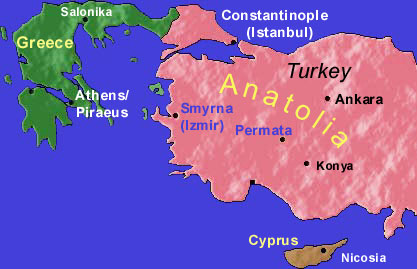
Smyrna, (today’s Izmir in Turkey) was indeed somewhat of a fairy tale city. It was known for its beauty, its tolerance and its cosmopolitanism, along with other great cities of the Mediterranean like Alexandria Egypt, Beirut Lebanon, Constantinople (Istanbul) Turkey, and Salonika (Thessaloniki), cities of trade and commerce along the sea, where many of its residents could easily converse in many different languages.
It seems that every municipality around Greece has had a program of events to commemorate the anniversary, with concerts, theater, film and lectures. In Chania Crete this summer a two day meeting of choirs from around the country, featured songs of Asia Minor. The background features a postcard from Smyrna from 2011.

Other programs have featured traditional dances from the area around Smyrna.

Museums as well have special exhibitions. The Benaki Museum (Pireos Annex) is featuring over 1,000 exhibits and 500 photos, before and after the catastrophe, until February 2023. I must get there and see it.
The American School of Classical Studies in an exhibit called “The Epic of Anatolia in the Greek Imagination: The Asia Minor Catastrophe in Literature Between the Wars,” examines the influence on writers who had experienced being uprooted from Asia Minor. Well worth a visit and also until February.
But to go back to the question at the beginning of the film, “how could that be?”
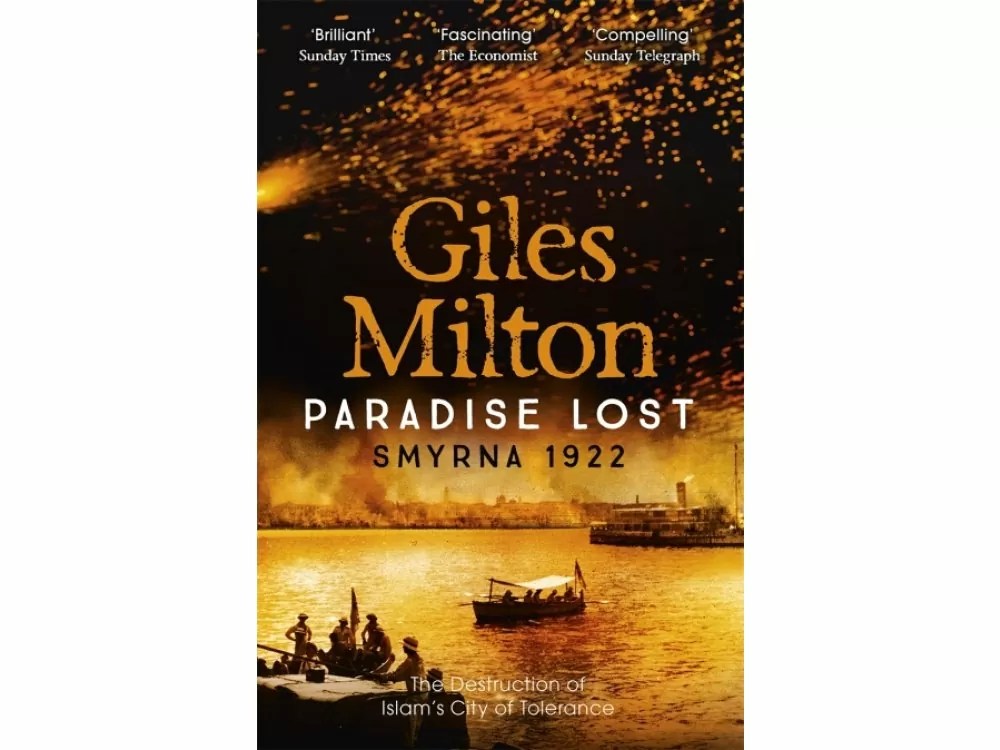
Not easy to answer. Like every historical conflict, there are numerous immediate and remote causes and various ways to interpret them. For a thorough historical background, check out the book Paradise Lost, (not by John Milton!) but historian Giles Milton (who is in fact the main narrator in Iliou’s film on Smyrna.)
Certainly rising nationalism played a major role at the beginning of the 20th century. In Louis de Berniere’s fascinating novel Birds without Wings, set in southwestern Anatolia, Turkey around this time, narrator Iskander the potter says, “There were too many who learned how to make their hearts boil with hatred…how to call upon God when they did the Devil’s work.”
It was the waning years of the Ottoman empire and there was a new wave of Turkish nationalism under Mustafa Kemal (Ataturk).
And in Greece there was the spread of the “Megali Idea,” (great idea) that Greek statesman Eleftherios Venizelos put forth at the Paris Peace conference in 1918. This idea of a greater Greece, assimilating the western coast of Turkey (Asia Minor) where there was a Greek majority in Smyrna, was embraced by the Western powers of that time, especially Britain. With their approval, Greece sent troops to Smyrna in 1919. At first there was great celebration and joy by the Greeks there.

But this event actually sparked the Greco-Turkish war. By 1922, three years later, a series of mistakes and misjudgments by parties involved in the international scene of the time, led to the defeat of the Greek army, that meanwhile had marched inland deep into Anatolia. It was in retreat, making its way back to the coast and Smyrna, along with Greek and Armenian refugees.
Smyrna was even known as “infidel Izmir” because of its large Greek population – in fact more Greeks lived in Smyrna than in Athens. There was an Armenian quarter and Jewish quarter as well in the city and the residents mostly traders and artisans. Outside Smyrna in opulent mansions lived the Levantines, Europeans who had been in Asia Minor for generations — they truly lived in a paradise of servants with endless dances, soirees, parties, attending the opera etc in this bustling vibrant city.

In September 1922 when Smyrna was full of the defeated army and other refugees, the Turkish army entered the city. Even though they entered shouting “fear not!” the main feeling was only fear, fear of impending massacres. Those with foresight had managed to flee the city earlier, but human nature is that people don’t usually believe how horrible a situation will become, and they cling to their current life. Certainly Greeks could never believe Smyrna would cease to exist. In any case, the French, British and Italian and American boats out in the harbor gave a false sense of security, that it would be easy to leave if necessary. But that’s not what happened. The boats of the different countries were in fact under strict orders not to intervene in the crisis and to only look after their own national citizens.
Under these orders of being “absolutely neutral,” soldiers of Western powers stood by and watched unspeakable atrocities. George Horton, U.S. consul general wrote “one of the keenest impressions that I brought away with me from Smyrna was a feeling of shame that I belonged to the human race.” It was Horton that helped get out the residents of the American Collegiate Institute, that had its beginnings in Smyrna and moved to Greece in 1922, later taking the name of the American College of Greece, where I taught for decades.
On September 13, fire broke out in the Armenian quarter and rapidly spread to other quarters. There were a number of eyewitnesses who saw Turkish soldiers with tins of petrol leaving houses that then burst into flame. Minne Mills, director of the American Collegiate Institute, was one such eyewitness.
It was sheer panic. People were running down to reach the waterfront, adding to the already thousands of refugees camping out on the streets near the quayside.

Hundreds of thousands were trying to escape the encroaching fire and the violence of the Turkish soldiers. However, most of the boats just turned a blind eye to the horrors going on along the quay. And the fire just kept burning — four days later the city was destroyed.

Crises create unexpected heroes. One such hero was Asa Jennings, an American Methodist minister who worked for the YMCA. It’s said that he managed to save 250,000 people by being on the phone tirelessly, lying, bluffing, and even bribing ship captains. He was finally able to secure rescue ships sent from Greece and other countries, as well as to get boats out on the harbor to drop their “neutrality” and help save lives.
On their way to mana Hellas or “mother Greece,” many disembarked on the islands close by, such as Lesvos (Mytilini) where nearly 100 years later, thousands of Syrian refugees landed on the island from Turkey on unsafe and dangerous boats. In fact the film Smyrna Mou Agapimeni, (My beloved Smyrna) released this past year, opens with a 2015 scene of pulling refugee boats onto shore. The film depicts with great realism not only the fire and the panic along the quay but also the privileged life of Greek and Levantine families.
The film, in English and Greek (and some French and Turkish) also shows the division among Greeks living in Smyrna about the “Megali Idea.” Two brothers: one who enthusiastically supports Venizelos and “mother Greece” while the other one feels himself to be an Ottoman citizen, plain and simple.
After the fire, refugees kept pouring into Greece. The following year in Switzerland the conference of Lausanne put into law a mandatory population exchange, perhaps the first time in history on such a scale. Based on the criterion only of religion, 1.2 million remaining Orthodox Christians living in Turkey were forced to leave their homes (with the exception of Constantinople) and move to Greece, while 400,000 Muslims living in Greece were uprooted and forced to move to Turkey. In many cases, they didn’t know the language of where they were going. This exchange was the finality, the end of 3,000 years of the Greek presence in Asia Minor.
In Birds Without Wings the Ottoman Greeks in the small town in the novel protest about leaving. “But we’re not Greek, we’re Ottomans,” they tell the authorities. “There’s no such thing as an Ottoman any more,” they’re told. “If you’re a Muslim you’re a Turk and if you’re a Christian and you’re not Armenian, and you’re from around here, you’re Greek.” As simple as that.
In Maria Iliou’s sequel to her film on Smyrna, “Expulsion and Exchange of Populations,” one of the Muslims in Crete throws his house keys in the water, sure he’ll never return. But many stunned refugees, thinking their move was just temporary, kept their “keys,” not yet ready to make a break with the only land they ever knew As with so many conflicts, ordinary citizens were caught up in the destructive web of politics and nationalism.

It wasn’t easy for Greece, a small poor country in any case, to absorb such a large number of refugees. Most went to Thessaloniki, Athens and Pireaus and communities around there. The refugees were hardly welcomed with open arms, they were looked down upon, and in many cases derided as “Turkish seeds.”
Neighborhoods of Athens have names that show their origin, such as “Neos Kosmos” (New World) or “Nea Smyrni” (New Smyrni) True to its origin as a site where Smyrna refugees settled, the municipality is having a whole month of cultural programs known as Ionies Yiortes (Ionian celebrations) because the area of western Anatolia along the coast was known as Ionia.
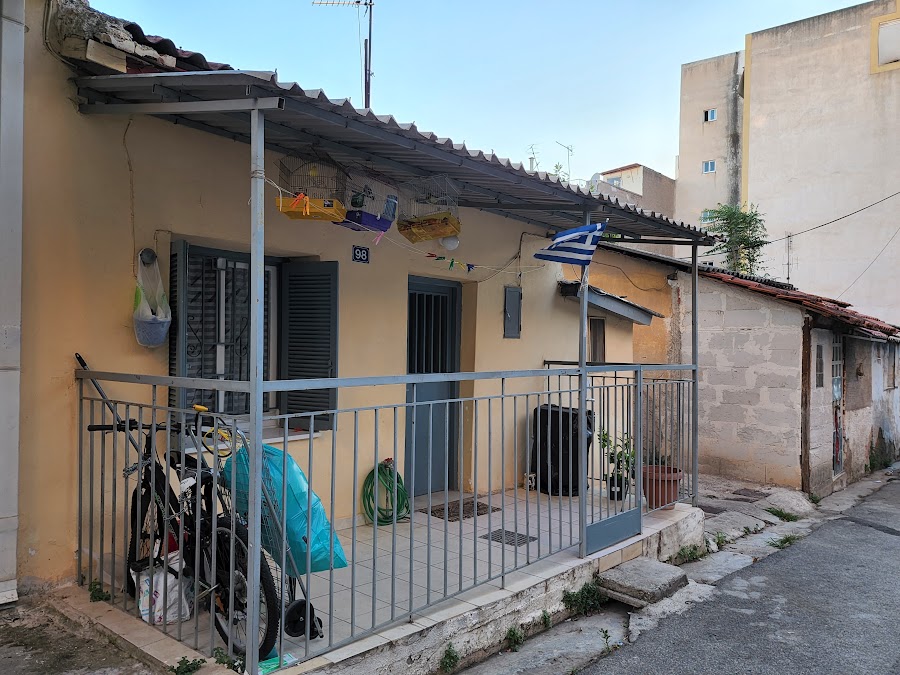
Another area where refugees settled was Kesariani. Not far from the main plateia with its wonderful fish tavernas, I found streets with the names of “Smyrna,” “Bosphorous” and “Nea Ephessis.” In groups of back alleys are still remains of prosfygika, tiny one floor refugee houses. Many are left abandoned, some are renovated and lived in today. Some lie next to new apartment buildings.



The refugees brought a great deal with them in food, music and culture. Greece would not be Greece today without the rich influx of 1922 refugees and their descendants. They brought with them music that mixed with Greek rembetika, urban music of the underground. Many of these songs expressed the sorrow of everyday life and the loneliness of exile. (More on rembetika in a future blog.) The following song written in 1936 by Panagiotis Tountas, an Asia Minor refugee in Athens and recorded then, is more of a bouncy almost humorous love song to a woman named Katerina who is cooking … It’s called Aman Katerina Mou which could be translated as “oh my Katerina,” with “aman” one of those hard to translate words used in both Greek and Turkish. You can see here the song both in Greek letters and in a transliteration, as well as a “somewhat” English translation.
This 2017 version is by singer Yiannis Kotsiras on a popular TV program, so you can also see the audience and dancers, as well as the traditional Asia Minor instruments of santouri, violin and oud, along with Greek bouzouki and guitar.
The violin gave way more and more to the guitar and the oud to the bouzouki. Note below the traditional Asia minor instruments in a concert this summer.

As for Venizelos, how did he feel about the outcome of events? He enthusiastically supported the population exchange as a way of bringing about peace with Turkey. About the exchange, he said “it will enable us … to ensure, despite the collapse of a Greater Greece, the consolidation of a Great Greece.”
A Great Greece. But at what cost.
When the fire had burned down the city, the New York Times’ headline was “Smyrna Wiped Out” and the article began, with a four word sentence: “Smyrna is no more.”
But there’s still no good answer to why it happened, to the fairy tale question at the beginning of the documentary, the question that’s asked in total disbelief: “how could that be?
In these days while Turkish president Recip Erdogan is preaching divisive rhetoric, not everyone is accepting it, as shown in the T-shirt of Turkish basketball star Enes Kanter.

If you like what you read, hit the like button and subscribe. Please share with your friends and social media. I’d love to hear your comments below.
There’s no need to log in to leave a comment. Just give an email address and your name.
Subscribe to become part of the olivesandislands community! Get new blogs and occasional newsletters delivered directly to your inbox. It costs nothing to subscribe. Olivesandislands does not share email information.
Note: Be sure to click on the confirmation email after you give your email address.

Sherri Moshman Paganos is a writer and former educator, inspired by her life in Athens, where she and her husband are happily retired and enjoying their travels in Greece and abroad. You can check out her writing — fiction, non-fiction, poetry and articles here.


A great piece, Sherri. The politicians had a lot to answer for. As so often.
So many lives lost and ruined.
LikeLike
Thanks Gillian. Sadly, isn’t that always the case.
LikeLike
Interesting. I hadn’t any knowledge of Smyrna (not surprising), but had been close by when refueling in Incirilik on way once to either Afghanistan or Iraq. What I do remember was the hostility of the Turkish military to our presence and also the “sweetness” of the air on landing.
LikeLiked by 1 person
I felt how could I not know anything about Smyrna….Interesting times you had back then. Seems so long ago doesn’t it.
LikeLike
Thank you for the history lesson. Smyrna sounds like a wonderful place in it’s time. I am touched most by the thought that its so hard to know when it’s time to give up and run. I would never have thrown my keys away.
LikeLiked by 1 person
Thanks Rachael for your comments. Knowing when it’s time to flee, that’s difficult. About the keys, I would have kept mine too.
LikeLike
I have been to Izmir with a group of students and professors from The American College of Greece. We visited the American Collegiate Institute, which still exists, and visited many sites in the city where the Greeks lived and worked and worshipped. There is a a great sense of nostalgia and love for the city that was. Thanks, Sherri, for bringing back those memories.
LikeLiked by 1 person
What an emotional and unforgettable trip that must have been. I’m glad I was able to bring back some memories you had from the visit. And I’d like to go myself some time!
LikeLike
Thank you, Sherri, for your informative post!
One century later, it’s pitiful to witness that no advancement in science or technology can ever prevent, change, suppress, or mask our true nature – one of hostility, cruelty, and brutality.
LikeLiked by 1 person
Thanks Stella. Horrible thought isn’t it but it seems Hobbes was right, as events constantly support his views on human nature…
LikeLike