The caves at Matala now lie empty and silent at night but in the mid Sixties until the early Seventies they were alive, inhabited by hippies, mostly Americans and western Europeans. In 1971 when Joni Mitchell sang in “Carey,” of “old scratchy rock n’ roll playing beneath the Matala moon,” she brought fame to the cave inhabitants. Until its “discovery,” Matala had been a sleepy isolated fishing village on Crete’s south coast.
Joni Mitchell wasn’t the first to call attention to Matala. A few years before, in September 1967, with the headline Beatniks Build an Eden in the Caves of Southern Crete, a Washington Post article describes a cliff, “pockmarked with caves…that has become the refuge of droves of European and American beatniks.”

The summer of 1968 was the turn of LIFE Magazine to play up the caves. In an illustrated article entitled “Crete: A Stop in the New Odyssey,” author Thomas Thompson tries to understand, as so many did, what could make an affluent child drop out of society and go live in a primitive cave, in a so-called “flower child commune” in southern Crete. In many countries it was a time of unrest and rebellion. Particularly in the States, political assassinations, race riots and Vietnam war protests rocked the country.
Beatniks, hippies, flower children, call them what you will, they were searching for an alternative way of life, which they found in Matala.

The town of Matala, still thriving on flower power nostalgia, lies 65 km south from Heraklion, main city of Crete. With our blue Suzuki rental car, we are taking the nearly2 ½ hour drive from Chania, about 135 km northwest of Matala.

After heading south, and going inland, you pass through dry mountain ranges dotted with shrubs. This harsh scenery gives way to a gentler landscape of light green carpets of olive trees. We’re sad to see a stretch of charred ground and burned trees, evidence of one of the many wildfires every summer — there goes someone’s livelihood.
Matala was the port for the nearby Minoan settlement of Phaistos, from about 1,700 BC (the archaeological site is much smaller and not as restored as Knossos in the north, but worth a visit).
As you approach the town, you notice a carved olive tree sculpture.

Ahead of you lies the beautiful horseshoe shaped beach and the “pockmarked” caves to the right.

But before we head to the beach and the caves, first we need to find Mama’s Bakery, owned by the Zouridakis family.

We have something to show the pleasant young woman inside who manages to find one remaining tiropita left for us. As she wraps it up, we show her a photo. Her eyes widen with surprise and then tears. “My grandmother! Did you know her?”
1998: family vacation when I took the photo and we met her grandmother, known as “Mama of Matala.” My daughter is sitting on Mama’s lap, my son standing between her and Elias. Anastasia who runs the bakery, is the granddaughter, the little girl in the red chair.

We had been told about how Mama took care of the hippies and I was curious to meet her then. There she was in the family bakery. In her early eighties, she had a sweet angelic smile, as you can see in the photo, and like so many elderly women, long white hair pulled back in a bun. She wiped her hands on her apron, untied it and we went outside to talk.
When did the first hippies start living in the caves? we asked her. She told us it was actually in the 50’s, when the first so-called “hippie,’ came around 15 years after WWII ended, the son of a German officer stationed in Crete during the Occupation. Then counterculture Greeks went to stay there. It wasn’t until the 60’s that the caves were discovered by foreigners, mostly Americans.
On her part, she baked bread every day and gave it to the “flower children,” along with sandwiches and yogurt, collected their mail, and “some who had money asked me to hide it for them,” she told us. ” I looked after them, however I could.”
She went against the prevailing opinion of the time. “The villagers were not too happy about them being there, they said they were dirty and had drugs,” she told us. “And the dictatorship and police went after them, so they kept moving higher and higher up in the caves. There were five levels. And finally the police made them all leave.”
[When the police forced the hippies out of the caves in the early 70’s, Greece was in the midst of a military junta. In 1975, when Elias first visited Matala, the only hippies left were sleeping on the beach, like him and his friends, under the almerikia, the salt cedar trees you see on so many beaches.]
Mama had a faraway look in her eye. “I remember,” she said “when I got my first refrigerator! We celebrated, opened a bottle of wine and the next day I made rice pudding for everyone.”
{In a video of British, American and Australian women looking back on their cave experiences in the late 60’s, one recounts how Mama’s rice pudding was one of their favorite foods. The title refers to advice the young women were given in Herakleion, advice they immediately ignored and got on the first bus going to Matala!]
I asked Mama if people ever come back to see her. “Oh yes! Many hippies became successful lawyers, doctors, university professors.” And over the years many returned to Matala to visit Mama. “They’ve never forgotten me!” she said proudly.
Twenty four years later in 2022, Anastasia, the granddaughter in the picture, tells us that recently an 89 year old American woman came back to Matala and Mama’s Bakery for the first time since she lived in the caves. In the summer Anastasia’s three children help out in the bakery along with her husband. The Zouridakis bakery, back in the “hippie” era, the only bakery in Matala, is still pretty much the only one in town, with another branch 3 km outside Matala, and a coffee snack place as well.
Between 1998 and 2022, we made another visit — in 2007 we returned to Matala hoping to find Mama again, only to be told at the bakery that the beloved Mama of Matala had died a few months before! Crestfallen, we left the bakery and went climbing on the caves. It was a day of strong meltemi, the northerly winds, that created huge waves and we couldn’t swim very well. Today it was much the same – the Matala Bay evidently is very prone to winds.


We decided it was time to get up from our towel under the shade of the almerikia trees, where sand was blowing into our beach bags, in our hair and eyes and ears and do our climbing.
A fence surrounding the caves with the sign “Roman Cemetery” emphasizes not the hippie settlements but the use of the caves for Greek and Roman tombs. Four euros lets you clamber over the rocks to your heart’s content. At night it’s locked, no staying in the caves allowed.

Historically, way before they were used as tombs, it’s believed that this honeycomb complex of caves was created in the Neolithic Age, carved out of the soft sandstone cliffs, probably for use as prehistoric dwellings and places of worship. It’s also believed that early Christians used to hide there from the Romans. Later in the Middle Ages, the site was used as a leper colony. Over the years, the the caves were used by fisherman and before international hippies, part of the Greek counter culture movement, as Mama had told us.

The caves figure in mythology. It’s in Matala where Zeus carried the princess Europa in the form of a white bull across the sea from Phoenicia. Here he regained his human form and mated with her “under an evergreen tree.” And of course Europe was named for this Phoenician princess.
Zeus, along with the flower children of many centuries later, knew a beautiful beach. The view from up in the caves of the beach and town across is stunning.

Probably newcomers were given the highest level or perhaps the lowest to the sea, which would be vulnerable to storms. Inside the caves, the “residents” set down sleeping bags on the natural tomb slabs.There were ledges to put personal stuff. We noticed some really impressive “suites” reserved for those more respected in the community.

We climb up to the so-called third level and peer inside. The caves really do have the feel of natural rooms that could hold five or six people. Also on same level are some giant thrones, chairs chiseled out of the rock, maybe where the senior members sat. In one of the caves “Freedom” is scrawled in one of the caves in big letters.


In “Carey,” Joni Mitchell sang about the Mermaid Café, where “I will buy you a bottle of wine/and we’ll laugh and toast to nothing and smash our empty glasses down.” By various accounts there were two cafes on the beach then. The Delfini Café was the one with the scratchy rock n roll but the Mermaid was the main hangout. One of the cave dwellers describes how it was at the Mermaid in 1969:
corrugated faces hunched over kerosene lamps and candles, samples of all the migratory hordes gone A.W.O.L. from the anthills of the world: campus Guevarists in Fidelista fatigues, sexual Leftists and sanyasins in long-flowing robes…Promethues-poseurs of Hip—all fixated in the dim waxen light like mannequins from Madame Tussauds.
The town itself plays up the flower power of its past, with this characteristic VW Beetle on the main street of the town.

It seems a little strange to be looking back at this period of time, once so real, as something “quaint.” Fifty years from now people will be laughing at our … staring hypnotically at our cell phones maybe.
Shops sell t shirts with whatever you’d like on them (besides the usual “Flower Power,” I liked the T-shirt I saw on an elderly grey ponytailed man exiting a shop: “Allergic to Idiots.”) There were crocheted bags, handmade leather sandals, sarongs and elephant pants (I didn’t see any bell bottoms.) I was fascinated with all the tiny VW Beetles and vans for sale.


Could it be, yes it is, “Born to be Wild” is actually playing from one of the bars! Fits right with all the flower power vibe.
Every June, the town hosts the Matala Beach Festival, three days of music and dancing when groups come from all over Greece to play, And since 2012, street artists have painted the street. It seems anyone can get a brush and colors and paint. It makes for a very colorful and cheerful walkway through town.


On the beach the billboard with the quoted lyrics from “Carey” unfortunately has a motorcycle blocking it.

“Carey” was actually the first song performed at Joni Mitchell’s surprise appearance at the Newport Folk Festival last month… but I prefer to put the link of her in 1972 at Carnegie Hall performing the song. Enjoy her introduction about going to Matala and the real Carey the song was written for.
Because the beach is so windy and the currents are whipping up the sea, we decide to head for Agia Gallini for a swim before heading back to Chania. Translated as “Saint Peace or Saint Serenity,” (was there such a saint?) “Gallini” is an appropriate name since the sea is always calm and glass-like , though years of sandstone washed into the sea have made it opaque – not dirty. It has a blue flag, seal of approval for its cleanliness, but it lacks that dreamlike deep blue color of most other southern Crete beaches. Near the beach an eye catching display of magenta bougainvillea begged to be photographed.

Back in Chania the next morning we enjoy the caltzounia (Cretan pies) that Anastasia, Mama’s granddaughter, had wrapped up for us as a present. These are sweet (caltzounia can be savory as well) with fillings of lemon and chocolate, and of cream. Delicious.

Although Matala is pretty with a great setting, and has its historical past, Chania gives you more of a feeling of a Cretan city with its traditions — gastronomy and music mostly — its blending of cultures, and its layers of history: not only the Venetians that have defined the city, but you can find evidence and ruins of Ottoman, Byzantine, Roman, even Minoan civilizations.
To be honest, the excavations are not the main reason tourists love this beautiful vibrant city….Chania is bustling this summer, part of record tourism in Greece. Along the Venetian Harbor, restaurants are doing their best to attract tourists, pointing out larger than life food pictures mounted on cardboard, or turning the pages of the menu, some noting the food is traditionally prepared by “my yiayia (grandmother) in the kitchen.” One of the oldest restaurants and the largest, Zepos (its motto “experience served on a plate”) is always full.
Walk past the too many loud characterless bars along the harbor, past the Yiali Tzami, the 17th century mosque, to check out the yachts, dreamy looking in the dusk, parked outside the old neoria – shipbuilding yards used by the Venetians. The crowd thins just a little here.


Here in the eastern part of the harbor are the string of fish places, but the best restaurants to eat are off of the harbor, such as Kalderimi on Theotocopoulou Str. with its upscale gourmet touches (see blogs 2020 Holiday in Chania and Chania with an Elephant Eye for a detailed look at their food) This time we sampled their goat tsigariasto (with sauteed stamnagathi, Cretan wild greens) and their fresh grilled kalamari with orzo with a citrus flavor and a sauce of the ink of the squid. I still had that wonderful taste of the kalamari days later.

We do find ourselves returning to old favorites again and again. Also mentioned in the previous blog post, the “Well of the Turk” is off of Daskaloyannis Street, full of restaurants, cafes and bars in Splantzia (the traditional Moslem area), The Ottoman influence was felt on Crete longer than the rest of the country. While much of Greece became independent in 1821 from the Ottomans, Crete remained under Ottoman rule until the end of the 19th century.

Here Greek, Turkish and Middle Eastern food is cooked with love and care. This time we sit in their cool and pleasant garden.

We order a popular seafood meze, gavros marinato, anchovies marinated with chilies, lime and ginger. The main dishes were lovely to look at and even lovelier to eat.


One of our favorite places is “To Hani” right outside the door of the restored synagogue (a must visit to learn its history and place in Chania, and the story of its restoration). Hani has its virtuoso bouzouki player and guitarist, playing all the great summer melodies that you want to hear and sing along with.


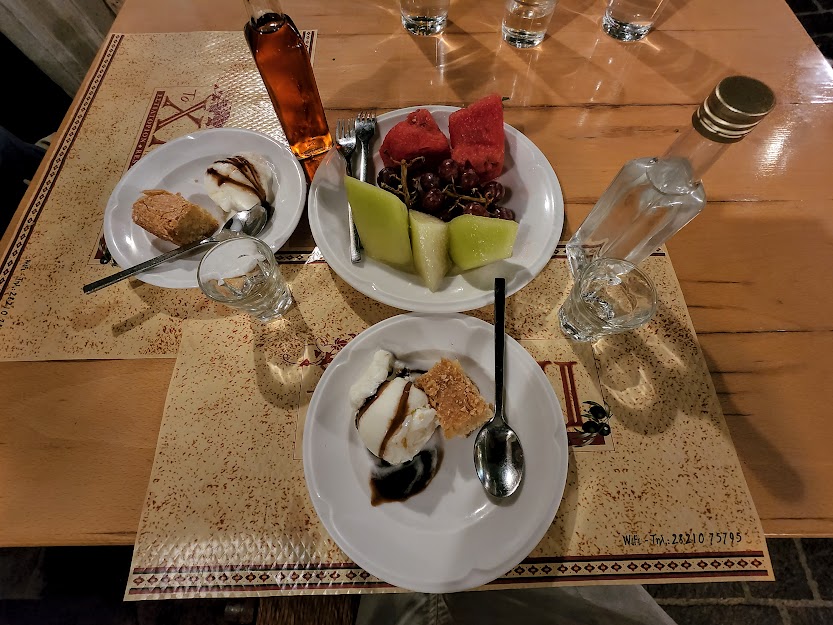
The waiters, even though they’re running from one end to another, make you feel they’re really happy you’re there. The kerasma, the treat of the “house” at the end of the meal, is not only raki, but also rakomelo (with honey) and not only karpouzi (watermelon) but varied fruit, ice cream and cake as well. Wow!
Another music restaurant is “Adespoto,” which has a sign on its old stone entrance saying it was used as a location for the film “The Two Faces of January” with Viggo Mortensen. A cat walks by seemingly unimpressed with that fact.

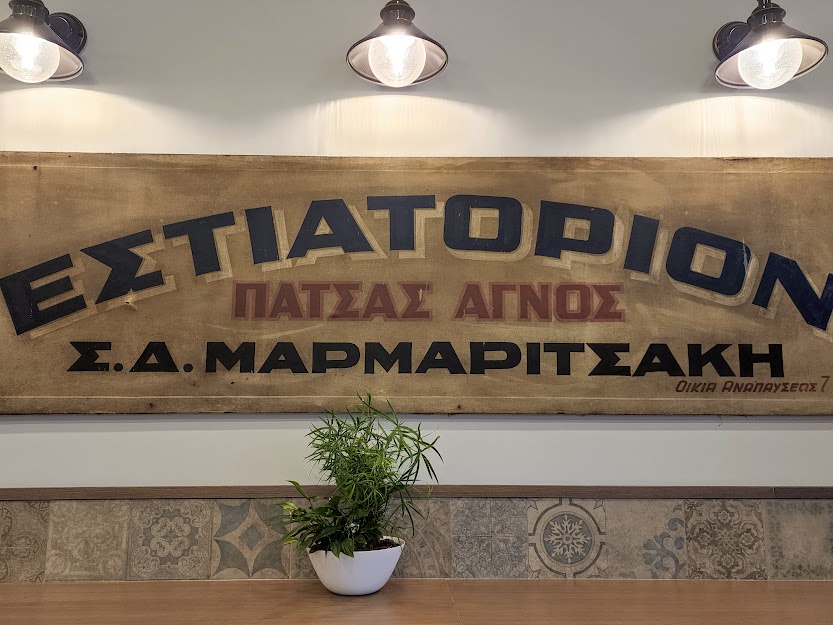
If you have a nice terrace or balcony, you can get se paketo or take out, tasty Cretan cooked food at Marmaritsakis, which used to be in the historic 1911 covered market, unfortunately closed now for renovations until the end of 2023. Now near 1866 Square (so named for a Cretan uprising, it’s the old style see-what-we’ve-cooked -today mayeirio, with dishes in huge pots. We talk one evening with Kyrios Stamatis as Kyria Sofia makes a delicious fresh Cretan salad with sundried tomatoes, lots of mizithra (Cretan soft white cheese), dakos (rusks softened by the olive oil), onions , fresh tomatoes, cucumber and peppers. In their new sparkling clean place, they’ve put on the wall the old restaurant sign from the market.
Looking for Cretan music and dancing? Your best bet is one of the paniyiria, celebrations held outside the town, where you definitely need a car to get you back at the wee hours of the morning. Ta Chalkina, the restaurant along the harbor which has had really foot stomping Cretan music in past years, was a lot more subdued this year.
We were looking forward to the Cretan dancing every night at the August Agricultural Fair but for some reason this year it was held earlier in July (?) But the town sponsored another music/dancing event every Tuesday evening, what they called a traditional “strata” — the word coming from the Italian “strada,” (road); in Greek the “d” became “t” and it has the meaning of “way,” or “walking” (in years past — and maybe still — yiayiades or grandmothers could be heard encouraging their grandchildren to walk with the expression said in a singsong voice “strata stratoula…”).
We found the musicians and dancers first at the bastion outside the naval museum

Then the “strata,” with the dancers and musicans walking while playing the lyra and lauto much to the amused looks of diners. The troupe ended up at the main cathedral square on Halidon st. where more musicians were waiting, and the bagpipe (askomandoura) player started in. Hours of music and dancing followed, with lots of audience partipation.


After the 1st dance, one of the dancers got a very public proposal of marriage (unfortunately I got the picture after he got up from his knees) and she went around showing off her ring)

Besides the “strata,” there were many planned music festivals like the Cretan world music festival,

to an impromptu “Zorba” dance on the harbor with a little breakdance mixed in.

As I’ve mentioned in previous blog posts, we stay at the delightfully named Casa de l’Amore on Theotocopoulou Street on the western side of the palia poli (old town.) We have known owner kyrios Giorgos for years as he was next door to the place our son lived when he was studying at the Polytechnic University in Chania. Across from us we look down at the breakfast diners at the newly renovated El Greco hotel.

I can’t resist putting this photo again, this house at the end of Theotocopoulou called the “honey moon rooms.”

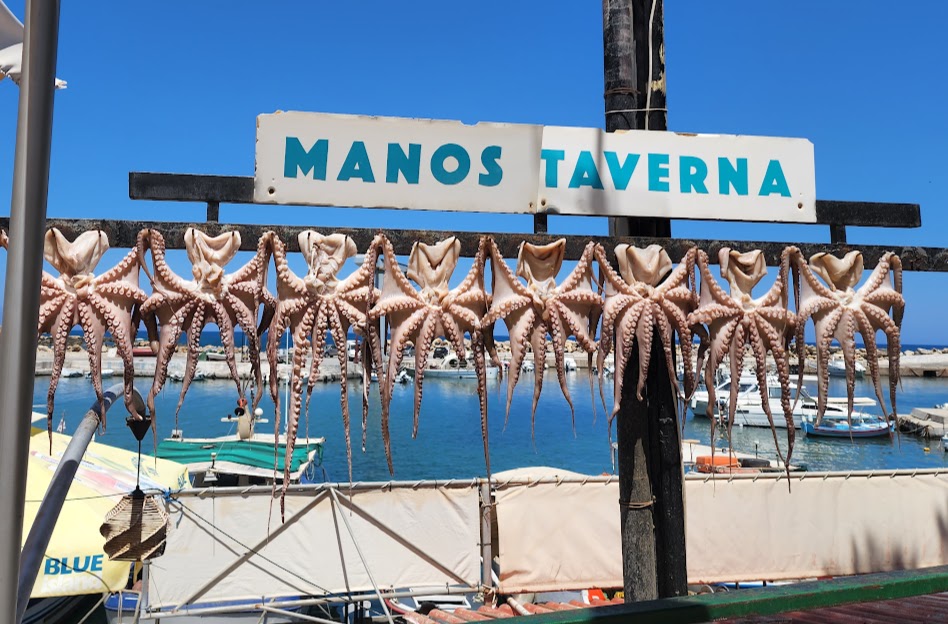
From our place it’s an easy walk west to Nea Chora, which besides the long sandy beach, is full of seafood restaurants. Manos is showing off its catch.
Although it’s become pretty tacky, we can’t miss a visit to the calm green sea at Stavros on the Akrotiri peninsula, east of Chania. “Zorba’s beach,” at Stavros, where Alan Bates and Anthony Quinn danced in Zorba the Greek, capitalizes much on this connection with its overpriced sunbeds and umbrellas, (Tip, take your own, you’ll need one, there’s no shade.) The stark camel mountain blocks wind, so it’s always serene and delightful.


It’s in Stavros that we meet up with my friend Karen, who has just published a book about her many years of living in a tiny shepherding village on Akrotiri outside Chania. Entitled Island Almanac: Seasons of a Life in Crete,” it’s a beautiful book of a year in the village, the changes in seasons, observations of nature and rituals, enhanced by photos, watercolors and Karen’s own poetry. It’s available through Mystis Press.

Twilight is beauty. At dusk, as on many islands, people line up to watch the golden colors of the sunset. In Chania, what makes it so special is the reflection of the lighting of the Venetian faros (lighthouse) in the water.

What a magical feeling to walk along the ramparts toward the faros.

Too bad that so many have the same idea …

One evening we watch the sunset from Kastelli, the hill behind the mosque, where a lot of excavations are going on along Karnevaro Street. it’s a great view of the harbor and evening stroll.

Some hours after the sunset and the sunset watchers are dining, drinking, walking along the harbour, the half moon starts its descent over the shapes of the old Venetian harbor.

And further south in Matala, the caves stay silent with their many secrets, while over the bay, the moon and stars shine in the Matala night.
Farewell Crete, we’ll be back!
This blog is dedicated to the memory of Vaggelis Pavlou (1964-2022), friend and former colleague, and lover of Crete, who left us too soon. Dear Vaggeli, rest in peace.
If you like what you read, hit the like button and subscribe. Please share with your friends and social media. I’d love to hear your comments below.
There’s no need to log in to leave a comment. Just give an email address and your name.
Subscribe to become part of the olivesandislands community! Get new blogs and occasional newsletters delivered directly to your inbox. It costs nothing to subscribe. Olivesandislands does not share email information.
Note: Be sure to click on the confirmation email after you give your email address.

Sherri Moshman Paganos is a writer and former educator, inspired by her life in Athens, where she and her husband are happily retired and enjoying their travels in Greece and abroad. You can check out her writing — fiction, non-fiction, poetry and articles here.


Sherri, this is so interesting. I want to catch the first flight to Crete. Maybe soon.
LikeLiked by 1 person
Thanks Georgia. Yes, go! But wait a little for the crowds to leave and take the day boat — it’s really pleasant.
LikeLike
Really enjoyed the details about Matala, i.e. the Mama of Matala. And I found the inclusion of video clips interesting and fun, especially the one with Joni Mitchell’s “Carey”. A lovely song that brings back many good memories. Thanks, Sherri.
LikeLiked by 1 person
Thanks Nancy, glad you enjoyed the blog and clips — such an interesting time wasn’t it…
LikeLike
Marvellously talented in your descriptions, as always, dear Sherri! The places came to life for me, compelling me to leave everything and dash off to Crete immediately! You really tickled my over enthusiastic palate with all the scrumchious yummies you have referred to and the photos are amazing! What tourist agency would not hire you as advertiser? I would also like to thank you for all that I learn through your inspiring blogs! As for Vaggelis, he used to visit Crete often, as he has good friends there. We never got to go there together as we were planning to, in post- covid era… May he rest in peace… Perhaps, that’s what he wished for, after all: to be whisked away by the sea to the white shores of Crete…
LikeLiked by 1 person
Loved your comments Sophie! ❤️ So glad you enjoyed the blog. As September is fast approaching, then next summer your travel plans can include Chania! And let’s have a glass of wine or Cretan raki to the memory of Vaggelis, our dear friend.
LikeLike
Ah, you’ve made me “homesick”! I lived in western Crete for 16 months between 2009 – 2011 and try to go back at least every other year. I’ve never been to Matala but have friends who go every summer for the festival. I had no idea about the caves and the hippies – so interesting! I confess that on certain Mondays, I have entertained ideas of running away to live in a Cretan cave:-) Your photos are gorgeous – you have really captured the beauty and soul of the place. Thanks for the trip down memory lane! (PS: Credit to Matt Barrett’s Greek Guides Facebook page for posting this blog entry).
LikeLiked by 1 person
Hi Kirstyn, thank you so much for your comments. I think we’d all like to escape into a Cretan cave at times! How wonderful you lived in western Crete — there must be a story there… If you’d like to follow my blog to see other posts on Greece, that would be great.
LikeLike
Sherri, I enjoyed this episode. You take the reader for a tour of the island that is not discoverable to the normal tourist.You and Elias have spent years discovering the island. I hope to visit some day. Ann
LikeLiked by 1 person
Thanks Ann. Actually one could have a blog only on Crete, there’s so much to discover and write about. Hope you’ll make it one day!
LikeLike
Sherri, You really brought everything to life for the reader here. As always, your descriptions are full of all the tastes, sounds, sights, historical facts, and even a musical touch this time. Just great!
LikeLiked by 1 person
Thank you Sue!
LikeLike
And somewhere in that ‘old Venetian harbour’, as the sun begins to set, in that orange ray of light, we see Vangelis sitting outside a mezedopoleio, raising a glass of raki to you, and smiling, he says, “Geia mas, Sherri, and thank you.”
LikeLiked by 1 person
What a wonderful image Stella. I would love to imagine Vangelis just like that.
LikeLike