It’s been a long summer with record heat and devastating fires. Just now, deadly storms and flooding on the U.S. east coast. All over, signs of climate change.
Remembering Mikis Theodorakis
The news of the death of 96 year old Mikis Theodorakis, the great Greek composer, reached me when I was about to publish this blog post. Outside Greece, Theodorakis was most famous for the music for “Zorba” but he actually wrote about 1,000 works of music from symphonies to film scores to popular songs. Over the years his songs have brought me reflection, tears and a lot of joy. It’s hard to think of Greece without his presence. As one of his singers said, “It’s like a column of the Parthenon has fallen.” I’m grateful for the time I saw him conducting his orchestra, with his grand gestures and his characteristic mane of black hair, in the Roman Agora in the 80’s. Instead of the played-everywhere “Zorba,” here’s another clip, one of him from 1977. The singer shown was one of his favorite performers, Grigoris Bithikotsis (who he met while both were exiled on the island of Makronisos during the Greek civil war after WWII.) This stirring song “Tis Dikaiosynis ilie Noite”(The Sun of Justice) is from a longer poem Axion Esti by Odysseas Elytis (who won the Nobel prize for literature in 1979). The chorus repeats the plea “Please do not forget my country.” The sound in the video is not the greatest, but note the crowd, it’s really electric.
Theodorakis has a connection with the area of Arkadia, as you will see a little further on…
Lykaio
After nearly a year, we decide that it’s time to visit our house in Lykaio Arkadia in the Peloponnese. Last summer I wrote about a visit to the province of Messinia, and the western coast (palace of nestor, methoni). Arkadia: the name conjures up images of Pan, the god of the forest, playing the pipes, with shepherds tending their flocks not to mention the beautiful nymphs cavorting around in nature. Well, although we saw no sign of Pan, we did see a number of sheep and actually awoke each morning listening to a ripple of sheep bells in the valley below. In fact, little has changed over the years in our Arkadian village.

Nafplio
Before arriving, we stopped, as we often do, for a swim in Nafplio, chosen as the first capital of Greece in 1829 after the end of the war of independence, and just about everyone’s favorite town. From the small rocky beach you can look up to the cliffs with pine trees and giant cactus, and the imposing Venetian fortress of Palamidi at the top (you can challenge yourself with the walk up 999 steps, but not recommended in the summer sun)
The turquoise sea is nearly always calm.
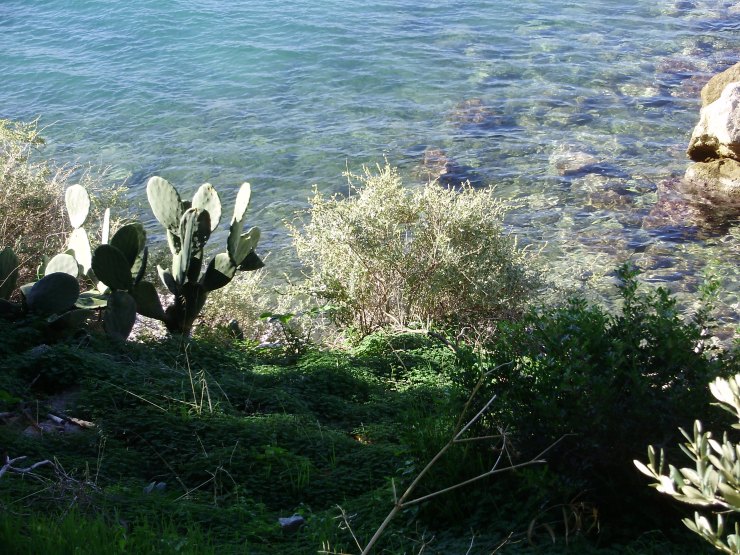
Back in the early 80’s there was a disco below Palamidi. The disco closed long ago but the eyesore ruins remain to remind us of the ugly aesthetics of the 70’s (lower right of photo).

Nafplio is a wonderful place to walk around with its neoclassical buildings, winding streets and cafes by the port (I describe Nafplio more in my blog post City Pleasures, Country Treasures.)
The province of the Argolida around Nafplio is mostly flat farmland, but as you head toward Tripoli, capital of Arkadia, mountains loom on all sides of you. As so few cars take this road anymore, you still see ruins of once bustling cafes and restaurants.
Theodorakis house arrest / Sto perigiali
A little digression here: near Tripoli, Theodorakis was under house arrest in a remote village called Zatouna for a period during the junta years (1967 to the end of 1973) and his music was banned. When he became a worldwide symbol of resistance, the government was forced to let him leave the country, where he went to Paris. But before he was allowed to leave, a military court summoned him to Athens. Accompanying him was a policeman. As fate would have it, this policeman was Elias’ uncle, the brother of my father-in-law. Along the way he supposedly said to Theodorakis, “Such a leventis (fine brave man), I wish I could let you go.” (This story was often told but I never heard what Theodorakis said in reply).
I offer one more song. It’s hard to choose, but this is one of my favorites. In this song, music is set to a poem by Giorgos Seferis, another Greek Nobel prize winning poet (1963).The song is called Sto Perigiali To Kryfo meaning “At the secret seashore.” See Seferis’ poem –original title “Arnisi” or “Denial”– and an English translation. Ah, that sweet sound of the bouzouki. It seems that tenor Marios Frangoulis is having a great time with the crowd, who know of course all the words to this moving and lovely melody.
There are three days of national mourning. So, rest in peace Mikis, and back now to my (mostly) Arcadian odyssey.
Southwest of Tripolis we skirt the town of Megalopolis (“large city”) but long ago it lost the grandeur it once had in ancient times; now it’s a sleepy little town that employs people working for “DEH,” the national electric company and the smoke from its coal-burning chimneys dominates the landscape there.

Village of Lykaio
There are two kinds of country houses or exohika — the kind you choose to buy and the other type, all too common in Greece, is an inherited house that you might not really want. (Guess which one fits ours). The house in the horio (village) of Lykaio (about 1,000 meters elevation or 3,200 feet) is a good half an hour on foot (or donkey) from the Hani (meaning “inn”) where my father-in-law spent his childhood. It’s where travellers on the way to or from Megalopolis stopped at his father’s place to drink some of his homemade wine and rest their weary feet or give their horse or donkey a rest. (We’re talking about the 1930’s, 40’s and 50’s).
For me, mountains inspire awe and respect, but it’s not the same as the love I have for the sea. (Though with this summer that was so beastly hot, the cooler mountain air can really be a blessing).
The villagers are friendly but a little suspicious of outsiders; if you take a walk by yourself and run into another villager you don’t know, they stop, look you over and ask you either poios eisai (who are you) or even worse (!) tinos eisai literally “whose are you” or “of whom are you.” (“Daughter in law of Theofilos Paganos” satisfies them). Sometimes I’ve found that the person asking is related (Looking into the village cemetery headstones you can see about four common names, with “Paganos” one of them). But with this insularity, the village will stay unspoiled with nature reigning. Not bad to have such a refuge in this world.

While our area is really off the beaten track, some of the villages in Arkadia near Tripolis are more well known and have many tourists, especially in the fall and winter. (More on a future blog…)
My father-in-law, who bought the land and built the house over 30 years ago, found it the perfect place to cultivate his grapes, make his wine, grow his tomatoes and other vegetables, gather the walnuts and look down the valley to Hani, his childhood house, and to play ferocious games of tavli (backgammon) with his friends at the village cafeneion. (More on the house and horio in “City Pleasures, Country Pleasures.”)
When he died 13 years ago, the house became pretty much abandoned for a while with our rare visits. Finally we reached a point where either we let the house fall to ruin or do major repairs. We decided on the repairs.
We found that we were sharing the house with mice, ferrets and other creatures who delighted in the holes in the keramidia (tile roof) that had developed over the years. When the workers opened the roof last September, they not only found mice settling in there, but even found walnuts they had carried up there to sustain them for the winter!

My father-in-law had tossed all sorts of junk around with no thought about it. He had installed an outdoor oven which couldn’t be used because of all the garbage around it. Take a look at the “before” and “after” photos.


Okay, I know what you’re thinking, that the “after” doesn’t look much better! But it really was cleaned up and painted. Now you can get at the wood for the winter. Also note the new stone patio.
The center of action in the village was/is the cafeneion. Notice the morea (mulberry tree). In fact the medieval name for the Peloponnese was the Morea after these trees that are characteristic and seem to be everywhere.

Near the cafeneion and in back of the church is the old school, where in fact my father-in-law used to walk to, from the Hani. The sign is still up though it hasn’t been used in 50 years. A chicken is also taking a walk.

Some of the houses are really fixed up nicely. Their owners come regularly to work on them and their land. The second house seems a little incongruous with the village simplicity.


Other houses have been left to abandonment. Note the two magnificent morea trees.

After all, the horio doesn’t offer much except a quiet refuge, so as with many small villages, the population is mostly elderly. In the winter live barely 10 or so residents, including stooped over Violeta, whose real age no one knows but she must be past 100. She still keeps a few goats and sheep in the front “yard” — dozens of them used to mill around outside her house.
There’s Telemachos in snowy white hair and moustache, who hobbles through the village with his cane. I still picture him doing the tsamikos (Peloponnesian dance) and gesturing while he used to give political speeches. We did some reminiscing about the amazing whistling system from a distance that he and my father in law used to show they were free to play tavli. No phones, just whistling.
Soula’s house, across from the main plateia, is like a meeting ground for all who pass by. “Come and sit for a coffee or a drink. Do you want a cookie? I’ve just taken them out of the oven.”
As their father used to do, Ilias and his brother keep the cafeneion. But others have the key and open it when there’s a need.
Near our house, Yiannis and his brother Dimitris offer us figs picked from their tree. How fresh and succulent!

Planning food can be difficult. You have to remember to take everything with you. The nearest market is a half hour drive down the winding mountain road to Megalopolis. We cooked a melitzana (eggplant) yiachni, a stew with also potato, carrot, fresh tomato, parsley and basil) using both the purple and white variety of eggplants (which has tougher skin but sweeter inside). It’s delicious with feta and/or plain yogurt. We also made a tortellini with green onion, fresh tomato and parsley and basil. Both eggplants and tomatoes are plentiful now; at the laiki (fruit and vegetable market) you can find them for as litttle as 50 cents a kilo.


The cafeneion used to sell a few items like beer and soft drinks but no more. The plateia next to the cafeneion is the only place to get good wifi.
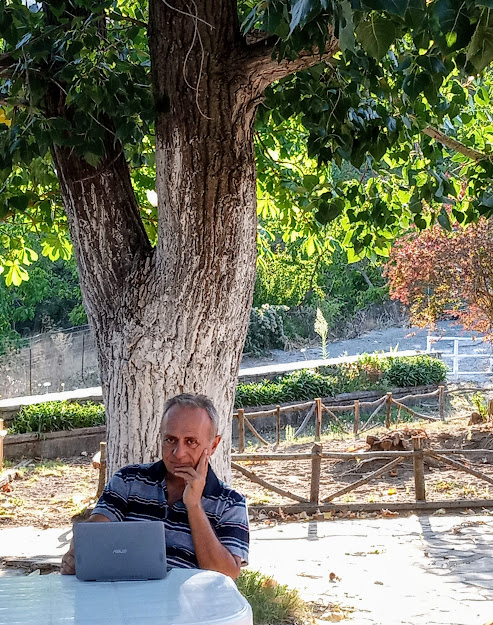
The plateia also holds a major plaque on the 1821 War of Independence. Arkadia was actually in the forefront of the fighting, and the plaque has a poem of lament, a miroloi,of a mother mourning for her fallen sons. In the list is a “Stefanos Paganos” — the family has been in this area and village at least 200 years.

At night there’s nothing to do but sit outside on the patio and look at the sky. The rising moon was playing hide and seek with the clouds.
Some village cats settled down with us to snooze after sharing some dinner. We were listening to some lovely songs about the full moon, but kept turning off the radio to hear the chorus of night birds.
The summer darkness has a beauty but you certainly don’t want to wander around after dark.The area is full of wild boars. We saw tracks not only outside the village but even near the plateia. No joke.
Speaking of wild boars… a year ago we were on the road toward Kalamata when we passed a truck of hunters, who had parked and seemed to have a large animal in the back. We stopped out of curiosity … so here I am with this literally bloody boar. I have mixed feelings that I’m posed here and showing this picture. But you get an idea of how huge these animals are: 120 kilos or 265 pounds.

Hunters consider it a real prize to nab a boar. A relative of ours in the area had meat from the animal for the whole year. The boars do seem to be plentiful in the area…
So much for hunting. This year we were busy cleaning,

Lykaio Oros (Mt. Lykaio)
But last year we visited some of the ancient ruins nearby. It’s not only the war for independence in modern Greek history that Lykaio and surrounding villages were active in, but the area also played a role in the ancient world.
In ancient times this area was called Lykaio Oros, Mt Lyakio, the holy mountain, where Zeus was born (wait a moment, wasn’t he born in on Crete?) Wasn’t he ruling the gods on Mt Olympos in Thessaly in central Greece? (He really got around!) Actually there are a number of “holy mountains” or areas called “Olympos.” So Arkadia is said to be where where the ancient Greeks first worshipped Zeus, and the sanctuary was established around 3000 years ago. The mountain peak was for Zeus and a lower sanctuary was dedicated to the god Pan.

Lykaion means “wolf” and the name comes from a gruesome legend. Plato and other ancients linked Mt. Lykaion to human sacrifice to Zeus. Those who ate the human part, according to the legend, became a wolf for 9 years and could only regain human form if they didn’t eat human flesh for those 9 years. (That didn’t seem to be too much to give up). Another part of the legend is that Zeus turned King Lykaios into a wolf after he’d betrayed him and gave him some human flesh. In any case, human sacrifice might well have been involved, as some human bones were found near the site. But in any case, what is certain is that from 1500 BC to 300 BC, tens of thousands of animals were sacrificed to Zeus.
Pausanius, indefatigable Greek traveller and geographer of the 2nd c. AD, wrote the following about the altar of Zeus:
“on the highest point of the mountain is a mound of earth,forming an altar of Zeus Lykaios, and from it most of the Peloponnesus can be seen. Before the altar stand two pillars with gilded eagles. On this altar they sacrifice in secret to Lykaion Zeus. I was reluctant to pry into the details of the sacrifice; let them be as they are and were from the beginning.”

What exactly happened at these sacrifices is not known. But we do know that Zeus was also honored with athletic games, like in ancient Olympia, held every 4 years from the 7th century BC. There’s a hippodrome area where they had horse races: chariot, horseback, and foot races, as well as pentathlon, wresting and boxing. There’s a “xenonas,” a kind of hotel for guests to stay, a bath facility, fountain house and administrative building.

Heading down, you pass the Lykaion oros fountain, the usual flock of sheep or goats, and a lovely view of the village of Lykaio below.


Ancient Lycosaura
The other important sanctuary in southwest Arkadia is ancient Lycosaura, said by Pausanias to be the oldest city in the world though this is much in dispute as there’s no evidence for its existence before the 4th c. BC. This is the sanctuary of the goddess Despina. There’s a modern village of Lycosaura (meaning “wolf lizard”) with the usual stone houses and reddish roofs. A steep road leads up to the sanctuary. First you see the area where there are various Hellenistic and Roman ruins of hydraulic function: an ancient fountain and cistern and Roman baths, and city wall remains.

After you traipse around there for a while, you cross over the road to visit the tiny one room museum. The guide looks surprised that anyone has stopped here, and shows you a few items inside, including the rendition of a famous colossal sculpture that was found in the sanctuary, of Despoina and her mother Dimitra. There’s also a picture of Despoina and Dimitra on the throne, guarded on each side by Artemis, goddess of the hunt, and the Titan Anytos on the other side (both looking smaller than the ones governing). This picture was found on ancient coins in the area. The original heads are in the Archaelogical Museum in Athens.

Then you head down down down some wooden stairs to where the actual sanctuary was. Just to get the family tree in order, who was Dimitra and who was Despina?
Dimitra (Demeter) is the goddess of the earth and agriculture and with Zeus, she is the mother of Persephone, goddess of the underworld. Persephone’s less famous half sister Despina is the daughter of Dimitra and Poseidon, god of the sea. Legend has it that Poseidon “desired” Dimitra, and in order to get away from his advances, she escaped to Arkadia and disguised herself as a horse among a group of horses belonging to a local King. He found her though, recognized her divinity and mated with her. Out of this union, she gave birth to an immortal horse and the goddess Despina.

Despina is actually not a name, but a title meaning “our lady” or “mistress” – (in Greek, you address a young unmarried woman with despoinis —kyria is for a married woman) The real name of the goddess of the sancutary was not known, as these were secret ceremonies like the ones in Elefsina. Later the name “Despina” became connected in the Greek orthodox religion with the Virgin Mary (‘our lady”) and the name day for Despina is the same as it is for Mary, August 15 (the Assumption).
Pausanias wrote “I am afraid to write to the uninitiated” which sounds like he knew the real name but was not divulging it, or else he was bluffing…This worship was known as the “cult of Despina,” always a local cult, tied to this particular sanctuary at Lycosaura, It never became anything panhellenic, probably due to the mountainous and isolated location of Arcadia.

In the sanctuary area, where you hear the wind continually, like the sound of running water, are ruins of a temple, stoa and theaterlike seats next to the temple, also several altars. The sacrifices to the gods were not as gruesome as those in Lykaion Oros, but still unusual. Instead of cutting the throat of an animal, the usual procedure, a limb was cut off and offered.
Back up at the top of the wooden stairs, our guide wishes us well and sits back to his isolated post for the rest of the afternoon, listening to the wind in the pine and cypress trees.

We plan to return to the village the beginning of October when the walnuts are ripe and the ground all through the village is carpeted with walnuts. So we set off on the second leg of our trip, to drive through the Langada Pass, the old road through the Taygetus mountains from Kalamata to Sparta (province of Lakonia) and then down to Gytheio, at the entrance to the Mani.
Langada Pass – old road from Kalamata to Sparta
In 1989 we had driven this road at night at a wedding, with the ceremony in Kalamata (where the bride was from) and the reception in Sparta, home of the groom. Back then, this was the only road through the Taygetus mountains and I remember saying “what a shame to be riding through this in the dark and not seeing anything.” After 32 years, we finally made it back. The road is not easy to find, as is the case with most of the old roads without toll; everything steers you to the “new” national toll road. They figure you’re always in a hurry and don’t have time to take the more scenic route, and this route for sure is scenic, one of the most beautiful roads I’ve been on. A little hard on the brakes though. The Taygetus mountain range is the highest in the Peloponnese and the name is one of the oldest recorded names in Europe, appearing in the Odyssey.

As you pass through the gorge and you ascend, the trees change from pine to spruce. I also notice many plane and oak trees. Lots of signs warn you about falling rocks. I would imagine it’s a little dangerous in winter and certainly not a road to make wedding guests take at night! I saw a couple of driving lesson cars, one near the entrance from Kalamata and another near the entrance for Sparta (quite a challenge for beginning drivers!) I guess if you can drive there you can drive on a straight town road …


There are springs of water, makeshift stalls selling honey and tomatoes, and a few tavernas along the way, deep into the shade of trees. You feel a pleasant coolness through much of the ride.
At the very top is a memorial marker as in many places in the Peloponnese remembering the partisans in World War II.
Near Sparta, you pass the infamous chasm of “Kaida.” It was Plutarch in the 1st century C.E. that started the story about the Spartans throwing off the weak infants judged unfit to live but only adult bones have been found there. It’s believed that criminals were thrown into the chasm, but this was apparently not done for infants.
Some villages on the slopes of Taygetus date from medieval and Byzantine times, such as Mystras, that we visited in the 1980’s. Mystras is the ruins of an ancient byzantine civilization and a UNESCO heritage site. Definitely worth another visit but again not in the summer sun. Another future blogpost.
Gytheio
The road from Sparta to Gytheio takes you through the usual car dealers and tire places. It could be a small town anywhere in the country. But in a roundabout leading to the road to Gytheio you suddenly face a giant helmet, perfect Sparta symbol.

Near Gytheio, you can see evidence of the fires that affected much of Greece the end of July/beginning of August.

While much of the country suffered from the fires, the hardest hit area was northern Evia, where for 8 days the fire burned, causing a major ecological disaster in the country along with a loss of home and property. Mt. Parnitha outside Athens was also on fire. Here’s a sunset from our balcony in Athens during that time.

Gytheio was the ancient port for Sparta. Today it’s well known for its seafood restaurants and neo classical houses.

Unfortunately we never got a chance to check them out — we had planned to use Gytheio as a base to explore the area of the Mani but we had to return to Athens for an emergency family issue. So the Mani will be a future Peloponnese wandering and blog post. (Another one!) We did manage a quick swim at lovely Mavrovouni Beach to cool off and clear our minds before heading back at record speed (so much for the slow scenic routes).

In this uncertain time, wishing all a good autumn in the months ahead, with love, music, art, and above all, health.
If you like what you read, hit the like button and subscribe. Please share with your friends and social media. I’d love to hear your comments below.
There’s no need to log in to leave a comment. Just give an email address and your name.
Subscribe to become part of the olivesandislands community! Get new blogs and occasional newsletters delivered directly to your inbox. It costs nothing to subscribe. Olivesandislands does not share email information.
Note: Be sure to click on the confirmation email after you give your email address.

Sherri Moshman Paganos is a writer and former educator, inspired by her life in Athens, where she and her husband are happily retired and enjoying their travels in Greece and abroad. You can check out her writing — fiction, non-fiction, poetry and articles here.


I really enjoyed this article Sherri. I feel the same way about Mikis Theodorakis, his music gives me goose bumps. I loved the story of Ilias’ uncle escorting Theodorakis to court! And your village sounds a lot like ours. A lovely read!
LikeLiked by 1 person
Thanks Nancy. Greece without Theodorakis and his music is indeed unthinkable! And I guess small villages all over have a lot in common.
LikeLike
Very enjoyable! I’m always amazed at the history that is literally under very stone and village in Greece. Looking forward to your next entry.
LikeLiked by 1 person
Thanks Ginny! True, we saw that when they were digging the metro. And not only.
LikeLike
Another article full of historical facts, information, pictures, places, and personal observations – and as always, written with love and appreciation. I enjoyed what you wrote about Theodorakis also. His music will go on forever, loved by all.
You did an excellent job of depicting everything and sharing family details.
LikeLiked by 1 person
So glad you enjoyed it Sue. Loved your comment and on Theodorakis’ music.
LikeLike