I. The days might be still warm and sunshiny and the evenings you’ll need but a sweater, but Little Kook, the sweet shop in the neighborhood of Psyrri near Monastiraki, is already in its Halloween mode in lurid purple. Always decorated with exuberance, allure and kitsch, Little Kook charms the most jaded passerby, whatever time of year.

To complete the whimsy, across the street, a giraffe is peering at the decorations through its binoculars.

This summer Athens overflowed with cultural events – everything from jazz ballads with a piano and voice to string orchestras of classical music to Greek popular music with bouzouki virtuozos. The end of the summer many singers and venues had tributes to Mikis Theodorakis (see previous blog). It seemed that all the municipalities got into the act this year.

The Niarchos foundation had its Nostos music festival (a word meaning “homecoming, the root for the word”nostalgia”), after the sun went down and the last kayak docked on the canal. The festival was very organized and even regimented — you had to not only pre register for events but show I.D. and proof of vaccination to enter or you could take a rapid test on the premises and wait an indeed rapid 15 minutes for the result.

Not only music but theater and cinema – – in its 11th year, the Athens open air film festival shows quality films in its various city venues, from near Mt. Pendeli, the palace of the Duchess of Plaisance — or Doukissis Plakentias as she’s known in Greek, with a metro station named for her too — (the Duchess was a rather eccentric figure in Greek high society in the decades after the Greek revolution) to the Byzantine museum (another one of her residences actually) to parks to outdoor cinemas in Athens. Other venues in recent years have been the Temple of Olympian Zeus and under the Acropolis.

And once again we had an open air cinema right across the street from our house – and I nearly mastered the art of staying awake at the 2nd showing at 11 pm.
September certainly is a lovely time to go away (for retirees) It’s still warm and sunny in daytime, with the sea glassy and calm, but the city is still rich in cultural events.

Besides outdoor events, we decided this past weekend to pay a visit to the restored “Ethniki Pinakothiki,” or the National Gallery of Art. Looking at art was surely one of the activities we missed during lockdown.

The museum has been closed for eight years (!) for a total makeover, and reopened to the public at the beginning of the summer.
Besides renovating the galleries and expanding the museum to twice its former size, I imagine they were putting in state of the art alarm systems, for back in January 2012, there was a heist. A Picasso, a Mondrian and a pen and ink sketch by 16th century Italian artist Guglielmo Caccia were taken – a piece of cake for the thief, a professed “art lover” as he called himself. Apparently he just brazenly walked in through an unlocked balcony door in the middle of the night! Several months ago, on a tip, the police finally found and arrested him. He surprised them by confessing immediately and led them to a hiding place where the Picasso and Mondrian were “wrapped in protective plastic” – the Italian print however was destroyed. Newspaper accounts of the time talked about “thieves” — they couldn’t believe it was only one person!
While waiting on line (a long one as the last weekend in September is European heritage days with free admission in E.U. countries to museums), you could watch a bored looking juggler at a traffic light or you could look up at Lycabettus hill, the highest hill in Athens, with the little church of Ai Giorgi (saint George) at the top. You can reach it with a teleferique or if you’re energetic, walk up where you have a great view of the city spread out below.

At the entrance you’re checked for an id and proof of vaccination. According to a recent law, museums accept unvaccinated only with proof of a negative rapid test within 48 hours.
Your first view as you walk into the cavernous space of the marble foyer is the joyful monumental work, “Street Market” by Panagiotis Tetsis, which captures in vibrant colors, in an abstract kind of way, all the exuberance of the market. It reminds me of the artist Jacob Lawrence, in his street scenes. The photo gives you an idea, but doesn’t really do it justice, as it’s only about half of the work.

The main feeling you have in the museum in fact is SPACE, so even if it’s crowded, as it was, you don’t feel squeezed or pressured to move on.
As it’s the Bicentennial year for the Greek revolution, the main floor features historical paintings of the 1821 revolution. Historical paintings of course were the record in a pre photographic era.
Most paintings seemed very romantic in the style of Delacroix and the French romantics, inspiring patriotism and nationalism. After all the battles and revolutionary figures and religious fervor attached to the fighting, one painting caught my eye: Theodoros Vrizakis’ “Farewell at Sounion.” This was a warrior sitting with his love in a kind of pastoral tradition, saying goodbye as he leaves for battle – they’re dressed in the revolutionary costume of the day. Way in the background almost unnoticeable is the temple of Poseidon at Cape Sounion.

The rest of the floor is other 19th century Greek painting. There are helpful explanations on the wall in English and Greek that explain schools and movements of art. Regarding impressionism, we’re told one reason it didn’t really take off in Greece is because of the clearness of the light here — the lack of clouds to create the luminosity of impressionism.
Along with symbolism near the end of century, genre painting was very popular, with scenes of everyday life, as in Nikiforos Lytras’ painting of “First Steps”

and Nicholas Gyzis’ work “The Betrothal of the Children.” During the Ottoman occupation, this betrothal was a way of protecting young boys from the practice of being taken to be soldiers. The details are stunning. Note the expression on the girl and boy, as if “what’s going on?”
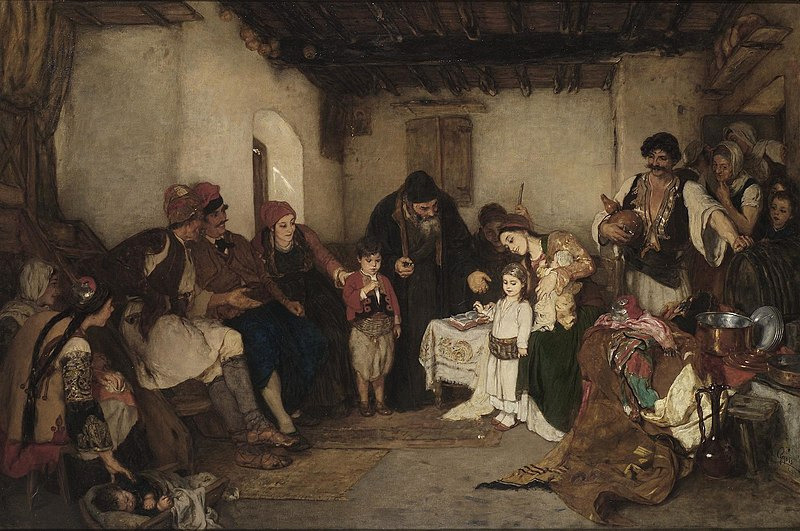
We saw that a number of the 19th century paintings (and early 20th) are on loan to the Louvre for a major exhibit until February 7 on “Paris – Athens, the Birth of Modern Greece.”
When you enter some of the totally abstract work of the 20th century, here is where you might say that means something but what. But as Picasso said (and could equally apply to music, poetry or any of the arts) “Why do we not try to understand the songs of a bird? Why do we love the night, the flowers, everything around us, without trying to understand them? But with a painting, people think they have to understand.”
Picasso was certainly an influence on Nikos Hadjikyriakos Ghikas’ paintings with its cubist feeling. His work really draws you in with its colors and shapes. Ghikas was part of the Modernist movement of the 1930’s, along with other artists and writers. You can see more of his work at the Benaki Museum in Athens and the Basil and Elise Goulandris Museum (which just opened a few years ago).

One of the characteristics of 21st century art was getting rid of the artifice of the frame. We can see this in “Mind Digger” by Alexander Psychoulis and then not only the frame gone, but we enter the non-painting realm completely with “Beauty & the Beast” (Michaelis Arifaris)


To reach the upper floors you can take the elevator or inner stairs, or more interesting, take the ramp on the outside. In the background is the Hilton, which was a controversial architectural wonder of the 60’s.

There’s also a tiny bookstore and a cafe below the main floor which wasn’t open yet, as well a a restaurant planned on the top floor.

After the food-for-the-soul visit, we took a little stroll in the neighborhood (where I lived for a couple of years when I first came to Athens) and ended up at Fatsio’s to take out some of their food-for-the-body to enjoy after our swim — it was indeed a warm day with cloudless blue skies. (Not good for impressionism).
According to the 111 Places in Athens that You Shouldn’t Miss, the owner, Georgios Fatsios, came to Greece in the mid 60’s and opened a taverna with Politiki food, i.e. from Constantinople (Istanbul). Now his son continues the tradition, keeping the decor the same — art deco on the walls and ceiling, whirling ceiling fans and atmospheric little lamps on the tables. Unfortunately, there’s no room to put tables outside (or maybe they don’t want to) but a few customers were there having the Sunday lunch tradition inside.


As it’s 2 pm, there’s not much left at the heated glass buffet. Their famed veal and eggplant is gone.
But there’s still zucchini stuffed with meat and rice in a heavenly tomato sauce, as we see in in this larger than life representation!

Along with summer culture, we were grateful that we could eat out again: in gardens, courtyards and by sea. Just as we dreamed of looking at art again during lockdown, eating out was also a distant dream. This time I’m including a piece written then (seems so far away now) that leads me down memory lane, comparing the food habits of childhood in the States of years gone by, with Greek cooking. If you grew up in the states in the 60’s, you might get a twinge of recognition!
II. Since lockdown took so many of the little joys that we were used to away from us – visiting museums, going to movies, eating fish by the sea -– we had to put our energy into something else. Especially with restaurants in Greece closed for six months, the daily “what’s for dinner” became the burning question. (Take out was available, but you don’t want to eat too much “dirty souvlaki,” as delicious as it is.) The lockdown meant a new focus on cooking, cooking with meraki, a hard to translate word meaning “love and care.” We were hooked on the reality show “Masterchef” every evening. The contestants made their own pasta, their own mayonnaise, their own sauces, they had fresh herbs available all the time. Their plates looked like fine Dutch still lifes. Why not us?
With so much taken from us, at least let plates of food awaken our senses, feast our eyes not just our stomachs. Growing up, I thought a sprig of green was as far as you go with a garniture or a slice of lemon if it was some kind of fish, which was always a variation on a frozen fillet. One of the differences then between restaurant food and food at home was that in the restaurant they decorated a dish with parsley. What guilt I feel now, all the uninspiring dinners I fed my kids years ago, frozen fish sticks or quick chicken schnitzel or spaghetti with primo gusto tomato sauce, when I was busy during the week with teaching and preparing lessons.
Preparing food in a hurry is how I saw my mother do it, trying to get dinner together for four ravenous children and a hungry husband. She would have laughed if you had said the lamb chops had to be garnished with parsley or dill or cilantro (what was that?) Food appealing to the senses was a nice idea, but who had time. In any case, food selection back then in the states hardly encouraged versatility. Cheese came in two kinds: an orangy yellow square wrapped in plastic, tasting of well, plastic, and a paler color of yellow (Swiss) with holes, also plastic wrapped and just as tasteless.
Muenster or cheddar were considered slightly daring. Parmesan came in a box with the taste of the cardboard. In his book Kitchen Confidential, Anthony Bourdain described the “stinky runny cheeses” that he tasted in France. To him, it was a revelation.
Of course you don’t need lockdown to appreciate and branch out with cooking. We started to learn to appreciate food more when I came to live in Greece and I saw it had taste! Simple but delicious. Fresh ingredients were just accepted to be part of the picture. And dishes took time, time to create and time to cook. During lockdown, slow cooking was perfect! We would return from our walks in the neighborhood or nearby Mt. Hymettus and turn our focus to cooking with meraki.
In contrast, the cookbooks back then in the states emphasized fast, get that food on the table for your hungry family. My mother’s cookbooks guided her; there was “50 Unforgettable Chicken Recipes” (the truth is they were mostly all forgettable). Help spare me from chicken ala king with Campbell’s cream of mushroom or cream of celery soup! There was also “365 Ways to Cook Hamburger” (again release me from those evenings of sloppy Joes, chile con carne and meatloaf).
Soup came in a can (Campbell’s of course), though to be fair, my mother did make thick soups for my father, with lots of onions and carrots, soups she learned from her mother: lentil, barley and borsht with sour cream — oh that purple hue, that smell, to this day I won’t touch anything with beets (which is too bad because beet salad is very popular in Greece). Soup wasn’t the only traditional eastern European dish; she also made cow’s tongue in raisin sauce, a dish I actually enjoyed when I was growing up, but as I remember, one day in my teens I told her I couldn’t eat it any more. (Not American enough? Who knows) She also had various Hadassah cookbooks, where members contributed recipes; there was always an overabundance of “kugel” (noodle pudding), brisket and pages of “super light matza ball soup for Passover.” (Later as she evolved in her cooking, she bought “The Meatless Gourmet” and “Jewish Cooking for Dummies.”)
From the 60’s staples like tuna macaroni casserole (that made my Greek husband gag), lamb chops and limp spaghetti with meat sauce, she gradually tried out some more adventurous dishes: chicken curry with pineapple, vegetable lasagne, or after a class she took on Chinese cooking at the Jewish Community Center, she fed us crispy egg rolls, but the process of chopping and filling and frying took so long that she vowed never to make them again, and she didn’t.
I would imagine that the lockdown in the states prompted many to discover the joy of slow and flavorful cooking. I couldn’t believe how delicious vegetables could be here: string beans, zucchini, eggplant, peas, leeks, okra, to name a few, cooked slowly with olive oil and sauce from fresh tomatoes and fresh herbs.

My vegetable experience growing up was mostly through Birds Eye; I don’t know which I disliked more, string beans or the peas and carrots that also sneaked in some nasty chewy lima beans, that I always picked out and left on the corner of my plate. Iceberg was the only kind of lettuce that found its way into salad, along with packaged tomatoes that had the taste of, you guessed it, the package. Arugula was unheard of. Fresh vegetables? I think once in a while my mother would buy an eggplant and slice it to make eggplant parmesan – that was very bold. In this era before foodies and cooking shows, there was only Julia Child on TV, but we tended to dismiss her: too French, too much butter.
The one French restaurant nearby was where my father would take us when my mother was overwhelmed with cooking dinner for her brood. If the food was indeed French, it was certainly adapted to bland American tastes. There wasn’t too much else then, a few Chinese places, all Cantonese, as I learned later, heavy on chow mein and gooey sweet sour sauce.
Still, this food was better than the TV dinners that my mother started buying when she went back to get her master’s degree. Presto: just open the package! Three neat little compartments on an alumninum tray that you heated in the oven. A recurring main meal – I shudder to remember — was Salisbury steak with gravy in one compartment, “puff potatoes” in another or some sort of salad (?) and an infamous apple cobbler or cherry crumble in the 3rd section. Although she avoided the fried chicken because she felt it was too heavy on fat, in truth all of the dinners were heavily processed with preservatives, and with extra salt and trans fat to make up for the lack of taste.
But she did have a fixation on low calorie, low fat or no fat (or as my father called it “no taste”) as he would smuggle into the house potato chips, salty peanuts and oreo cookies, as well as raid the chunky peanut butter in the middle of night (that she tried unsuccessfully to hide in the clothes hamper.) So by the time I asked her for her recipe for beef Stroganoff superb to impress a college boyfriend, she was substituting low fat yogurt for sour cream. The boyfriend was not impressed; his first dinner for me in fact had been a steak bearnaise (oh the calories! the fat! the cholesterol!)
She made a few concessions to calories, when she made pancakes (but the syrup was low calorie). Those pancakes! They sank to the stomach like lead and remained there for the rest of the week. Years later when I visited her from Greece with my children, she took to making meatballs with the same lead qualities as the pancakes. (“Are we going to have Grandma’s meatballs?” they would ask a little worriedly before the visit.) Meatballs and also baked chicken in orange sauce always waited for us. I tried at times to recreate “Greek dishes,” like yemista (stuffed tomatoes and peppers) and spanakopita, (spinach pie) but even when I had pretty much the right ingredients, they never turned out the way they did in Greece. Something missing with the meraki.

Besides the ladera, dishes cooked in olive oil and tomato sauce, and the delicious pasta dishes baked in the oven with lamb, I discovered fresh fish had heads and tails, and all you needed was salt and lemon to bring out the flavor. In the lowliest fish taverna, you can eat like a king, as we did recently with this plate of koutsoumoura (red mullet).

Those early years in Greece it seemed nobody thought of watching calories. But there was no need, as everything was naturally healthy. An exception was the sinful syrupy desserts, hardly of diet material.
On “Masterchef” for their creations, besides olive oil, they would use enough butter to make Julia Child proud, in addition to olive oil, the staple in all Greek homes. We get our oil in huge 15 kilo cans from a friend who produces it near Kalamata, the best oil producing area and we get honey also in large quantity, from friends of ours who keep bees on the island of Leros.

Toward the end of lockdown last May and with spring on its way, we started having vivid dreams of sitting in a taverna or restaurant either in a garden under a giant platano, or plane tree, or by the sea. What a thought, being served, no dishes, no pots to wash! Throughout the pandemic, no one suffered more than restaurant owners, having been closed for six months although some places (the souvlaki places mostly) did a great business with take out and delivery.
Now we’ve been able to eat out these last 5 months in gardens and seaside. But still when we cook, we try to continue cooking with meraki because food is care and food is love and joy.
And to set the record straight, souvlaki and pizza are certainly not the only take out food. And that’s the subject of the next blog.
If you like what you read, hit the like button and subscribe. Please share with your friends and social media. I’d love to hear your comments below.
There’s no need to log in to leave a comment. Just give an email address and your name.
Subscribe to become part of the olivesandislands community! Get new blogs and occasional newsletters delivered directly to your inbox. It costs nothing to subscribe. Olivesandislands does not share email information.
Note: Be sure to click on the confirmation email after you give your email address.

Sherri Moshman Paganos is a writer and former educator, inspired by her life in Athens, where she and her husband are happily retired and enjoying their travels in Greece and abroad. You can check out her writing — fiction, non-fiction, poetry and articles here.


Reading your blogs about Athens lures me back to the city. I look forward to visiting the new museums and eating at the popular tavernas. Thank you, Sherri
LikeLiked by 1 person
Hi Connie, thanks, I love what Athens offers. The city is waiting for your return!
LikeLike
We are fortunate to live in a place that is full of so many interesting sites, museums, cultural events, and wonderful food! I enjoyed reading your blog. Some of your American food memories sounded very familiar to me. Like you, I love the tasty Greek food. Indeed, it needs meraki, but it is worth every ounce of it that you give. I look forward to visiting the new Pinakothiki that you described so well. Thank you, Sherri.
LikeLiked by 1 person
Thanks for your comment Sue. We’re fortunate indeed. It’s definitely worth a visit, in fact would like to go back again. “Meraki” is a key ingredient, but unfortunately we don’t always have time. Maybe with the cooler weather, we’ll stay home more!
LikeLike
Really lovely tribute to the vitality and diversity of Athens. And I love the stroll down memory lane and our eating habits growing up! Birdseye ns Swanson. I remember them well.
LikeLiked by 1 person
Thanks so much Nancy. Oh yes, Swanson TV dinners, I’d totally forgotten that name, that was the major brand then.
LikeLike
Enjoyable, as always. I remember the first time I had a TV dinner in the states. I wanted to be more American and chose the salsbury steak you describe. I realized how bland and uninspiring it was next to my Mom’s traditional Greek cusine. When my health class teacher in high school asked us to describe a nutritious food we ate at home, I described spanakopita- a foreign concept in 1969 in the US.
LikeLiked by 1 person
Hi Ginny. Definitely bland I’m sure next to your mom’s cooking. And spanakopita was unknown then outside of Greek kitchens!
LikeLike