In Puglia olive trees dot the dry landscape. Infinite rows of them are planted, along with grape vineyards and every so often, you see an old trullo, a small dwelling with a cone shaped roof. More on trulli later.

In this dry riverless land with chronic water shortages, the olive tree has sustained people for thousands of years and its uses were not just for food. Once, olive oil was exported to be used for lighting in European cities like London before gas lamps took over in the early 1800’s. Olive oil was even a commodity on the stock market in London and Naples.
Two buses, one a burnt orange color, and the other red, wend their way through the flat Puglian landscape. There are around 80 of us, from the Agia Paraskevi Laiko Panepistimio (people’s university), where we do continuing education, on our annual end of year excursion. This year we’re visiting various towns of the area, including what was at one time “Magna Graecia,” or ancient Greek colonies in the southern Italian province of Puglia, the heel of the Italian boot.
(Magna Graecia was part of Calabria (the toe of the boot) as well as Sicily, with Greek colonies established in Syracuse and Akrata -Agrigento. You can read more about the Greek colonies and take a journey around ancient and modern Sicily in my 2023 blog post here.)

Our travel agency, Kalidoni Travel, provided us with this colorful map of the areas we would visit.

I. MATERA
From the port of Igoumenitsa, on the western coast of Greece, we cross the Adriatic Sea to Brindisi,

From here it’s a two hour drive to our first stop, Matera, right over the border from Puglia in Basilicata, once known as Lucania.
You could never be prepared for your first glimpse of the sprawling old cave town of Matera below from the new town. It’s like nothing you’ve ever seen, like a monochrome lego set of buildings stacked one on top of another in a ravine. Absolutely still. Some staircases here and there.Tiny shapes of tourists walking among the whitish stones (from local limestone) known as sassi. Birds swooping here and there.

It’s been compared to Cappodicia in Turkey, with its rock carved monasteries and churches.


Near where you look down from the “balcony” as they call it, two young men are playing a tarantella.

You can’t just look at Matera from above though, you need to walk down to see it up close.This is one of the oldest continually inhabited cities — some estimate as far back as 9,000 years ago in Paleolithic times people lived in these stone caves, hammered out from the steep gorge.


Up until the 1950’s, Matera was a crowded city.You look at it now and think how amazing it looks, how quaint, but through the centuries and well into the 20th century, thousands crowded into rooms, often with their animals, with no sanitation, windows, electricity, plumbing. Water there was, from an ancient hydraulic aqueduct system. Our guide told us that they filtered the water with eels that then fed on the bacteria (!)
Disease was rampant in the sassi, especially malaria. It’s estimated as much as 80% of children didn’t reach the age of 12.. In the 1950’s, the government forcibly evacuated the 15000 people living here to relocate them in new housing.

Yet, even though this area was known as the “shame of Italy,” there was a strong sense of community and solidarity among the residents of the caves.
Our guide pointed out these holes as a place where oxygen entered the houses

The old town with its jigsaw puzzle look and old stones actually has a look of Jerusalem around 2000 years ago or so it seemed to Mel Gibson, who in 2004 filmed here “The Passion of the Christ” It was used for some scenes too in the James Bond film “No Time to Die.”
After the evacuation, for many years Matera was off the tourist map, but after 1993, it became a UNESCO site and a number of caves were turned into restaurants, shops, airbnb’s. All the usual tourism trappings.

Matera was once a refuge too for monks and hermits throughout the ages. There’s a whole area in the cliffs with “rupestri” or rock churches.

Included in the list of sights is the Casa Grotto, where you can see in miniature exactly how a typical cave was.

During the Mussolini years, this region, Basilicata, still rugged and remote, was where anti-fascist intellectuals were exiled. Artist and doctor Carlo Levi was sent for a year to this area, which he described in his book Christ Stopped at Eboli. What the peasants used to tell him is that Christ (meaning civilization) never quite reached the village they were in, so remote, so poor and superstitious. Levi’s book may have also influenced the government in eventually closing off the caves. It’s a wonderful read and/or see the well-done 1979 film, directed by Francesco Rosi.

The town above the sassi is full of pleasant restaurants and cafes and squares with Baroque era architecture from the Spanish rule.

The Spanish ruled southern Italy from the early 1600’s to 1800’s. Their rule left deep cultural, economic and historical marks, not in a positive way. The Spanish rulers entrenched the feudal system, which contributed to great disparities between rich and poor and made the merchant class very slow to develop.

But Baroque art flourished. Typical is the facade of the 1700 Church of San Francesco d’Assisi along the main street above the caves.

Here’s a close up of the bronze sculpture of the olive tree. Enttitled “TheTree of Life” by Andrea Rogg, its roots, trunk and branches are a symbol of past, present and future.

The Bank of Napoli decoration: just wondering, is it lit up every night or just for the Christmas season?

Some churches were considered as purgatory for the people’s sins. The skulls on this church door symbolize that death doesn’t “discriminate” against those in positions of authority.


With impressions of Matera in our mind, we drove northeast to Bari, the capital of Puglia. Here in the 11th century Romanesque style Basilica di San Nicola are the remains of St. Nicholas, patron saint of children and sailors.

Nicholas’ relics, as we were told, were taken from Constantinople in 1087, perhaps due to fears of unrest in the region , and brought to Bari. Almost from then this impressive church has been a pilgrimage site in visits to his crypt inside the church. (I was surprised to read that after the Virgin Mary, St. Nicholas is the most venerated saint in Christianity.)
My friend Diana tells me there’s more to the story than this. Nicholas had actually been Bishop of Myra (now Demre) in southeast Turkey. Italian merchants in both Venice and Bari saw advantages to having the relics in their cities. In the end the Barians won out — they broke the tomb in Myra with an iron bar and spirited Nicholas’ remains away, escaping just ahead of the angry townspeople.
The Basilica was built to house the crypt and Bari so became one of medieval Europe’s great pilgrimage centers.

The church is on the edge of Bari Vecchia, the old town and though we had very little time, we took a quick walk through the labyrinthine streets with its pretty courtyards.

In the old town on the Strada Arco Basso, pasta-making grannies or “nonnas” sit outside and hand roll and shape the traditional Italian pasta orecchiette meaning “little ears.” (At the end of the blog post is a recipe I tried for orrechiette ai pomodorini.)
This reminded me of the Netflix series “Nonnas,” based on a restaurant in Staten Island, NY, where they don’t use any professional chefs, just a series of Italian grandmothers and each one cooks from her own region of Italy. And not only Italy, I think they use nonnas from all over.
It’s amazing to see how beautiful and vibrant the old town is. Over 40 years ago I passed through Bari when it was a “no go area” full of street crime and gang activity. Today, some changes really are for the better!
On our way to the hotel we passed some burnt fields of trees. Unfortunately, as our guide told us, many trees are suffering from a bacterial infection. The gnarled and twisted trunks of many trees show they are thousands of years old, some even planted by the ancient Romans.


II. GRICO SPEAKING VILLAGES
Most of the places we visited are on the growing tourist map of Puglia, but not so the Greek speaking towns. A little history here first.
Puglia, like other areas in the Mediterranean area, is a history of invaders. When the ancient Greeks went there to establish colonies, they found earlier inhabitants, the Mesappii, who had arrived from 1000 to 1500 BC. The Greeks and Mesappii lived in a kind of uneasy peace until the Romans conquered both and the Mesappii never recovered again.
Greece did recover several hundred years later for a while. From both ancient and Byzantine Greek, mixed with local dialect, it’s theorized that the language of Griko developed. The Italian government recognizes Griko as an official language minority and the EU gives it endangered language status.
As you enter the town of Calimera (good day) a sign welcomes you: Kalos irtate (in Greek it would be Kalos irthate) At the church of San Brizio is a sign in the three languages:

This sign greets you at the main park in the town.

And here a 4th century BC tombstone sent by the Greek government for good will in 1960 with the same message:

Griko is spoken in about seven Puglian villages with around 1500 speakers, mostly elderly of course. It’s similar to Grekanika, which is spoken in some pockets of Calabria,
Our next town in this area of “Grecia Salentina” (Salento is the name of this part of Puglia) is Corigliano, known for its medieval castle.
We walk through the town, passing San Nicola Viscovo, another exquisite Baroque church from the era of Spanish rule.


Inside the church the huge “tree of life” mosaic was done in the early 1990’s by local craftsmen. It’s an artistic tribute to the 12th century mosaic in Otranto that we will see later.


Another arch marks an entrance to Corigliano’s historic center. You can see the coat of arms of the de’ Monti family, who commissioned the castle, at the top of the arch.

The rounded style was a “newer” architectural development, designed to help eliminate blind spots.

In the main park of Corigliano a group of elderly men are enjoying the sunshine on this Sunday morning. All through the park, men are sitting. No women. You feel like you’re in any Greek small village…

Intrigued by a line of what looked like poles with jugs on them, we wandered off and saw they had quotes of famous philosophers. Here’s one by Descartes: “Doubt is the beginning of knowledge.”

We wanted to explore more of these, but we could hear some clapping and singing at the park entrance. “I think we’re missing something!” we both said.
When the men heard some of our group speaking Greek, they got excited (“ah Grecia!”) and replied in Griko. Before we knew it, Eleni, one of our members, began dancing and there was a lot of clapping and smiling on both sides.

Time to say goodbye because we had to move on to our third village, Sterniata (or sometimes called Chora, which means “village” and it’s often the name given to island capitals that are usually high above the sea.) where we had an appointment with the President of the local Greek Association, and historian, Giorgio Filieri.
Giorgio was very unassuming, low keyed, happy to talk to us, and spoke very good Greek (not Griko) with a musical Italian lilt. It turns out he had spent some time in Greece where he met his (Greek) wife.
He led us to the Baroque church of the Assumption, where he spoke to us about the town, about Griko and the area of “Grecia Salentina.”


We’re going to visit a preserved 16th century olive mill, one of the attractions of Sterniata. Carved directly into the subterranean limestone, it was originally built to hide the olive oil production from thieves and pirates (!) during the Middle Ages and Renaissance. This “lampante” (lamp) production was very profitable for supplying oil for lighting. The underground temperature of about 18°C, was perfect for extracting and storing oil.
Historically, during the pressing season, workers and their draft animals lived in these underground caverns for months at a time!

In these vats, the water sank to the bottom and the olive oil floated to the top, where it could be skimmed off by hand.

Through the narrow streets, near where Giorgio told us he was born, we’re on our way to where the Greek Association, Chorama, meets in a stately old palazzo.


It was definitely a family affair at the association with Giorgio’s wife and children. There was not a dry eye in the room when Maria Clelia, the older daughter, made a speech to us in Greek, that “a sea might separate our communities but we’re all brothers…” “She was clearly the star of the performance, playing tambourine, singing and then dancing with her younger sister Antonella while Giorgio played the guitar and sang some southern Italian songs.

Before exchanging gifts, an elderly member of the association told us a little about his childhood and entertained us by reciting some of his poems.
To stay alive, the Griko language ideally needs support from educational institutions in Greece.
The following evening Giorgio came to our hotel with an accordionist and tambourine player, two singers / dancers and of course his family, to play for us, and get us up to dance.


A word on the famous southern Italian dance the tarantella, or more specifically the pizzica tarantella as it’s known in Salento, this region of Puglia (Pizzica means “bite.”) Folk legend claims that the only way to cure the poisoned bite of the tarantula spider is through this frenetic whirling dance to the beat of a tambourine.
“A dance, a ritual, an exorcism and an expression of unparalled desires” is how Anthony Bourdain describes the tarantella in his episode on Puglia in the series “Parts Unknown.” The only way to cure the bite is to “call in the musicians and dance.” (There certainly seem to be similarities with the Bacchae, the followers of Dionysos and the ecstatic trance of their dancing.) Check out the whole episode – during it, Bourdain eats a 5 course meal at a grand palazzo with Francis Ford Coppola, whose parents are from the region, and also visits Matera.
The evening ended with one of the most well known songs of Salento: “Kalinifta” (“good night” in Griko). Here it is sung in Griko by the Greek group “Encardia,” who sing and keep alive the songs of southern Italy. Enjoy!
OTRANTO
The Griko speaking villages got us away from tourists but now we’re on our way to Otranto, a lovely city on the southeast coast, two hours by boat directly across from Albania.
In 1997, there was a tragic shipwreck with Albanian refugees. In the Piazza de l’Humanite, stands a monument of commemoration.
Otranto started as an ancient Greek and then Roman port. As part of the Byzantine empire, it kept the Greek language and rites until the 11th century.
Through the medieval castle area, we walk up to the town.

In 1480, an Ottoman siege of the town ended in a grisly event. After 15 days of fierce resistance, Otranto fell and by historic accounts, 800 local men were beheaded during the siege. Inside the Otranto Cathedral you shudder seeing their preserved skulls and bones behind a glass.

But that’s not the main reason to visit the cathedral. The entire floor is covered with a huge 12th century mosaic (referred to in a copy of it in Corigliano). This enormous Tree of Life mosaic was created by a monk named Pantaleone and his team of artists and craftsmen who completed it in just two years, between 1163 and 1165.

This huge mosaic of history and mythology is like a vast medieval visual encyclopedia:filled with strange figures, kings, animals, mermaids, zodiac signs and biblical scenes and legends. It’s extraordinary.

Nowadays, Otranto has a totally tourist vibe. The walk through the castle area, with its souvenir and gelato shops could be in Plaka, Chania, Corfu, Mykonos, Nafplio, any number of places in Greece. Only all the bags of different pasta for sale makes it different. At Santa Marea, where the gelato was heavenly, we got to listen to music of Buena Vista social club.


IV GALLIPOLI, SANTA MARIA DE LEUCA, LECCE
Our hotel had pretty grounds but it was three kilometers from the town of Gallipoli.

Gallipoli, or Kallipoli, means beautiful city. And indeed it is.
It’s dominated by a 13th century castle, largely rebuilt in the 1500’s.

The old town center is actally a small island connected to the mainland by a 16th century bridge.
It of course had its series of invaders. Before the Normans conquered the town in the 11th century, there was a brief period of Arab rule, evident in the architecture in this house

The promenade along the sea front is delightful but first we’re checking out the 17th century Baroque cathedral inside the town, Agia Agatha.


Agatha, in the center of this painting, was a 3rd century AD Christian martyr, known today as the patron saint of breast cancer patients. In her gruesome story, while in prison she was tortured and her breasts cut off. She was miraculously healed but then died of further torture.

A Greek 16th century fountain has bas reliefs of mythological figures.


SANTA MARIA DE LEUCA
At the southernmost part of Puglia, at the very tip of the “heel,” the Adriatic meets the Ionian in Santa Maria de Leuca, its name from the Greek lefko meaning white, referring to the local stone.


The lighthouse, which can be seen from 40 kilometers away, is the second largest in Italy, after the one in Genoa.
The column next to it was built during the Mussolini rule.

On the site of a pagan temple to the Roman goddess Minerva stands the cathedral, Spiritual Sanctuary Santa Maria de Finibus Terrae. Legend says that the Apostle Peter landed in Santa Maria de Leuca, converting the population. Countless times the cathedral was sacked and destroyed by Saracens and Ottomans, and rebuilt each time on the same spot.

Indeed the Cathedral has been a spiritual sanctuary as well as the surrounding town. After World War II, it became a displaced persons camp. Seaside villas housed thousands of European refugees, including Jewish Holocaust survivors, between 1944 and 1947.
LECCE
Now we’re turning inland and heading for Lecce, known as “Florence of the South,” but for its Baroque splendor not Renaissance. When you walk around, you see the golden or honey color of the so-called “pietra leccese” or soft stone used in building the Baroque churches and aristocratic palazzi.
We enter Lecce from the 16th century arch Porta Napoli, with its flowering trees, all that’s left of the city walls and once the main gateway to the town.

Lecce at one time was full of monasteries. Many people of wealth had houses in Lecce but there were poor too, who welcomed the monasteries. There, parents could send their children and at least be assured they would have something to eat.
Lecce is a city for strolling slowly through the Centro Storico and looking up and admiring the carvings on balconies, facades, churches, doorways and palaces — figures of angels, flowers, saints and monsters looking down at you.


Besides the Baroque tradition in architecture of houses, cathedrals, etc. the Romans had a strong presence here. For centuries a Roman amphitheater was buried until it was discovered (not all of it) by accident in the early 1900’s during excavations to establish the bank of Italy. It had an estimated 20,000 seating capacity! Animals or wrestlers came out of the door in the middle.

Lecce was …. hot and it was the middle of the day. After our tour and we had free time, we sat in the shade next to the amphitheater in the piazza d’Oronzo, patron saint of Lecce, the main piazza, to “revive.”
The cafe Martinucci was beckoning us from the other side of the piazza. This was easily the best gelato we tasted. Here it is … melting quickly. Two divine flavors that I recorded, not to forget: cafe Leccese: coffee flavor with almond cream, and pesto di mandorla e fichi: almond paste swirled with fig sauce. Wow. The drink itself Cafe Leccese is an espresso poured over ice with almond syrup.

We didn’t want to miss the Baroque – Rococo marvel of Santa Croce, the basilica of the Holy Cross. The facade is full of mythical figures, angels and fantastical creatures.


It seemed the late afternoon aperitif of choice was the aperol spritz. Cafes were full of tables with the apricot colored liquid, but aperol is just one of many “spritzes,” as I saw in this sign, which lists the ingredients in each as well as the amount of alcohol.

Some of our group carried little boxes with the traditional sweet of the area, pasticcioto, with custard cream inside.

TARANTO
Taranto is an attractive seaside city but less touristy than Otranto or Gallipoli, not only because of its location but it’s highly industrial on the outside of the town.
Taranto was the only city that had a tourist information and gave out maps. Something that you used to expect in tourist towns!
Taras, the original name of the town, was for the son of Poseidon. The myth goes that when he was shipwrecked, Poseidon sent a dolphin to save him.

Taranto was the most powerful of Greek city states in southern Italy. In his philosophical journeys among the Greek colonies, Plato spent some time here studying. It was settled in the 8th century BC by the Spartans, who didn’t generally “do” colonies. But.one of the reasons was to find a refuge for illegitimate children that were persecuted in Sparta, whereas in Taras they lived freely. The Spartan colonists planted roots of olive trees and grapevines that they carried with them from Greece.
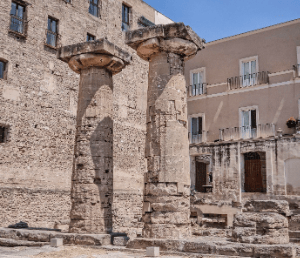
In the harbor area, two giant Doric columns are displayed from an 8th century temple, either to Zeus, Poseidon or possibly Apollo, who was the first to thank for a good settlement.
The usual fortifications:

It’s known for its ceramic plates. Wouldn’t you like to eat off of these …..

Mussels cultivation has been the lifeblood of Taranto for 2500 years. There are perfect conditions in the nutrient rich lagoon between the Mar Piccolo and the Mar Grande.
Taranto has a fine archeological museum, displaying the history of southern Italy.

Area around the old town


The road leads out to the Piazza Duomo to the Cathedral of San Cataldo, patron saint of the town, whose statue you can see at the top. This 10th century church (with a Baroque facade) is the oldest Romanesque church in Puglia.

Along the waterfront:


In front of the castle and administrative building. Besides the Italian flag, the other four flags from left to right represent the republics of Venice, Amalfi, Pisa and Genoa.

ALBEROBELLO
The landscape changes from the overwhelming Puglia flatness to green rolling hills. We’re headed now for a totally different experience as we enter the fantasy land of trulli. They’re like nothing you’ve ever seen, like Matera was unique, but in a totally different way.
Meaning “beautiful tree,” “Alberobello” itself is such a pleasing word to say and is a world heritage site. What exactly are trulli? They are whitewashed huts of limestone (prevalent everywhere) with a low square base and grey cone shaped roofs, topped with a sculpted pinnacle. Dating back as far as the 14th century, these “dry stone” buildings, using no mortar, cleverly could be taken apart quickly if royal tax inspectors showed up.

Don’t you just expect the door to open and out walk one of the seven dwarfs, or a hobbit with his furry toes, or one of the lollipop guild in “The Wizard of Oz” welcoming us to “Munchkinland!”
But I saw only humans.
From the Rioni Aia Piccola area, you can climb up and get a good view of the trulli below. You can see some have painted on them zodiac or other symbols.


This is a quieter neighborhood than Rione Monti, which is an area with galleries, shops and small restaurants and where most of the visitors walk around.
As it was a holiday (Festa della Republica on June 2nd), Rione Monti was full of Italian visitors.


A popular souvenir item is a local liqueur like cherry or almond, sometimes itself in the shape of a trullo. And of course pasta in different shapes.


In Rio Monti, the 1927 Church of Sant-Antonio is built in the form of…what else, a trullo.

Next to a cafe at the parking you can see a model of what a traditional trullo might look like inside.

Even the arancini, deep fried rice balls traditional to Sicily and are round in shape, in Puglia they are conical like the trulli! They’re often stuffed with either meat and piselli (peas) or with fresh mozzarella and parmesan. When fresh they’re delicious though a little heavy.

ORECCHIETTE RECIPE
Orecchiette is Puglia’s pasta. In our dinners at the hotel, twice we had orecchiette for primo piatto, the well known al pomodoro (with tomato sauce) and once with small shrimp in a garlic sauce.

When I got home with my package of orecchiette, I was eager to try making it with pomodorini (cherry tomatoes) with arugula and fresh basil.
So here is my recipe for Orecchiete ai pomodorini, which we ate accompanied by a Puglian wine that we brought back…
300 gr orecchiete pasta (you can substitute another small pasta that’s good for catching sauce)
1 package tomatinia (cherry tomatoes) cut in half
2 – 3 garlic cloves
red pepper flakes, salt & pepper
fresh grated pecorino or parmesan
extra virgin olive oil
Boil salted water to make the pasta. It should cook around 10 minutes to be al dente.
While boiling the water, saute the garlic in oil around a medium temperature, being careful not to burn it. You want to give aroma to the oil. Discard the garlic if you prefer. Add the tomatoes, stir, after cooking a bit, squeeze them with a spoon to help release their liquid. Add pepper flakes if desired, salt & pepper.
Simmer for about 10 minutes. If the sauce is too thick, add some saved pasta water when you drain the orecchiete. Stir. Add fresh basil and/or arugula (roka). Stir the pasta into the sauce. Add some of the grated cheese. Eat immediately! Add more cheese if you want and a little olive oil on top. Buon appetito!

Ciao Ciao Puglia! Arrivederci Magna Graecia!
If you like what you read, hit the like button and subscribe. Please share with your friends and social media. I’d love to hear your comments below.
There’s no need to log in to leave a comment. Just give an email address and your name.
Subscribe to become part of the olivesandislands community! Get new blogs and occasional newsletters delivered directly to your inbox. It costs nothing to subscribe. Olivesandislands does not share email information.
Note: Be sure to click on the confirmation email after you give your email address.

Sherri Moshman Paganos is a writer and former educator, inspired by her life in Athens, where she and her husband are happily retired and enjoying their travels in Greece and abroad. You can check out her writing — fiction, non-fiction, poetry and articles here.


Sherri Hi,Thanks for sharing your fantastic travels. I thoroughly enjoy reading them and travelling with you. Do you go with a particular group /travel agency?Have a great summer!Filia Georgia Sent from my iPadOn 17 Jun 2026,
LikeLiked by 1 person
Thanks Georgia, so glad to hear you’re enjoying the travels! The trip was with Kalidoni Travel. They’re great — we used them last year too with our trip to Cyprus. I meant to include that in the text, I’ll add it. Have a good summer! Xx
LikeLike
Excellent work Sherri Thank you for sharing YG
LikeLiked by 1 person
Thanks so much Yianni — and for photos!
LikeLike
Excellent!
LikeLiked by 1 person
I can only imagine the amount of research you did for this article. The article is terrific. Before reading it, I knew almost nothing about the places you describe.
LikeLiked by 1 person
Thanks Neil. Actually my main research is being there, using my eyes and ears. But right, when I get back I do a lot of reading to make sense of my experiences (and photos!)
LikeLiked by 1 person
We enjoyed reading another interesting article and we learnt a lot !!
LikeLiked by 1 person
Thanks Olina, I’m happy to hear!
LikeLike
Fascinating journey to Magna Graecia
LikeLiked by 1 person
A trip you would love to take sometime!
LikeLike