Carnival weekend! Let’s go with an organized trip to the northern Greek town of Xanthi, that holds the second largest carnival in Greece, after Patra.
Xanthi is in Thraki or Thrace, the northeast province of Greece bound in the east by Turkey and north by Bulgaria. Because of its proximity to Turkey, the area has always had a substantial Muslim population.

“Soggy” is the main word to describe the trip, the first two days anyway! We don’t have to worry about drought this year, there’s been so much rain that it’s just oozing out of the ground

In many cases, rivers are overflowing their banks.In fact, one of the promised attractions on our excursion, a trip to the Evros river delta on the border between Greece and Turkey, had to be canceled because of high water. The delta, a protected area, is inhabited with a large number of different species of rare flora and fauna — besides rare plants, hundreds of bird species, many animals and different species of fish and reptiles.
Past Thessaloniki to Kavala, around 150 km, it’s flat and full of rivers, with (surprisingly) a lot of cultivation of kiwi.We pass through the Axios River delta, also protected land from any kind of building. Besides the Axios, we also have the Loudias, Strymonas and Aliakmonas. (These names give me a shiver of recognition as they were on the material for the citizienship test I took a few years ago. Geography study questions: name the largest river in Makedonia. Name three rivers in central Greece.. Where does the Aliakmonas River empty into…. Where does the Axios start? etc. etc.)

The area is full of lakes too, the Megali Volvi, 3rd largest in the country. As we drive by, small almond trees are blooming among tall bare white birch trees.
One of the things you can’t help but notice in the soggy landscape are abandoned looking buildings that used to house farm machinery, and rusting machinery out in front. A real eyesore!
I. Kavala
It was pouring about a half hour out of Kavala, a pretty coastal town, but slowed to a drizzle so that at least we could walk around the city, actually the 6th largest in Greece. I remember staying here many years ago when I used to do testing and oral interviews for the Michigan exam. Then it was the end of May, warm and sunny…
Our guide told us that this area, all over eastern Macedonia and Thrace, was big in growing tobacco, leaving old tobacco warehouses, many in elegant 19th century mansions.

Many of them have been abandoned but here in Kavala, one has been put to particularly good use.

The Regie Tobacco Warehouse Complex owned by the Regie (Rezi) the Ottoman tobacco monopoly in the late 19th century, was one of the few with an inner courtyard. The current owners have made it into a shopping mall.


Also in the new part of the city is the 16th century Aqueduct built during the reign of Suleiman the Magnificent. Locally it’s known as the Kamares (arches) and it has 60 of them.

As in many other places in Greece, St Paul came here too and his visit is commemorated by the modern Church of St. Nicholas in an open air mosaic done in Byzantine style.

Formerly a 16th century mosque, it was converted to a church in the 1920’s, with, as often the case, the bell tower on the site of the former minaret.

From the corner where the church is, a turn will take you up walking to the Panagia area, the old town of the city.
The Imaret, with its 18 domes overlooking the harbor, is one of the trademarks of Kavala. Built in the early 19th century by Mehmet Ali, the Egyptian pasha, he wanted to give back to the town of his birth a charitable institution — seminary and orphange — as well as soup kitchen, for the poor of the town. Today it’s a luxury hotel (and you can peek inside to see ….)

Look down from the archway to see the sea below.


Kavala has an old history. It was founded in the 7th c BC with the name “Neapolis” and flourished economically and culturally. In the Roman area it was a station on the Via Egnatia, the Roman road that went to Konstantinople, and it was the port of the Roman colony of Philippi. When St. Paul visited in 49 AD, it gained some recognition as well. In the 8th and 9th c AD it became known as Christoupolis, with a strong Byzantine fortress, that you can visit today if your leg muscles and your energy let you keep walking up. The city was conquered by the Ottomans in 1391 AD but about a century later it was abandoned for a while, until it began to be restored and the aqueduct was built. As with the rest of the area, it became part of Greece in 1913.


Kavala and the area around is also known for its kourabiedes or kourabiesi, butter almond sugar cookies, here using local sheep butter and almonds. I associate these with Christmas time, but here they’re eaten all year.
On the other side of the harbor, the guide pointed out popular places Kavalans go to eat fish (in good weather.) By the time we got to the hotel in Xanthi, the heavens had opened. It wasn’t just the sogginess, but we were dealing with bronchitis issues and not wanting to ruin the trip…
The next day armed with hats, gloves, scarves, boots and umbrella, we went out to battle the cold wet weather!
II. Toxotes, Porto Lagos, Alexandroupoli, Komotini
Near Xanthi, on the Nestos River that borders Thrace on the west is the resort of Toxotes, developed by Pontic Greeks who emigrated in several waves from the Black Sea area in northeast Turkey. The Pontics were displaced by persecution and then the 1923 population exchange.
It takes a lot to imagine this as a popular sunbathing resort. In the summer there’s kayaking and most of the year, lots of walks in the area.


Our guide told us that they’re fixing a train from Athens to Alexandroupoli. Sounds good if it’ll ever happen.
This area is very popular with hikers as well as sunbathers. There are a number of trails as shown in the sign, from the Nestos River to the Rhodopi mountains.
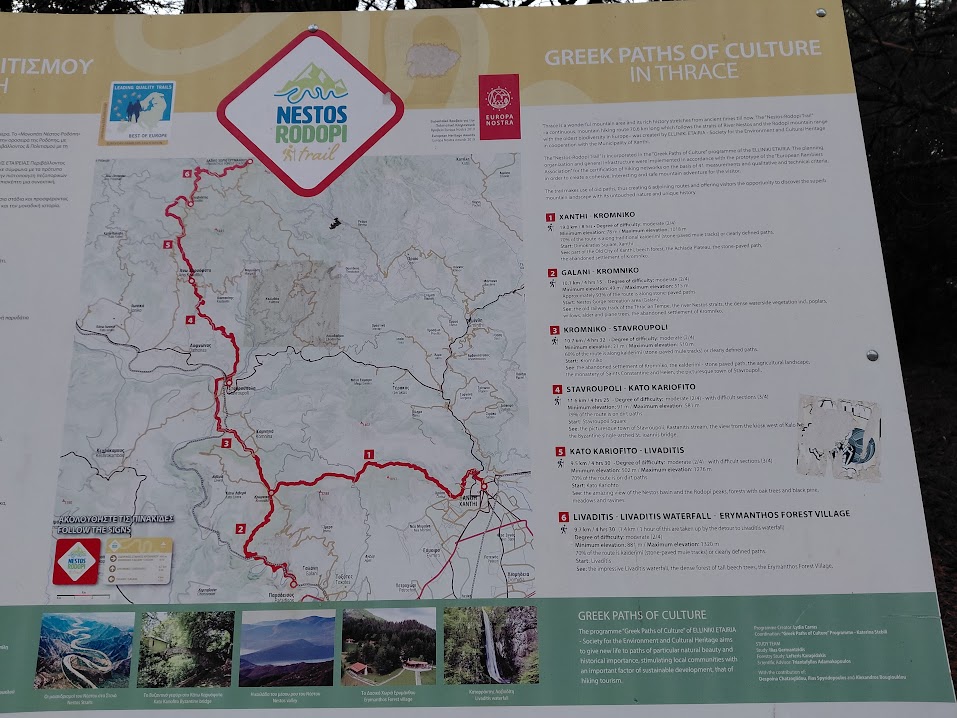
We left lightly raining Toxotes to enter Porto Lagos, with its cold driving rain and its monastery of Agios Nikolaos. These actually seem like two monasteries joined by a narrow wooden bridge. They’re known as floating monasteries because they indeed look like they’re floating in the water.
This is one of the largest wetlands in the area on Lake Vistonida. The monastery was built in early Byzantine years in the 1st monastery 400 AD. The story says that when a hermit in the area healed the local Bey’s daughter, the governor offered him the Vatopedi Monastery of Mt. Athos (perhaps the name reminds you of a story with the monks about 20 years ago).


This area developed as a commerical port with boats that send out products like tobacco and fish farming.
Being a wetland, one of the things the area is famous for are flamingos, We hoped to see some!

While we didn’t see any flamingos in Porto Lagos, afterwards, we passed groups of them. From the bus it was impossible to get a photo as all you saw were the raindrops on the window. The flamingos fly in very striking characteristic groups or “pink clouds.” I finally was able to get one lone bird when the rain subsided a bit, but it looks more like a heron.

We’re near Komotini, but it’s rained so much there that the shops didn’t open in the morning, so we press on to Alexandroupoli first.
One of Greece’s newest cities and today an important port and commercial center, Alexandroupoli was founded as a small fishing village in the mid 19th century with the name Dedegeats. In ancient times, when the city was known as Sali, the Kikones inhabited this area and according to mythology, Odysseus and his companions clashed with them on the way back from Troy. (It was their wine that Odysseus used to get the Cyclops drunk.) When the city became Greek in 1920, Dedegeats was changed to Neapoli (Turkish travelers still call it Dedegeats.) In that year however King Alexander I visited the city and the authorities decided to rename it Alexandroupoli in his honor.
Its landmark is its faros or lighthouse that when lit can be seen as far away as the island of Limnos.


The town seems to be mostly cafes and restaurants, with modern apartment buildings. This grand building has an interesting history, first as a tobacco warehouse in the 1890’s, then a place to house refugees after 1922. It was also used as a prison, a hostel during WWII, then a warehouse for farming products and finally became the town public library.


Since we were not able to get to Evros because of the swollen river, we were taken to Komotini, one of the major cities of Thrace. It’s a university town with a large student population. I remember years ago (also sent there with the Michigan exams) walking around the town — it was full of life. And many cultures together — Turkish, Greek, Roma and Pomachoi, who are Muslims and mainly live in small villages in the Rhodope Mountains. They have unique customs and identity, including a mostly Slavic dialect, combined with Greek and Turkish words.
This weekend was definitely not full of life. Except for very few, businesses didn’t open in the narrow cobblestone pedestrian mostly Turkish market area and very few people were walking on the street. One of the only places open on one side had tables where young people were drinking wine and on the other sold pastourma, prosciutto and spices.

Only the mosque seemed to have people. Every so often the door would open and someone would come out and quickly put up their umbrella.


When the weather is good, this is a beautiful well kept park to walk in, here next to one of the city landmarks, “The Sword” as it’s called, dedicated to World War II heroes. Here our bus was waiting to take us back to Xanthi, around 45 minutes away.

III. Xanthi Old Town, Carnival
The three week long Carnival time culminates on Sunday but there are pre-lenten concerts and dance performances throughout the month of February. All the hotel employees are dressed up in costumes to get us in the mood!
We tear ourselves away from the delicious breakfast at the hotel (Z Palace) with its homemade pitas and jam among the other delicacies to get ready for our walk to explore the old town of the city before the carnival starts. How thrilled we are it isn’t raining! The sun is putting up a good struggle to get through the clouds.

First stop, the tobacco warehouse “P” built in the form of a Greek “P” but as you can see, now destroyed.

The KTEL or long distance bus station has another tobacco warehouse.

The streets are starting to fill with spectators. DJ’s on corners are playing music to give us kefi (high spirits) You can’t help but sing along. “At the copa copacabana music and passion were always the fashion at the copa they fell in love” is blaring from the speakers.
It’s never too late to pick up a hat — sombreros are always in style. Other stands sell crowns, whistles, masks, wigs, foam, confetti and serpentines..

Our walk takes us to the central plateia with the “Old Clock,” the Ottoman Clock Tower built in 1859 by a wealthy Muslim local. It was barely saved from being demolished in 1972, during the junta. But it must have been a time with Greek Turkish tensions, because although the clock was saved, a marble inscription in Arabic text was removed from the monument and destroyed in retaliation for the removal of signs from Greek schools in Konstantinople.


The wealthy tobacco merchant Vasilis Kougiomtzoglou built this mansion around 1870 for his two sons, in two identical sections. In the building courtyard are two small individual hamams, the men’s and women’s baths of the house. Today it houses the Folklore and Historical Museum of Xanthi


A famous native son of Xanthi was the great composer Manos Hatzidakis, whose beautiful melodies have entranced generations. He was born here in 1925 and lived in the town until the age of 7, when his parents separated and he went with his mother to live in Athens. This house with all the wire figures was where his piano teacher lived, with whom he started lessons when he was 4.

Hatzidakis’ father, originally from Rethymnon Crete, practiced law in Xanthi and was involved in the prosperous local tobacco trade.
The family lived one flight up, the first floor (American 2nd floor) of this 19th century building, known as the Daniels mansion or “la Grande Maison.”

Today the house is called the Multispace for Art and Thought:”Grande Mansion” and it’s used for a music library, for music ensembles, a radio station, coffee bar and theater.
Manos’ piano where he started lessons is preserved.


The pen he used for signing, and an article written on the day of his funeral says “Sleep Hatzidakis, in the arms of the earth.” It’s a reference to the lyrics of one of his well known songs “Sleep Persephone in the arms of the earth.”

We leave behind this bygone world to join the Carnival spirit outside.
Outside, the Red Cross is getting ready —

Time to don our (Venetian) masks…


We find a good spot to watch the spectacle of the parade, a little up from the Kisynthos river.

I’m always amazed by some people’s costume creativity. Not part of the Carnival itself, but first a man passes with his robot. It’s hard to tell who’s a real human, who’s a robot.

The Carnival always begins with the King, then the Queen of the Carnival on a float approaching (see photo)


One group follows another — all ages participate, though mostly young people. To get us in the rhythms, Carnival music plays continually — Samba, Gypsy Kings, Macarena Latin.The Brazilian “Lambada” plays over and over — THE Carnival song. Listen if you’d like.
Here you can read more about Carnival customs in different parts of Greece.


As the participants pass by, they high-five us, the spectators and stop to paint our face with crayons.


What’s a parade without floats? The usual practice is to satirize topics in the news and current political leaders.
The bottom float is certainly not a very good likeness of this particular figure…the one on the other side is Putin. Very apropos now with the rocket isn’t it.


I really don’t know the purpose of these dinosaurs!

Usually at the end of the Carnival, there’s a custom where the “Tzaros” or Jaros is burned at the Kosynthos River in a spectacular fireworks show. What is the Tzaros? It’s a manmade dummy mounted on a pile of trees and the idea is to exorcise the evil. This year however, due to the swollen river, they decided to cancel the ceremony.
This is what it might look like if they were going to have it.

After the parade we followed the groups over the Kosynthos river to the stadium where they rested a bit before the party continued.


The loukoumades stand (small donut balls fried in hot oil served with honey) is always popular.

What energy! After a small rest, it seems everyone kept dancing.
Music kept playing all over the city and especially at the old clock, where there was a dj and partying all night.

IV. Cave of Alistrati
The next day after the Carnival parade is Kathara Deftera, or Clean Monday, the beginning of the Lent period.
In Athens all the municipalities give out traditional foods, including bean soup, halvah and taramosalata. It’s also traditional to eat seafood (shellfish).

In parks there’s live music and dancing, and people picnic and fly kites.
On the trip though, except for some halvah at breakfast, we’re not really in the Clean Monday spirit so much. Now we’re heading northwest, passing by some snowcapped peaks on our way to the Alistrati cave in north central Macedonia
We pass through a lot of small villages on the way, more train stations not in use any more.

Ahead of us lie the dramatic peaks of Mt. Menikio.

The Alistrati cave, discovered by a shepherd (aren’t they all!) in the early 1900’s, is located in a village between the cities of Serres and Drama. Outside the cave, you can have a coffee in the welcome sunshine and buy traditional products like legumes and almond cookies.
Opened in 1998 to the public, the entrance to the cave (always 20 degrees C and with 75% humidity) takes you down a long long corridor.
A robot telling us “My name is Persephone” greets us and tells us a few things about the cave at the beginning. Persephone can speak 33 languages (!) including ancient Greek, and can answer certain questions.

Our guide Maria carries a flashlight and even though lights are on, they’re on a timed system, so just to be sure! There are lights in both the corridors and on the stalactites and stalagmites, which are the first to go out. There’s an idea that light is bad for them, as she told us only photos without flash are permitted.

There’s much oohing and ahhing — amazing the power of water on limestone and the gift that nature gives us!

These growths in the middle are known as “eccentrics,” — they don’t follow the usual stalactite pattern and seem to defy the laws of gravity often by growing out, not down.

Our guide explains to us that if the water is full of metals like iron, it will fall very heavy, and thus stalagmites will form from the ground; if it falls lightly without metals, then it will form stalactites. Whatever, they’re particularly beautiful.

We couldn’t help but think about the Diros caves that we visited in the Mani peninsula in the Peloponnese a few years ago, a huge tourist attraction. The caves have similarities but Diros is a partly seawater cave.


While inside the caves of Diros in the Mani, hippopotamus fossils were found, inside these caves the main residents were … bats. The interesting thing is that even when they left the cave, the bats have some kind of instinct to return there over the years, no matter where they’re living. You can still see a few here and there. Some of the rocks have been left covered with bat droppings over the centuries — they were left for analysis.
As we left, the lights, not for the corridor but for the stalagtites and stalagmites, were going out, to be lit again when the next group came in, a school waiting with a lot of kids shouting in excitement….
For sure, the sun felt heavenly out at the snack bar. .But it was soon time for our return to Athens. We had miles to go before we reached Athens.
As you drive south through Macedonia, you face Mt Olympos and its snowy peaks.

On the way back, in central Greece, we notice fields of small olive trees. We learn that this area is third in Greek olive oil production, after Messinia (Peloponnese) and Crete. The small olive trees make it easy to harvest the olives.
It’s a historical area. Near the site of the battle of Thermopylae, we pass Pelasgia port, where Achilleas left from to go to Troy, using wood from tree trunks in the area.
Despite the rain days before, the carnival was fun. I still think that southern Greece and the Peloponnese have more dramatic scenery, but it was certainly interesting to see cities and towns of northeastern Greece.
Unfortunately, because so many people left Athens for the Carnival / Clean Monday weekend, the traffic going into the city is just crawling along

Kai tou hronou! And next year!
***
The beginning of March there’s a lovely ancient custom in Greece. Years ago my kids would come home from school with a “martis” (March) bracelet that the teacher would put on, with twisted red and white thread to mark the beginning of spring. The tradition is that when you see the first swallow returning from its winter migration, you take it off and put it on a rose bush for them to use as a nest!
Happy spring with peace.

If you like what you read, hit the like button and subscribe. Please share with your friends and social media. I’d love to hear your comments below.
There’s no need to log in to leave a comment. Just give an email address and your name.
Subscribe to become part of the olivesandislands community! Get new blogs and occasional newsletters delivered directly to your inbox. It costs nothing to subscribe. Olivesandislands does not share email information.
Note: Be sure to click on the confirmation email after you give your email address.

Sherri Moshman Paganos is a writer and former educator, inspired by her life in Athens, where she and her husband are happily retired and enjoying their travels in Greece and abroad. You can check out her writing — fiction, non-fiction, poetry and articles here.


Great travelogue. I’ve heard a different story about the ‘martis’ (March bracelet): it’s worn on the wrist to gauge the sun’s strength, i.e., if it leaves a tan line, as an indicator for planting etc.
LikeLike
Thanks Diane. I’ve read different stories too about the bracelet’s use, one being keeping out the spring sun (?). You can also put a “mati” on it for protection against the evil eye.
LikeLike
Hi, and thanks for the tour. I knew nothing about the area you write about. I’ve never been to Greece. But maybe one of these days . . .
LikeLike
Thanks — you’ll need to add Greece to your travels!
LikeLiked by 1 person
Looks like you had a terrific time! One of my favourite towns in Northern Greece is Kommotini – it gives people a different perspective of Greece – a divergent cultural blend. xx
LikeLiked by 1 person
I agree Kathryn about Komotini from visiting it years ago but unfortunately this time it was like a ghost town from the heavy rain, “closed up” with hardly a soul on the streets!
LikeLiked by 1 person