On the first Sunday from November to March, the state museums and archaeological sites are free and it’s always pleasant to see how many visitors, locals and tourists alike, are stepping among the ancient stones, especially on an unseasonably warm sunny day (which are getting more and more common).
As you stroll among the cypress, olive and pine trees, the traditional trees of the Greek landscape, it’s humbling to think that Socrates walked on these very paths as he invited Athenians to join his discussions on philosophy and morality. For a while at least.
After the Acropolis, for which you need a timed entry ticket now, the Agora or marketplace is the most important site of ancient Athens. But it was so much more than just the commercial center. Lively and crowded, it was a political and social meeting place, the heart of public life in the city as well as a place to pay homage to the gods. It was where religious celebrations took place, also theatrical and musical events, as well as athletic contests.

Until recently, the entrance to the Agora was around the corner from Monastiraki metro station, down Adrianou Street in the midst of tavernas, restaurants, cafes, gelaterias and jewelry sellers. The day we went, there was a heated game of three card monte (or in Greek as it’s known as pappas (priest) Where’s the pappas?
And where’s the entrance? We see a closed gate and only a bulldozer and mounds of dirt. Up close though a sign with a small map tells you that its temporary entrance is now on Apostolos Pavlou, the pedestrian street down the corner and to the left. (If you go, be sure to check online. This construction looks like it might last a while.) So you follow Adrianou to the end, to Thisseion, go left and at the Athinaion Politeia Restaurant, you’ll see to the left a way a path along the wooded area.
Before the entrance, I noticed some beautiful marble amphorae among the trees.

The temporary entrance takes you to the back of the Temple of Hephaistos, so let’s start there. Hephaistos, son of Zeus and Hera and the husband of Aphrodite, was the god of fire or the forge. (It was originally thought that the temple was to Thisseus, mythical founder of Athens and for that reason the area took on the name of Thisseion). — Hephaistos’ legendary skills were used to build the palace of Zeus on Mt. Olympos.

With 34 columns, this is the best preserved Doric temple in Greece. Here you can look into the cella, the inner sanctuary and out the other side. Originally built in 480 BC, it was destroyed soon after, along with everything else in the Agora by the Persians, and rebuilt in 449 BC under Pericles by Ictinus, one of the architects of the Parthenon.
Because it’s up on a hill (as major temples usually were), it has a great view of the Agora area and the Acropolis. The garden has been reconstructed to look like it was in Roman times.

As often the case, the Temple was converted to a Christian church (Agios Giorgos) in Byzantine times.

The area below the Hephaistos temple was full of other temples. There was even evidence of a synagogue in the Agora, according to a plaque, so this explains why the Apostle Paul was here drumming up support. Apparently his sermons in the Athenian synagogue didn’t have much of an impact, but they did lead to a small group of Christians.
Besides the religious temples there was the Monument of Eponymous Heroes — these were famous heroes of the ten ancient Athens tribes.

The administrative center was in the tholos, a round structure that was the headquarters of the Boule (Council). One third of the administrators would take turns sleeping there, so the idea was that there were always responsible officials on hand!

Here’s what it looked like then:

The Metroon, a later administrative building, housed an important sanctuary for the Mother of the Gods (Rhea).
Between the temple and the Stoa of Attalos ran the Dromos or the Panathenaic Way, This is where many would have entered the Agora. The Way extended from the Dipylon Gate of the Kerameikos (Athens’ ancient cemetery) all the way up to the Acropolis.

Along the Panathenaic Way, went the procession of the Great Panathenaia every four years, dating from the 6th c. BC and depicted in a frieze in the Parthenon. During this festival, dedicated to the goddess Athena, foot races and chariot races were held on the road, that in the 2nd century AD was paved mostly with stones. The winners received olive oil stored in prize amphoras. You can see some of these huge amphorae at the Acropolis metro station, in its “museum” of artefacts from the area. (How did they lift these?)

Near the Way was one of the great Roman buildings, the Odeon of Agrippa, built to honor its donor, Marcus Agrippa, around 15 BC and designed for musical performances. In front sat colossal statues of Tritons and Giants. Four of them later adorned the Palace of the Giants, which was built over the remains of the Odeon, destroyed like most of the Agora in 267 AD by the Herulians, an East Germanic or Scandinavian tribe.

And now we’re coming to the other major building on the Agora, the Stoa of Attalos, named for Attalos king of Pergamon, who built it during the Hellenistic era, 2nd c BC. (Before he became a king, Attalos actually studied philosophy in Athens.) The stoa too was destroyed in 267 AD and left for ruins until the 1950’s when the American Archaeological School underwent a major project to rebuild it.

It was like a two story shopping mall with expensive shops of the time.

From one side you can look out at the garden.

The other faces Adrianou Street and the oldest metro line tracks.

The interior is full of statues, such as Aphrodite, Hermes and other gods.
On the coat of armor of this statue of the emperor Hadrian, he has both the goddess Athena (probably known to him as the Roman Minerva), and Romulus and Remus, legendary wolves founding Rome. As a great philhellene, it seems fitting that he combined both Greek and Roman religious/cultural symbols. He gave his name to Adrianou, the long menandering street in front of the Agora, that goes from the Plaka to Monastiraki and down to Thisseion.

The statue used to be below the Temple of Hephaistos before it was decided to move it to the Stoa. I think I preferred it with the greenery around.

The facade of the Odeon of Agrippa

Of the 21 stores on the main floor of the stoa, ten were unified after the restoration in the 1950’s to form a museum gallery that’s a small gem of archaeological finds, and not to be missed. You can see examples from each period of history, from Late Neolithic Bronze Age, Geometric, Archaic, Classical, Hellenistic and Roman – Byzantine. Some of the objects are fascinating, like these boots found in a woman’s tomb from 900 BC.

These pyxides from the geometric era were used as containers for food offerings, often found in family cemeteries. The handle in the form of horses, as the note tells us, symbolizes the noble origin of the dead.

A child’s commode (!) from the Archaic period (6th c. BC)

This display shows ostraka from ostracism ceremonies. Kleisthenenes, leader of Athens, decreed that ostracism be used throughout the 5th c BC as a way of protecting the city from despots. Those who were participating would scratch on a potshard the name of a citizen in the community deemed a threat to the state, and if ostracized, the person was banished for 10 years. Six thousand people had to be present for the decision to be binding.

Gradually the ceremony was seen as a tactical political maneuver to get rid of rival politicians, probably the case below when it was voted to banish Themistocles, whose name you can see on some of the shards. After his military successes, particularly the Battle of Salamis, Themistocles’ power grew, alienating his political opponents, who used his perceived arrogance and boastfulness against him. They also accused him of taking bribes to grow rich, which fueled public resentment even more. Some things never change.
After you exit the Stoa, you don’t want to miss seeing the church of Agios Apostolos. Built in the 10th century, when the Agora started to be repopulated after centuries of disuse, it’s one of the earliest Byzantine churches in Athens, In some places you can see “kufic” ornaments, a decoration imitating Arabic script, a popular building motif of the time.

Agios Apostolos Church, along with the Temple of Hephaistos, are the only two structrures to remain intact from their original construction.

Nearby are some ruins with a decidedly Roman look, using terracotta besides stone.

And a modern touch, this statue was added in 2021 by Chinese artist Wu Wieshan and known as “Socrates and Confucius: An Encounter.” A nice thought to imagine these two ancient philosophers in discussion.

From the 6th c BC up until the 3rd c AD, there were dozens and dozens of structures built over the centuries, layer upon layer in the Agora. To read about more, you can check out this site here.
Right above the Agora is Aeropagus Hill. Aeropagus, lying across from the Pnyx hill, where citizens used to gather to discuss and make decisions, was named for Ares, the Greek god of war. The hill was connected to many major mythological events such as the first murder trial conducted by the gods, in which the god Poseidon indicted Ares for killing his son. Orestes’ trial also is said to have taken place there, after he killed his mother, Clytemnestra.
So in a way, the oldest supreme court of Ancient Athens was established on the hill. To this day, the Greek Supreme Court for criminal and civil law is called Areopagus.

In the 80’s (and maybe 90’s if memory serves me) if you wanted to climb up the vrachos (rock), you had to use the 6th c BC steps carved into the rock! That it was scary and slippery didn’t stop people (and us) from climbing. No doubt there was an accident for they finally put in metal stairs, making the climb much easier. However when you do reach the top, don’t be complacent — the marble is still slippery — so wear the right shoes. The view of Athens below makes the climb worth it, especially at sunset.

Besides ancient crime trials, the rock is associated with early Christianity — around 50 AD, the Apostole Paul used to preach from it to the Areopagites, the members of the court. A few of the members converted to Christianity, including Dionysius, after whom the pedestrian street that goes in front of the Acropolis Dionysiou Areopagitou was named.
Vrysaki neighborhood
For about 100 years after Greek independence, a neighborhood flourished above the Agora. It was highly populated and known for its tavernas, wine places, cinema, a place where residents from other areas liked to go. The giant statues of the Palace of the Giants were part of the main square of the neighborhood. They used the Agios Apostolos church. Did they know that the Agora was under their feet? Hard to say.
I learned about the Vrysaki neighborhood from a talk at the American School of Classical Studies by Sylvie Dumont, In her book about Vrysaki, Dumont recreates the community and describes how Athens was transformed by the demolition of the neighborhood in the 1930’s. More than 5000 inhabitants were displaced and 348 properties were torn town for the the American School excavation. “It was a unique episode in the history of Greek archaeology,” writes Dumont. A sad episode surely and controversial at the time. Destroying modern history for the ancient to shine. It’s a tough decision, but I suppose it was unavoidable.

Part of the neighborhood was already destroyed when the first train line was built in the 1890’s.

Roman Agora
The Agora continued being a political and social meeting place during the Roman era, but the commerical and financial aspect was ordered to be moved to the Roman Agora, a few minutes walk away.
The four marble Doric columns at the entrance, were built in 11 BC from donations from Julius Caesar and Augustus, and dedicated to the goddess Athena.


In the back of the Agora, probably the most famous structure (and still standing) is the Tower of the Winds, probably built before the Agora started to be used. On its octagon shape it had small sculptures showing each wind direction (southeast for example). It was a kind of combination wind/weather vane, sundial and water clock where time was revealed from a hydraulic clock in the interior. We really don’t know exactly how it worked. It’s said that market tradesmen could see and estimate the time needed for merchandise to reach the port of Piraeus!

As with so many monuments, the Tower of the Winds or Aerides as it’s known, had an interesting history through the years, including during Ottoman times it was used as a tekke or place for whirling dervishes.
Across from the Agora near the Tower of the Winds among some overgrown vegetation is a very old looking door with no sign about its origin. My trusty guide 111 Places in Athens That you Don’t Want to Miss identifies this as an Ottoman Gate. If you get close yes you can see some circular designs and an Arabic inscription with the name of its founder Mehmet Fahri the Honorable. Once the entrance to a medresse or theological school founded in 1721, 100 years later when the Greek War for Independence broke out, the Ottomans sadly converted it into a prison.

Hadrian’s Library
As mentioned before, during Athens’ Roman rule, Hadrian left his mark more than any other Roman emperor. Just take a look at his library, across from the Monastiraki Metro. I think many confuse this site with the Roman Agora. In any case, outside Hadrian’s Library there’s a comfortable ledge to sit on, as Elias is doing on a sunny January day, enjoying some Asian street food noodles.

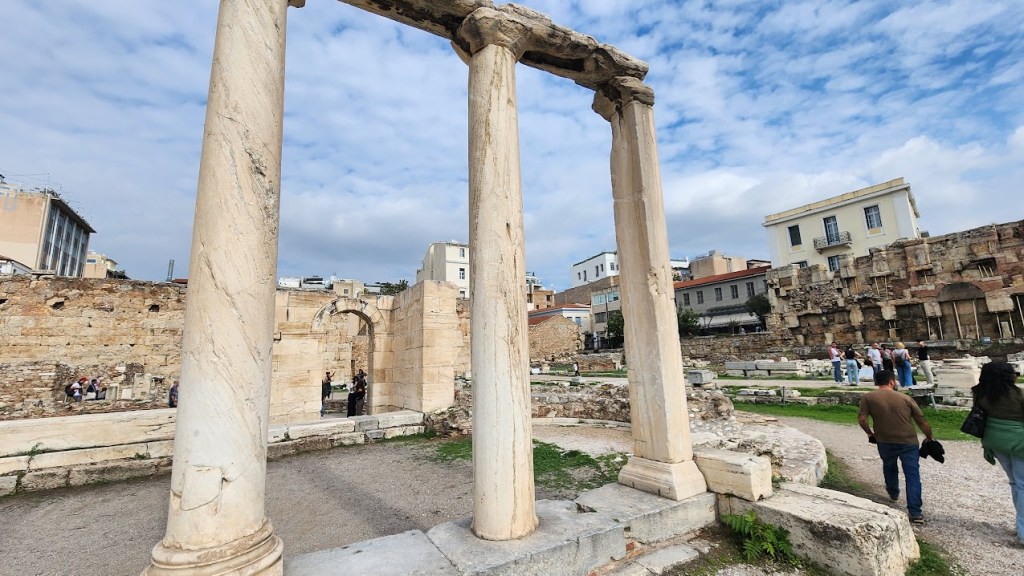
If you go through the gate, you’ll be impressed at the scale of this library and cultural center. Built during Hadrian’s 3rd visit to Athens in 131 – 132 AD, the Library was part of his grand plan to revamp Athens. It certainly was impressive with the high surrounding walls and the 100 columns that used to decorate the gallery.
If you look all the way to the right where there’s an indentation, that’s said to be an early 5th c AD Christian church.

The library section is all the way in the back, next to the auditorium, where you could hear lectures and listen to music. It’s said that there were 17,000 books, papyrus scrolls and other documents. The library also served as the official state archive and a philosophy school.
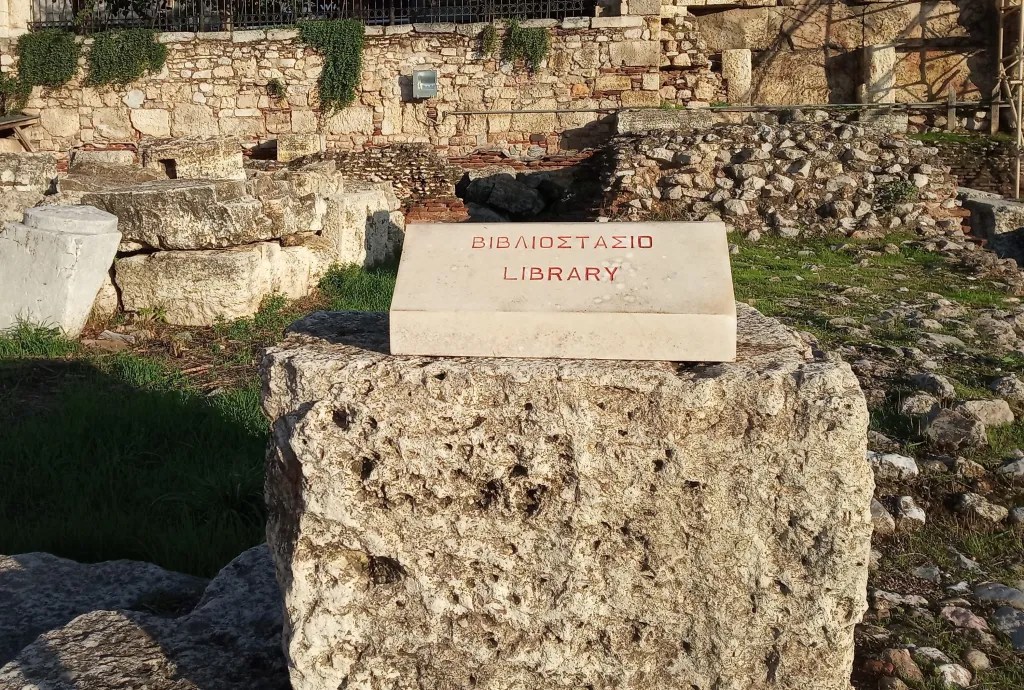

In the interior courtyard are remains of mosaics, fountains and several churches built in Byzantine times,

The Roman arch looks out on the Greek columns.

The Tzisdarakis Mosque, Museum of Modern Greek Culture
While we’re practically on Monastiraki Square, let’s take a quick look at the Tzisdarakis Mosque. Athens has many Greek and Roman monuments but hardly anything left from Ottoman times, except for here and there a building like the Ottoman Gate mentioned above. The Tzisdarakis Mosque, or Mosque of the lower fountain, contains a collection of pottery and ceramics and is part of the Modern Greek Culture Museum.

One of the structures preserved inside is a mihrab, a prayer niche, elaborately decorated with painted vegetal motifs and inscriptions.

This view below of the mosque on Monastiraki Square also includes the 10th century Byzantine church of Panagia Pantanassa and its bell tower, constructed a few centuries later. I love this mixture of civilizations in the heart of the city, Byzantine, Ottoman and Ancient.

Looking down on the square from the top of the mosque steps gives a good view of the hodge podge architecture that is Athens.

A few steps away from the square, we went inside the new main collection of the Modern Greek culture museum, into this complex of large and airy compartments, but this was after seeing so much and our eyes were too glazed over to register anything else. Another time…. next month!
Always interesting to be a tourist in your own backyard and Athens offers no end of monuments and museums. But next month, the post will be on a trip abroad to neighboring Italy.
Until then, thanks for reading!

If you like what you read, hit the like button and subscribe. Please share with your friends and social media. I’d love to hear your comments below.
There’s no need to log in to leave a comment. Just give an email address and your name.
Subscribe to become part of the olivesandislands community! Get new blogs and occasional newsletters delivered directly to your inbox. It costs nothing to subscribe. Olivesandislands does not share email information.
Note: Be sure to click on the confirmation email after you give your email address.

Sherri Moshman Paganos is a writer and former educator, inspired by her life in Athens, where she and her husband are happily retired and enjoying their travels in Greece and abroad. You can check out her writing — fiction, non-fiction, poetry and articles here.


A highly enjoyable read! The Ancient Agora must be one of the best sites in Athens and needs a good guide like this one!
LikeLiked by 1 person
Thanks Roz. I hope I did it justice — there’s such an incredible amount to describe.
LikeLike
Bravo!!!
Sent from Outlookhttp://aka.ms/weboutlook
LikeLiked by 1 person
Thanks John. I’ll check out your blog.
LikeLike
An incredible tour. Thank you!
LikeLiked by 1 person
Thanks for your comment!
LikeLiked by 1 person
So much history packed into your terrific blog. Love the pictures.
LikeLiked by 1 person
Thank you so much Diane!
LikeLike
Hi Sherri,
what a great read again. And I have to go and see that former mosque you are describing!
best, Judit
Judit Neurink, author https://juditneurinkauthor.com/ and journalist stories and analyses on Iraq and the Middle East Nieuwe roman: Rahila’s geheimen https://www.mosaelibro.nl/ontdek-de-roman-van-judit-neurink/ Ook nieuw: DNA liegt niet https://www.walburgpers.nl/nl/book/9789464565324/dna-liegt-niet My best seller: The Jewish Bride https://www.amazon.com/Jewish-Bride-Iraqs-lost-past/dp/1980257922/ref=tmm_pap_swatch_0?_encoding=UTF8&qid=&sr=
Get my author’s letter and a book for free https://dl.bookfunnel.com/synh13x8hp Mijn wekelijks Bericht van een Theedrinker http://www.juditneurink.eu Voor presentaties*: Zij Spreekt https://www.zijspreekt.nl/sprekers/profile/Judit-Neurink/864/nieuws/random/0/0/1/ en *mijn agent Dorine Holman https://www.dorineholman.nl/auteurs-/56 NL: 0031 646 19 3332 Athens: 0030 698 624 3549
https://www.avast.com/sig-email?utm_medium=email&utm_source=link&utm_campaign=sig-email&utm_content=webmail Virus-free.www.avast.com https://www.avast.com/sig-email?utm_medium=email&utm_source=link&utm_campaign=sig-email&utm_content=webmail <#DAB4FAD8-2DD7-40BB-A1B8-4E2AA1F9FDF2>
LikeLiked by 1 person
Thanks Judit, definitely worth a visit, the mosque is right on Monastiraki Square
LikeLike
This piece is informative and evocative, both – a fantastic overview and tour –
LikeLiked by 1 person
Thank you so much Starry
LikeLike
Great write-up Sherri!
LikeLike
Thanks Connie!
LikeLike
One of my favorite areas! Great post!
LikeLiked by 1 person
Thank you! Hope to return sometime!
LikeLiked by 1 person