Chania whispers in your ear and lures you to its northern Cretan shore. You might feel at times ‘been here done this’ too often. But when you return to a vacation place again and again, you enrich your present memories with those of the past.
No matter how often I walk past Semiramis restaurant, it begs for a photo.

I compare it with its look six years ago when I caught this couple arm in arm.

In the 21 years we’ve been visiting there are tremendous changes of course. Years ago you might have seen some women sitting outside their small houses on the cobblestone streets, in the morning chatting with their neighbors, maybe cleaning green beans for lunch. No more. Their sons and daughters have given the houses to hotels or air bnb’s, a phenomenon everywhere in high tourist locales.

The cats! They stretch out in the pedestrian streets and more unlikely places. They seem well cared for — everywhere you see hotels and restaurants leaving them dishes of food.

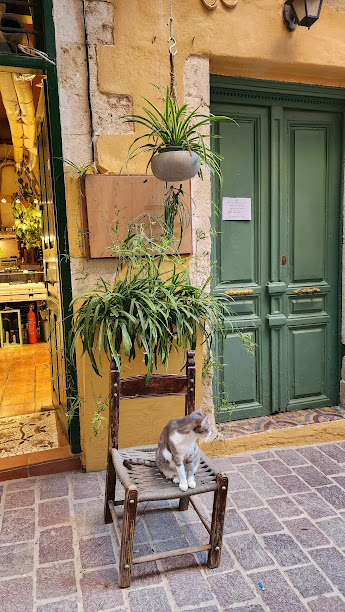
Old town colors and shapes…


Actually we faced a big change on this trip. The place we always stay, Casa de l’Amore, has closed its doors, but we were fortunate to find Casa di Pietra, a little ways up the street on Theotokopoulou, considered as one of the best streets in the old town. At one end you face the Lefka Ori (White mountains) and the other goes down to the sea. On the main floor of Casa di Pietra shoppers browse.

I can’t recommend it highly enough. The owners, Sifis and Spyridoula, were warm and hospitable and gave us daily “surprises” — grapes, figs and olives from their land, a bottle of their wine and homemade cake (see recipe below).

Above the shop, rooms either face a small patio and the Venetian walls (advantage, super quiet) or in the front, with a balcony overlooking the constant activity on Theotokopoulou, right over Kormoranos bakery. The place with the yellow sign by next summer surely will be a new hotel!

History — Ancient and Modern
The Venetians, who ruled from 1205 to 1669, left their mark more than any other conqueror in their fortifications.

Before the Venetians, Byzantines also left massive walls, along Sifakas and Karnevaro Streets.

This area on the hill behind the port (Kasteli) is the earliest part of the city. Ruins even date from Minoan times, 3000 BC. But even by the time Minoans came, the hill had already been settled by Neolithic settlers, as we learned in the Archaeological Museum. Excavations began here in the 1960’s by a Greek-Swedish team.


Adding to the many layers of civilizations were also Romans and Arabs, and after the Venetians, the Ottomans ruled until 1898, when Crete gained autonomy and then a few years after, united with Greece. There’s not much left from this period except for the magnificent 17th century mosque, Yiali Tzami, along the port, now used for gallery exhibitions or concerts behind it.

Another Ottoman influence is the Agios Nikolaos (Saint Nicolas) church in Splantzia, the traditional Muslim area, of the old town. After the Venetians, it was used as a mosque under the Ottomans, then returned as a church, with both the minaret and campanile, or bell tower, kept together in this unusual combination showing the blending of cultures.

A church used as a mosque and vice versa is common but more unusual is the 14th century church that was given to the Jewish community in the 1600’s for a synagogue. In World War II it was bombed and left in ruins until it was restored with great care in 1999. Since then it’s been an important religious and cultural center in the town. You can find out more about its history here or on its website.
The other existing minaret is along Daliyanni Street in Splantzia, a lively street with restaurants, mezedopoleia and bars.

To go back to the Venetians for a moment, besides fortifications, as seafarers, they filled the port in the 16th century with neoria, or dockyards, with their pointed roofs, that you admire as you walk along. Of 23, today only 7 exist. The one known as the Great Arsenal is used for exhibits and is the premises of the Center of Mediterranean Architecture.
In the background notice the Agios Nikolaos church just mentioned with campanile and minaret.


This trip we decided to visit the fairly new Archaeological museum, on my friend Karen’s suggestion. We take an early morning walk along the port, past Koum Kapi and reach the pretty neighborhood of Halepa (Chalepa), its new home. It used to be housed on Halidon Str. in the former Venetian Monastery of Saint Francis, a beautiful building but totally inadequate for the collection. Along our walk, the old port retreats behind us.


A historic note tells us this hotel was built in 1886 by a merchant named Themistokles Mitsotakis (any relation to the current prime minister I wonder?) and at the turn of the 20th century it was used as the British Consulate.

The museum is a very large glass-filled state of the art building constructed in the last few years which displays even Pre-Minoan and Mycenean finds, and although homo sapiens were found in southern Crete in Loutro and the island of Gavdos 130,000 years ago, the Minoans were the first major European civilization. Kydonia is the name given for this ancient city.
The era around 2000 BC was the era of great Minoan palaces with these giant pythoi, containers or storage jars that held olive oil, wine or honey. They were even sometimes used for burial.
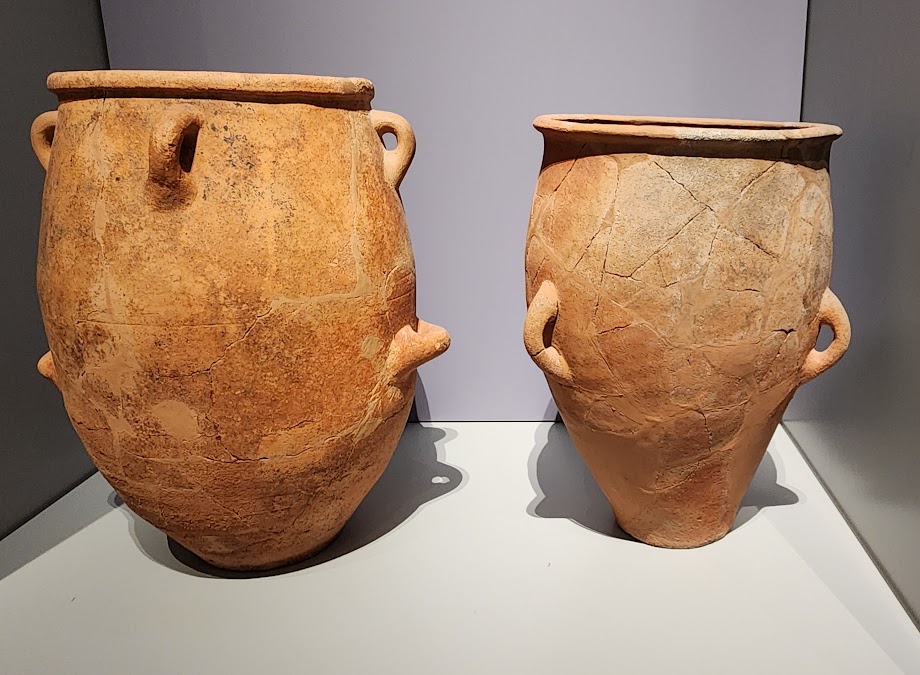
A sign in a Chania wine bar tells us “a meal without wine is called breakfast” but in the museum we’re told that “wine generally accompanied meals, and also formed part of breakfast.” Diluted of course as the ancients used to drink it.
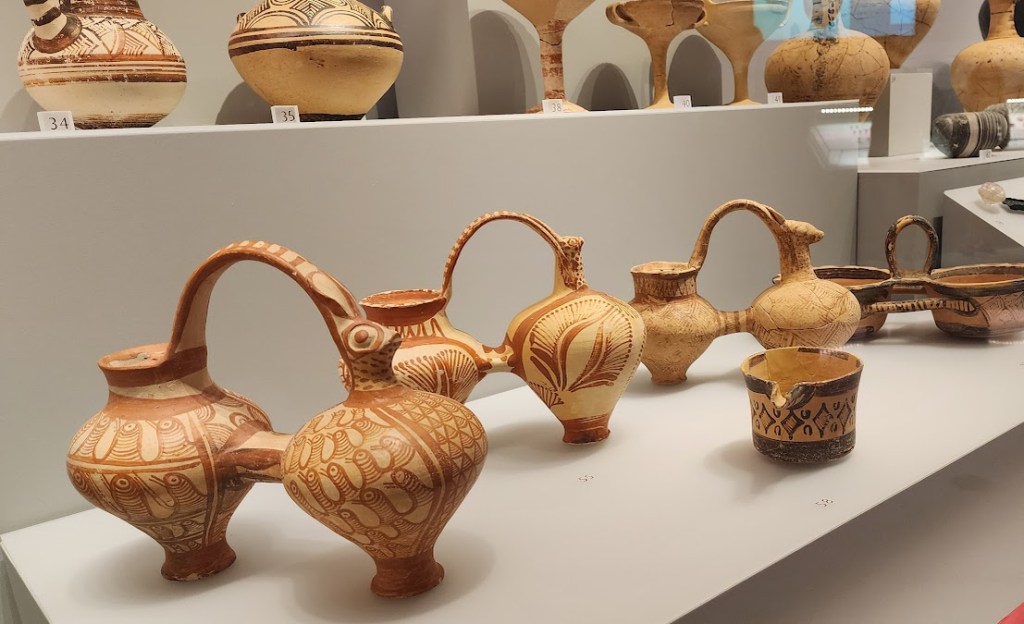
Over 1000 small bull figurines were found in a cult space to Poseidon, when he was an early god of fertility and the earth

This boat actually contained a “honey pot,” and was buried with the dead to appease the gods after death.


Interspersed with the ancient, there were also modern interpretations of ancient myths like this sculpture “The Dance,” modeled on Minoan ceremonies where dance was an important expression of joy and an integral element of religious ceremonies.

Doesn’t the fluidity of movement remind you of Matisse’s Dancers?


The Archaeological Museum delves into the distant past, but for modern history, Chalepa was also the family home of Eleftherios Venizelos, often considered to be the greatest Greek statesman. The house was finished in 1880 when Venizelos moved in with his family at the age of 16.

Venizelos was a voracious reader with 25,000 volumes in his library. The story goes that during the Occupation, when the Germans set out to burn a number of his books, the then mayor of Chania is credited with saving over 8,000 of his books. (Venizelos was no longer alive at this point — his sons were living in the house.)
The walls of the kitchen were painted to “entertain” the Germans commandered in the house.

In the U.S., an enterprising Greek American set up a line of coffee in his name.

Great men as we know inspire either admiration or hatred. The museum contains both his bloody shirt from the first attempt on his life in Paris and the bullet-ridden Packard from the second assassination attempt in Athens.


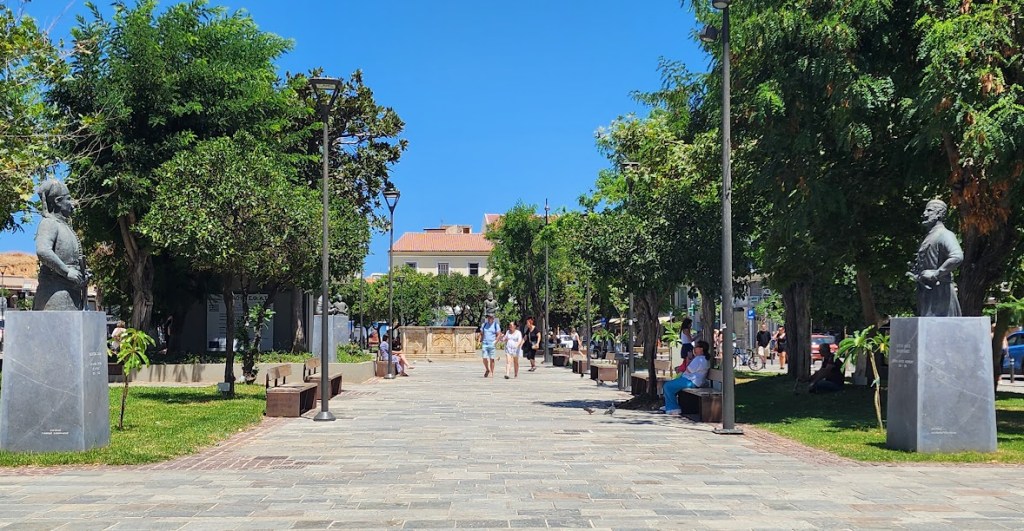
The bus from Chalepa back to the center takes you to the 1866 Plateia, so named because it was the year of a major uprising against Ottoman rule. The recently renovated square is full of statues of fierce looking 19th century Cretan leaders of the uprising.
A couple of blocks from the square going away from the port is Marmaritsakis, an old fashioned mayeireio where inside you select your dishes from what they’ve cooked that day. It’s so hard to choose. Their lahanodolmades, stuffed cabbage with meat, herbs and rice with avgolemono (egg lemon) sauce just melt in your mouth.

You can eat there — there are a few tables, or take out. They have kept their old sign from 1928, when they were in the municipal covered market (completed in1913 and under renovation now for several years…)

Just across from the square, next to Halidon St. leading down to the Venetian port, is the “famous” Funky’s. Everywhere you go people are holding pizza boxes from Funky’s, just a hole in the wall really that has amazing crepes and pizza and delicious ready salads. (Try the mushroom and sun dried tomato salad with baby spinach, arugula, sauteed mushrooms, walnuts, parmesan flakes and vinaigrette dressing.) In the morning, all kinds of pitas and coffees are offered. There’s a large number of efficient and friendly personnel, and fresh ingredients and good prices too. More than once we found ourselves there… (There’s also one in Thessaloniki.)
Tavernas
But we also visited our favorite places to eat, like Pulse, at the foot of Theotokopoulou across from the San Salvatore Bastion.

As always we wonder how they make vegetables taste so heavenly. You can actually hear all the “ummms” and “ohhhhs” from the diners, even a “belissimo!” here and there from Italian tourists.
Most people seem to order the vegan moussaka and they’re not disappointed. But there’s so much more to try. Asparagus with a peanut sauce. Baked anthoi, zucchini blossoms with tomato sauce and melted cheese. Summer quinoa salad.
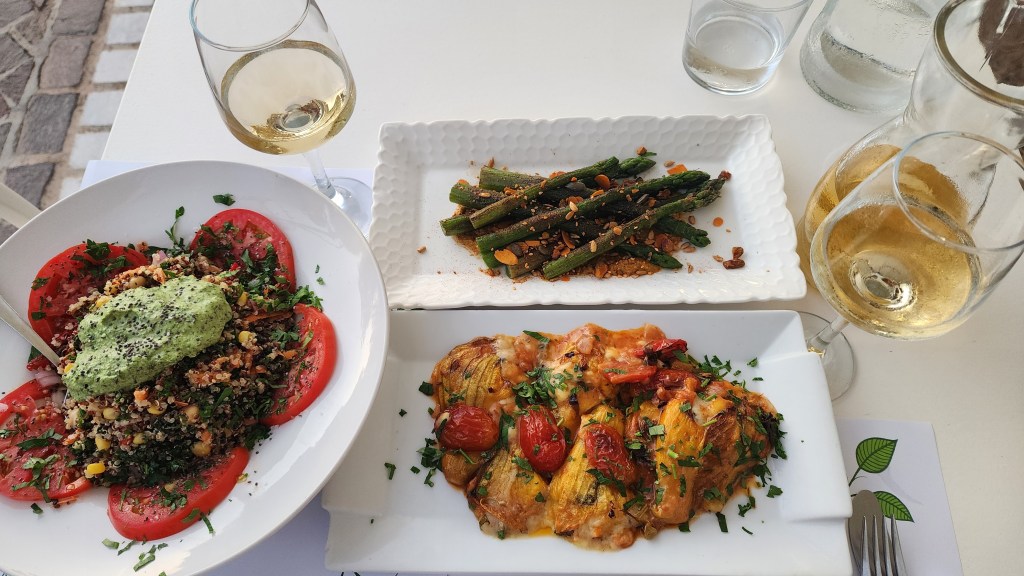
Lefteris, the owner’s son, remembered us from the year before (and my blog!) The vegetables he told us are grown behind the restaurant — tomatoes, zucchini, aubergine, kale. Not only the food but the location at the foot of Theotokopoulou is special. Best table: slightly raised, facing the sea. Best time after sunset when it’s a little cooler —
We returned a second night to try the mushroom carpaccio, marinated mushrooms with gremolata, as Lefteris explained, a green sauce with chopped parsley or dill, also lemon zest and garlic and pine nut “parmesan.” The carrot fritters with herbs, apricot and pine nuts and a dipping sauce smelled heavenly like Indian samosas and tasted delicious too.

We also tried the vegan cheeseburger , with potatoes, vegan cheese, homemade mayonnaise and ketchup. This was a popular item too. Not to forget the house wine! Fruity, light and refreshing.
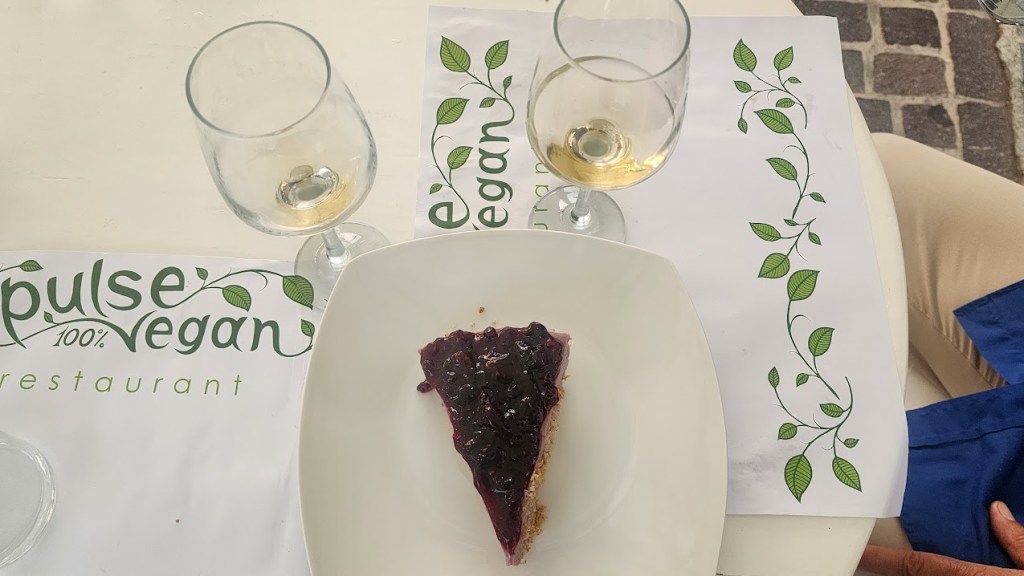
And for the kerasma (treat), a homemade dessert — vegan blackberry cheesecake.
Another of our favorite places, this one in Splantzia near Daliyanni St. (the street with the minaret mentioned above) is the Well of the Turk, that blends North African, Middle East and Greek flavors. Andreas is always happy to see us and manages to find us a table out in front of the busy restaurant. (The photo from another time certainly doesn’t capture the busyness!) It’s also pleasant to sit in the garden on the side.

Each year we try different appetizers. Ordinarily you wouldn’t get too excited about grilled vegetables, but look at what they did; they combined soft myzithra (Cretan white cheese) on half of the dish, and on the other added gavros, a small anchovy-like fish. You might be surprised, but the mix of flavors worked beautifully.

We stick with the main dishes we love, the fatayer bi sabanikh with pita with spinach, mizithra cheese, lemon, walnuts and raisins and aubergine meatballs.
Their kerasma (treat) is always exquisite. Along with the raki, they bring a plate of orange slices, exquisite baklava and ice cream. Wow. Orange first to clean your palate and then the sweets.The baklava is light and the ice cream is perfect. (Personally I can’t handle raki after drinking wine — but Elias has no problem.)

To feed our soul, we also love going to Adespoto restaurant with its amazing bouzouki player and guitarist. One entrance is on Sifakas, (across from the Byzantine walls) the street to buy your Cretan knives — one place advertises “Cretan dancing knives! Samurai swords!” (I don’t think tourists can carry these in their luggage!) It can also be reached from Splantzia streets. Adespoto usually means “stray” or “homeless” but can also mean “away from others, a particular place” and what a place it is, the shell of a Venetian house whose interior was bombed in WWII, and made into a garden for the restaurant.

The restaurant likes to boast it was used for filming in “the Two faces of January.”

Look under this sign noting the music in the evening.

We ate slowly (mushroom risotto and yiaortlou — a Greek and Turkish dish of meat with a yogurt sauce and usually pita) to enjoy the music as always. The bouzouki player totally dazzled us with his playing and his concentration!


These places mentioned are not along the main port. Beware. Some of the ones especially on the western side have somewhat aggressive people who run after you and steer you to the menu displayed, with its bright laminated pictures of the food, and practically hypnotise you into sitting down…
One restaurant near the mosque had an unusual centerpiece of ceramic lemons!

Strata
If you want to hear some Cretan music but can’t get to a paniyiri, (a celebration outside Chania in a village, where they play all night and people dance) for several years now, every Tuesday is the strata. From Italian strada, street, musicians walk along the limani (port) playing the lauto, lyra and drum and stop at the Maritime museum for some dancing. Here they might give out some glasses of raki too.


Then they walk up Halidon to the Metropolitan Church, which was given in the 19th century to the Greek population. (A note on the wall tells us it was previously a Catholic church and then used as a soap factory (!) by the Ottomans.)

Here the dancers stop where the musicians are waiting and the party continues.


Around 11:30 or so “it’s your turn!” They give a few tips and get everyone dancing.
Beaches
It’s about a 12 minute walk to the long sandy beach of Nea Chora from Theotokopoulou the western part of the old town. First you pass Talos Square, with its sculpture that commemorates a sea disaster in the 1960’s.

You walk past the swimming pool, right on the sea, which is always full of kids being picked up by parents after their swimming lesson. Nea Chora (New Country) was given the name after the population exchange in 1923 when refugees from Asia Minor populated it, but before, after the 1866 uprising, rural Muslims had moved here away from the town

You can get organized sunbeds or bring your own umbrella. As Nea Chora is very susceptible to north winds, which is much of the time, an often better choice is to take a city bus to Agii Apostoli, with its crystal clear water, and a cave to climb in. Here, as opposed to Nea Chora, there’s a lot of shade, with both pine and almerikia (tamarisk) trees.


The best beaches are on the south coast, Loutro and others. But east of Chania on the Akrotiri peninsula, you can find excellent beaches, like at Stavros, 14 km away, that you can reach with the KTEL bus.
Stavros isn’t just any beach. It’s where part of “Zorba the Greek,” a film that practically defined the image of Greece in the 1960’s was filmed. Back then in 1964 the beach was pristine and isolated. Today the sea with its play of green and turquoise is still translucent and always calm, with the mountain keeping out the winds. (The mountain was also used in the unsuccessful logging scheme that Zorba (Anthony Quinn) and “Boss” (Alan Bates)
But the beach has been more than discovered of course, with its myriad umbrellas along with the (overpriced) organized umbrellas and seabeds. With no shade, the sun is fierce. The beach bar of course capitalizes on its connection with ‘Zorba’


Back in 2009 I was thrilled to meet the film’s cinematographer Walter Lassally here. Of German descent, growing up in England, Walter eventually settled in this lovely community of Stavros. It was here on a shelf in the Christiana restaurant that he displayed the Oscar statuette he got for ‘Best Cinematography.’ It was better here at the restaurant, he felt than his house, more accessible as he said to people making the pilgrimage to Stavros to pay homage to the movie. A few years after I met Walter, the restaurant burned to the ground under mysterious circumstances, burning the Oscar as well. For more on Walter Lassally, click here.
In the final scene of this classic black & white movie filmed here in Stavros, Englishman Alan Bates in impeccable white suit and tie, pleads with Zorba to teach him to dance. Quinn throws off his jacket right away, then finally Bates does as the two dance syrtaki, at first close up, then receding in the distance to the driving music of composer Mikis Theodorakis. A great movie ending.
Commemorating Mikis Theodorakis
Theodorakis based the music of “Zorba,” this world famous instantly recognizable melody (I remember at the 2004 Olympics you heard it at every event) on Cretan traditional folk melodies.
This year is the Centennial of Theodorakis’ birthday and concerts all over Greece have been honoring him, but especially this summer there’s been a rich program on Crete, where his ancestral home is located outside Chania in Galatas, his place of burial.
(When he died in Sept. 2021, I also wrote about him in my blog then, click here.)
“Crete narrates through its culture
Because Crete never stops singing!
And this year, it sings with the voice of Mikis
For humanity freedom and hope.“
Crete Festival 2025 booklet
We were lucky to see one of the Crete festival concerts on his birthday (July 29) inside the old town at the Maritime Museum, the Firka fortress.

Chairs went quickly so we found a seat up on the ledge that looks across to the faros. Great seat and view.

“Firka” is the Turkish word for “barracks,” which is what the area was used for, as well as a prison.


The venue was magical in itself but even more magical were the performers: pianist/composer Stefanos Korkolis, performed along with singer Sofia Manoussaki and also the Chania choir.
As in any Theodorakis concert, you can hear a swell of voices singing along his beloved songs. One of Theodorakis’ characteristics in his songs is that he often took poetry from major poets and set it to music, making the poetry accessible to everyone.
Sto periyali to krifto (The Secret Seashore) comes from a poem of Greek Nobel prize winner Georgios Seferis, called ‘Arnisi” (Denial). Click here to see the lyrics in Greek and English. It’s nearly impossible not to sing along to this lovely melody. In this version with tenor Mario Frangoulis, the crowd is having a great time and he looks like he’s enjoying it too.
The next day we went to the village of Galatas outside Chania to visit the family home, now a cultural center of sorts, on its way to becoming a museum. Actually because his family moved around so much, he didn’t really live there until he was 24.
When I first saw him conduct his orchestra, it was in the Roman Agora (another evocative venue) in Athens in the 80’s. There he was with his wild mane of hair conducting with grand gestures and I first felt the electricity in the crowd and overwhelming love not only for his music but for him, a larger than life character who, not content with being a world acclaimed composer, fought for justice throughout his life, was banished to the island of Makronisos after World War II for his political views, and exiled out of Greece during the military junta, during which time his music was banned.

Romanos, the curator, told us at times it was very busy with school visits and others, but we were the only ones there. Quiet reigned except for the tzitzikia (crickets) outdoors in the garden.
Korkolis had told us that Mikis’ brother Yiannis, who wrote many of the lyrics for the songs, actually felt almost ashamed of his writing, and used to bury his poems under the lemon trees in the yard!

Here at Galatas is where he wrote the poem that was set to music in Omorfi Poli (Beautiful City) To think he had buried the paper with these lyrics! Edith Piaf used this beautiful melody in her song “Les Amants de Teruel.”
At the age of 12, Mikis first started setting poems of great poets to music in his school reader. This was one of his loves and almost missions throughout his long and creative life.


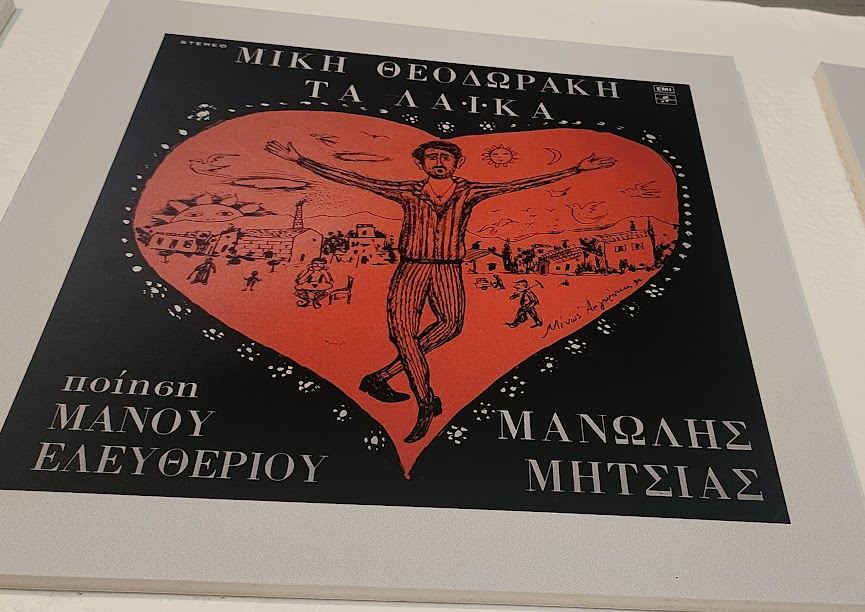
This record cover and many others were part of an exhibit at the Grand Arsenal mentioned above on what they called physical manifestations of music to contrast with the digital of today. Here’s a rack of more Theodorakis album covers.

And a case with your record player for your 45 rpm records!

Mikis was indeed a restless soul. Music was his passion and his genius but he couldn’t stay idle. “There is no time!” he wrote. “Artists and audiences must quickly join hands and climb together to the top of the hill, to see what lies hidden on the other side!”
Not only Mikis
Many cultural events took place while we were there, like in the Anatoliki Tafros (Eastern Moat theater), where Koum Kapi starts. There we saw the new generation of Italian tenors, who not only sing but joke around like Pavarotti, Domingo and Carreras used to do. They did mostly Italian film music but also a few arias to the delight of the audience.

Okay, so we succumbed to a selfie with the faros, Chania’s landmark, in the background. The faros itself was started by the Venetians in 1570 but renovated and rebuilt by the Egyptians in the 19th century in the form it has today, almost like a minaret.
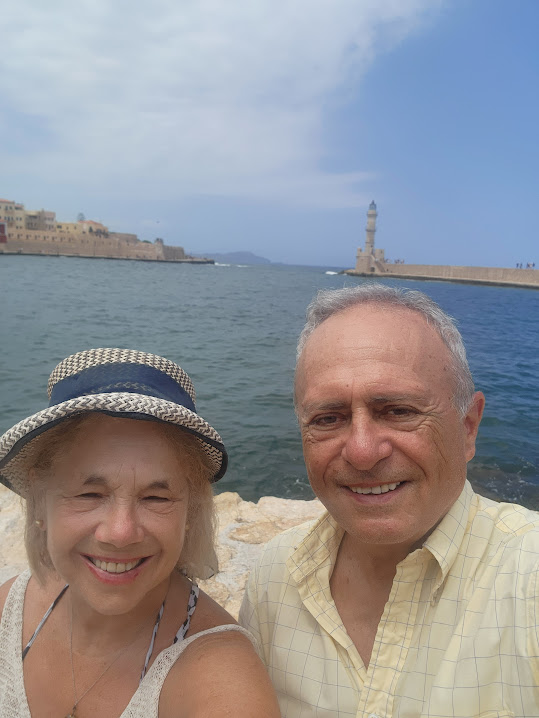
Walking along the ramparts leading to the faros is one of the most popular activities, preferably at sunset.

So, Chania just might lure us back next year. You can fill your ears with wax, but can’t escape Chania’s siren song.
*****
And here is Kyria Spyridoula’s banana orange cake, as she related it to me:
2 cups flour
1 teaspoon baking powder
1 teaspoon soda
1/2 teaspoon salt
2- 3 mashed bananas — if they’re very ripe, you don’t need sugar, if medium ripe, add 2 teaspoons brown sugar
Some walnuts
Mix all the ingredients well with a wooden spoon.
Add 2 eggs and a little oil (olive oil or vegetable oil, a little less than 2 cups)
Less than 1/2 cup freshly squeezed orange juice and some orange zest (grated peel)
Also add some chocolate drops if you’d like
Mix well all the mixture with a spoon
Bake at 160C or 170C.
It’s great too with strained yogurt and a little honey if you want it more sweet.
Kali orexi! Bon appetit!

If you try the cake, let me know with a comment.
You can check out my previous blogs on Chania: with an elephant eye, a visit to the caves of the flower children of Matala, exploring Loutro and the Samaria Gorge, going to Falassarna, Polyrinia and the ancient olive tree and museum at Vouves and with a visit to Elafonissi and Kedrodasos.
Thank you for reading — comments are welcome in the section below!! And enjoy what’s left of the summer!
If you like what you read, hit the like button and subscribe. Please share with your friends and social media. I’d love to hear your comments below.
There’s no need to log in to leave a comment. Just give an email address and your name.
Subscribe to become part of the olivesandislands community! Get new blogs and occasional newsletters delivered directly to your inbox. It costs nothing to subscribe. Olivesandislands does not share email information.
Note: Be sure to click on the confirmation email after you give your email address.

Sherri Moshman Paganos is a writer and former educator, inspired by her life in Athens, where she and her husband are happily retired and enjoying their travels in Greece and abroad. You can check out her writing — fiction, non-fiction, poetry and articles here.


Very nice, Sherri, recognition and new information, both in your blog for me. Thanks! (but do they get longer, or I am imagining things?
best, Judit
Judit Neurink, author https://juditneurinkauthor.com
LikeLiked by 1 person
Thanks Judit — glad you learned sth new too! Actually I had some really long blogs many months ago and shorter ones recently — it depends… 😃
LikeLike
A wonderful place!
LikeLiked by 1 person
I believe so…worth a visit!
LikeLike
Thank you for this wonderful blog post! I consider western Crete my “second home” but sadly haven’t been able to visit since 2023. I’m overdue and hoping to get there next September, and this post and all the lovely photos made me even more nostalgic and determined to make sure I do so:-)
LikeLiked by 1 person
Thanks Kirstyn. Yes I remember your affection for western Crete — hope you’ll be able to make it back soon!
LikeLike