Cadiz is blessed with its palm trees and plazas, wrought iron balconies and its seafood specialties. On the Atlantic Ocean, it’s a city with a laid back vibe, resembling more Havana Cuba than a city in Spain.

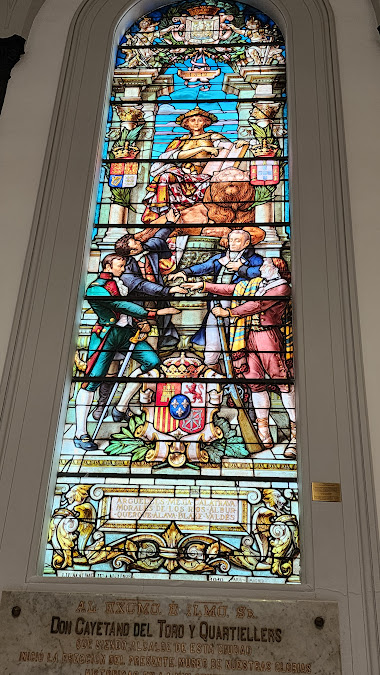
Apparently the Phoenicians admired it too for its strategic location on the southwest tip of Andalucia. In 1100 BC they established the town, using it as a center for trading metals like gold, silver, copper and bronze, and salted fish, according to the Cadiz historical museum. The town, known in those years as Gadir or Agadir, is one of the oldest continuously inhabited cities in western Europe (along with a few ancient Greek cities like Athens, Argos and Corinth). Later, the Carthiginians and Romans had their turn to rule, and then the Visigoths. Finally the city fell under Moorish or Arab rule for 500 years, along with the rest of Andalucia and much of Spain. In early modern times, the Age of Exploration, Columbus set sail from here in his 2nd and 4th voyages to the Americas. In Cadiz, Spain’s first liberal constitution was signed in 1812. An entire museum, Museo de las Cortes, is dedicated to the signing of the Constitution, and to historic personalities of the time.
The apartment where we’re staying, Fabio Catedral I, is spacious and spotless with a kitchen and dining room area and off of one of the main squares, San Juan de Dios, around the corner from the 19th century Ayuntamiento (city hall) This plaza from the 15th century, is a hop, skip and a jump from the harbor and train and bus stations. In the square there’s constant activity from kids playing football to entertainers with guitars and piano.

In the port, giant cruise boats are anchored in the mornings, with thousands of tourists then strolling up Calle Pelota to get to Cathedral Square, in the oldest part of the city. (The tourism though is nowhere near the levels in Malaga, Barcelona, Canary Islands or other areas of Spain, where local anti-tourism movements have sprung up to the extent of posting fake signs at the beaches warning of “falling rocks” or “dangerous jellyfish.”)
The impressive Catedral de Santa Cruz sobre las Aguas (Santa Cruz over the waters), is a trademark of the city, begun in 1716 and finished in 1838, a mixture of styles: Baroque, a little rococo here and there and neoclassical. The cathedral was built with money from the very prosperous trade between Spain and America, and especially Cadiz which had a virtual trade monopoly throughout the 18th century, considered its Golden Age. At this time, Cadiz was the richest, most commercial and most cosmopolitan city in Spain.

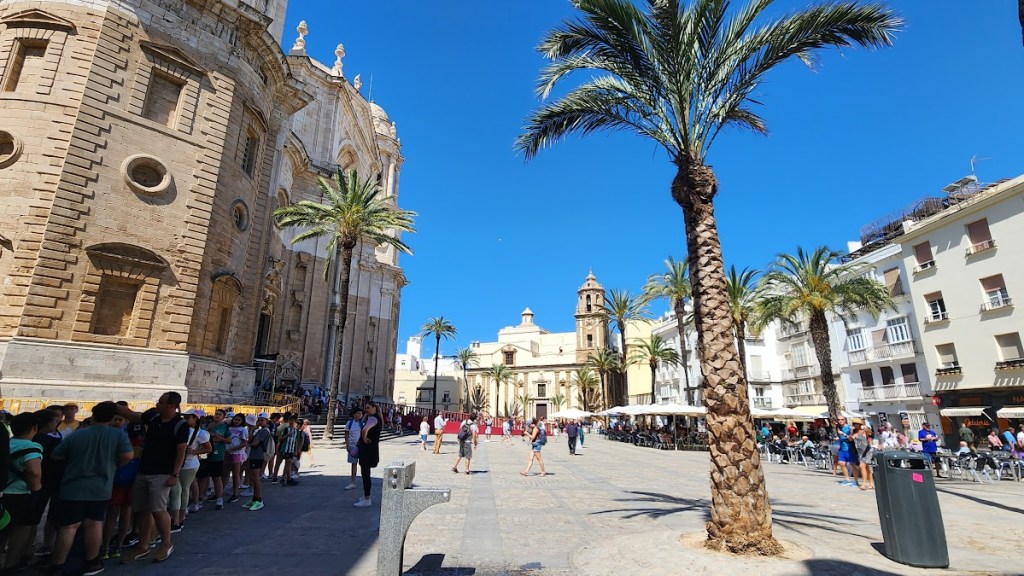

Across from the Cathedral lies the 17th century church of Santiago Apostle, that belonged to the Jesuit college. The walls around the church, as many walls in Cadiz, are made from sea barnacles. It’s very impressive to walk around inside with its sculptures and altarpieces.


Here’s another view of the church exterior through the Arco de la Rosa.

The name of the arch comes from a chapel that was on this site, dedicated to Cadiz’ patron saint Rosa.
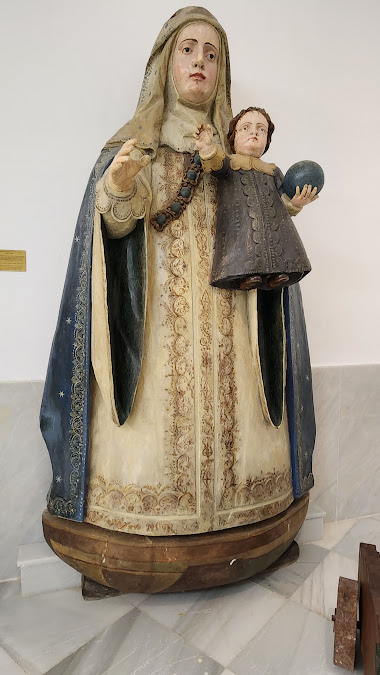
As portrayed in the Museo de las Cortes, here’s a wooden sculpture of Rosa that had once belonged to a ship.
Arches separate one barrio (neighborhood) from another. Notice the original thick city walls here.

A block from Cathedral Square you’ll find yourself looking over sea walls and the ocean. Here’s the scene looking right as you face the water.

But we want to keep moving past the cathedral, where Calle Pelota turns into Calle Campania. Among the high scale shops is a down home looking coffee place, where locals walk in and the personnel already know what kind of coffee they want. We realized that freddo or Greek frappé is not really a big thing here; when we asked for a cold cafe con leche, they nodded, and then just put cold milk in the hot coffee.
But if you want hot cafe con leche, it’s delicious everywhere. Here we sat down at Capricho on Calle Ancha (Wide Street), an elegant street and indeed the widest street in the town. Note the house with the lions on the facade.
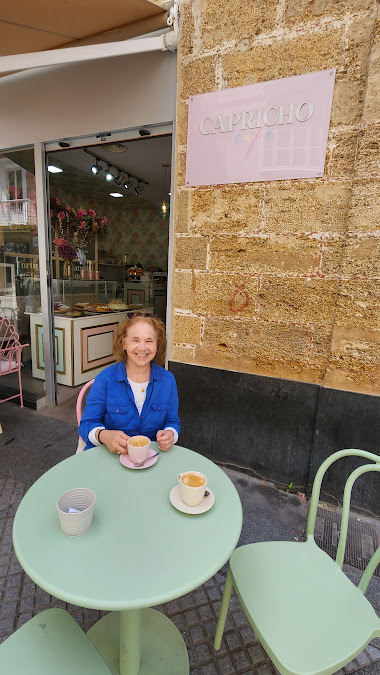

I don’t know why the prices for coffee are half or even one third of what they are in Athens –and not only Cadiz but all over.
Let’s go back to Calle Campania where it reaches Plaza de Flores with its lovely fresh flowers for sale, next to the Central Market.
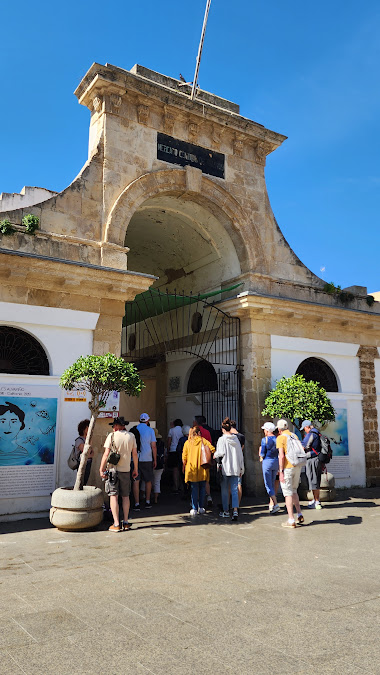
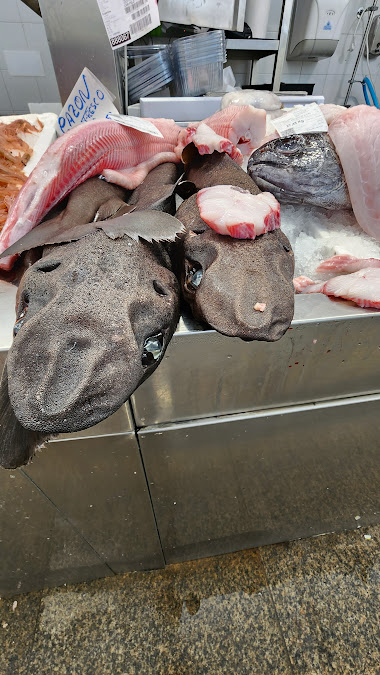
Like Barcelona, and its market La Boqueria, there are stalls with wonderful and exotic looking fish. The market closes by 3 or so and doesn’t reopen, but the restaurants in the rincon gastronomico (gastronomic corner) open again at 8. (Siesta is taken very seriously and all the shops and restaurants close for several hours and reopen in the evening).

“Vamos a la Playa” — As one of our days in Cadiz was pleasantly warm and sunny, we decided to head for Playa La Caleta for a swim. To get to the beach, you walk past the market through the barrio de la Viña. Probably the most popular barrio in the old town, it began as a vineyard, then a fisherman’s settlement. This is where the Cadiz Carnival, one of the most well known in Spain, takes place every year, with carnival groups singing all over the streets.
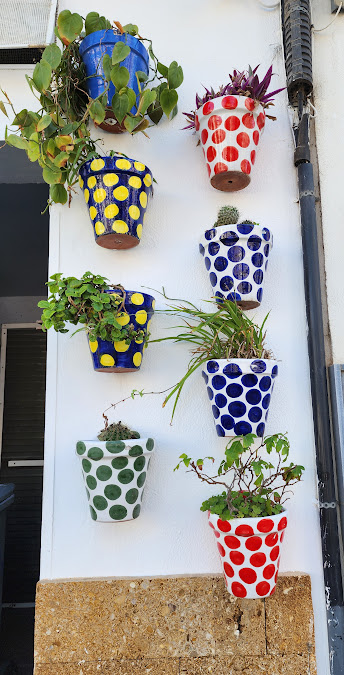

Most buildings have small wrought iron balconies, either left alone, or the balcony space closed up if the residents made an extension to their houses.


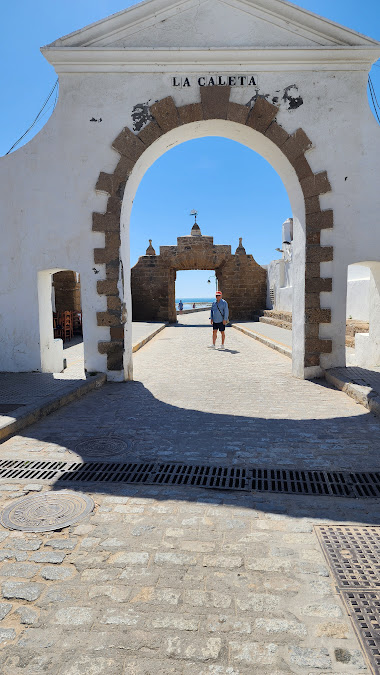
La Caleta is a compact city beach on the southwest side of the town. The entrance has a kind of faux Moorish look.
The kitschy looking Balneario (bathing house) de Nuestra Senora de a Palma y del real has been left abandoned for many years. It serves an important purpose providing shade.

There’s a castle at each end of the beach. The Santa Catalina castle reminded me a little of the one in Methoni, on the southwest side of the Peloponnese.

The water might not seem as clean as the Greek seas but it was beautifully calm and surprisingly warmer than our earlier swim we took outside Athens before we left.
Because the beach and promenade has a Havana type look, it was used as a backdrop for the James Bond film “Die Another Day” where Hallie Berry emerges from the sea. Note the castle when Hallie talks with Pierce Brosnan. We used the same shade.
If you have more time and want to swim, the Playa de la Victoria, a little further on the southeast side, is considered “the best urban beach in Europe.” It’s certainly one of the longest, extending for many miles.
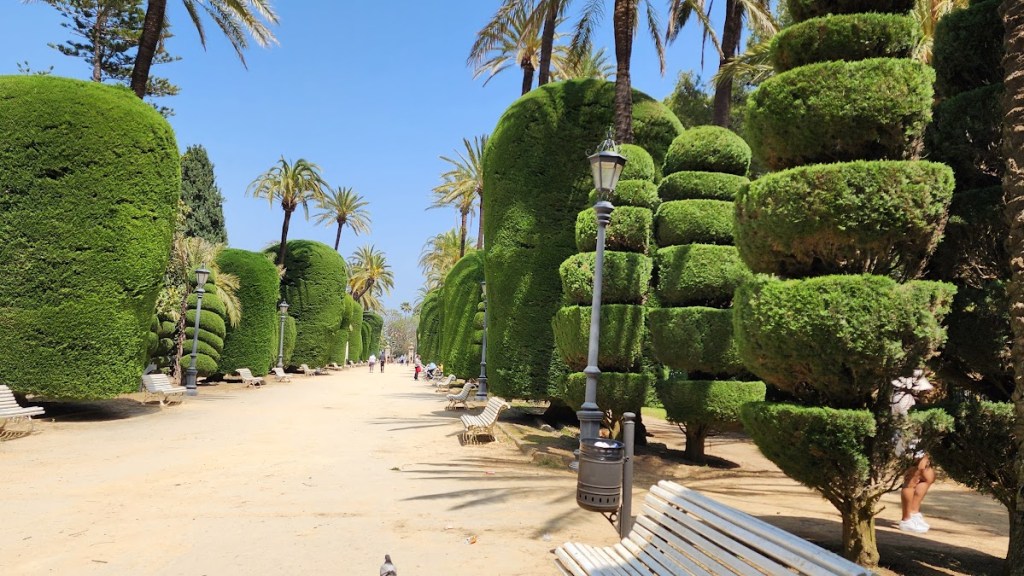
As nice as the beach is, there’s more we want to see. On the far west side of the town is the lovely Parque Genoves, by the sea with its striking manicured hedges and waterfalls. The largest park in Cadiz, it contains the Botanical Gardens which took the form we see today in the late 19th century.

The park has a statue of Cadiz native Manual De Falla, considered one of the best early 20th century Spanish composers and pianists.

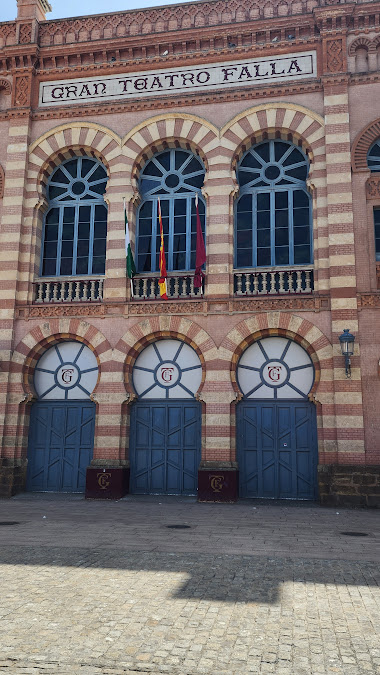
And a few blocks from the park adjacent to the medical school of the University of Cadiz is the 19th century Falla Theater (known as the “red bricks temple”) actively used today. The theater is in what’s known as the mudejar style, which blends Christian and Moorish architectural elements.
Here’s an orchestral arrangement of De Falla’s composition, Spanish Dance #1 from his opera, La Vida Breve (Short Life).
The ocean unsurprisingly has always formed an important part of life in the town. Of the 160 18th century watchtowers that viewed approaching merchant ships, only one is left today, the Torre Travira, official watchtower of the port in the 18th century. From above you can enjoy a panoramic view of the city.

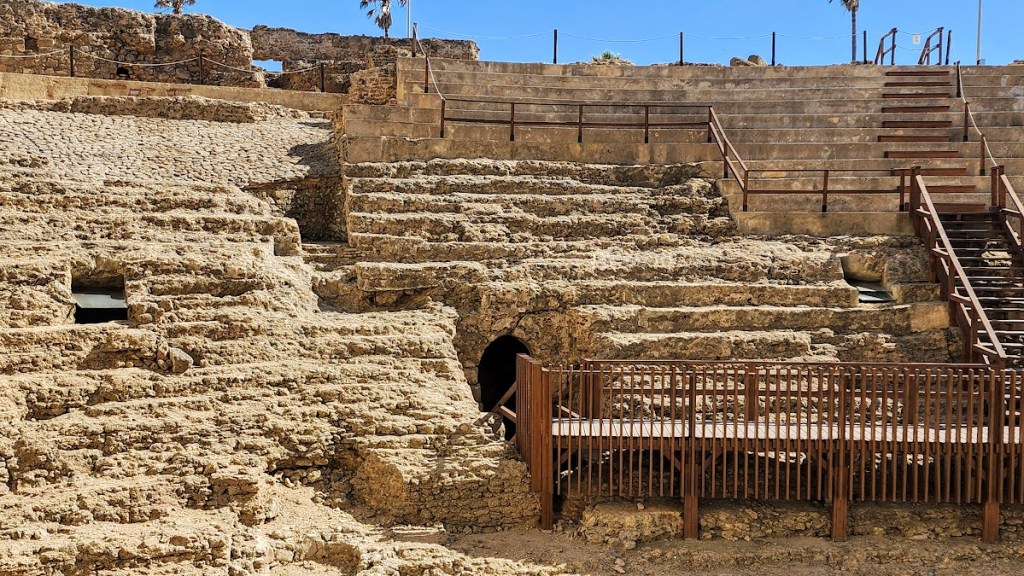
On our walks we came across ruins of the 1st century BC Roman theater, the largest built in the Roman empire. Abandoned in the 4th century AD, it could hold 10,000 spectators.
Wandering around the streets, you notice how common it is on Cadiz walls, as it is throughout Spain, to have religious shrines and pictures.

One of the prettiest plazas is Plaza Mina, site of the Cadiz historical museum. Inside, I found it interesting the terracotta masks found in a necropolis in Cadiz’ early history.


These strolling musicians turned up all over the old town, where they entertained to the delight of the cafe customers who treated them with money and glasses of beer. What an intriguing mixture of singing styles and clothes: Mexican Mariachis, a guy wearing all the flags of the world and another man in Elizabethan tights, who liked to break into “O Sole Mio.”

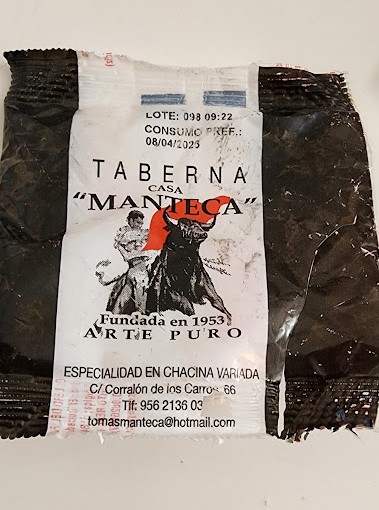
Cadiz is known for its tapas and seafood and we didn’t want to miss the experience of eating at Taberna Casa Manteca in the barrio of la Viña.
At 8:15 every evening, 15 minutes before they open, there’s a line around the corner of the restaurant. We were lucky to get one of the few tables out in front. The restaurant is owned by two sons of a famous torero or matador and the interior is full of bullfighting posters among photos and other memorabilia.

We had a wonderful collection of tapas and half raciones or portions, from chicharrones, one of their specialties (pulled pork) to tuna to another fish with queso, and the delicious dish with the sauce is stuffed peppers with shrimp and bacalao. Of the little tortillitas, one is with shellfish, and one with vegetables. All these accompanied with a white Spanish wine.


One night we ate at one of the few places open in the market. Lady Papa was very sweet and friendly and we got recandillo pulpo, a kind of Russian salad with pieces of octopus that we’d eaten in Cordoba, berenjanas rebozadas (aubergine) very popular dish with a honey sauce, and an assortment of bacalao. All tasty but a little too heavy on the fried.


A year and a half ago when we visited Granada and Cordoba, we planned the next time in Andalucia to stay in Sevilla and then Cadiz on a day trip, but that was before I found out that the week we were visiting was the Sevilla Feria de Abril. The April Fair and the Holy Week celebrations two weeks before are both major celebrations and draw visitors from all over Spain. (This year major storms made authorities cancel the Good Friday processional, which had locals and tourists in tears.) Finding a hotel at these times is a challenge and hotels charge double and even triple their prices, so it seemed to make more sense to stay in Cadiz, an hour and a half by train, and go for the day. (Cadiz is 4 1/2 hours by train to Madrid but the train system is excellent.)

Sevilla, the birthplace of flamenco!

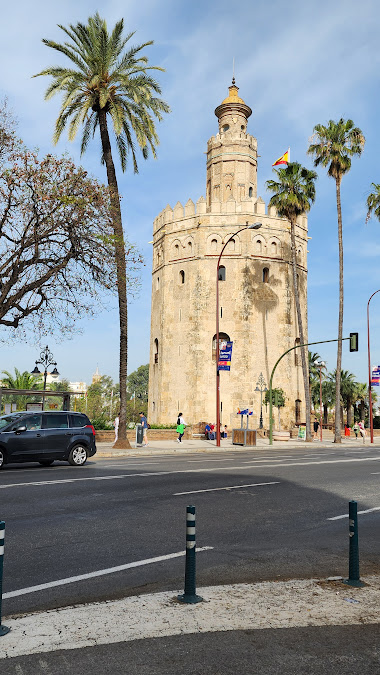
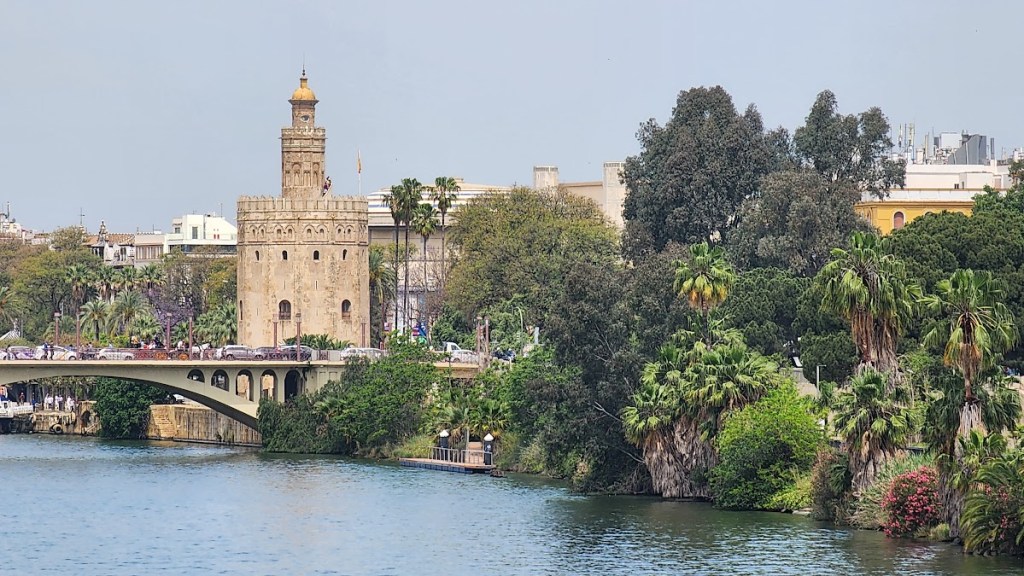
Trying to get our bearings in the historic downtown, we passed the Torre del Oro and the Alfonso Hotel, which opened its doors in 1928 and is one of the most luxurious hotels in Europe. Some scenes in “Lawrence of Arabia” were filmed there.

Sevilla’s cathedral is one of the largest Gothic cathedrals in the world. When it was finished in the early 16th century, it replaced the Hagia Sofia as the largest religious structure. The cathedral was built to show the city’s wealth as a major trader after the Reconquista (when Christians took back Spain from the Muslims). Those who began the construction in 1402 supposedly wanted to make it so beautiful and so large that whoever saw it finished “would take us for mad.”


The Giralda, the bell tower for the cathedral, was a former minaret that stood on the site of the mosque under Muslim rule, This is a good example of mudejar elements, this ornamentation and decoration used in Christian Spain from the 13th to 16th centuries, that was applied to Romanesque, Gothic and Renaissance styles.

As we saw in the Mezquita in Cordoba, there’s a blending of cathedral and mosque styles.

The Royal Alcazar! Even if we had found tickets (difficult for the same day — better to do it online before your visit), we had the time pressure to get out to where the Feria was being held, outside the historical center. But definitely worth another visit to this vibrant city to tour the Alcazar, whose gardens have been the setting for several “Game of Thrones” episodes. (The Roman bridge in Cordoba with the Mezquita in background has also been featured.)

The Cathedral, the Alcazar complex and the General Archive of the Indies, documents of the Spanish empire in the Americas, are part of the UNESCO World Heritage Site.
Before heading to the Feria, we wanted to walk around a bit in the adjoining barrio, Santa Cruz, so you follow Calle Agua (Water Street) up from the Giralda. At first, the street is wide, until eventually you get to streets so narrow you can practically reach out and touch the other side of the street.


We’re in the heart of what was once the centuries old thriving Jewish quarter of Sevilla. In the summer of 1391, nearly 100 years before the expulsion of the Jews in Spain, anti Jewish sentiment fueled a pogrom, where many Jews were killed and others driven from their homes. Synagogues were stripped and turned into churches. Pogroms also took place in other parts of the country (such as Barcelona). After this, the Jewish community faced a choice: be persecuted, or convert to Christianity. Those that converted were always under suspicion of continuing to practice their faith. Thus, to arrest and interrogate conversos, the infamous Inquisition was born.

After our Santa Cruz walk, we relaxed in the gardens behind the Alcazar. These costumes for photo ops existed all over Sevilla and Madrid.

We got our first glimpse of a carriage on its way to the Feria. The drivers are wearing the traditional wide hat, the cordobes.

To get to the Fairgrounds, you need to cross over the Guadalquivir River.
The Feria was started in 1846 as a trading fair. By the 1920’s it had become a celebration of local culture and traditions and went on uninterrupted even during the Spanish Civil War.

You follow the crowds dressed for the event. Actually, you feel like you’ve walked into a set of “Carmen” with these beautiful Andalucian dresses, even from toddlers, also dressed in their red flamenco shoes. This lovely woman was waiting on a corner perhaps for her consort, who would be dressed in a jacket, though it was starting to get very warm from the pleasant morning coolness.

Many came to the fairgrounds with public bus, but the really stylish way of entering the fairground entrance is with a carriage, especially if the coachmen are dressed like they’ve just stepped out of Downtown Abbey.
The portada, or entrance looked like something out of Disney’s Fantasyland.


Once inside there was a procession of horses.


The first thing we needed to do was make our way over to a public caseta or tent. Most of the 1,000 or so casetas are private, representing families or organizations. (You need an invitation to go inside.) In the information pamphlet we were given, there is a list of all the casetas and the location, so for example there might be one for the Radio Club Sevilla, another for the Club Deportivo Bomberos (the Sporting club of firefighters) and another for the family of Joselito del Gallo, etc. etc. What happens in these casetas? Eating, drinking and dancing, often all night long.


But also a number of public casetas exist, and we were in search of one to get some cold beer. The temperature by this time had climbed to 32 degrees C, even hotter inside the casetas. That didn’t dampen the enthusiasm and the desire to dance.


We felt very underdressed (as tourists) and I felt as if I should at least have a red flower in my hair and Elias a jacket with tie and handkerchief in his pocket (as he used to love wearing when he worked).
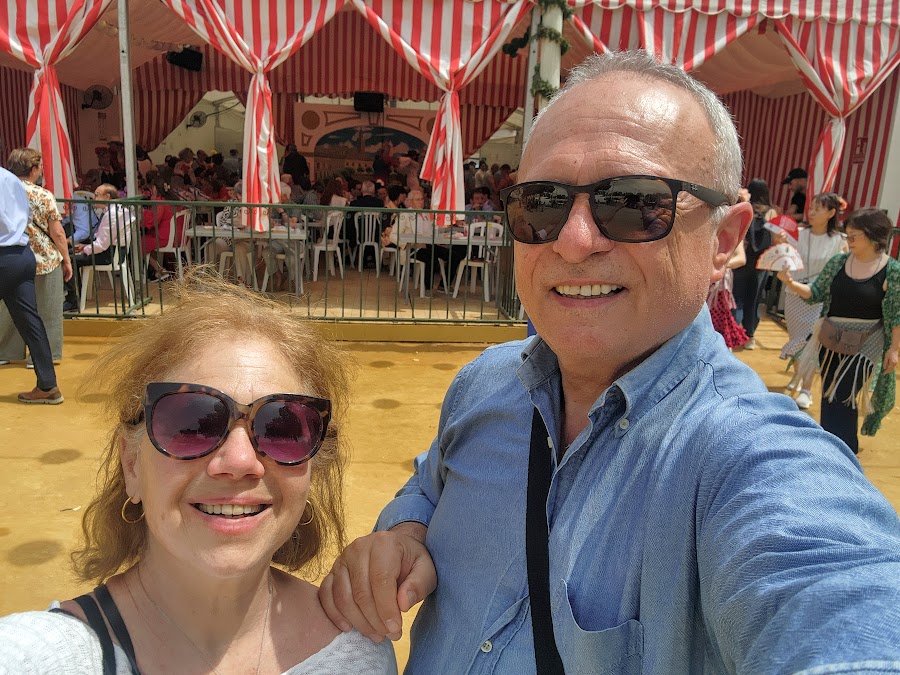
It was really an experience. We saw such pride and joy in being Andalucian. The Fair is the joyous counterpart to the solemn Holy Week. Both sides of life, both to be recognized.
We decided to slowly make our way back over the bridge and sit for a while in the Maria Luisa Park that has lush plants, benches and tiled fountains.Every so often, carriages would drive through or horses.


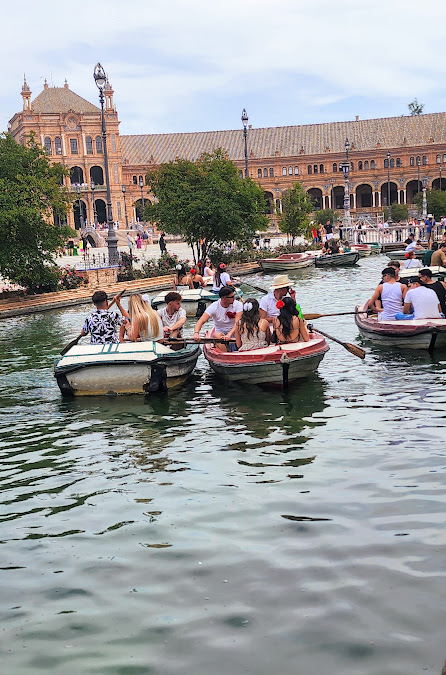
At the edge of the park is the gorgeous Plaza de España. This palace, built in 1928 for the Ibero-American exposition of 1929, mixes a whole group of architectural styles: 1920’s Art deco with elements of Baroque revival, Spanish Renaissance revival and Moorish (Neo-Mudejar) revival. The result is fantastic.
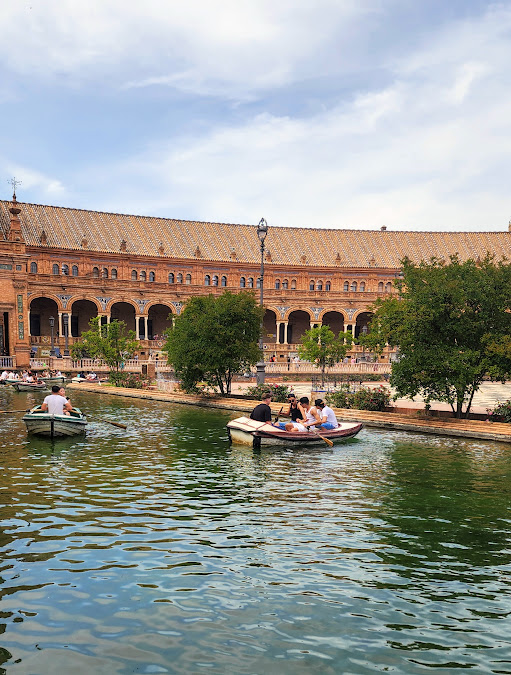
It’s a popular place to take photos. Two women wearing flamenco dresses in different color polka dots took turns photographing each other.

There are four bridges, each one representing an ancient kingdom of Spain.

Near one of the entrances to the palace, a woman entertained us with her flamenco dancing.

So we vowed to return to this vibrant city, non Feria time, non tourist time, perhaps months like February or November, tour the Alcazar, take a look at the Royal Tobacco Factory that inspired Bizet to write “Carmen,” see flamenco and of course sample some famous Sevilla tapas.
Back in Madrid, we had a couple of days before we flew to the States to spend time with family, and we returned to our favorite places: the Retiro:

the area around Plaza Mayor and the Palace


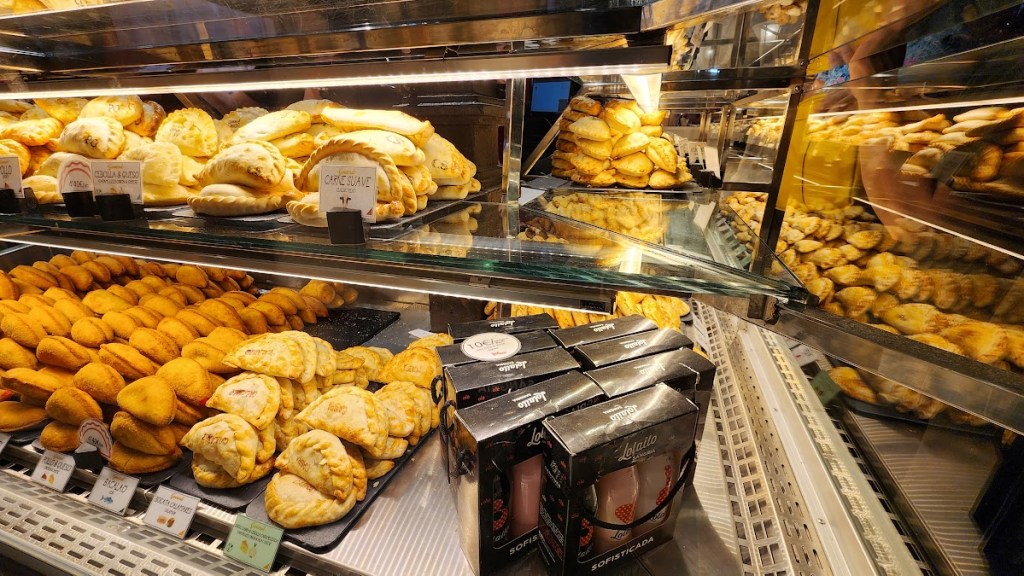
The Mercado of San Miguel with its abundance of exquisite looking tapas and heavenly smells and tastes:


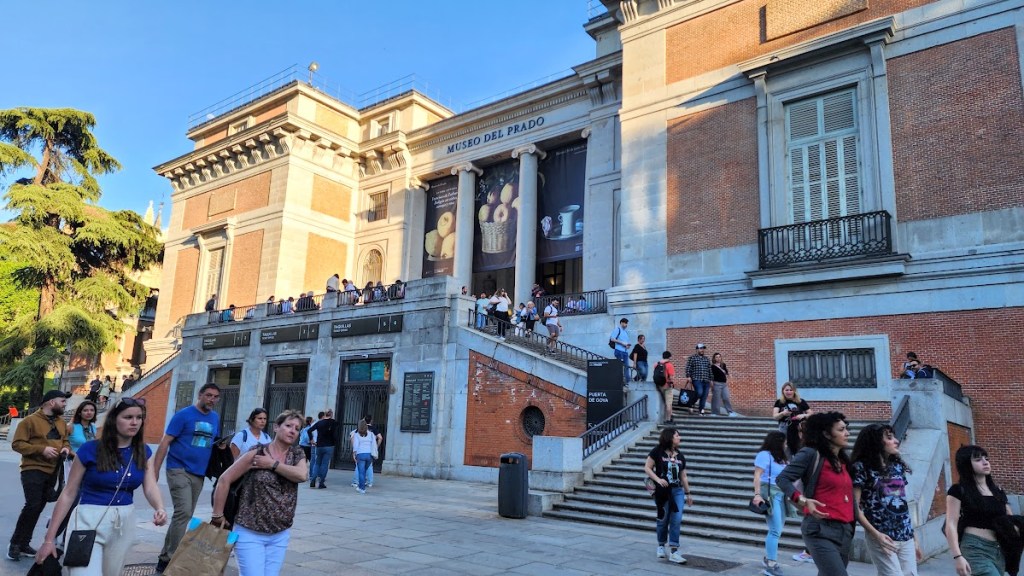
The Prado and Goya’s black paintings:

Velazquez’ “Las Meninas” inspires representations of the Infanta Margarita’s dress all over Madrid. This one was near Atocha train station.


Plaza Cibeles

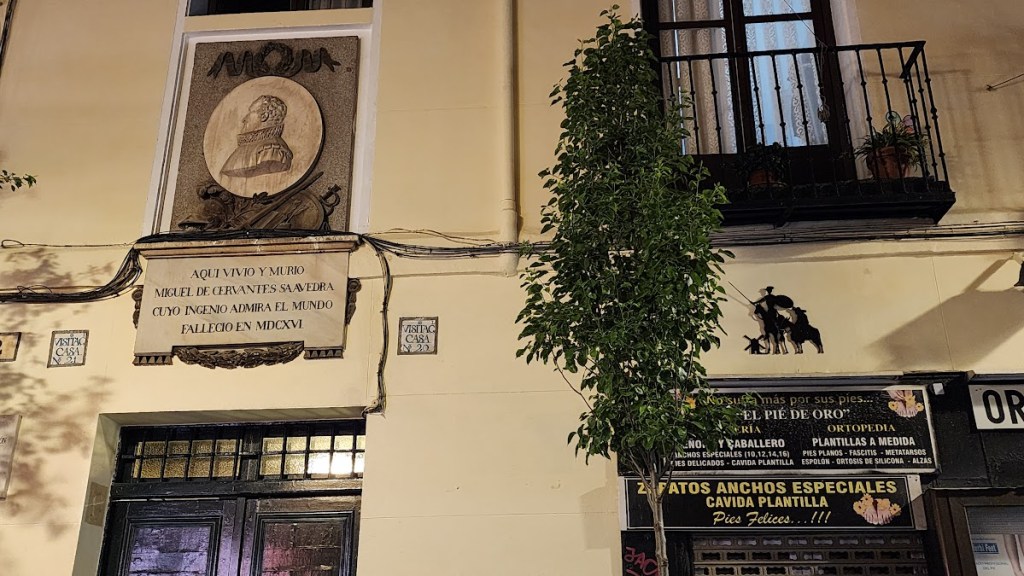
The Barrio de las letras, where we like to stay: Calle de Cervantes and the house where Cervantes lived and died, and Plaza Santa Ana, with the statue of Lorca.

This time we noticed a new trend in silliness, bachelorette and bachelor groups walking around the city. A popular get up was the groom riding a blown up rooster, the bride a hen. (I hope this trend isn’t planning to come to Athens…)


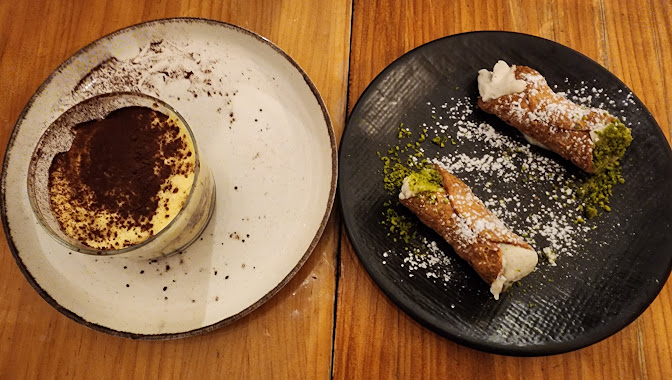
Our favorite return places also included restaurants, like Il piccolo diavalo, that I described in my last Spain blog. After so many Spanish tapas, we were craving some good Italian pasta dishes. Beginning with baked aubergine in tomato sauce and salad, we had some heavenly gnocchi, linguine with truffles and mushrooms, cacio e pepe with tuna and spaghetti bolognese. Washed down with a white Italian wine, and not to forget dessert: cannoli and tira misu. Ah…

And there you have it: Cadiz a real surprise in its importance in Spanish trade and its pleasant vibe today, Sevilla, a bustling city with the April Feria, and Madrid with its stately buildings, its youthfulness and its lively streets and plazas. España: hasta la proxima visita!
If you like what you read, hit the like button and subscribe. Please share with your friends and social media. I’d love to hear your comments below.
There’s no need to log in to leave a comment. Just give an email address and your name.
Subscribe to become part of the olivesandislands community! Get new blogs and occasional newsletters delivered directly to your inbox. It costs nothing to subscribe. Olivesandislands does not share email information.
Note: Be sure to click on the confirmation email after you give your email address.

Sherri Moshman Paganos is a writer and former educator, inspired by her life in Athens, where she and her husband are happily retired and enjoying their travels in Greece and abroad. You can check out her writing — fiction, non-fiction, poetry and articles here.


Very Nice, Sherri!
LikeLiked by 1 person
Thanks Nancy!
LikeLike
Although Andalucia has such charm and rich culture, nothing beats the Greek sea/food. My many years of experience on both sides can attest to the above.
LikeLiked by 1 person
I totally agree. Looking forward to both the Greek sea and seafood this summer!
LikeLike
What a wonderful trip, Sherri! A vibrant culture with intense richness in food, art, folklore, history, and entertainment! Thank you for the beautiful pictures and descriptions! Truly enjoyed traveling with you once again! It was nice to see Teddy, too!
Adios Amigos!
LikeLiked by 1 person
Muchas gracias Stella! I’m so happy to have you along on my travels.
LikeLike
Another wonderful blog, rich with photos, and interesting information. Bravo!
LikeLiked by 1 person
Thanks Sue — would love to return to Cadiz sometime!
LikeLike