The boat from Chora Sfakion (Sfakia) slowly enters the bay of Finikas, the ancient name for Loutro, with its clear blue waters coming into view. What pleasure you feel at this beautiful village ahead of you at the bottom of the dry and rocky cliffs, small green shrubs dotting the hillside. In the pleasing symmetry of the white stone and blue shutters of the small hotels, Loutro is a little Cycladic picture in the south of Crete.

About 15 years ago we decided to stay a couple of nights in this little paradise, and now years later, we came here as a day trip.
Loutro can only be reached by boat or on foot — 2 to 2 1/2 hours from the small port town of Sfakia, which is about an hour and a half drive southeast of Chania.

The 20 minute ferry ride to Loutro from Sfakia has wild vistas like this isolated church in the cliffs.

The beach of Glyka Nera or Sweetwater Beach, so named for its freshwater springs, lies between Loutro and Sfakia. At Sweetwater, you can find a few (precious!) almerikia or tamarisk trees for shade. What look like little white sails in the picture, are umbrellas. Even here in this remote spot!

You can walk to the beach from Sfakia and Loutro in about an hour, and it’s a popular boat excursion from Loutro.

When you get off the boat at Loutro, you just want to ooh and ah at the scenery but you have to keep walking with all the tourists in this small space and products being unloaded to the hotels and tavernas.

On this trip we met up with Alison Murray, who along with her husband Stavros Androulakakis, own and operate the Porto Loutro hotel. There are two Porto Loutros, the original one that opened in 1989, by the beach, and a second one that’s on the hill, completed a few years later. The first hotel was built on gardens next to Stavros’ family house in an original Venetian building. Throughout the 90’s, the Porto Loutro was the only hotel – there were rooms to rent, but Loutro hadn’t taken off yet as the very popular resort that it is today.


Alison is like a mother hen, clucking among her brood of visitors and asking about them solicitiously. But during a lull in taking care of guests, she tells me that she needs to be “tough but nice” at the same time. Her caring and involvement have brought her share of loyal visitors who return year after year (she told me, some have been coming for 25 years). A number of other hotels welcome guests now. They’re all in the Cycladic style, except for a new beige stone hotel on a hill, that stands out for not following the Cycladic colors.

You could say that Alison is the very soul of Loutro and she has created a number of Facebook groups, including “Lovers of Loutro” where you can see her beautiful photos, or “Hotel Porto Loutro” on Instagram. For information on Porto Loutro, you can also check out hotelportoloutro.com. Surely she will help make your stay memorable and you’ll already be thinking of your return the next year!
This photo of Alison’s shows where she lived in the village in the 80’s before the hotel was built.

Loutro is your total rewind and refresh place — besides swimming, there is not much else to do, except to select which taverna you’re going to eat in, which bar you might have a drink in and where to have your morning coffee.

During the day you watch the people disembarking or getting on the boats to Sfakia or Agia Roumeli, you swim, you might rent a canoe or pedal boat or look up in the hills and see some goats nibbling from some shrubs. You can walk through the village in 5 minutes, so when it’s crowded, you really feel it.
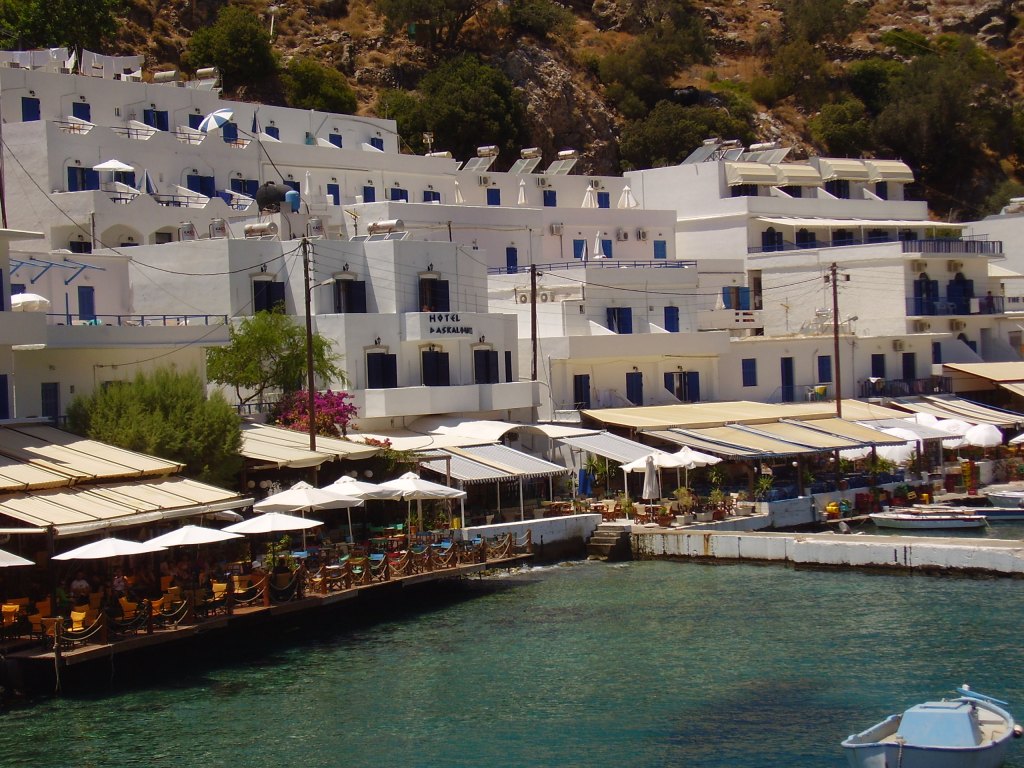
There are two main pebbly beaches — the town beach, with umbrellas squeezed up next to each other and a beach a little further. You’re actually forced to get an umbrella and sunbeds as there’s no shade. (Nor is there room on the tiny beach to put your umbrella and no way to put it up through the stones.) It’s a reasonable 8 euros though to rent sunbeds. We keep walking to the 2nd beach, a little less “one on top of another’ than the first. The water is delightful — crystalline and surprisingly cold.

It seems that Loutro wants to play up its image as a family resort, as shown by this sign near the beach.
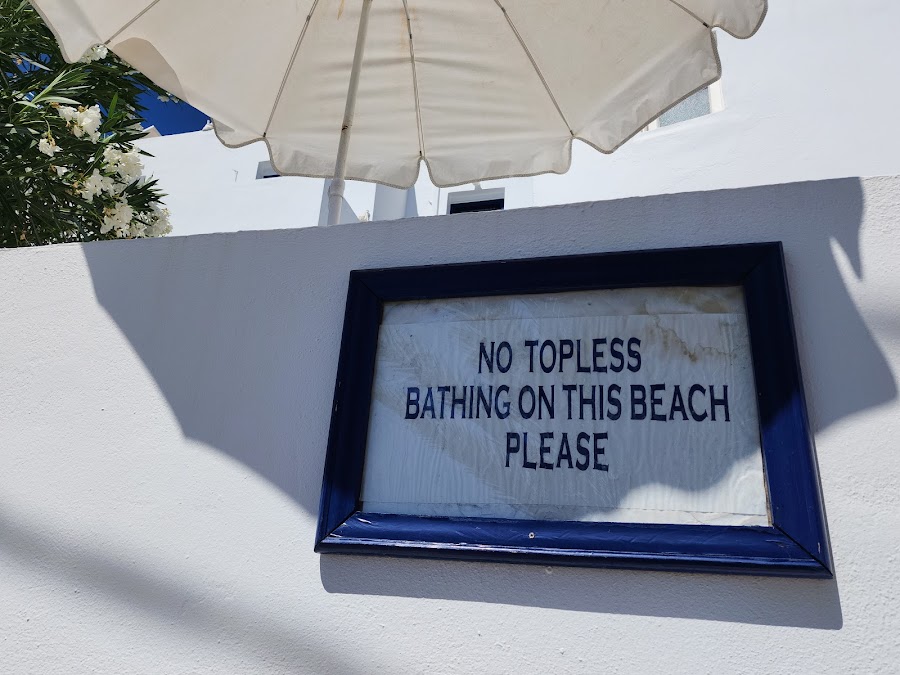
The resort has attracted celebrities and politicians. In 2008, settled right next to us was the Mitsotakis – Bakoyiannis family. 90 year old family patriarch Konstantinos Mitsotakis was splashing around in the water along with everyone else in the family and their guests.
If you come in April or May, you’re rewarded with wild flowers and few crowds. At that time or after the summer, you can hike up to the ancient town of Anopolis, about an hour or follow the paths above the sea. Unless you do the hike very early in the morning, summer is not the time to go trekking under the sun, nor the time for solitude.
Loutro is lovely no doubt, but we decide that certain places appeal to you more at certain times in your life. When you’re working, as we were in 2008, you have more of a need to relax and not move constantly on your vacation. That first magical view of Loutro coming into view was and is special.
The time is passing. One last look around. Oh that light! Those colors!

Time to wait for the boat to take us back to Sfakia.

But it’s nearly an hour late because it’s coming from Agia Roumeli, the exit of the Samaria gorge and they’re making sure that all the hikers are accounted for and not left behind in this remote village, also accessible only by boat.
While Loutro is compact and tidy, Agia Roumeli is larger, wilder and less crowded, except during the afternoon hours of around 2 to 5, when hikers are finishing their approximate six hour trek through the gorge (the longest in Europe). During these hours, exhausted hikers fill the restaurants, having a cold drink before taking the 5:30 or 6 pm boat that will take them to Sfakia to get the bus back to Chania. Very few people stay over in Agia Roumeli which gives it a kind of desolate air at night, with dozens of ghostly chairs throughout the village. I think the place has a real end of the world feeling.
There are a few organized umbrellas on the pebbly beach and as with Loutro, there’s no shade– Oh where are you tamarisk trees, the delight of so many Greek beaches!

The Samaria Gorge Hike
A hike through the 18 km gorge, carved out by the river that flows between the Lefka Ori (White Mountains) and Mt. Volikas, is a must for any visitor to Crete (provided your knees are in good shape and you’re kind of “youngish.”) After the four times that I’ve done the hike, each time at the end, I’ve practically peeled off my clothes (each time wearing a bathing suit underneath) dropped my stuff on the beach and ran into the Libyan Sea for the best swim ever.
The following photos are from my 2009 hike with daughter Suzanna.

You start your hike at the highest point of the Omalos plateau at the xyloskala or “wooden stairs”– you hold onto wooden railings to help you in the steep descent. You need to take this part slowly because it’s easy to slip on the well-worn stones. The terrain changes constantly in the gorge, but throughout you’ll find fresh springs. For a while you’re walking over bridges and river beds.

About halfway through you reach the abandoned settlement of Samaria (people actually lived here until 1962, when Samaria was made a national park, mostly to protect the kri kri, the Cretan mountain goat that lives here and is an endangered species.) Mules are there to carry those who can’t make it.


And this photo goes back to 1998 when we did the hike with our kids.

The hardest part of the terrain, where you’re wondering why on earth you undertook this hike, is when you’re walking under the sun on heavy boulders. The interesting thing are the signs telling you to be alert for unusual plants growing in the cracks. And it’s true, you see little leaves, even flowers, peeking out. It’s said there are 450 varieties of wildflowers in the gorge.
Soon you reach the most unusual and photographed spot, known as Portes or “Gates” or also “Iron Gates” where the width is only 3 meters wide (!) and the walls reach a height of 500 meters at their highest.

Some tour companies offer what they call the “lazy hike” from the Agia Roumeli exit up to the Portes. When you exit, it’s like a mirage, you see a stand with cold orange juice under the leafy plane trees. But this is the old town that was destroyed by floods in the 1950’s and then moved further away. So you have to keep trudging a little while longer. The city was known as Tarra in ancient times, famous throughout Crete for its sanctuary of Apollo.
This past summer with the heat wave in July, the gorge was closed for a few days. Ordinarily it’s open from May (when the wild flowers are at their blooming peak) through October.
Here I am on a school trip some years ago in April — still some snow.

Though it’s hardly changed over the years, Agia Roumeli back in the mid 70’s when Elias first hiked through the gorge with his friends, had no electricity, only generators. And no tavernas, just a place that cooked eggs and potatoes for him and his friends as they camped freely on the beach.
The boat from Agia Roumeli to Loutro looks as if the mountains are falling right into the sea. Note the sunlight playing upon the water.


As we get on the boat from Loutro this time, we can see the telltale signs of the hikers coming from Agia Roumeli with their dusty sneakers, straggly hair and weary look. Tomorrow many of them will be shuffling along in leg pain. That’s the price you pay for this magnificent hike.
Our boat, the Daskalogiannis (and the Daskalogiannis hotel in Loutro where we stayed in 2008) are named for a Cretan hero from this area of Sfakia.

A wealthy shipowner, he was the leader of one of the first revolts against the Turks, in 1770. Expecting help from Russia that never came, Daskalogiannis finally decided to turn himself in, hoping it would help his people.
It was east of Agia Roumeli in Frangokastello, where Daskaloyiannis surrendered to the Turks. He met a grisly death; the Turks skinned him alive. According to the Lonely planet guidebook, witnesses related that he “suffered this excrutiating death in dignified silence.” A true Sfakian.
Frangokastello, 11 km east of Sfakia, is a 14th century Venetian fortress, that was built not only to deter pirates but also to impose order on the rebellious Sfakia region (who hated the Venetians as much as later the Turks). Its name was the Castle of St. Nikitas but the locals derisively called it Frangokastello, the Castle of the Franks, a term used for any Catholic foreigners, and the name stuck with the Venetians too. A story goes that when soldiers and builders arrived to begin constructing the castle, some local Sfakians destroyed every night what the Venetians built during the day. Eventually, the Venetians were forced to bring in additional troops and the perpetrators were betrayed, arrested and hanged.
Below the castle is a sandy beach, wonderful to relax on and cool off in the sea after traipsing around the castle.
If you keep going further east you get to Preveli, a beautiful south coast beach (in Rethymnon prefecture), that we visited several years ago. My son Theo typically tells us how to get there: you go a little while along a dirt road and then you park the car and walk a little ways along a path to the beach. The reality always is the dirt road goes for a number of kilometers, destroys the tires, and the walk is about a half an hour in the sun….) But what a lovely setting it is….


But we’ve wandered too far east, let’s go back to Sfakia and further west to Sougia, which we visited in 2010 with the boat from Agia Roumeli and then the bus back to Chania. As a town, there’s not much to see; it’s a “nouveau” Greek town with unsightly antennas on the roofs and satellite dishes. There are several organized campgrounds (and probably free ones too).


Sougia is famous for its beach, the longest in southwest Crete. From there you can take a water taxi to Lissos.

Or if you have the will and strength, you can walk — it’s about 90 minutes. In any case, it’s very rewarding, according to son Theo. At Lissos, they’ve found structures from 320 BC, baths, a theater, acqueduct, a healing temple and cemetery. But the reward is the beach and swim, as Theo captured in his photo.

Further west from Sougia lies Palaiohora and the famous Elafonisi, subject of a future blog…
These are just some of the beautiful sites along the south/ southwest coast of Crete, and a brief trip through the Samaria gorge. If you have the time and endurance, there are many hikes you can take through more gorges, and many beaches, still rugged and wild that you can discover, many only on foot.
Chania
Back in Chania, the town is full of life and tourists. From all the years we’ve been coming here, we see both small changes — a restaurant we know for example is adding a breakfast menu — and larger changes like all the new building right outside the old town and renovations of abandoned Venetian buildings inside the old town.
As I’ve written three other blogs on Chania, 2022 on Matala and Chania, 2020 Holiday in Chania, and in 2019, Chania with an Elephant Eye, I’ll mostly just post photos. But first a few food photos.
Granted, the food is delicious just about everywhere you go (though I’d avoid the touristy places along the port where they hire someone to pull you in to look at the brightly colored menu). The special Cretan touch is the kerasma, the “treat” after the meal. It’s always an exquisite tiny carafe of raki and usually fruit — watermelon — or a sweet. These two treats offered us go well beyond that.
At the “Well of the Turk,” one of our favorite places, after its delicately seasoned Moroccan and Turkish dishes, our waiter Andreas brought us a fruit plate — watermelon, melon and orange, as well as homemade cheesecake, along with the raki.

While at the Hani, after our delicious salad and main dishes, they brought us watermelon and grapes, along with homemade brownie and stracciatella gelato. Wow.
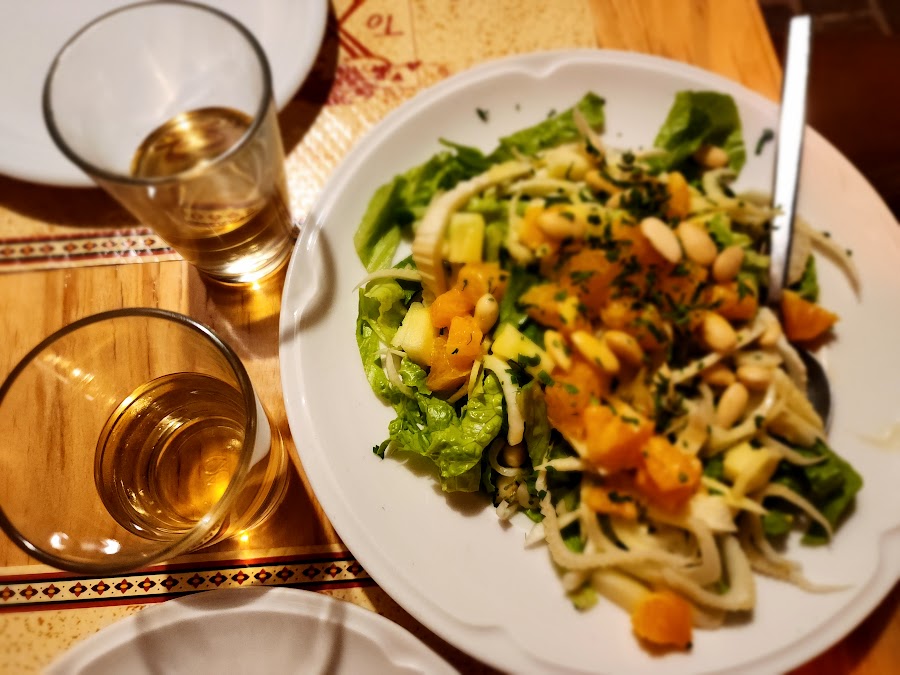


The Hani is a friendly family run place which has great music to listen to and sing along. You’ll find it right outside the walls of the restored synagogue and the Synagogi bar that has a steady stream of customers.

Down Theotocopoulou St. where we stay, on the side near the sea, this time we try Pulse, the vegan restaurant. We start out with the Meze Board I, which is surely the favorite with all. What an amazing combination of flavors that seem like they’re dancing in your mouth, as Elias expresses it. It contains hummus with roast vegetables, quinoa salad, mixed salad, potato cakes, vegetable samosas, veggie manchurian balls in sweet spicy gravy, pitas with vegetable pate. Even a confirmed carnivore would be converted. The other dish is of “anthoi” or stuffed zucchini blossoms, a popular Greek dish in the summer, usually stuffed with rice and a lot of herbs. At Pulse, they stuff it with herbed ricotta cheese.

Still hungry, we order the risotto verde with spinach, peas, caulifower, broccoli, spring onion and dill but we have to wait a bit as they cook everything right then.

Now with food out of the way, here are some photos taken on walks around the old town:


Agios Nikolaos in Splantzia was first a church, then a mosque from Ottoman times with both a campanile and minaret and then a church again.


From Theotocopoulou St. on the west side of the old town, it’s a 10 to 15 minute walk to Nea Chora with its long sandy beach. The Pentagono cafe on the way with its flowers and fruit display leads to the shaded walk under the almerikia (tamarisk trees). You follow the open sea — the last day we were there it was a little rough — and pass by the monument to the Battle of Crete. Nea Chora was one of the areas most heavily bombed during World War II. And at Nea Chora, the Agistri Restaurant displays its catch.


An event that began last summer, every Tuesday evening in the old town is the “strata” where a procession of traveling musicians and/or dancers end up in Mitropolis Square (the main cathedral) and perform for hours. In this week’s theme, a traditional Cretan village wedding was shown. The procession included several men chanting what’s known as rizitika, from the word rizes, meaning “roots.” These are songs of an oral tradition of the past , sung unaccompanied by instruments, usually about pain and loss, (that go on and on….) but as I read, they can also be sung at weddings. How strange, how solemn and dirgelike the music was, almost like the epitaph on Good Friday. Hardly the music to celebrate a wedding!


But once we get to Mitropolis Square, the Cretan musicians are waiting for the party to start. And traditionally, everyone wants to dance with the bride and groom. A table is set up with bottles of raki and little glasses, and paximadia (Cretan rusks). The organizers bring to the guests bread baked with glykaniso or anise, a traditional gift to the bride along with honey and pomegranate, that she throws to the ground and breaks, then starts her dance with the groom to the driving beat of the lauto and lyra. Chania, continual exuberance and celebration! That’s what draws us year after year…

Stin ygeia sas, to your health!
If you like what you read, hit the like button and subscribe. Please share with your friends and social media. I’d love to hear your comments below.
There’s no need to log in to leave a comment. Just give an email address and your name.
Subscribe to become part of the olivesandislands community! Get new blogs and occasional newsletters delivered directly to your inbox. It costs nothing to subscribe. Olivesandislands does not share email information.
Note: Be sure to click on the confirmation email after you give your email address.

Sherri Moshman Paganos is a writer and former educator, inspired by her life in Athens, where she and her husband are happily retired and enjoying their travels in Greece and abroad. You can check out her writing — fiction, non-fiction, poetry and articles here.


Wow. Every place you describe is so beautiful. I want to jump into each picture and experience the scene in person.
LikeLiked by 1 person
Thank you Diane — your vacation here is waiting for you!
LikeLike
A wonderful description of some visited and others not yet visited places. I remember Alison from Porto Loutro – must be well over 20 years ago! Sherri you write about all the places I want to visit/revisit! Thank you.
LikeLike
A wonderful description of some visited and others not yet visited places. I remember Alison from Porto Loutro – must be well over 20 years ago! Sherri you write about all the places I want to visit/revisit! Thank you.
LikeLiked by 1 person
Isn’t that amazing you remember Alison from 20 years ago…time for a revisit for sure and so much more along the coast to visit for the first time!
LikeLike
Thank you, Sherri, for writing about my favourite summer holiday place – Rethymno, Crete!
The next time you go, visit, if you haven’t done so already, the beautiful and completely secluded Ligres Beach (17 km east of Prevel) or Triopetra Beach next to Ligres. After your swim, you can go for lunch at Amadolakkos Tavern in Koufi, Rethymno. The whole day will truly be an experience!
LikeLike
Thanks Stella, always looking for new tips! If we’re near Rethymnon, we’ll check out these beaches and the Amadolakkos taverna
LikeLike
Isn’t this just the loveliest area? Great description. We were not able to go down the Samaria Gorge when we were there due to it being closed because of an earlier earthquake. In our list for next time we are in Crete! Lori
LikeLiked by 1 person
Just beautiful, my favorite part of Crete. Oh yes, be sure to do the Samaria gorge next year, an unforgettable hike. After the Loutro – Marmara trek you did, the gorge will be easy for you!
LikeLiked by 1 person
That is good to hear!
LikeLiked by 1 person