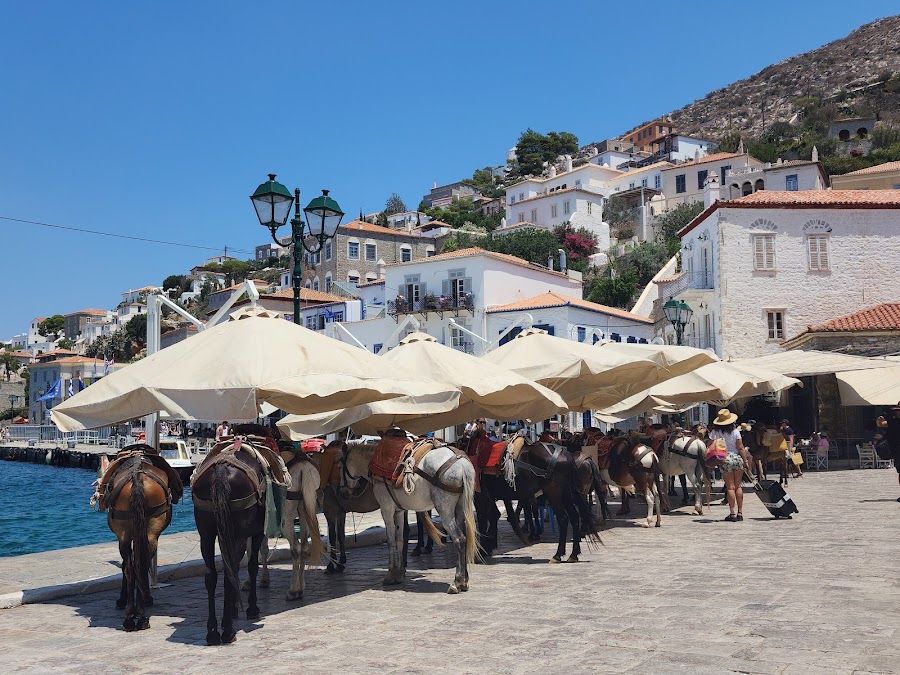
Who wouldn’t love Hydra, an island without the sound of car engines or revving motorcycles? Instead you hear the clip clopping of the mules and donkeys, carrying groceries, visitors’ luggage, residents’ packages, even building materials. “Sorry sorry mister hello!” was the donkey driver’s warning to Elias to move out of the way. The mules and donkeys are the land taxis – there are also the water taxis sprinting to beaches in different parts of the island.
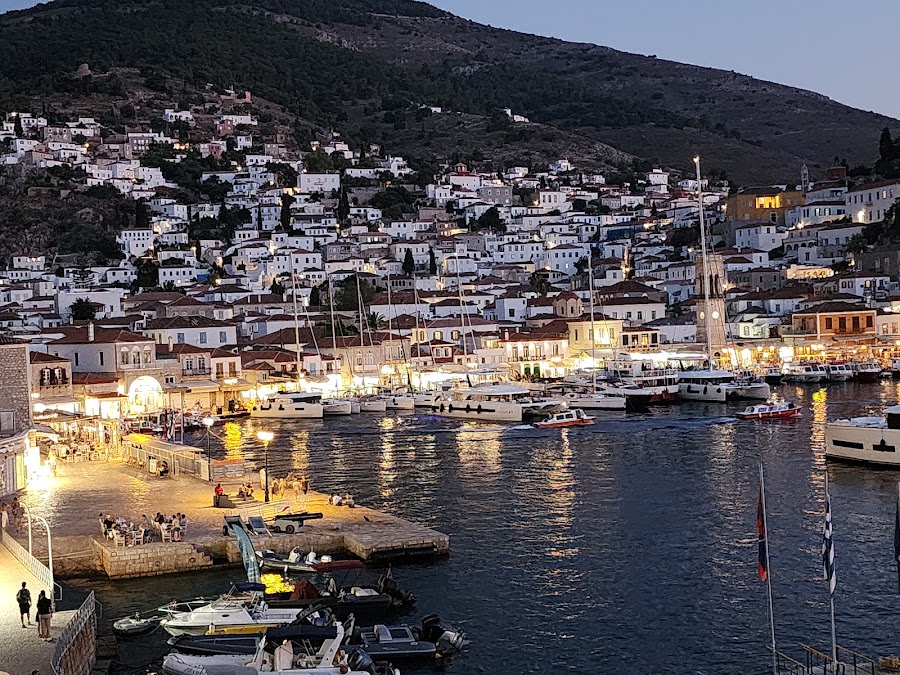
In Hydra to get anywhere you need to walk. The amphitheatric port is small and the cubist looking stone houses, mostly from the late 18th century when Hydra was a maritime power, lead along narrow cobblestone alleys up to the hills from the port. If you stay for a few days, you’ll climb thousands of steps.
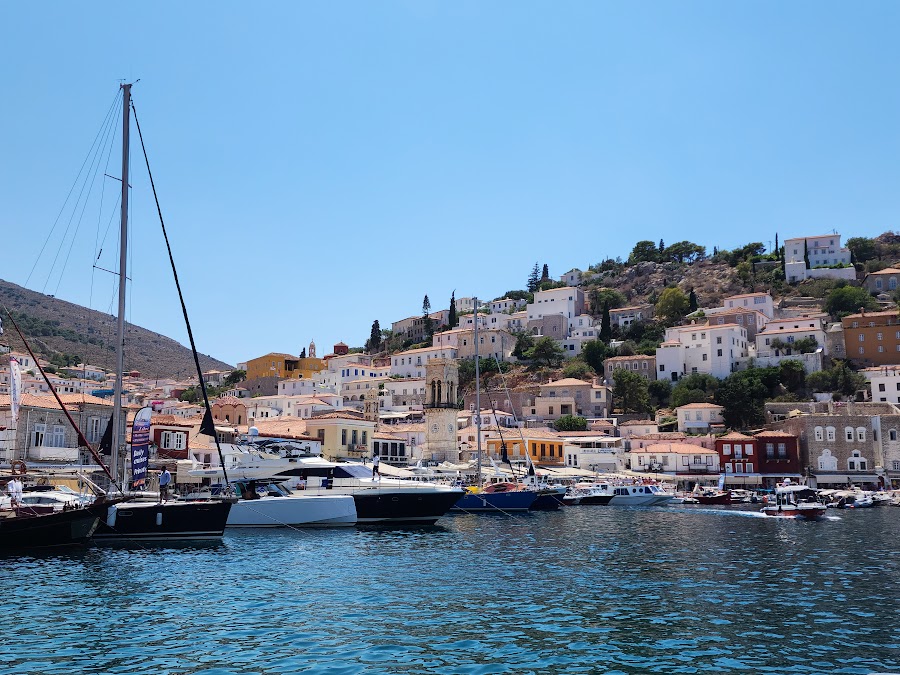
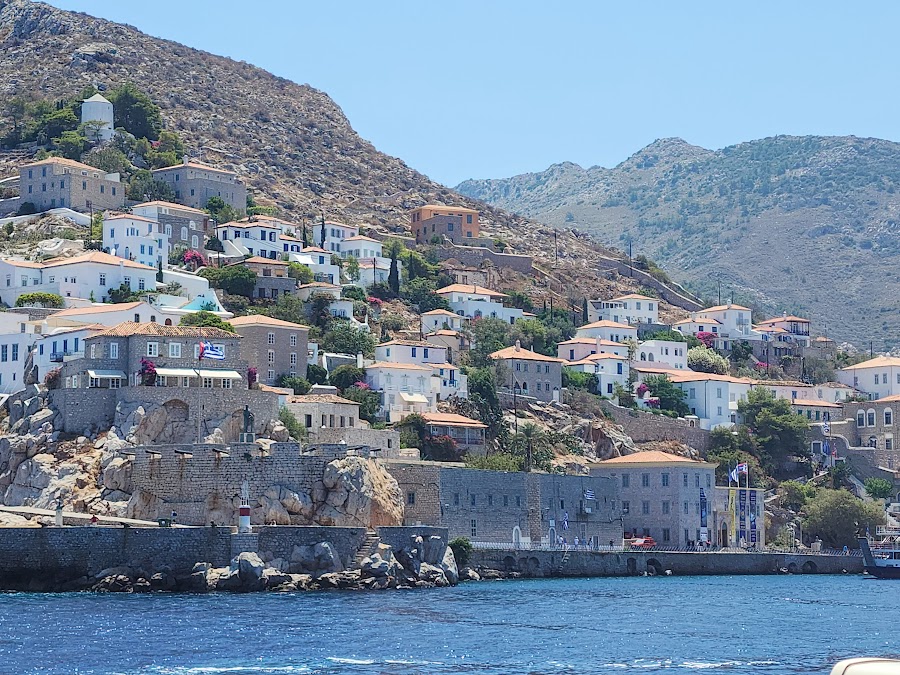
Hydra, also written “Idra” and pronounced “Eedra,” has the sights and sounds of any island on a summer morning down by the port: tourists standing in the sun crowding around the little boats waiting to take you to island beaches, the noise of loading and unloading of products, the yachts looking for a place to dock, sea gulls swooping down, cafes filling up with people under shaded awnings drinking their coffee and watching the morning scenes.
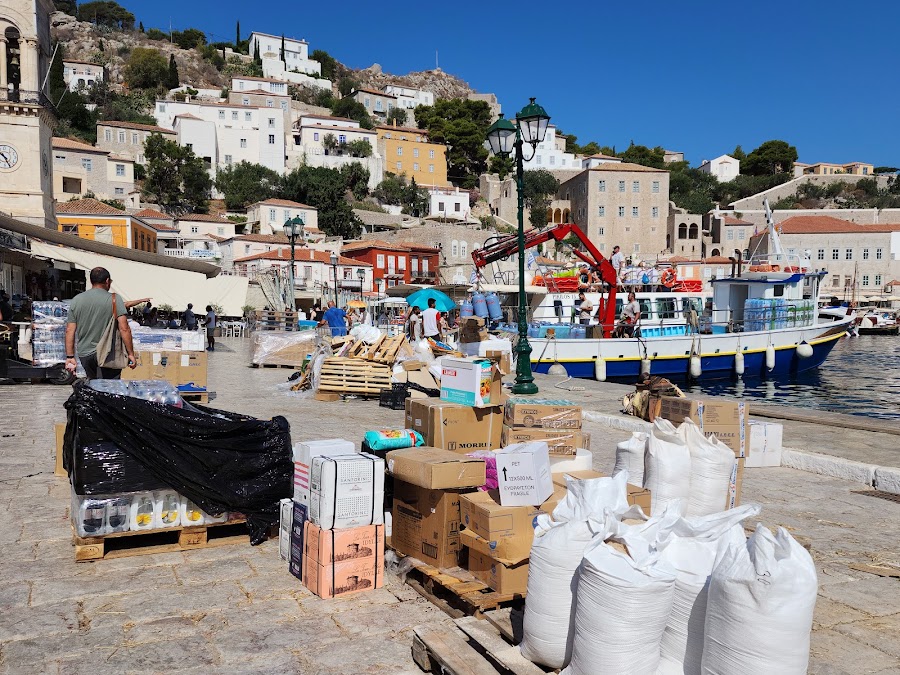
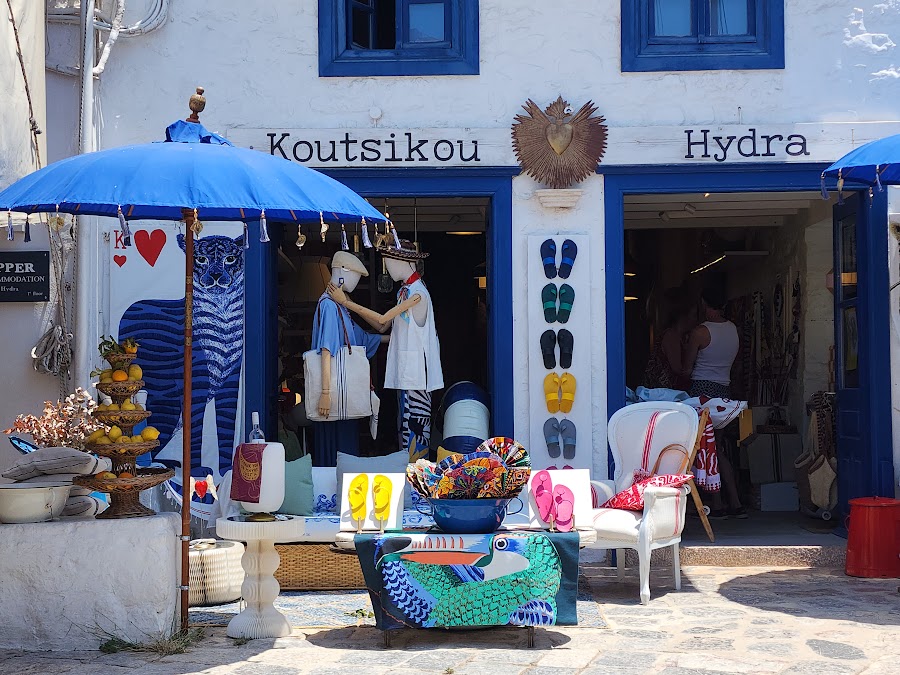
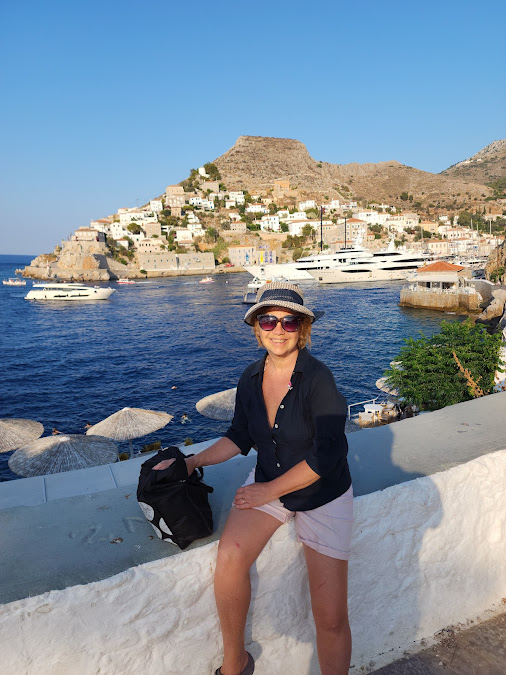
Hydra’s beauty and its proximity to Athens has attracted the rich and famous, many who come with their yachts and shop at the silver and gold shops and pretty stores with beautiful bathing suits and dresses with no price tags.
The island is a popular weekend destination so we made sure to go during the week to be a little less crowded and easier to find a place to stay, One way to spend a few hours in Hydra that many tourists follow is the popular three island cruise from Athens that also stops at two other Argosaronic islands, Aegina and Poros. These few hours are just enough time to cool off with a swim off the terraced rocks west of the town at Spilia or Hydronetta, under the 1821 cannons.
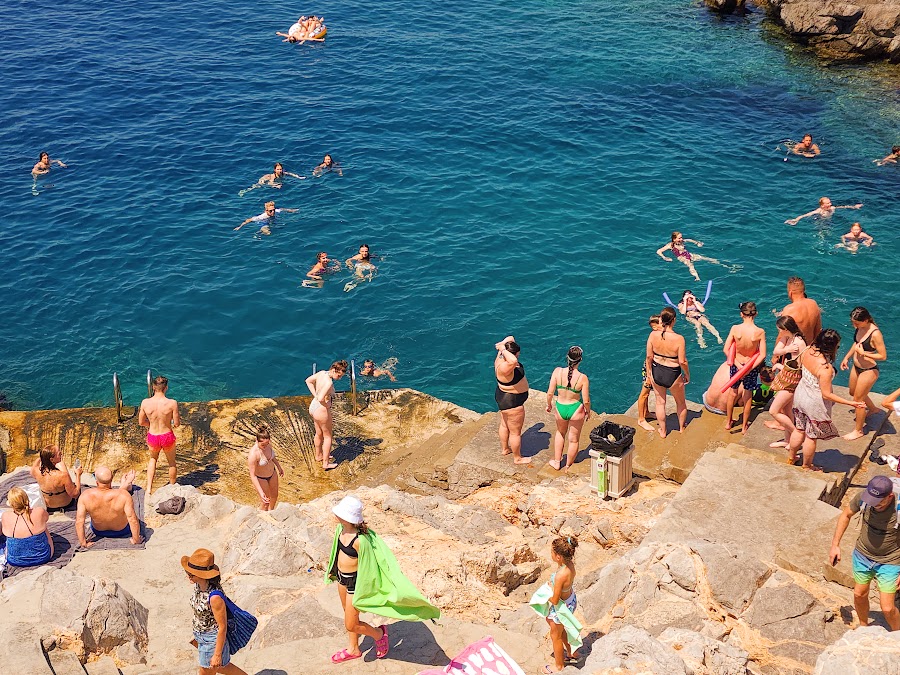
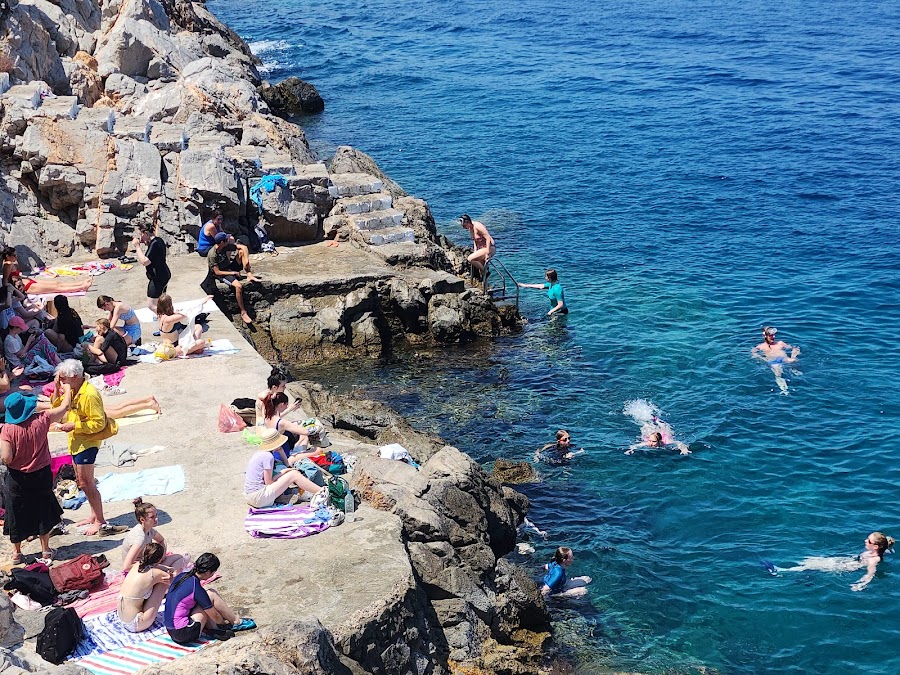
We’ve been day trippers here many times so this time we wanted to spend more days on the island. Actually, in 1984 I took the boat to Hydra in June with my mother who was visiting me from the States. I had no idea then that it was a holiday weekend and no accommodations were available anywhere. (Who made reservations in advance back then on the islands?) I left my mother in a café at the port and trudged around the hills to see if someone, anyone, could offer us a room in their house somewhere, anywhere. Finally, we found one way way up with goats and chickens outside our door. An unforgettable experience for my mom….
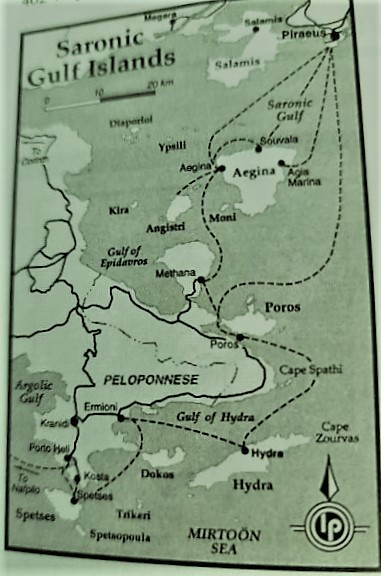
Several years ago the regular slow ferry boat from Pireaus was discontinued, making the hydrofoil the only way to get to the island, in an hour and a half instead of 3 1/2 to 4 hours. So, several times a day the sleek red Hellenic Seaways quietly enters the harbor. This was a sad development indeed for anyone like me who likes slow boats, sitting out on the deck and feeling the andante rhythm of the sea, not bouncing over the waves shut inside like in an airplane. “A hermetic sardine can of a conveyance for getting hurriedly to a place where time slows to a standstill,” is how Daniel Klein expressed it ironically in his book Travels with Epicurus. (Philosopher Klein, loaded with philosophy books, went to live in Hydra for a year in 2012 to explore the meaning of life.)
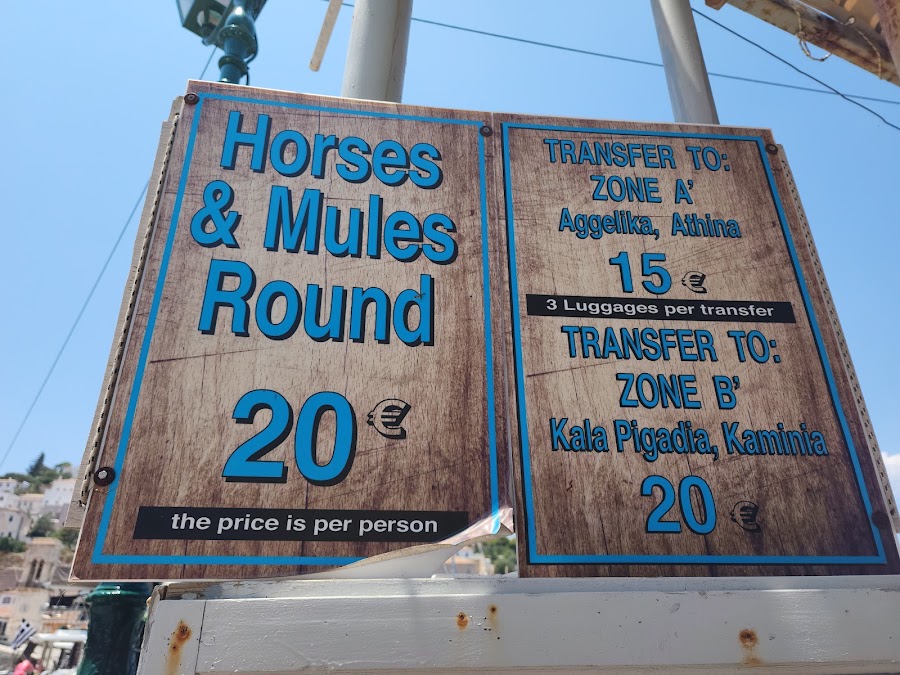
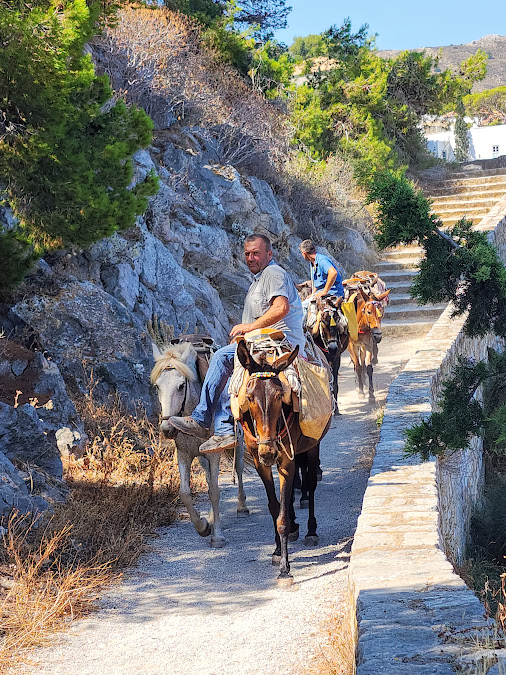
And time does slow down. When you can’t go faster than your feet (or donkey) you look at time differently. How far is the village of Kamini? A 15 minute walk. No other way. And though I saw signs for mule or horse rides, I never saw any tourists riding them — those old wooden saddles look a bit uncomfortable. In some cases I saw the animals really loaded down… When they’re not working they’re in the harbor waiting and swishing their tails.
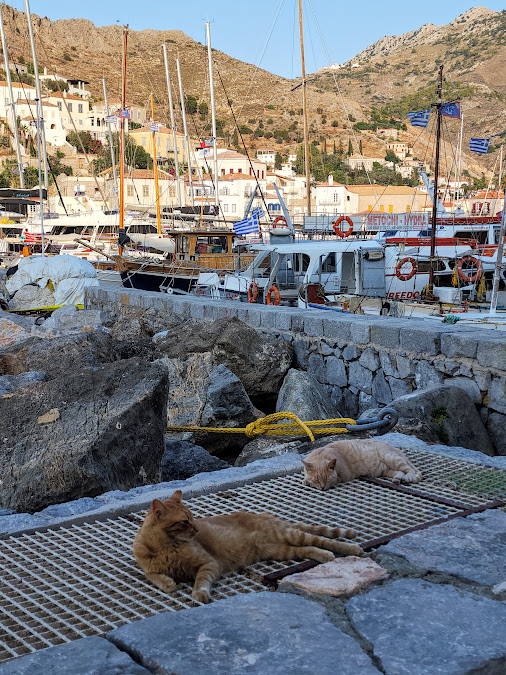
Even the cats that are everywhere under your feet are mostly sleeping, no hurry at all. Here it’s unusual that one of them is awake.
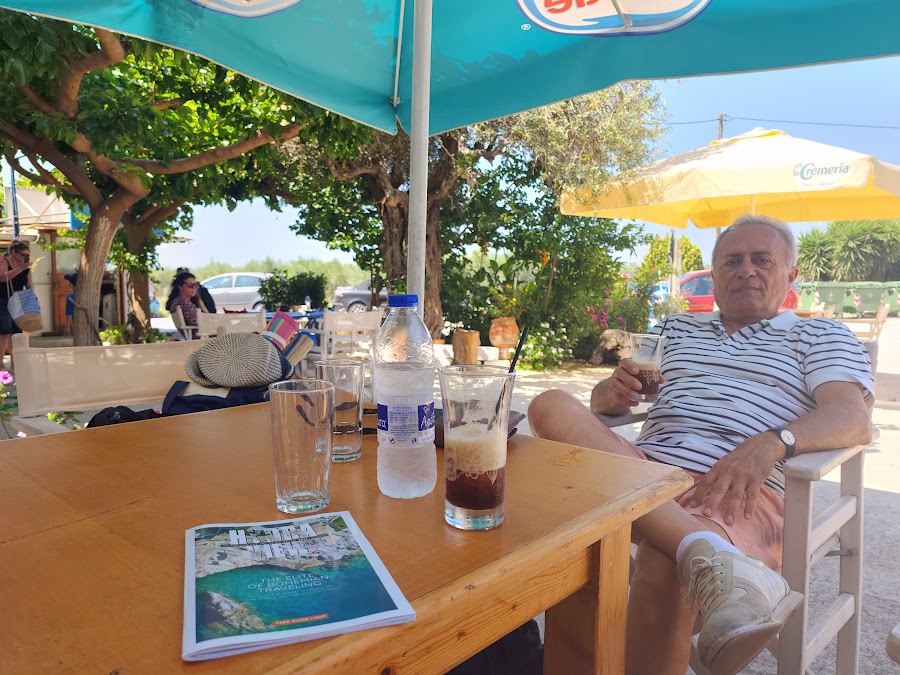
If you want to go to Hydra, there is another way besides the fast boat. You can drive to the town of Metochi (near Ermioni), in the Peloponnese, leave your car (in a safe parking lot) and take the 20 minute boat that goes across to Hydra. This is what we decided to do. It’s a good three hour drive to Metochi from Athens, with a lot of winding turns the last hour. If you get to the ferry early, everyone seems to relax and have a coffee at the only place nearby. It’s a good way to unwind from the driving.
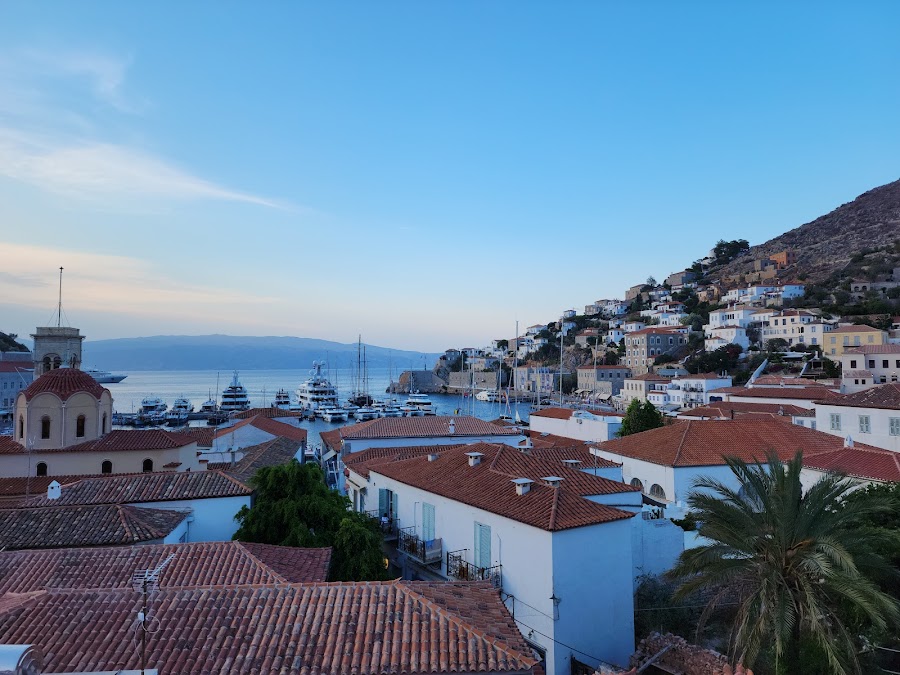
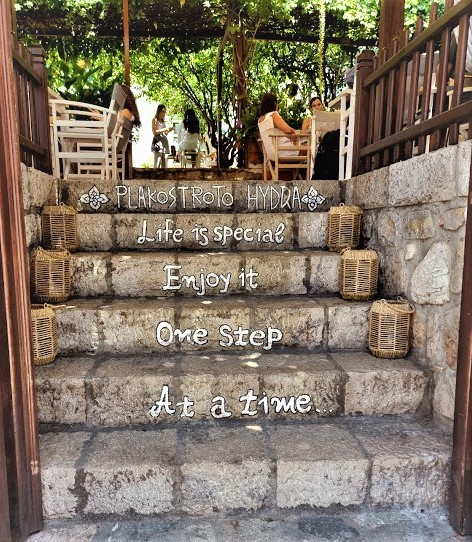
Fortunately we’re staying near the Hydra port at Botsis Guest House across from Plakostroto bar/restaurant and its soft music. Kyria Eftihia is very pleasant and accommodating. They’ve given us the large attic room which is around 3 flights up…(watch your head on the rafters) But once you get up there, wow, what a view. From one side we see the houses on the hillside and on the other, the port. There’s A/C but if you open the balcony door on one side and leave the window open on the other at night, there’s a great cross breeze.
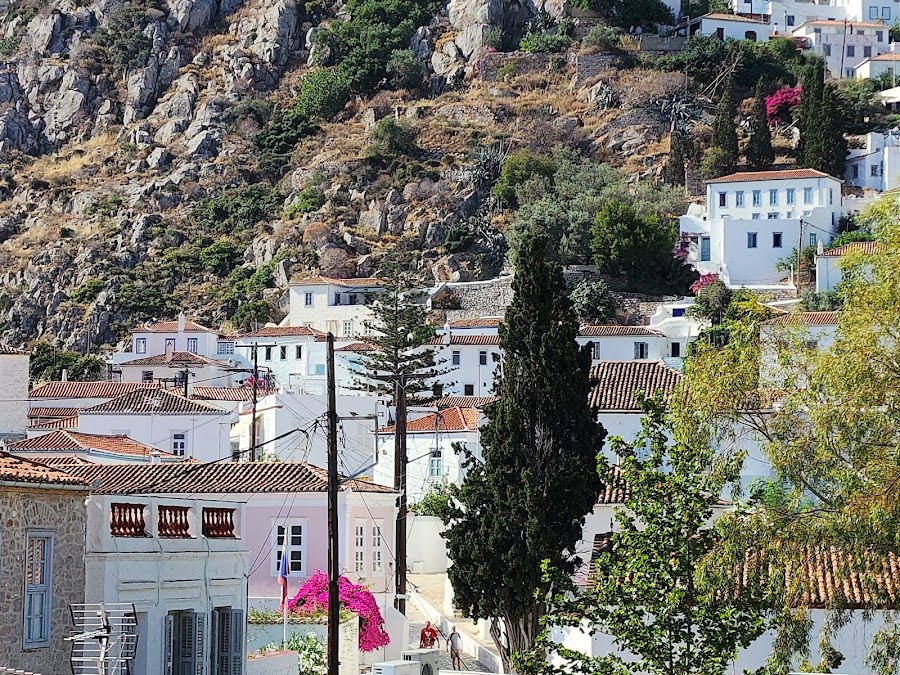
Wherever you walk outside the port, you’re on cliffs looking down at dramatic views of the blue green Aegean. This is on the road west to Kamini past the rocks.
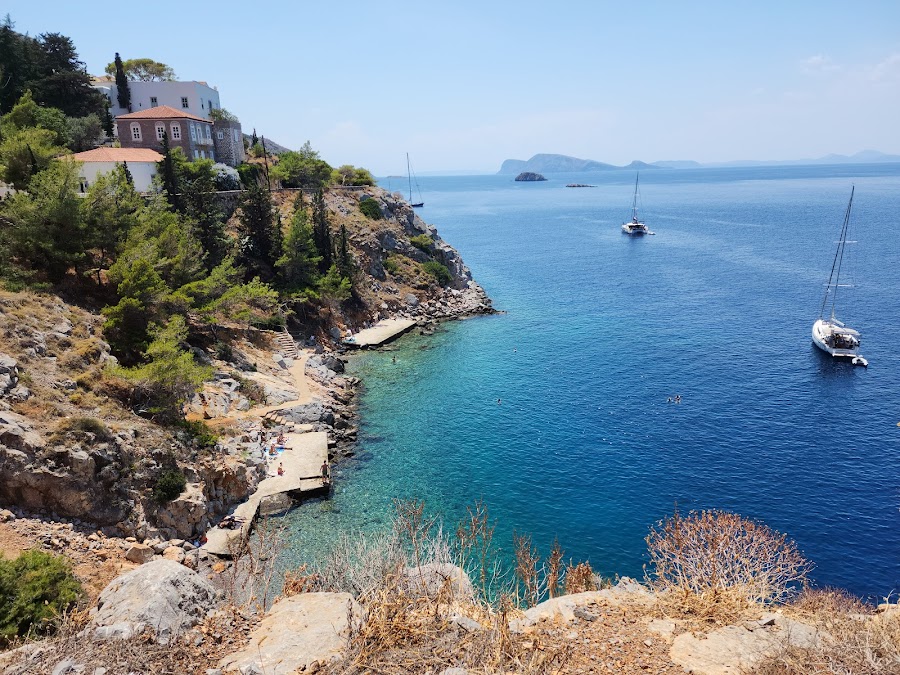
We even manage to find shade on the Mikro Kamini beach. Like Santorini, Hydra is not known for its beaches, i.e. not sandy beaches, but pebbly beaches or small rocks are fine. Often with rocks, the water is even cleaner and more transparent and you just don’t want to come out of the sea. On the beach in Kamini I notice that people are actually reading books (could this have something to do with time slowing down?)
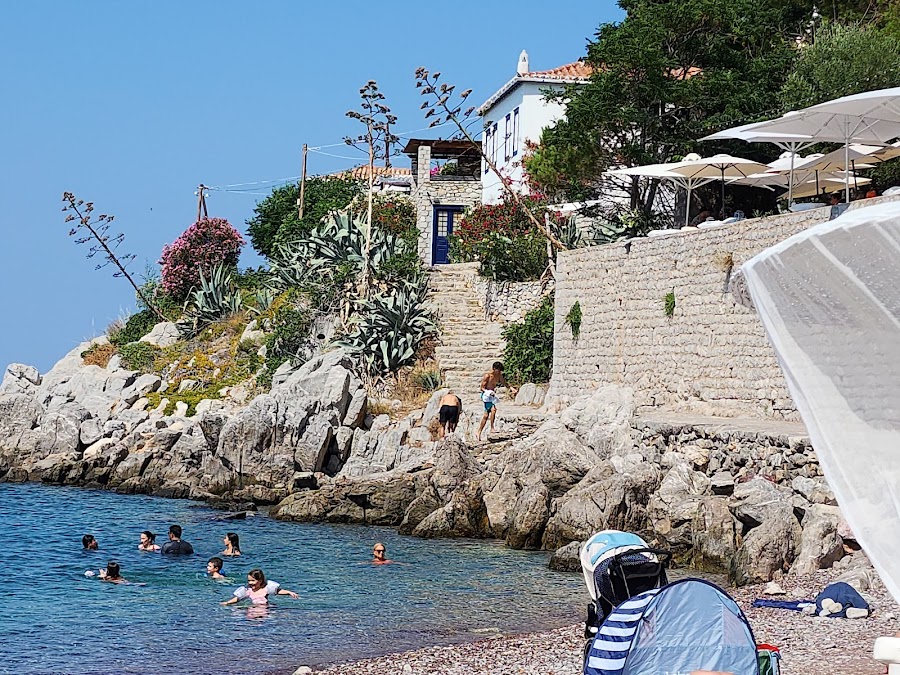
The door you see at the top of the steps is in detail below.
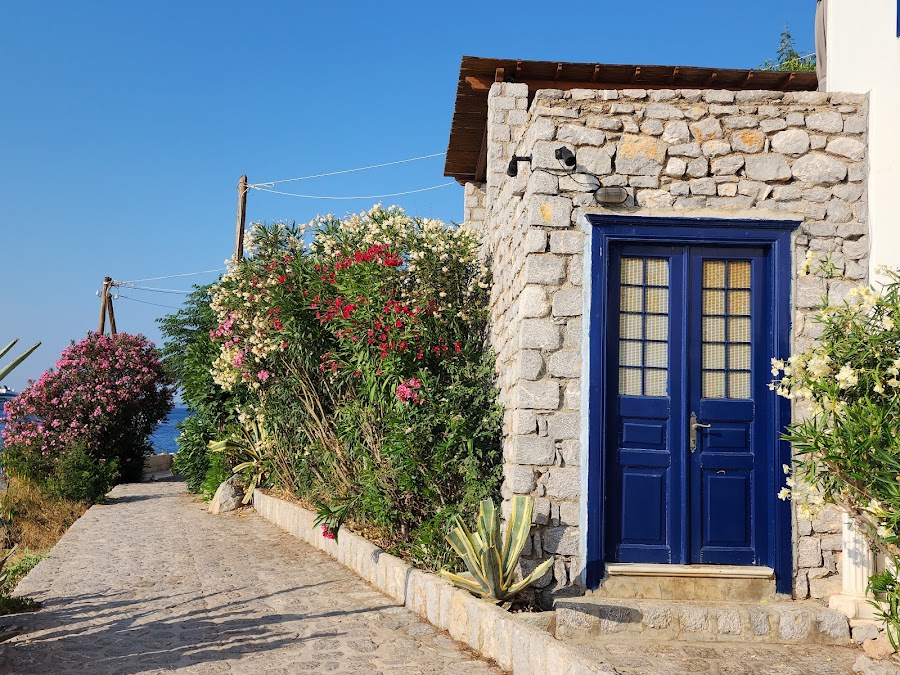
After Kamini if you’re brave enough, you can keep walking on the road to the next village, Vlihos, but in this sun, it’s better to stay put.
We rest a little on the way back into the port.
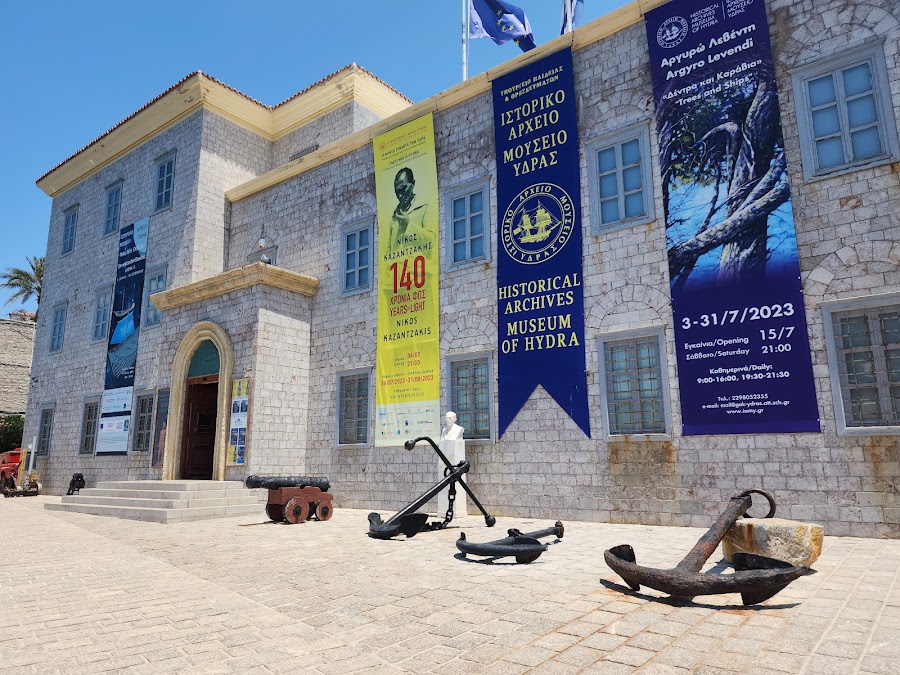
A more challenging walk than the one to Kamini is the 30 minute walk (seems longer if you’re walking in the sun) going east to Mandraki, the old naval shipbuilding area. This walk is wilder and more uphill. You pass the historical archives (more on that later),
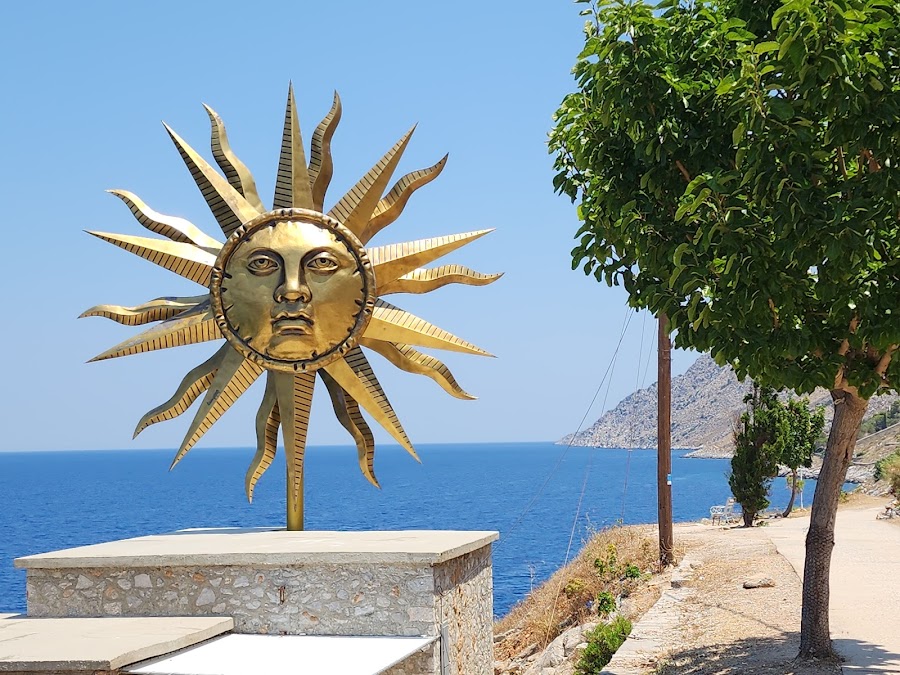
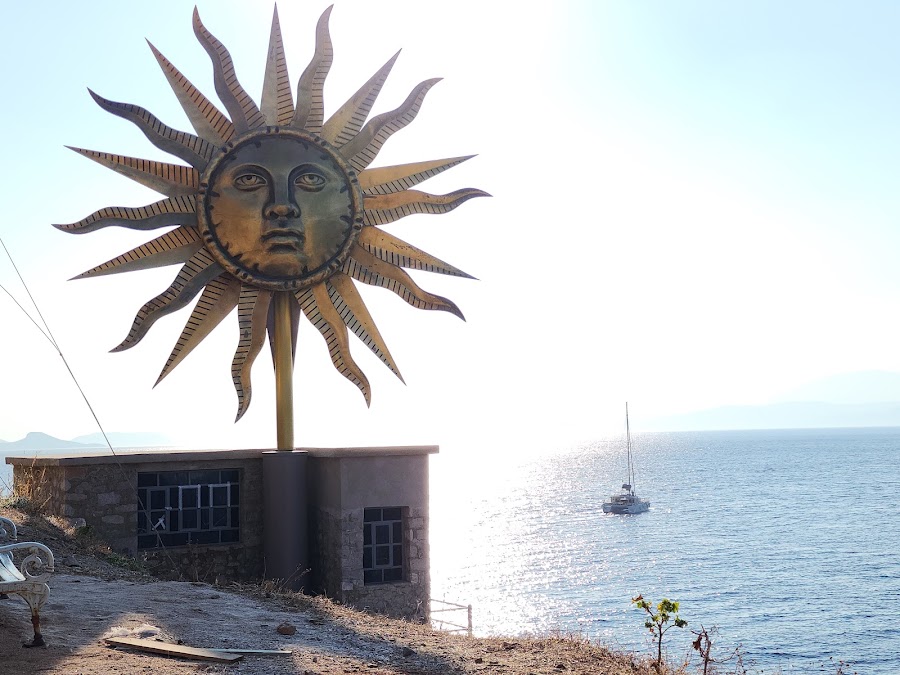
As you round the corner, up ahead of is the installation of the Apollo Wind Spinner by American artist Jeff Koons. The yellow face of Apollo greets you on both sides as the rays spin around and around. (Inside the old slaughterhouse are more installations by Koons).
Mandraki is actually two beaches. The much touted sandy one is where you find the hotel Miramare but nearby is the one with smooth boulders, definitely larger than pebbles, which extend into the sea floor. The sea as everywhere is crystalline, it’s quieter than at Kamini and people are swimming off some yachts. Houses on cliffs are rented out and the local taverna, next to a tiny whitewashed church, is a popular place with tourists and locals. Here we had a simple lunch of some gavro marinato (marinated anchovies) and fried shrimp with horta (kale) and tzatziki, with ice cold Mythos beer.
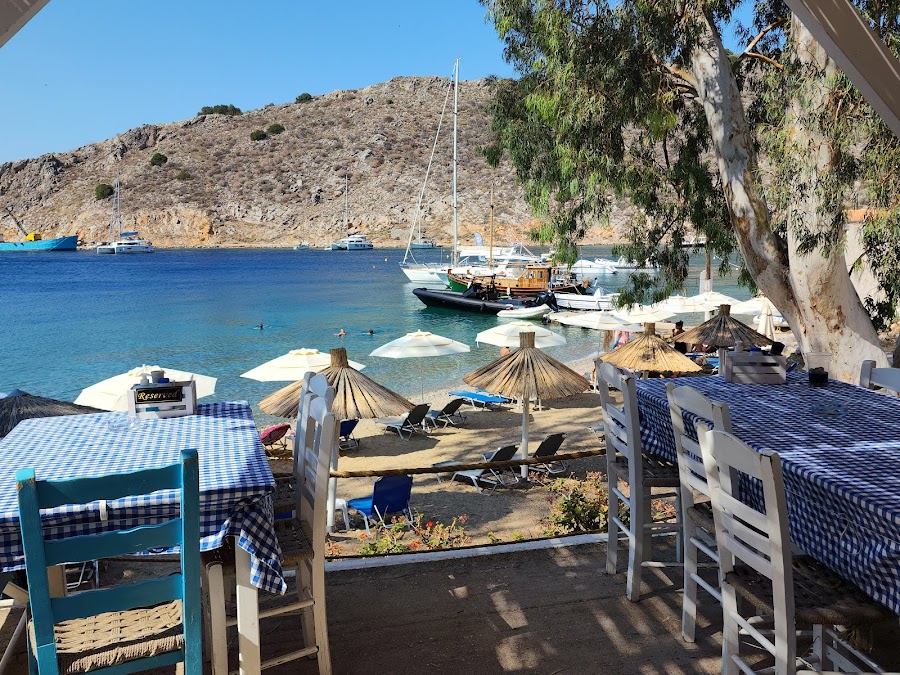
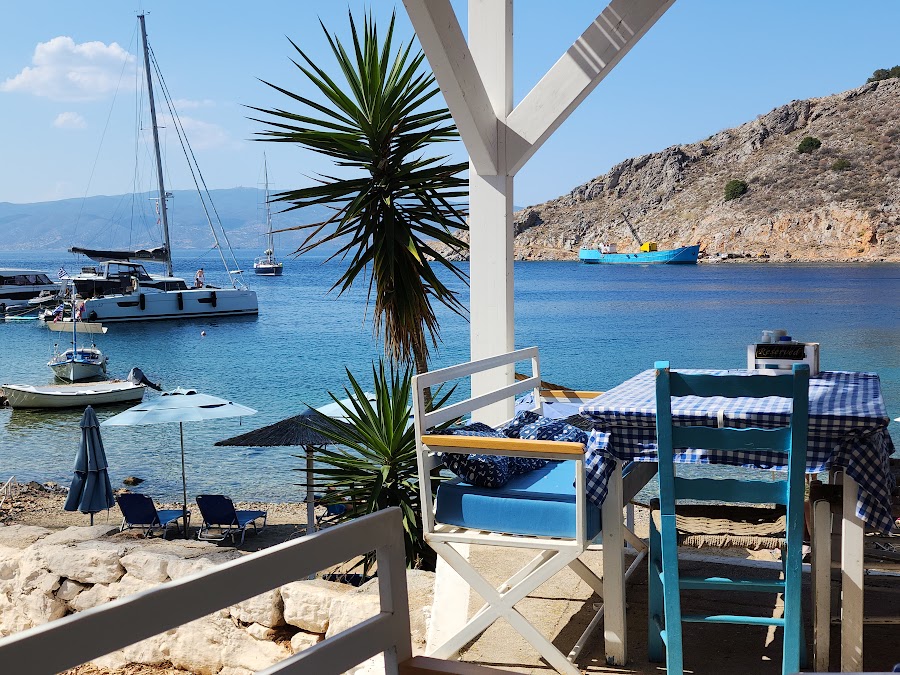
The blue of sea and sky is carried over in the checked tablecloths, chairs, gates and house shutters.
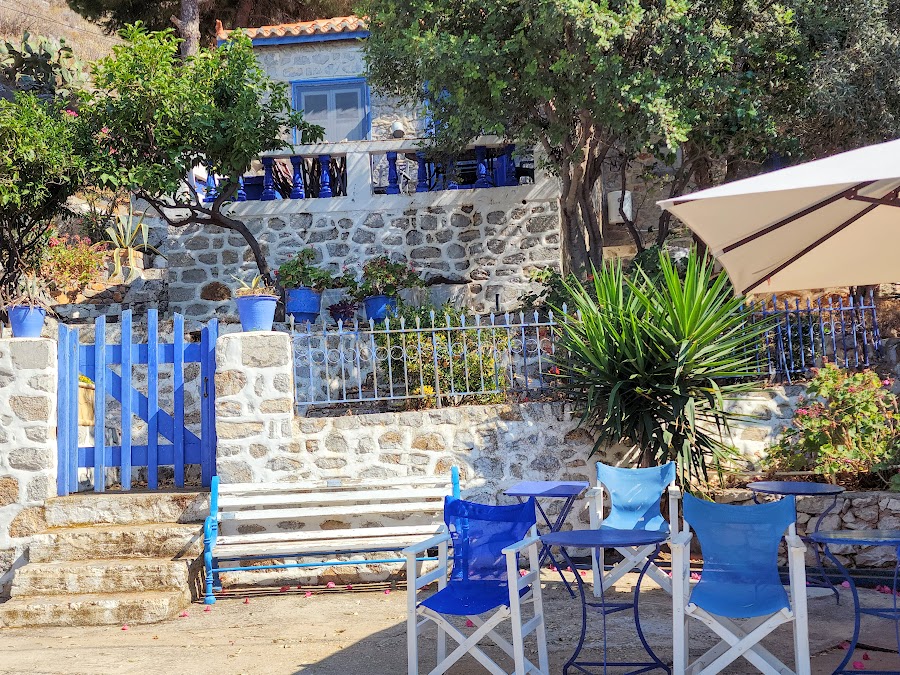
The lunch fortified us for the walk back to town and the dramatic views.
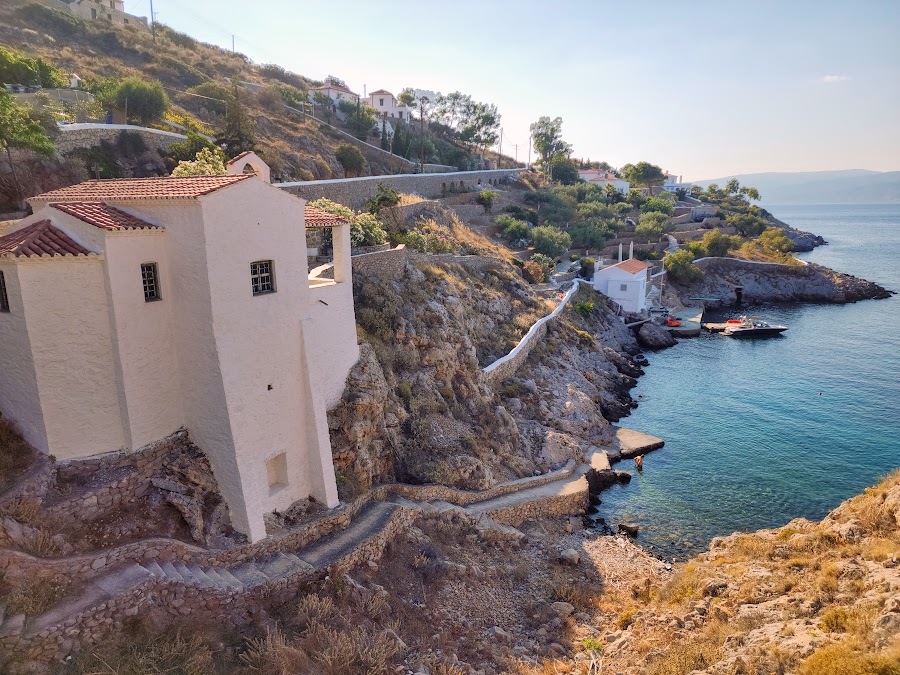
Now we saw the Apollo from the other direction with the afternoon light starting to fade.
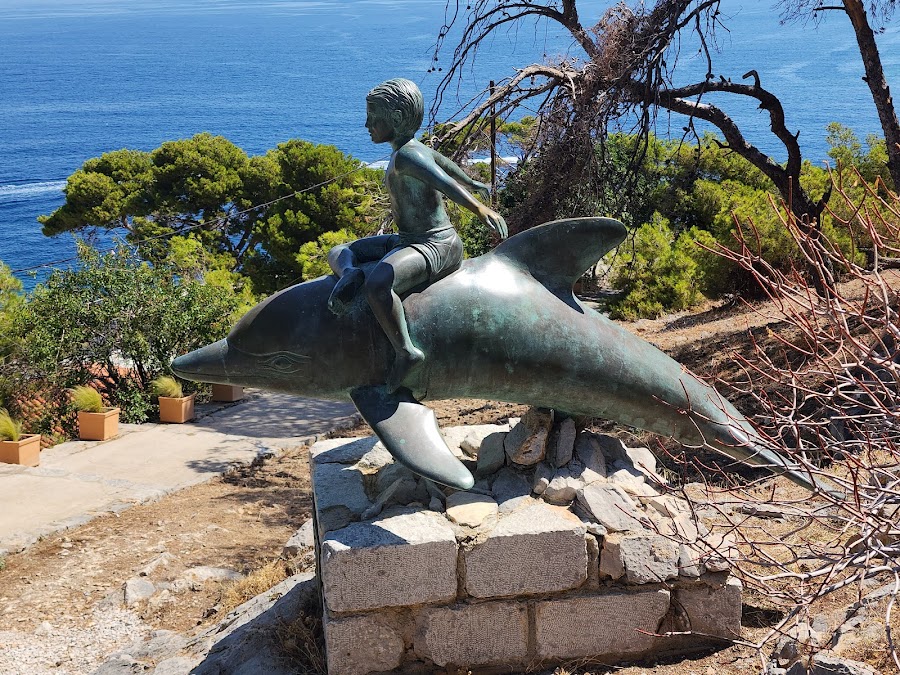
The beauty of the island first attracted filmmakers in the 1950’s, with the film “Boy on a Dolphin,” featuring a very young and busty Sophia Loren, who plays a sponge diver (which is the livelihood of many islanders at the time). The film is mostly forgettable, but listen to how sweetly she sings the title song in Greek (ti ein’afto pou to lene agapi) “what is this that’s called love …”
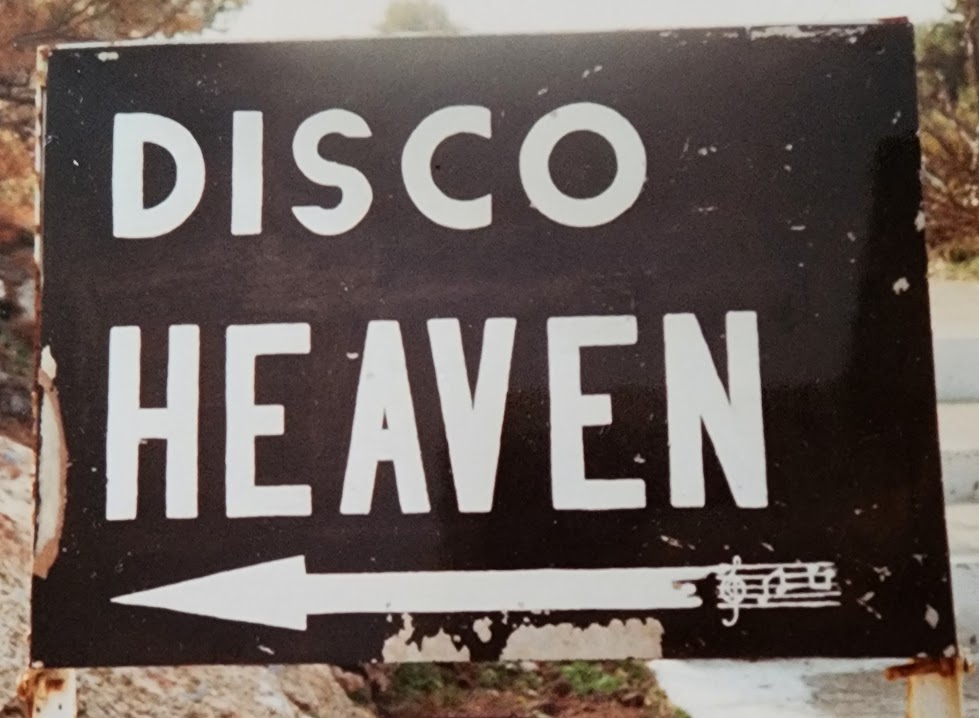
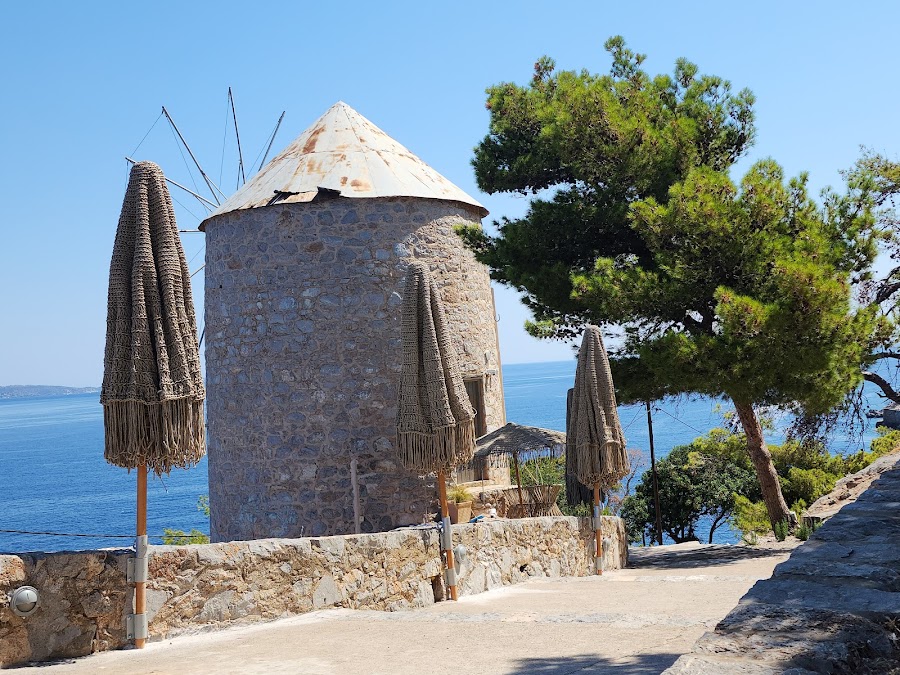
You can find the bronze statue, Boy on a Dolphin, on the road past the rocks but instead of following the road to Kamini, you take the uphill path to the old windmill (in the 80’s and 90’s I remember this was a big disco with the name Disco Heaven in enormous letters).
Near the statue looking down on the windmill is a bench in the morning shade, wonderful to rest your weary legs.
Here we saw a couple of donkeys being ridden and led back, empty of products, to the main port. Most likely they had delivered supermarket items to a house in Kamini.
I read recently that Loren will be made an honorary citizen of Hydra as a “sign of gratitude for her great contribution to the island and cinema.”
Other films of the 50’s and 60’s set in Hydra included Michael Cacoyiannis’ The Woman in Black with Ellie Lambetti and Dimitris Horn and parts of Phaedra (Melina Mercouri and Anthony Perkins, dir. by Jules Dassin.)
Hydra has always had a pull for artists and writers. In 1960, a young Leonard Cohen yet to make his musical mark came to Hydra and stumbled on a white stone house for sale, that he bought for $1500 (inheritance from his grandmother). It’s a plain white house unmarked. If you ask where is to spiti tou Koen, (Cohen’s house) people will tell you where it is, but there’s no sign or marker, as it’s not really a tourist attraction — his family comes and stays sometimes. There seems to be a feeling of pride that he chose to live on Hydra for some years. After he died in 2016, a plaque was made to his memory on the Hydra- Kamini road. A plaque and of all things, a… bench? How curious. Maybe that’s where he used to sit and gaze down at the sea for inspiration.
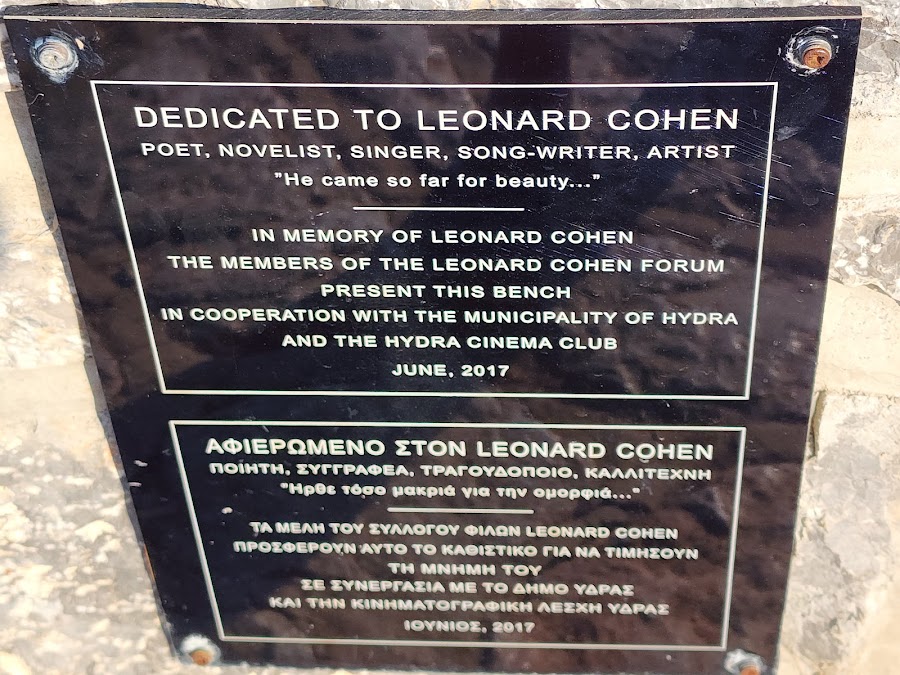
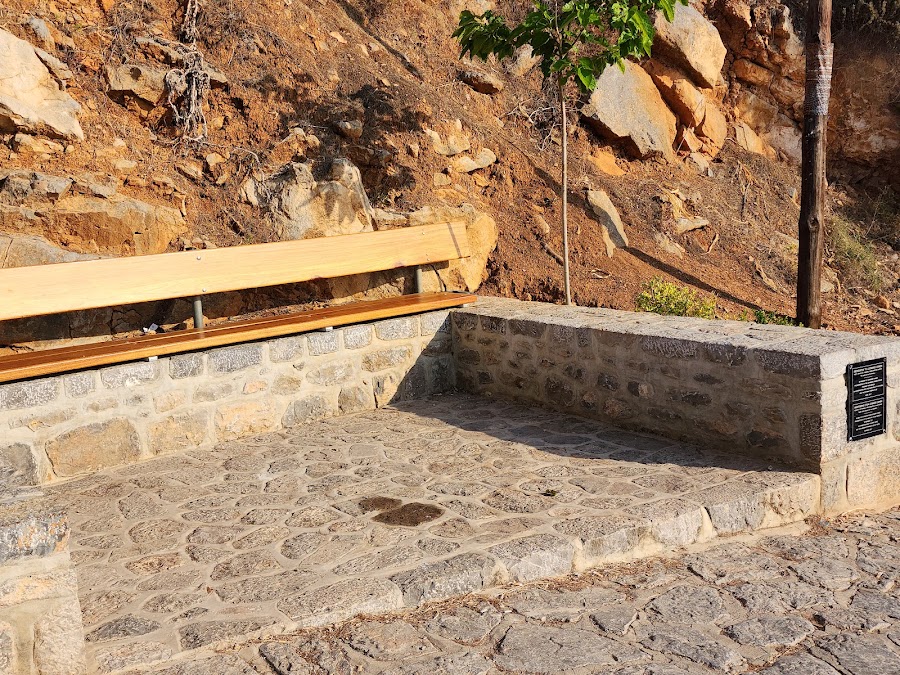
Cohen lived in the house through most of the 60’s. Part of we could say a bohemian expatriate community of writers, the group included Australian couple Charmian Clift and George Johnston who had come to live in Hydra with their three young children.
Cohen later wrote of the Johnstons: “They had a larger-than-life, a mythical quality. They drank more than other people, they wrote more, they got sick more, they got well more, they cursed more and they blessed more … They had guts. They were real, tough, honest.”
They sound like they were self destructive characters out of an F. Scott Fitzgerald novel, or more keeping with the time, beat writer Jack Kerouac would have loved to take them with him “on the road.” A golden charmed couple until…they were not. Their ending was an inevitable roller coaster ride that crashed. Charmian committed suicide in 1969, George died of TB one year after; of the three children, one also killed herself, another died of alcohol.
Greece of the time had a certain mystique that attracted artists and writers, musicians and generally just world wanderers. They visited and stayed before the country opened for mass tourism, back when it was an “affordable paradise.” Like the hippies who went to live in the caves of Matala on the southern coast of Crete, people came in search of an alternative way of life.
Of the house purchase, even though it had no electricity or indoor plumbing, Cohen said later “it was the smartest decision I ever made.”
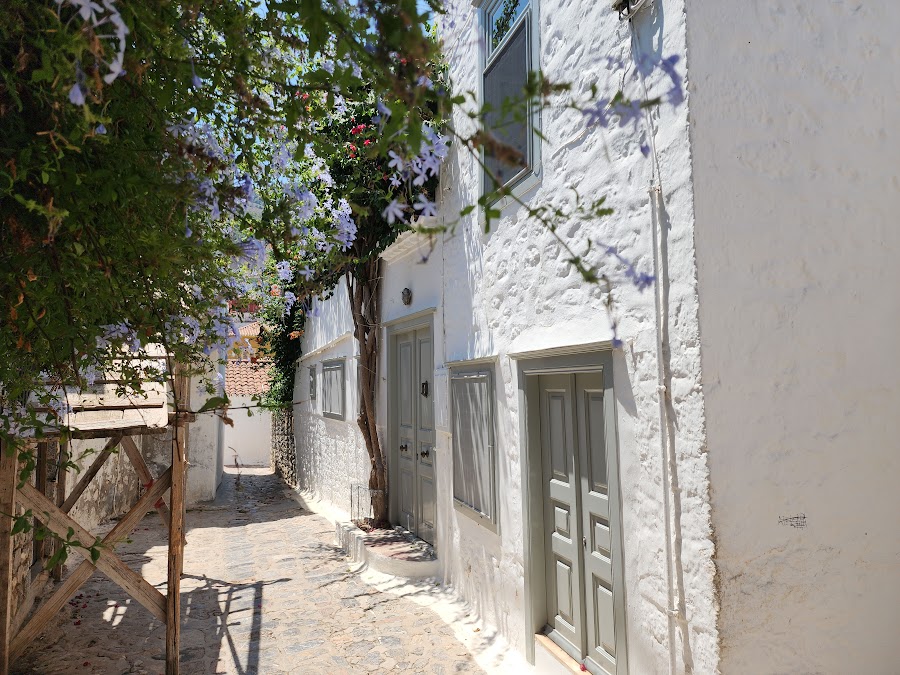
Nor was there electricity anywhere on the island but soon after Cohen’s purchase, he noticed one day from the house the construction of telephone poles and birds sitting on the wires…This inspired one of his most well known songs, “Bird on the Wire”:
Like a bird on the wire / Like a drunk in a midnight choir / I have tried in my way to be free.
It’s on Hydra that he found his muse, Marianne Ihlen, his great love. After he left the island and they parted, he wrote and dedicated to her his beautiful song of love and longing, “So long Marianne.”
Oh so long, Marianne, it’s time that we began
To laugh and cry and cry and laugh about it all again
Years later in 2016 after hearing she was dying of cancer, he wrote “I’m just a little behind you, close enough to take your hand. This old body has given up, just as yours has, and the eviction notice is on its way. I’ve never forgotten your love and your beauty. But you know that. Safe travels old friend. See you down the road.” Three months later, he was gone too.
It was Marianne who was crucial in his move from poet and trying-to-be novelist to songwriter. A 2019 documentary “Marianne and Leonard: Words of Love” tells their story And in May of this year, a new documentary was filmed in Hydra called “So long Marianne.”
Though Cohen didn’t live permanently in the house after the 60’s, he often returned to Greece and my friend Vicky spotted him several times in the 70’s in Athens.
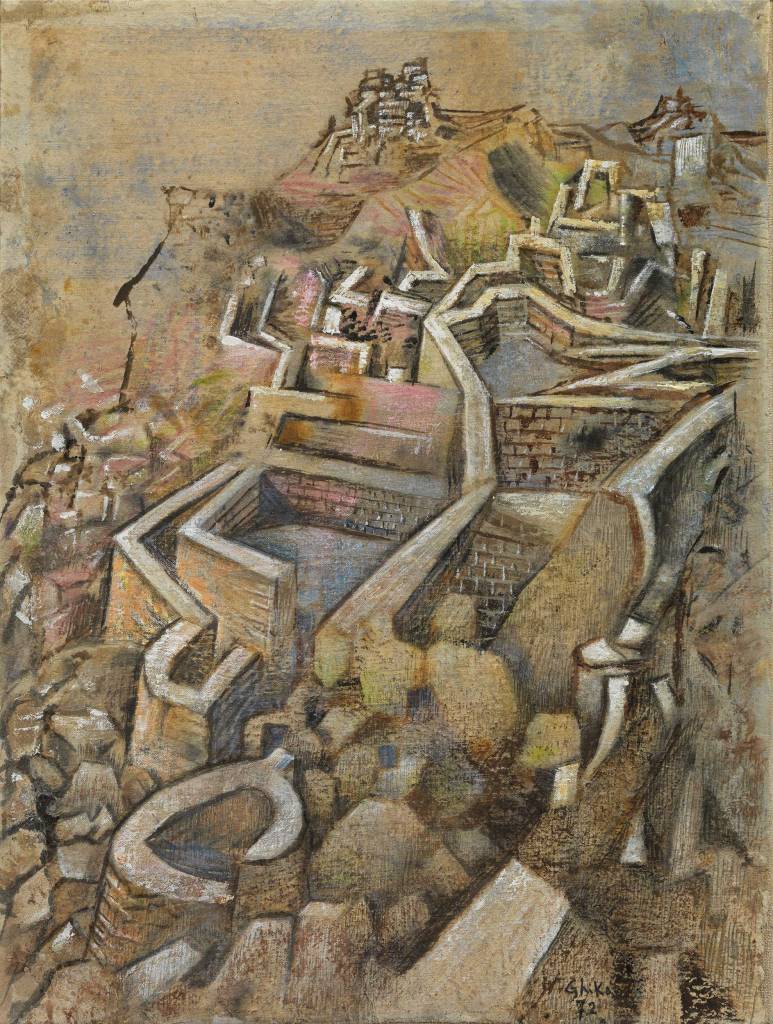
Greek painter Nikos Hatzikyriakos Ghikas, in his 18th century mansion above Kamini, built by his great great great grandfather, entertained guests like Patrick Leigh Fermor and painter John Craxton. Henry Miller went to visit Ghikas in 1939 — at the time Hydra was very poor with a dwindling population. It was while later staying in Ghikas’ house that Miller wrote the 1st draft of The Colossus of Maroussi.
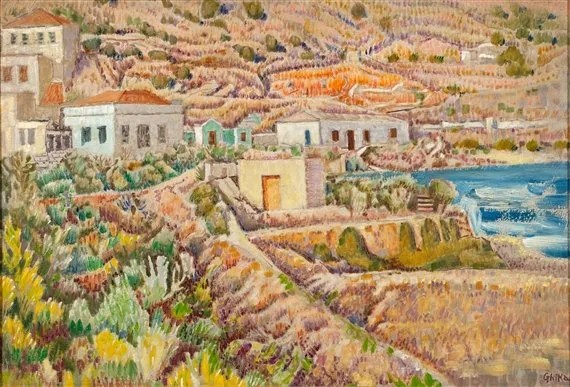
In these two paintings of Hydra landscapes, in the 2nd particularly, Ghikas played around with geometric shapes and interlocking planes.
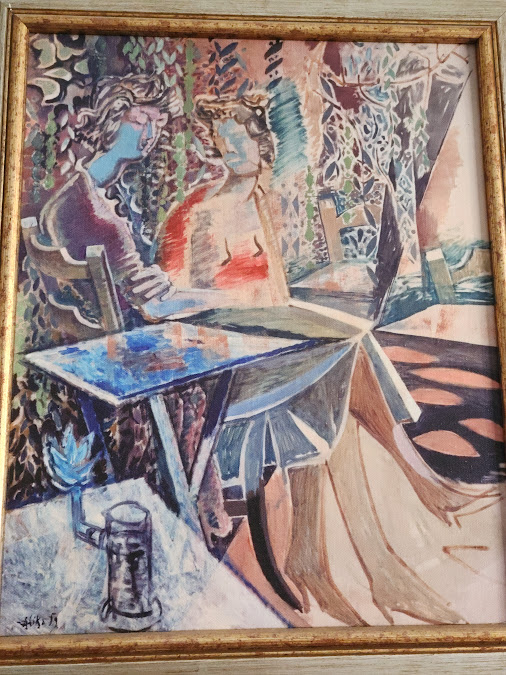
Though he is more known for his landscapes, his paintings of people are also very popular. In “Two friends” from 1959, you can see the cubist style here too.
Sadly, when the Ghikas mansion burned to the ground in 1961, it was never rebuilt and Ghikas never returned to Hydra after that.
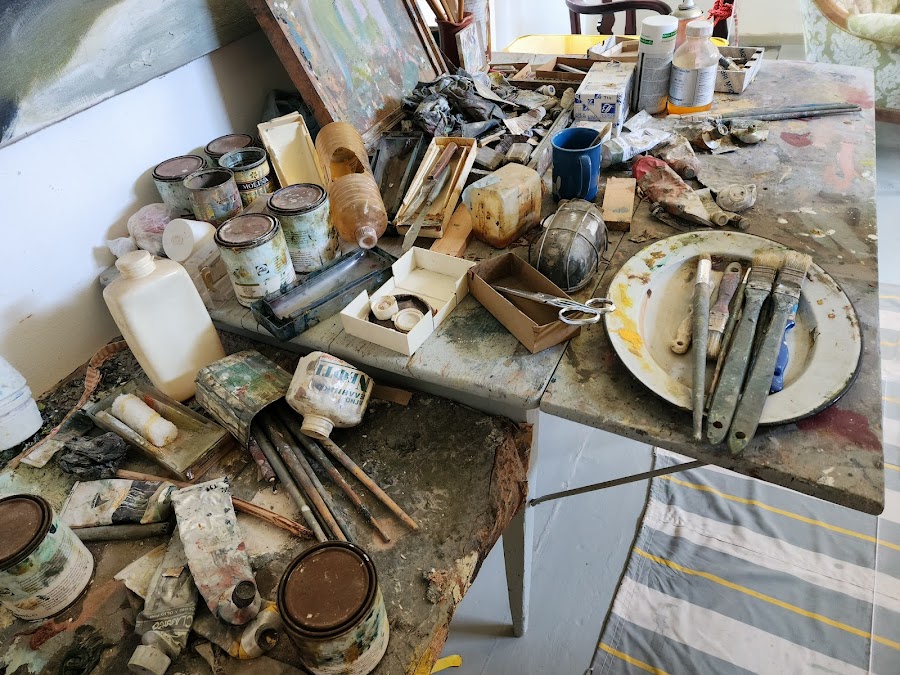
The house of Leonard Cohen is right near the house of Hydriot artist Panayiotis Tetsis, that we visited. Tetsis lived and worked on the island for a time in the house of his grandparents. “A painter is like a cook,” Tetsis liked to say, “he has to know how to use the tools” and the tools were left in his studio upstairs exactly how he had it.
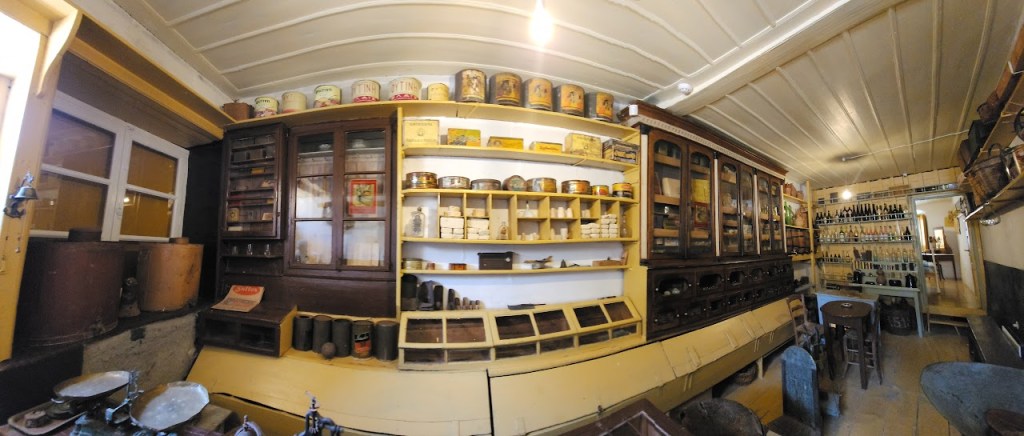
The downstairs is really fascinating. In the house, as was common at the time, they had a business as well, an old bakaliko or old supermarket. Everything was scooped out and sold in bulk: brandy, ouzo, wine, pasta, beans, all left intact the way it was in the early 20th century. Customers were offered wine to drink while shopping (!) Tetsis was introduced to paints at an early age, people everywhere saved and mixed paints, painting their own doors and windows.
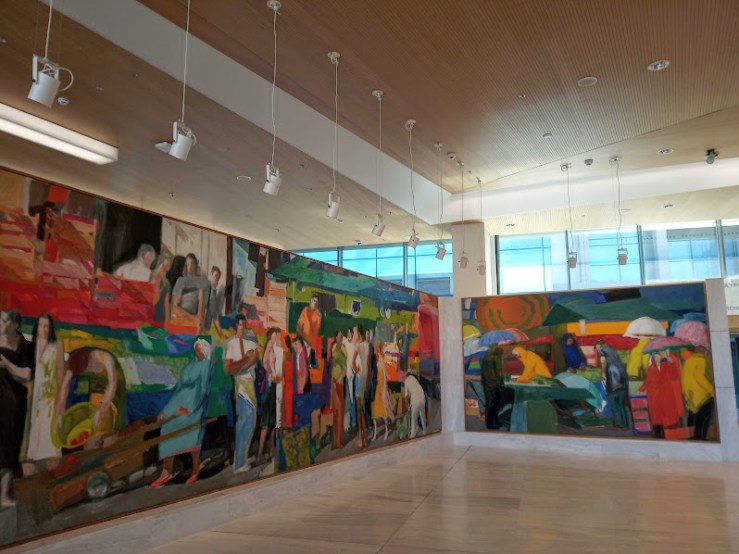
One of his most well known paintings, with its gorgeous shapes and colors, is the large Street Market in the foyer of the Ethniki Pinacothiki, the national art gallery
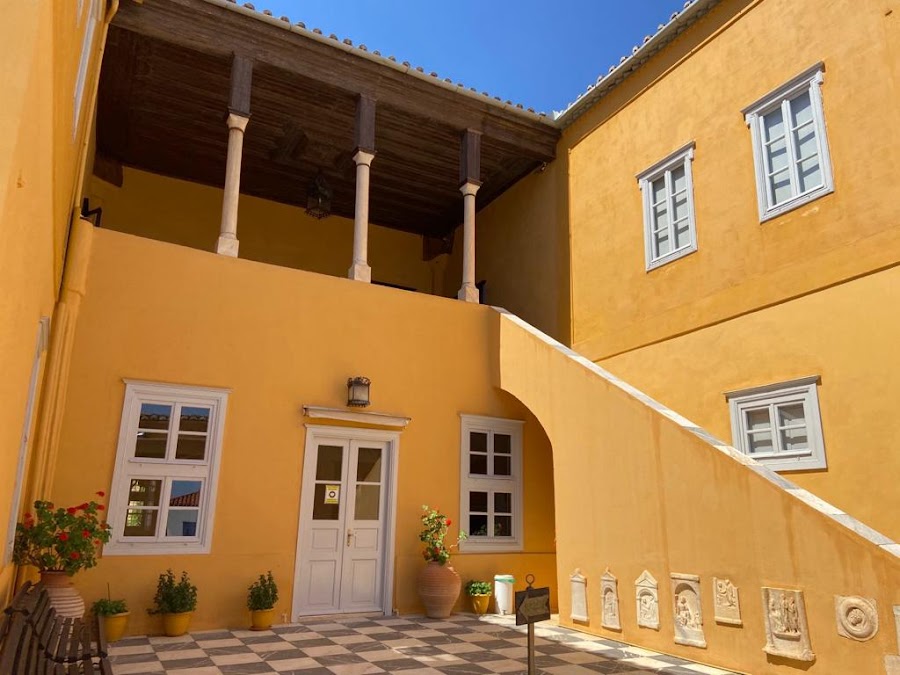
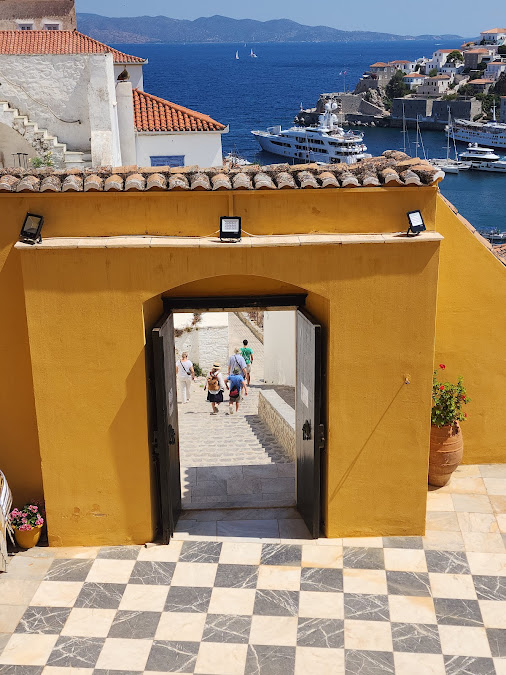
Right near Tetsis’ family house, up and down some steps of course, is the Georgios Koundouriotis mansion. Known as the “yellow house,” it stands high above the harbor. Koundouriotis was a wealthy shipowner as well as leader in the 1821 War for Independence.
Hydra really started to thrive in the late 18th century, the time when many of the archontika or stone mansions started to be built. As the Lonely planet Greece guide tells us, Hydra like other islands, was ignored by the Ottomans, so Greeks from the Peloponnese started going there to escape taxes and the Ottoman yoke. As agriculture was impossible on this rocky island, the settlers started building boats – one of the big shipbuilding areas was Mandraki beach — and by the early 19th century the island had become a great seafaring power. When the revolution broke out in 1821, Hydra contributed greatly with its fleet of ships.
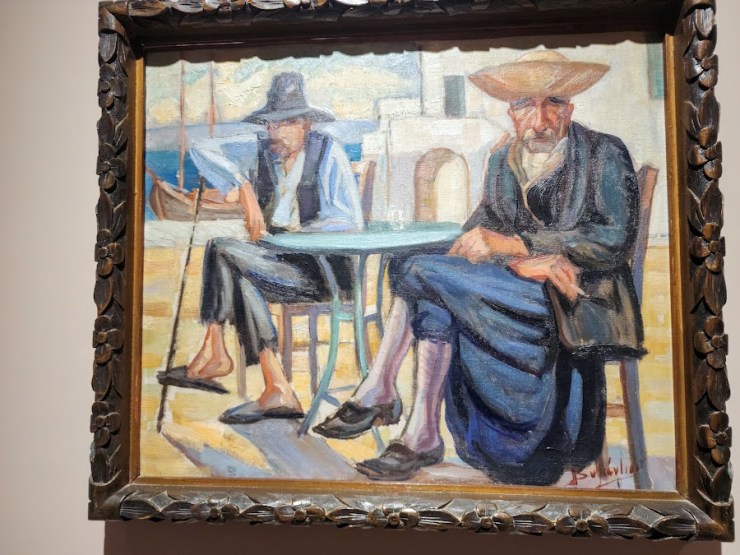
The mansion of Koundouriotis is part of the Historical Archives – rooms show artefacts and costumes of the time from different parts of Greece and there’s a collection of paintings by father & son Constantinos and Pericles Vyzantios
From the house, you get a great view looking down at the harbor and looking up at the hills.
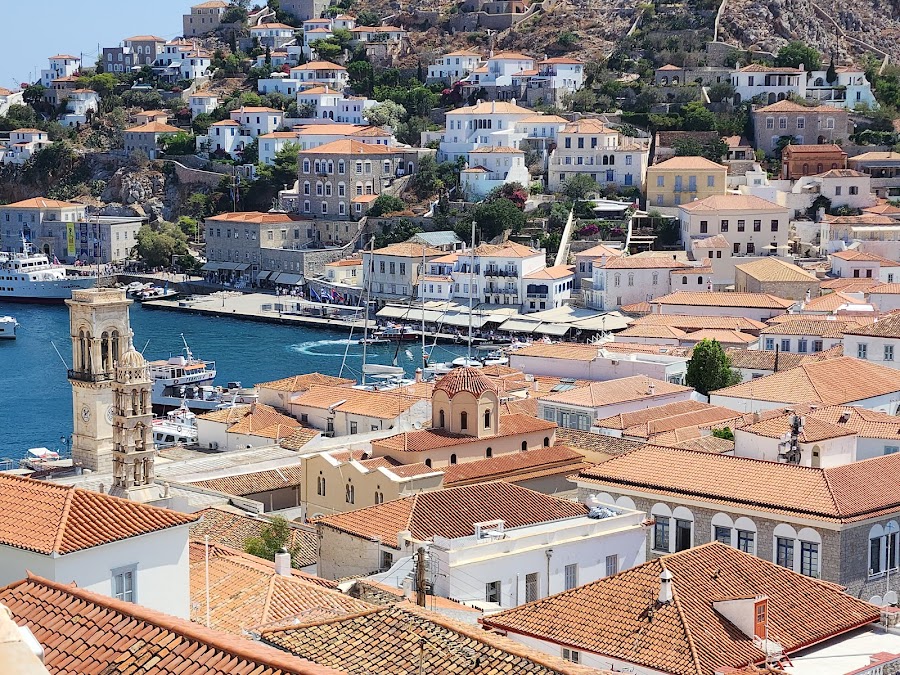
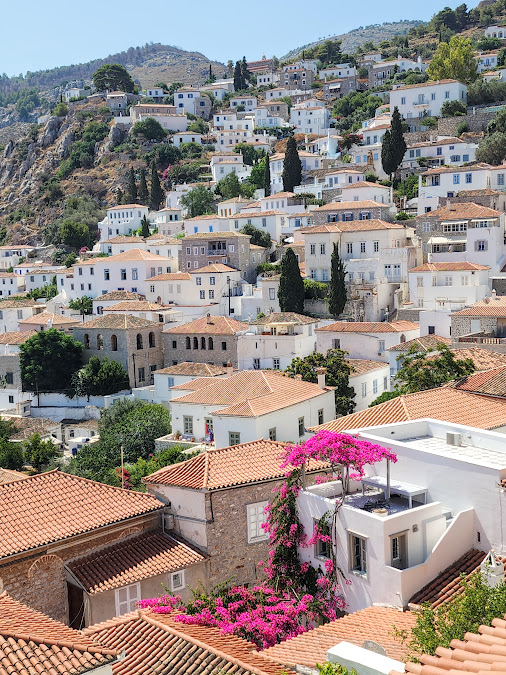
Besides Koundouriotis, another leader of the Revolution was Admiral Andreas Miaoulis, who commanded the fleet of ships. In late June every year a mock battle is held in the harbor held in his honor. A popular street name all over Greece, it is in fact the name of the street we’re staying on, one of the “main” streets, a little wider than the other tiny cobblestoned alleys. We’re surprised one day to see a car on our street (how did that get there?) We had heard the slow bells of a funeral, and indeed a priest was driving up, taking the coffin up to the cemetery way above the town. Of course, how else? (The only other vehicle we saw was a small garbage truck for the trash collection — the streets in fact are kept very clean.)
To get to the Koundouriotis and Tetsis houses, you wander around the stone alleys – no names on the streets in upper Hydra –you see donkeys delivering packages, every so often a splash of magenta or fuschia in the bougainvillea.
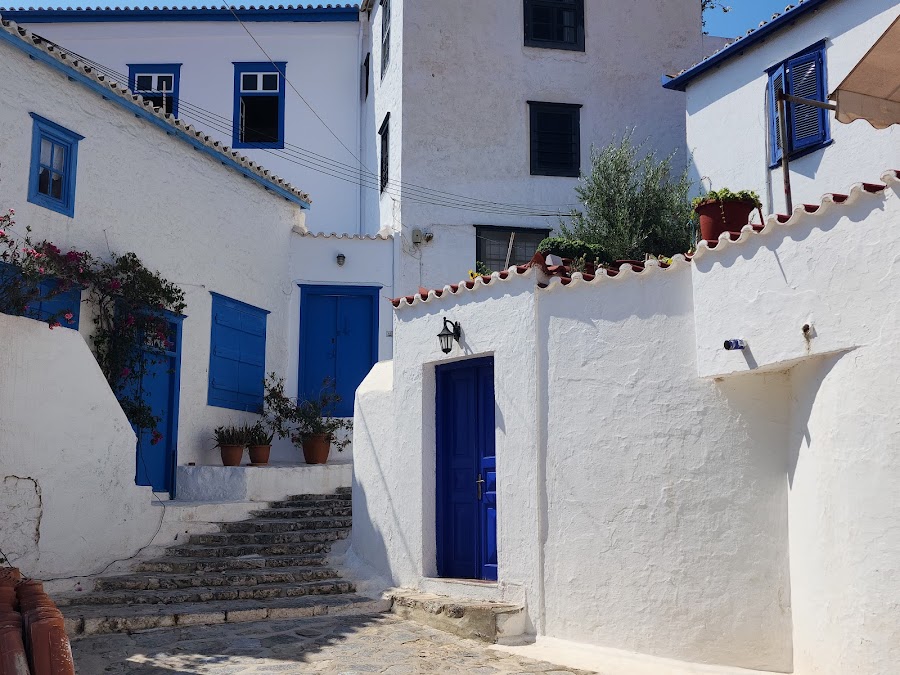
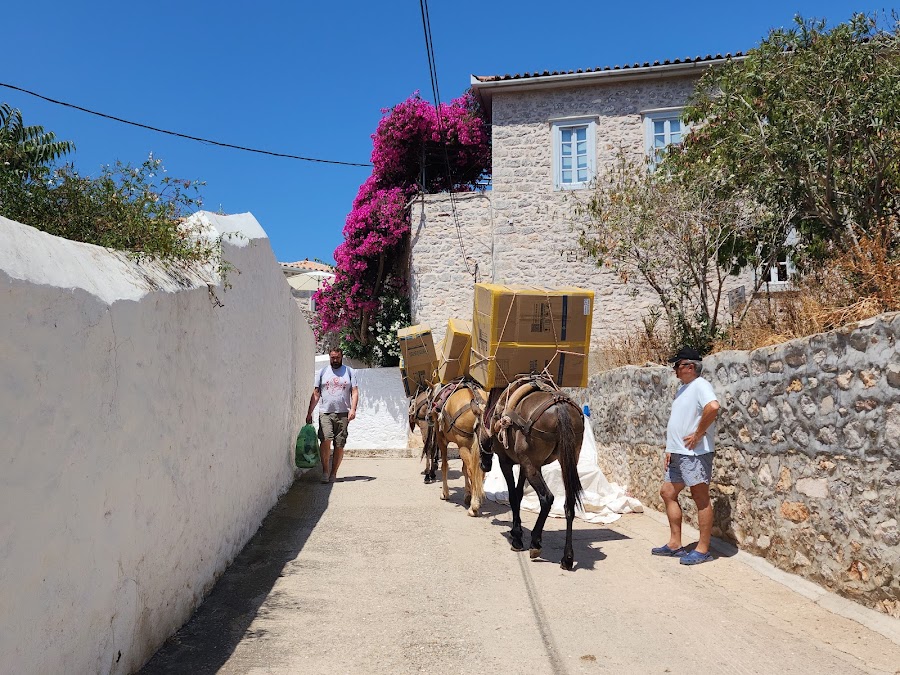
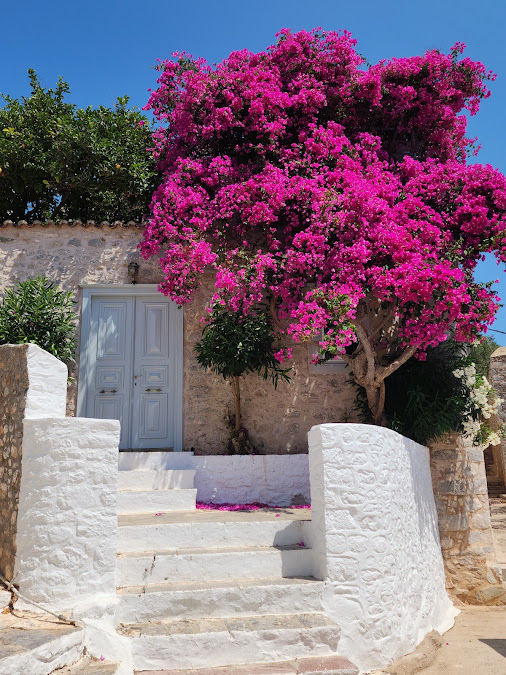
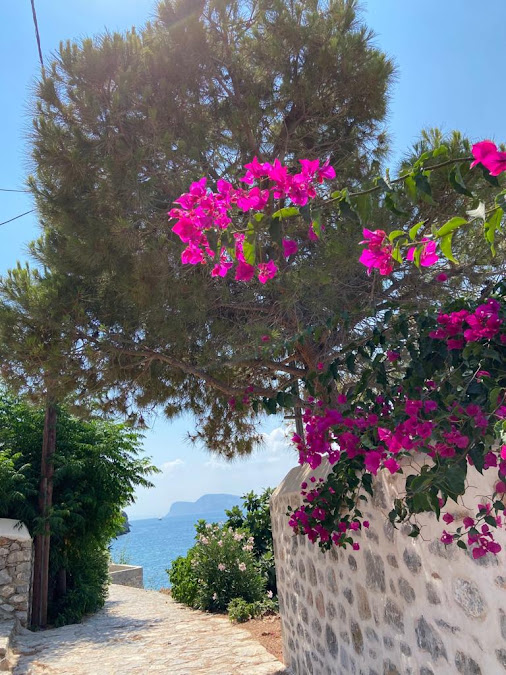
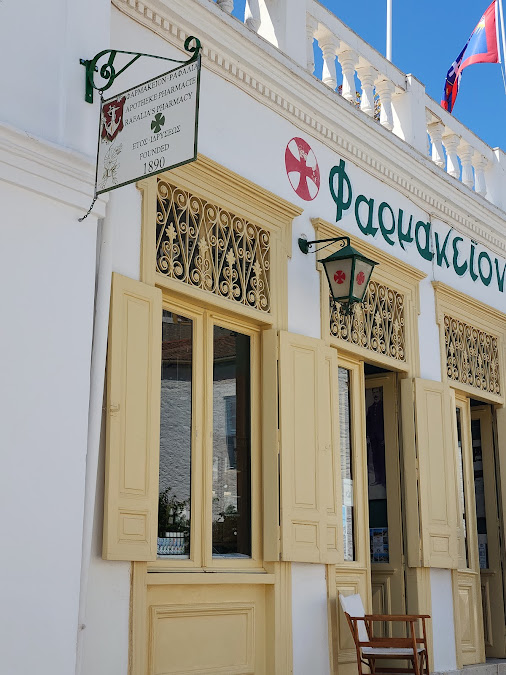
Important not to be in a hurry so you can lose yourselves in the maze of these quiet streets away from the bustle of the port. Most of the houses we noticed have ledges in front so you can rest from the walking! In back of the port too you can see the oldest pharmacy on the island, from 1890.
As mentioned, the Historical Archives can give you more of a sense of Hydra’s history, especially around the time of the Revolution. We happened to stumble on quite a wonderful event one evening, the opening of a tribute to Nikos Kazantzakis 140 years after his birth, 140 years of light. Although Kazantzakis had no connection with Hydra (with the Argosaronic island Aegina he did, where he wrote Zorba the Greek ) the museum in cooperation with the Kazantzakis museum outside Herakleion Crete (near his birthplace) put together the exhibit and the opening. As Kazantzakis is my favorite Greek writer, we didn’t want to miss it.
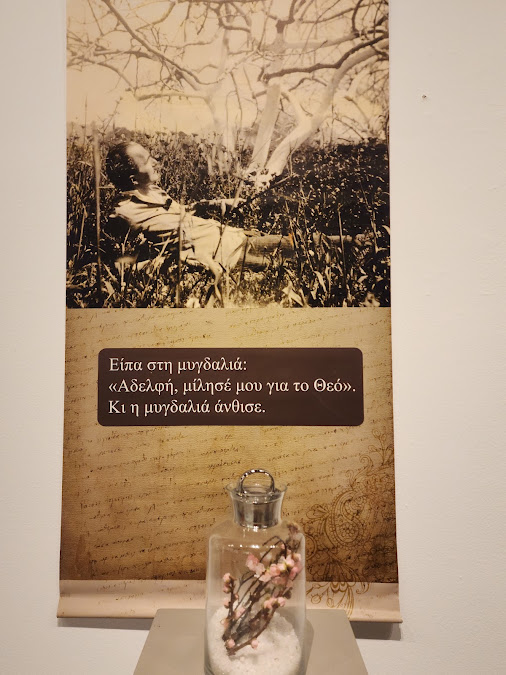
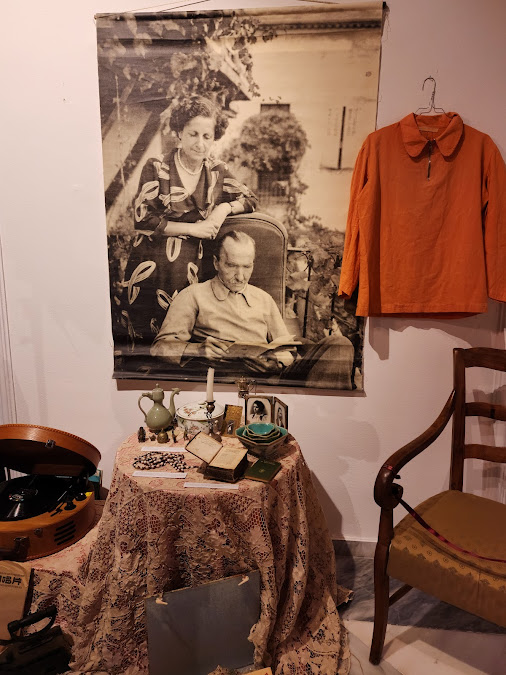
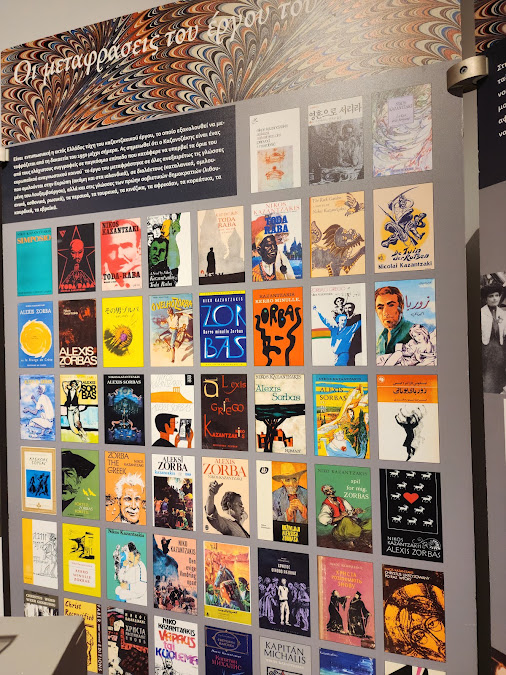
The exhibit and speeches were all very fine, but outside on the museum terrace, some Cretan dancers were performing.
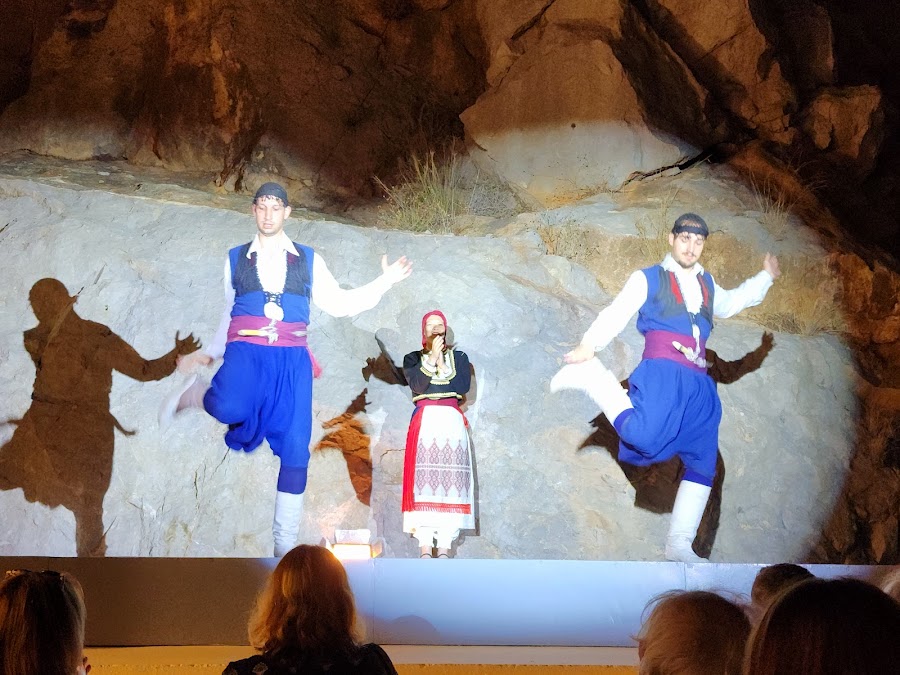
A Cretan event without raki, impossible. Tray after tray with tiny shot glasses of raki was being passed around, as well as giving Cretan traditional caltzounia.
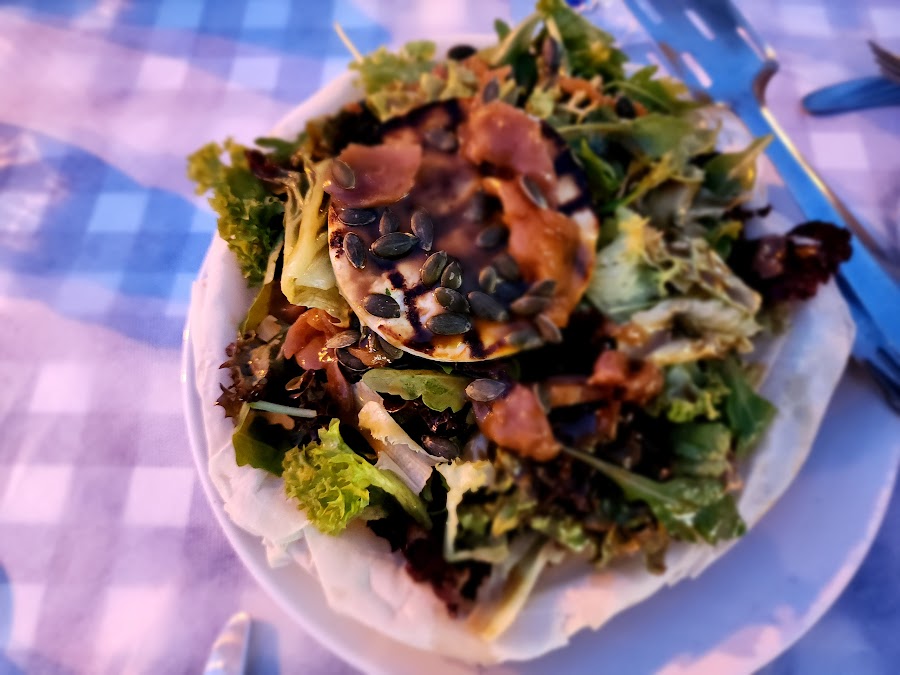
Restaurants in the town? The first evening we tried Piato right on the port with its blue checked tableclothes and little olive trees next to the tables with lanterns.The cats at our feet raised their heads and then went back to sleep. We had an exquisite salad with several kinds of lettuce, roka (arugula) sundried tomatoes, haloumi cheese on pita, apricot, pumpkin seeds, honey, olive oil and balsamic.
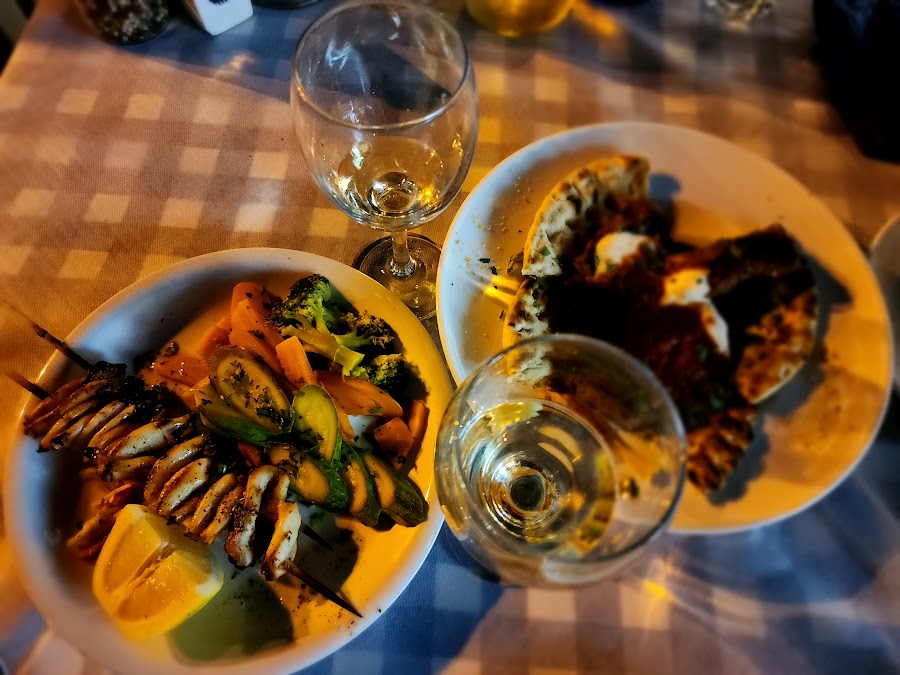
Kalamari souvlaki with steamed vegetables and kebab yiortlou were next. Delicious but the portions could have been a little bigger… Like other tavernas, it’s a bit expensive but that’s the price you pay for a lifestyle island!
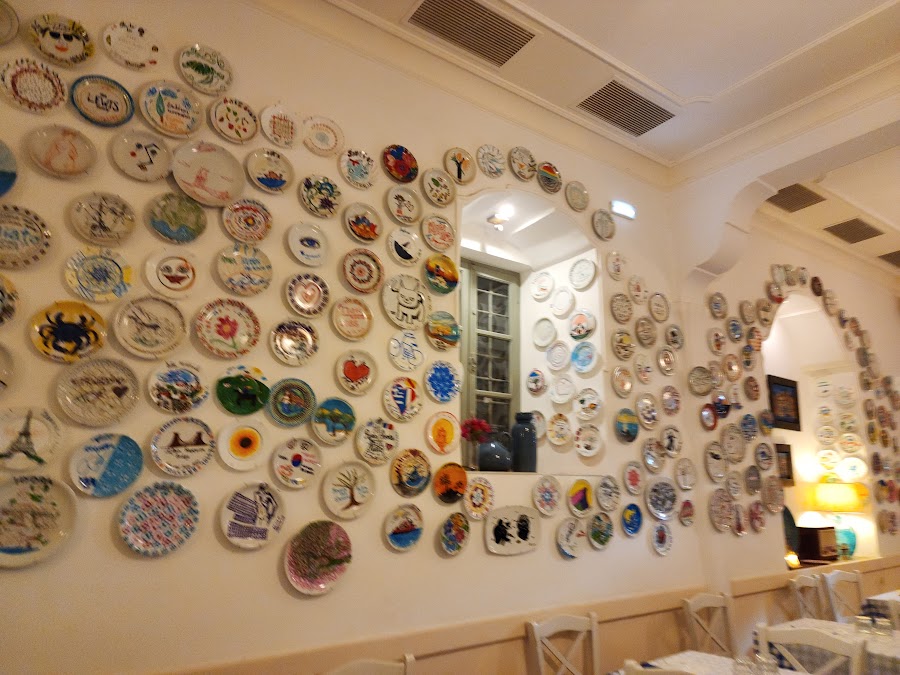
When I went inside to pay, I saw the walls were filled with plates (thus the name piato. The owner Tony told me that when he opened in 2015, first it was manageable with few tables but then more and more tourists started coming to dine.To pass the time, he gave customers plates and markers and told them they could decorate them however they wanted while waiting, so that’s what’s on the wall. This way it looks like a traditional island house decorated with plates.
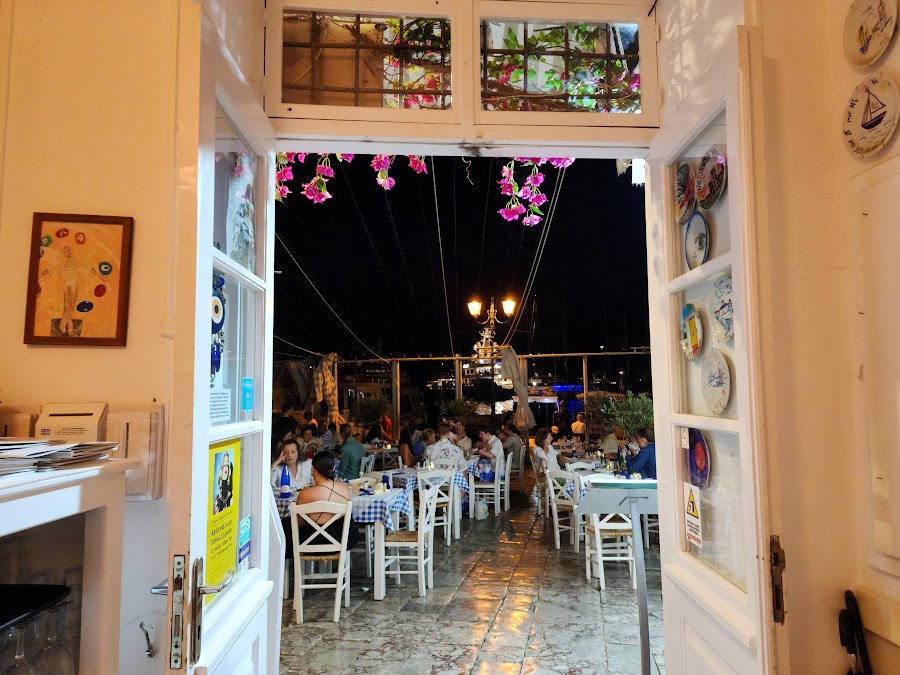
Like a lot of restaurants and hotels, Piato is a family operation: Tony’s mother in her 80’s is the cook (“how does she do it!” he said to me in wonder) and his daughter, studying marketing at the American College of Greece, waited on our table.
Though we didn’t go there, I liked the story about the Pirate bar/restaurant near Piato. It was originally an antique store, but the owner in the 70’s was giving his customers so much wine that he decided to open a bar.
As the weekend is approaching, there’s a lot more traffic on the sea. We’re waiting for the Freedom III to take us back to Metochi, refreshing ourselves with a cone of homemade salted caramel ice cream from the Cool Mule, everyone’s favorite sweet shop.
So long Hydra! “To laugh about it all again…”
If you like what you read, hit the like button and subscribe. Please share with your friends and social media. I’d love to hear your comments below.
There’s no need to log in to leave a comment. Just give an email address and your name.
Subscribe to become part of the olivesandislands community! Get new blogs and occasional newsletters delivered directly to your inbox. It costs nothing to subscribe. Olivesandislands does not share email information.
Note: Be sure to click on the confirmation email after you give your email address.

Sherri Moshman Paganos is a writer and former educator, inspired by her life in Athens, where she and her husband are happily retired and enjoying their travels in Greece and abroad. You can check out her writing — fiction, non-fiction, poetry and articles here.


Once again you took me on a magical, colourful,emotional journey… can’t wait for your next Olives and Islands blog. Marilyn
LikeLiked by 1 person
Thank you Marilyn for your very kind words!
LikeLike
very good congratulations !!!
LikeLiked by 1 person
Thanks George!
LikeLike
Thanks for the journey. Great pics.
LikeLiked by 1 person
Thanks Ginny. Glad you enjoyed the trip!
LikeLiked by 1 person
Hydra is truly a gem! You could call it ‘a jet-setter’s hideaway’. It has maintained its stylish image, and it continues to attract those who seek inconspicuousness, tranquility, and privacy.
Thank you, Sherri!
LikeLiked by 1 person
The island for sure has managed to keep its high end image. I love how it’s still beautiful and tranquil in off hours that is. Thanks Stella!
LikeLike
Lovely, Sherri! I’ve been to Hydra twice but never realized what an artists’ colony it was. And great pictures as usual.
LikeLiked by 1 person
Right, the artist aspect of Hydra is something I wanted to explore on this trip. Thanks Nancy!
LikeLike
I’ve just sent this to a friend who is visiting Hydra soon and not just for a day trip as so many do. You describe an enchanting and unique island, the inspiration of so many artists and writers!
LikeLiked by 1 person
So glad you shared the blog with your friend and it’s so worth staying beyond a day trip. How I love the beauty and inspiration of this island!
LikeLike