Rodos or Rhodes, island of the sun god Helios, 4th largest Greek island. Medieval town of the knights. Island of beaches, water sports, all inclusive hotels, island of green and forests. Kastellorizo, tiny, serene, isolated, nestling next to Turkey.
Both are part of the island chain, called the Dodecanese (meaning “12”)

Let’s begin in the old town of Rhodes, explore other parts of the island, then sail to the scenic harbor of Kastellorizo.
In its long history of many conquerors, Rhodes was ruled by the Knights of St John for just a little over 200 years, but the reign of the Knights marked the old town with their heavy walls and dark, forbidding air. Look up the street of the knights at dusk.

Who were these rulers? The Order of the Knights of the Hospital of Saint John were founded in 12th century Jerusalem. When the Crusaders lost Jerusalem, the Knights were thrown out, first going to Cyprus and then to Rhodes, where in 1309, with some wheeling and dealing, they were handed over the island. At first their main purpose was to tend to the poor and sick, but they grew increasingly militaristic as the need to defend themselves grew. In Rhodes they regrouped into seven languages based on their place of origins: Provence, Auvergne, France, Italy, Aragon, England and Germany (eventually adding an eighth, Castilian from Spain). But the spoken language among them was French and the written Latin. The inns of each language, now used for administrative purposes, are found on the street of the Knights.


Through the centuries, parts of the Palace of the Grand Master were destroyed and rebuilt, but it was nearly all destroyed in 1856 in an explosion of gunpowder that had been stored and forgotten. Nearly 1000 people were killed. The Palace was left in ruins until the Italians rebuilt it. The island was under the Italians from 1912 to 1943. Rhodes and all the Dodecanese islands officially became part of Greece in 1948.
Today the Palace is a museum.


The archaeological museum nearby is housed in the former Hospital of the Knights. Our local guide Emmanuela told us that the Knights were considered excellent doctors. Medical care was totally free for the up to 100 patients inside and that everyone had their own private servant while recuperating. Not bad!

Although the city of Rhodes was founded in the 5th century BC, there are few ancient ruins in the old town beyond the 3rd c. BC Temple of Aphrodite and some Byzantine walls.


It was the Ottomans who kept the island the longest. One of the few traces of this time is the mosque of Suleyman, who finally captured the town in 1522 from the Knights. The mosque is at the end (or beginning) of Socratous St., one of the main shopping streets.

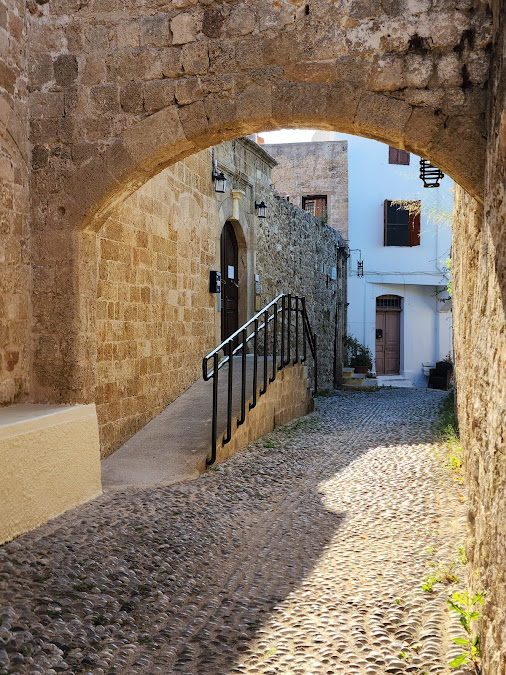
If you wander in the quiet streets off the main squares, you’ll find locals who are sitting out at tables in the narrow alleys.

The dark narrow streets contrast with the lively main squares.


At Jewish Martyrs Square a four sided memorial in English, French, Greek and Hebrew remembers the small Rhodian Jewish community, which dates back 2000 years. They lived nearby in the Juderia, the Jewish quarter, until their deportation in 1944, after the Germans had taken over the island from the Italians (and turned on their former allies). Every summer in July descendants of the community from abroad gather at the nearby 16th century synagogue for commemoration ceremonies.
In the recently published One hundred Saturdays: Stella Levi and the Search for a Lost World, Michael Frank brings to life 99 year old Stella Levi’s still vibrant memories of her life in the Rhodes Juderia pre World War II.

This square is also known for the lovely seahorse fountain, a popular meeting point.

Shops sell everything from miniature Colossus of Rhodes to spices, chess sets, armour, bags, sunglasses, the blue mati (against the evil eye), imitation vases, caps, Panama hats and beach towels, as well as plenty of jewelry stores to decide on your gold or silver. With all the shops and the smell of the leather in sandal shops, it could be the Plaka or countless islands. This shop, Gallery Royal, had a very interesting collection of objects for sale.

Back in 1982, before I had even moved to Greece, I stopped in Rhodes on my way back to Pireaus from Karpathos, an even further Dodecanese island. I stayed in a small pension in the old town — at that time there were plenty of small pensions and rooms to let but by the 2000’s or so they were gone completely. Now it’s just shops and any accommodation is outside the town walls, in the so-called ‘new town’ and there it’s hard to find any kind of small pensions. Rhodes is fully into a world of large hotels and package tours.
New Town
To exit the old town you can choose from eleven different gates. The Eleftheriou gate is the most beautiful.

Once you exit, you’re approaching the pretty harbor of Mandraki that has the famous bronze deer statues, with the names of Elafos and Elafina (male and female deer, symbol of the island) which according to legend, mark the spot where the Colossus of Rhodes stood, legs open, to allow ships to go through. To celebrate a victory, a 32 meter high bronze statue (the same size as the Statue of Liberty, called by Emma Lazarus as the “new Colossus”) was constructed dedicated to Helios Apollo, or better known as the Colossus of Rhodes. One of the Seven Wonders of the Ancient World, it took 12 years to build.

It captures the imagination the story of how the ships went through its legs, but that’s considered an impossibility. It might have stood in the harbor but its legs closed.
Archaeologists believe however, that the statue was not in Mandraki Harbor at all but inside the old town at the top of the Street of the Knights, where later the Palace of the Grand Master stood.
In any case, it only stood for 56 years before an earthquake in 226 BC made it collapse. Then the statue lay abandoned for eight hundred years because the Delphic oracle warned against touching the remains that were scattered all around! “But even lying on the ground it was a marvel,” wrote Pliny the Elder.
Eventually it was in fact chopped up in 653 AD by the Arabs when they conquered the island, and sold for scrap. To carry it away, it took 900 camels!
Around Mandraki, the administrative structures have the mark of Mussolini inspired buildings, a certain Fascist building style of the 1920’s and 30’s emphasizing simple lines, symmetry and lack of ornamentation. This is the public theater.

In the northwest part of the new town by the beach, hotels are put up every which way. There are hotels on the beach road, but if you’re only a block away from the sea, when you look out from your balcony, you can see a sharp angle of a building jutting out here, another there to fit in an empty space. So you might have just a half view of the sea, not to mention the abandoned buildings. When tourism took off in the 70’s & 80’s, there was a frenzy of building to make a quick profit. An owner’s dream is to have a hotel with an infinity pool across from the beach.

Small inns are closing; just four years ago in 2019 we had stayed in a small boutique hotel with a lovely garden and rooms cleverly named for artists (we were in the Matisse room). Very sorry to hear now that this charming place closed…

One place we like to eat in the new town is the Niohori restaurant (on quiet Kazouli street next to a Catholic church) where we had eaten and enjoyed the fresh delicious dishes and friendly service. By the time we got a table it was late because it’s become popular among both locals and tourists. We started with a salad with haloumi cheese, roka (arugula), figs and cranberries, where the flavors blended beautifully.

We continued with dolmadakia (vine leaves stuffed with a little ground meat, rice and spices) and eggplant ragu, along with their own baked whole wheat bread and white house wine. We kept ooing and ahing, it was all so tasty.

This year’s visit to Rhodes, we’re on a tour with 47 dear fellow classmates from our Dimotiko Laiko Panepistimio Agias Paraskevis, literally, “People’s University of the Municipality of Agia Paraskevi.” (It offers bi weekly lectures by professors from Greek universities on topics on everything from literature, philosophy and geopolitical to medicine, social issues and history.) This is our end of year excursion, led by our student body committee and its tireless president Frieda, accompanying us and taking care of the excursion.

Was there an ancient city of Rhodes? Yes, it can be found on the Monte Smith hill (named for an English admiral). There are some columns from the 5th century Temple of Apollo, above a Roman a 2nd c. BC stadium where they held competitions preparing for the Olympic games and a reconstruction of the theater used by the School of Rhetoric.


Ancient Rhodes was founded in the 5th century by already existing Doric settlements on the island in Kamiros, Ialyssos and Lindos, dating back to 1100 BC. The Dorians established profitable trade routes to the East, which continued for many centuries. Through the centuries Rhodes attracted invaders because of its strategic position, crossroads between Asia, Africa and Europe.
That’s the historical version. The mythical version says these settlements were given the names of the three grandsons of Helios the sun god and his wife Rodi. That’s how we get the origin of the island’s name, that Helios fell in love with a beautiful nymph, Rodi. When his sunlight touched her skin, she magically transformed herself into an island….
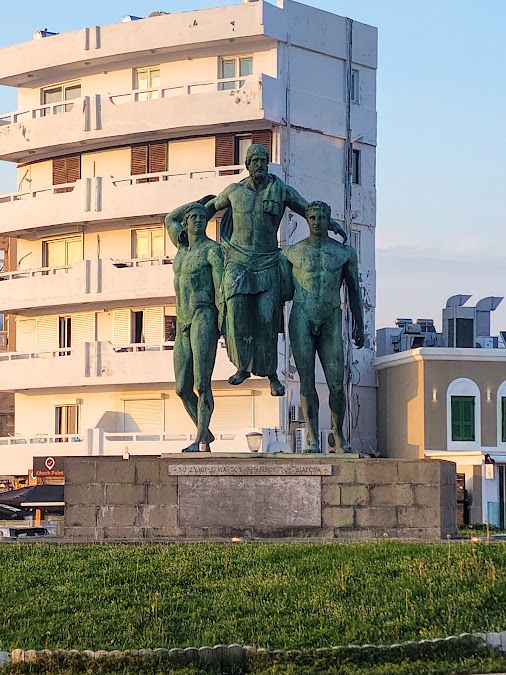
Our hotel is near the statue of Diagoras, a 5th century BC athlete and two time Olympic winner of the event called the Pangration. No niceties in this event, it combined boxing and wrestling and the only things you were not allowed to do was to bite your opponent or poke out his eyes. In the statue he’s being lifted by his two sons who have just competed and won (that’s why they’re naked and he’s clothed as a spectator)
Diagoras was deliriously happy that his sons not only won but surpassed him. The legend goes that a Spartan who was watching this (leave it to the Spartans) called out “Diagoras, die! You can’t go any higher in your happiness so die!” And he died soon after …
We’re a block from the city beach near the northern part of the city, down from the Aquarium and up from the casino and the villa that Lawrence Durrell lived in for a time. We’re very affected by the winds, as is generally the west side of the island. Our first night the wind was so strong that we actually had to sit inside to eat (unheard of this time of year!) – at a local mezedopoleio (serving mezes)

Under the plastic pomegranate tree we sat and admired the walls decorated with past inventions:: old record players, rotary phones and 45, 33 and 78 records as we listened to nostalgic music of past singers and the raucous laughter of a group of young guys who were drinking raki at a neighboring table. Oh yes, and the food: highlights were the grilled octopus with fava and grilled mushrooms with garlic.
West side and island Interior
Going west out of the town, after the Diagoras airport, on our way to Ixia, the first thing you see is a settlement of small flat houses known as the Kritika, built the beginning of the 20th c. while Rhodes was still under Ottoman occupation, to house Cretan immigrants who came to Rhodes to work. The law originally stated that the houses must remain in the families, and until recently, no renovations or changes were allowed. Today there are still some descendants living there, some buildings are used for shops, some are abandoned.


The small Kritika form a contrast to the string of nearby luxury hotels: Rodos Palace, Oceanis Beach, the Sheraton, Cosmopolitan, Belair, Lito… Many are all inclusive, dinner included, activities around the pool: aerobics, outside of pool: yoga, meditation. Animateurs keep the kids busy. You might never go into the town at all. Next town is Ialyssos or also known as “Trianda” or thirty, because it was 30 families who came from Constantinople in Byzantine times and founded the city.
Near Trianda, you notice a giant cross on a hill. That’s Fileremos (filos – friend, eremos – solitude), where you can drive up through forests and see some ancient remains of an acropolis. Today in this pleasant wooded area it’s a refuge for peacocks who strut around (the males of course) and you hear their deafening “caw caw!”. They even climb trees as I learned.

In the 1930’s the Italians reconstructed the “Golgotha” or Calvary of Jesus Christ, with 14 bronze plaques along the path of the Passion of the Christ and the large cross you see from a distance, You can walk up to the 15th century monastery of the Knights. Inside, as our guide told us, was an icon the Knights had brought with them from Jerusalem. When they left the island, they took it with them, but over the years it surfaced in Italy, Malta, France and Russia, and is now housed in the museum in Montenegro.

Fileremos is a pleasant wooded area but it’s not the only forest, the island interior is blessed with pine and cypress trees but you need a car (or tour bus) to see it.
On our tour of west central Rhodes, our first stop is Agios Nikolaos Foundouklis, a church from 1467. Our guide Eleni tells us that the church was done in memory of the builder’s three children that died and some of the frescoes inside take on this personal nature. “Foundouklis” comes from the area being rich in foundoukia or hazelnuts.


Near the church a hand made sign points the way for filia, agapi, oneira, alligii and sevasmos: friendship, love, dreams, solidarity and respect. Can’t argue with those.

All around us now are pine forests with a splash of pink flowery plants here and there. We’re approaching the area around Salakos, below Profitis Ilias. The Italians built the Elafos (Deer) inn in 1929 in an alpine style, and they had it open for coffee for our group.

We explored around the quiet verdant paths. Some mountain goats were wandering around. In the photo they’re practically camouflaged. See if you can spot a white one to the left and a black one to the right.

Above the Elafos Inn, was an old abandoned church of St George (you can see a relief of him slaying the dragon)

We also stumbled on what looked like an abandoned older inn with a magnificent view. According to my friend Martha, who has a house on Rhodes, this was the official home of Cesar De Vecchi, the governor of Rhodes under Mussolini. He was greatly hated, as he was a model of how a Fascist governor should be …. When the Elafos Inn was restored (it was also left in ruins for many years), no one wanted to touch the De Vecchi estate!


The graffiti left on one of the walls is appropriate for the house of a Fascist governor.

This is vineyard country. We stop at a wine tasting.

We also peek into a folk museum (the owner’s grandmother’s house). Everything was in one room, which was only decorated with plates, a sign of how much wealth the bride had.


The town of Embonas is on the slope of the largest mountain of the island, Mt. Attavyros, 1215 m. The name of our cheerful and friendly waitress at a creperie was Tsambika – many islanders bear this name and soon we were to hear the story of why. Many of our group were pleased with the lunch at Ilias Taverna.

Instead of joining the group for our tour of the interior, some opted to go to the island of Symi, north of Rhodes, for the day (see map). It was a tempting idea, but we decided to leave it for a day trip next time we visit…
East coast to Lindos
Our last excursion in Rhodes takes us along the east coast, which is not affected by winds and is considered to have the best beaches. We’re on our way down to Lindos, which many regard as the jewel of Rhodes.
Leaving the town on the eastern side you pass through lots of deserted buildings from years way gone by. Our first stop is the Kallithea Springs, with its medicinal waters from ancient times. You’ve stepped back to the 1920’s when the Italians built and dedicated this spa. I feel like I’m in an Agatha Christie book or film, that might be entitled “Murder in the Kallithea Baths.”

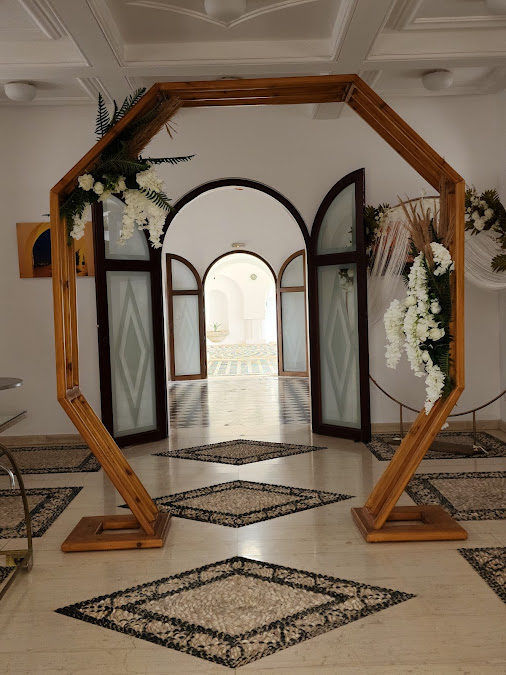
The entrance has a traditional mosaic floor called hohlakia. These black and white stones that form various designs can be found all over the beaches — they used to gather them to make the mosaic floor. Today you can order the stones online. (!)

You walk through a colonnade to a large domed building, elevated from a small beach.


Inside the dome shaped building are tiny windows with blue stars. Note the Arab style of the arches. According to the brochure given, the water was good for skin diseases, obesity, diabetes, tropical diseases, dysentery, malaria, allergies, asthma, cystitis and intestinal problems.
Our guide Emmannuela tells us the spa site is commonly used for weddings (and indeed it’s all set up for a wedding later that evening) In fact her wedding pictures were taken here! Note the hohlakia, the stone mosaics.

In the small museum were great photos of the era when the baths were built:

In the late 60’s the spa was falling apart and left for ruin, until the state stepped in and gave money for it to be restored, which was completed in 2007.
A number of films were made here, some Greek, starring beloved actress Aliki Vouliaklaki, and international like The Guns of Navarone (with Gregory Peck, David Niven and Anthony Quinn) Quinn in fact loved Rhodes and a nearby beach is named for him.
After stepping back in time to the Kallithea Springs, soon after, we hit Faliraki, home of the largest water park in Greece, maybe in all of Europe. We used to hear that it attracted crazy young British tourists (!) like Malia on Crete, but according to Emmanuela, it’s calmed down a bit in recent years because like in Ixia, they’ve built luxury hotels, so they’ve raised the average age of people staying there. Leaving Faliraki, we pass the kitschy “Kolossus cafe” with an almost scary looking replica of the statue.
South of Faliraki near Kolymbia, there’s a turn off to Epta Piges (Seven Springs) a beautiful spot where a lake is fed by springs. I’ll never forget crawling through an endless tunnel to get to the springs on our trip in 2000.
Remember Tsambika, our friendly server mentioned earlier? The story with the name is that in the 11th century a shepherd saw flames coming from the mountain, and to him it looked like swords or “spithia” or in the local dialect, “tsampithia.” The word spread that there was an icon of the Virgin Mary on the mountain. The cypriots who were missing an icon from a monastery took the icon to cyprus, then it went back Rhodes, back to cyprus, back to Rhodes. Now the icon is found in the “lower” Tsambika church in the village of Archangelos.
The “higher” church on the mountain is a place of pilgrimage for childless women. If they do conceive, they promise to name the girl Tsambika and the boy Tsambikos.

Approaching Lindos… The white cube houses remind you of the Cycladic islands.

Of the three Doric settlements, Lindos was most important because of its excellent vantage point and good harbor. First established around 2000 BC, the ruins include ancient, Byzantine, Frankish & Turkish remains. To climb up to the ancient Acropolis you walk through the town, passing all the shops, bars and restaurants, then an uphill climb. Here is where we stopped – we had done this climb when we visited with our kids in 2000 and with the heat and humidity, we decided to forego it and sit and have a cold drink (but a sizeable number of our group made it to the top. Bravo tous!)
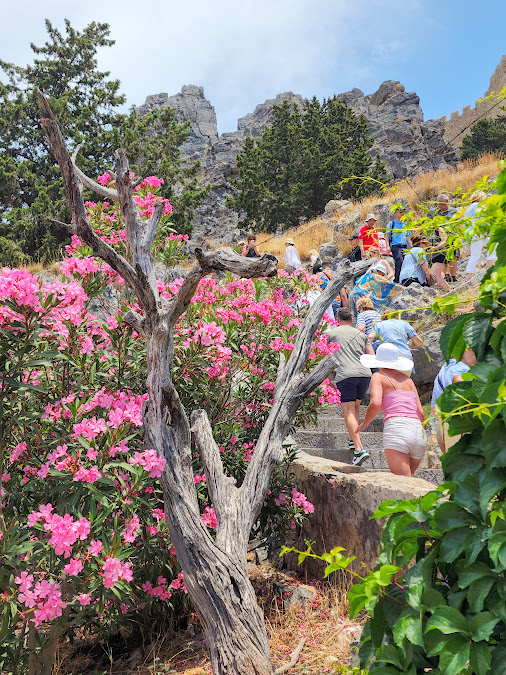

Note: Lindos is the hottest place on Rhodes — it’s common for summer temperatures to reach 40 and more degrees) It might be possible to take a donkey up to the top, I saw a group of them waiting off of the main plateia.
The narrow walkways are filled with shops, creperies, bars, restaurants with people calling after you “Hey do you feel like Greek food today?”
Some of the eating places are in gardens with what’s called “captain’s houses,” 17th century houses in courtyards with hohlakia, the mosaic stones. Wooden facades and ornately designed doors. Wealthy captains used to have these houses, but now they’ve been bought by wealthy Rhodians and others.

I was thinking of all the recent articles warning you about overcrowded places in Europe in summer months. Rhodes is actually near the top, and Lindos the #1 destination on Rhodes. And because it’s small, you really feel the huge number of people, the feet stomping through the narrow streets. Whoever of course who can visit in September or October will find Lindos a lot more manageable and charming.
The good thing is that large hotels are forbidden, as well as unsightly hot water heaters.

Despite the parking above the town, cars still go down the steep hill to the main plateia, causing unnecessary traffic jams. When they see there’s nowhere to park, they drive back up, or turn to go down to the beach.
Beach developers in this area of Rhodes, like on Mykonos and other Cycladic islands, are unfortunately ignoring stop work notices and erecting unlawful beach structures, much to the consternation of local authorities.
On my 1982 visit, I had taken a bus from Rhodes town. I was in awe, I thought Lindos was the most beautiful place I had ever seen with its three layers, the Acropolis, Cycladic island- like town and beach. I wandered through the quiet streets, and even though it was August, there were few tourists. I went down to the beach for a swim. When I came up to the main square, a stooped over very old woman had spread out on the ledge around the tree, some of her fine embroidery. I bought just a little petsataki or doily from her, that I still have. She smiled sweetly at my clumsy attempt to speak Greek. Now I didn’t see anyone selling homemade embroidery.

Let’s have the final photo of Lindos; on a path hidden from the parking is this statue of 6th century BC and native son Cleobilus with the Acropolis in the background. (This is the name of Lawrence Durrell’s villa in Rhodes town).

The travel agency had promised our group a lunch at where else, a restaurant named Tsambikos , the name of the owner.

It was lovely to be out of the sun with a a pleasant breeze. they brought us salad, cheese croquettes and petaloudes (butterflies), the name given to their zucchini fritters, and main dishes of chicken or kalamari.


There was plenty of wine and beer, which in the heat, made us all drowsy… dessert of tourta (one of our group had a birthday) and homemade kataifi. Some of us from somewhere got energy to do a little island dancing….

Kastellorizo
Actually our best sweet, which I’ve saved for last, was our visit to Kastellorizo.

Not very well known to foreign tourists and although part of the Dodecanese, it’s far from any other Greek island, practically and a little uncomfortably in the arms of Turkey — 1.25 miles or 2.5 km from the Turkish coast. It’s so close that you get a message on your cell phone, welcoming you to Turkey.

The regular boat from Rhodes takes 4 to 4 1/2 hours, but once a week (Tuesdays) the high speed boat, which we took, goes and returns the same day, making the trip in 2 hours and 40 minutes each way.
Megisti, meaning “biggest”,” is the island’s official name because it’s the largest of a group of islets. Dorians, Romans, crusaders, Egyptians, Turks , Venetians and pirates have landed through the centuries because of its strategic position. In the 1923 Treaty of Lausanne and population exchange, it was given to the Italians, who had the rest of the Dodecanese. Many islanders emigrated to Australia, especially to Perth, where there’s a large expatriate community, and refer to their homeland as “the Rock.” Speaking of Australians, the “wedding of the year” is planned for June 17 on Kastellorizo, with the son of a Greek Australian billionaire.
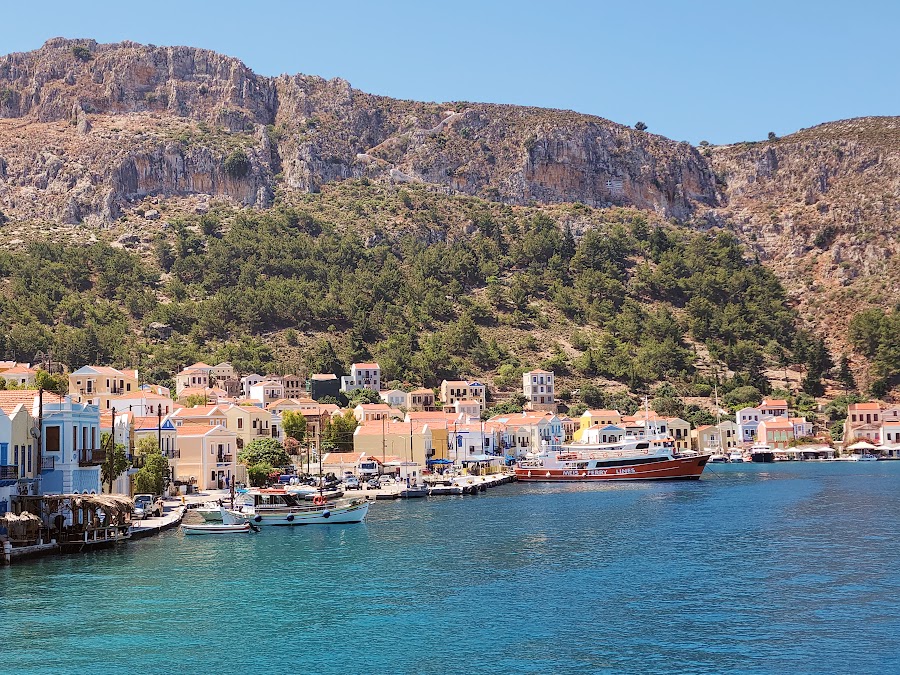
We had sentimental reasons for visiting Kastellorizo. Our son Theo spent six months of his military service here and the rest on Rhodes. The island is considered a hardship post, beyond paramethoria or near the border area. You can see up to the base above the port, about a 10 minute footpath away.

But we weren’t the only ones tearing up. Kastellorizo inspires emotion in Greeks, due to its position so close to the Turkish border, and with the island at times a source of contention and friction between Greece and Turkey. Certainly there’s a feeling of pride in the Greek flags everywhere. But there’s back and forth traffic from Kastellorizo to the Turkish coast; Greeks go shopping in Turkey and Turks come over to Kastellorizo to eat in the fish tavernas.
The waterfront is like a dream. If you could design an island port, it’s the way you might want it, with its two story mansions in pastel colors, the red tiled roofs and small wooden balcony. Perfect to be captured in watercolors! (It reminded me of the island of Kalymnos, also Dodecanese, in its pastel colored houses that look beautiful from the boat).


The historical museum found in the 18th century mosque was closed, but there was plenty of climbing to do.


We decide to climb up to the medieval castle — St. John’s Knights were here too. In fact the name Kastellorizo comes from Kastello Rosso (red castle).
On the way up to the castle we stop to take a look at the impressive and grandiose church of St. George Horafiou (of the fields), from the early 20th century, but never completed. Apparently it’s always closed and needs restoration work inside. It’s right near the school, where we’re told that there were three students graduating and taking the university exams.


Near the school and church a statue commemorates the famous Woman of Ro, Despina Achladiotou. She and her husband were the only residents on the tiny island of nearby Ro. Every morning, even through the Nazi occupation, she raised the Greek flag and then kept on doing it as a kind of act of defiance to the eyes of the Turkish soldiers. She continued living there and raising the flag every morning until her death in 1982.

From here we’re close to the castle, and climb up a rickety stairs to the top. Our eyes can’t get enough of the views of the port and the other side.
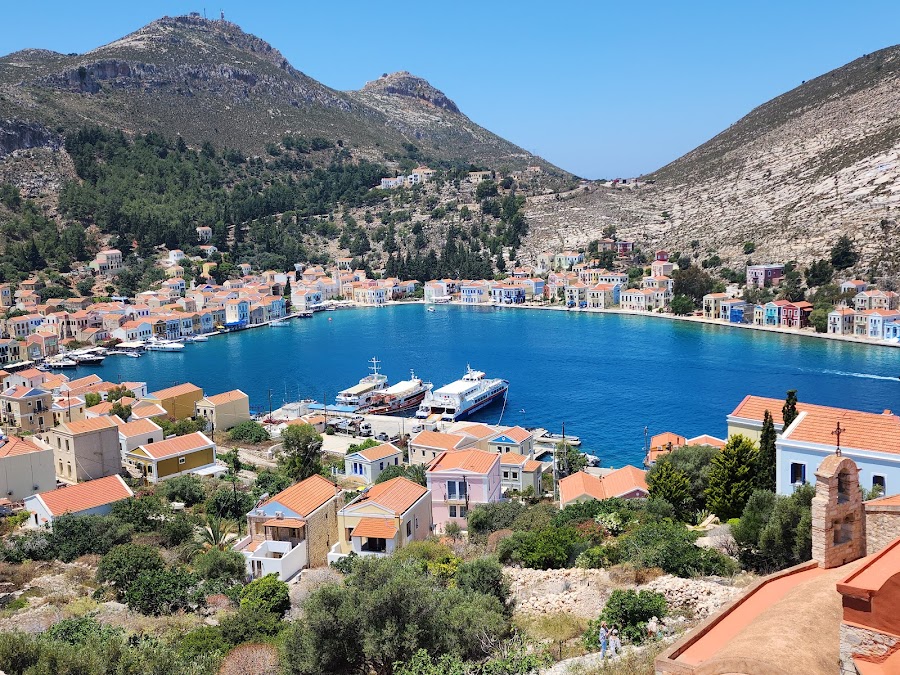


Under the castle, as you go back toward the town, is a Lycian tomb. This is quite a find; although these tombs are common along the Anatolian coast of Turkey, this is supposed to be the only such tomb in Greece. Cut into the rock, these tombs with their Doric facade are from the 4th c. BC, around the time of Alexander the Great when the Greeks conquered the Lycians. At one time they were richly decorated.

Where’s the beach? By this time all we yearn for is to find a way to feel the cool sea on our skin. But there are really no beaches, just swimming off the rocks. (Though the Megisti Hotel all lthe way to the east of the harbor seems to have a swimming area.) Under the tomb we notice a staircase leading down to a rocky area. Here is where we slid into the blue green sea.

From here you can see the little boats that go to the Blue Cave, where refracted light gives a deep blue color to water (some of our group went and were amazed at the beauty.) After the climb to the castle, we needed to get in the water.
If you remember the 1991 film Mediterraneo about four Italian soldiers stranded on a Greek island during World War II, that was filmed here in Kastellorizo. Factually, the island was heavily bombed during the war.
Back in the harbor, fish restaurants are mostly empty. One “visitor” is hoping for some customers…

At a cafe, we sample some of the island sweet, koutoumari, and try to store up our last mind pictures of Kastellorizo before getting on the boat.
We look across at Turkey. The sky is so clear we can actually see how sun reflects on a window of a house.

Back in Rhodes, the town is having a traditional glendi, a party outside the town hall in Mandraki Harbor. It’s a celebration with traditional dancing from different parts of Greece and traditional food. Besides the endless line for souvlaki, one table offers dolmadakia while another has fasolada or bean soup that they ladle from a cauldron.

Women sit making pitas, like crepes, that are served hot with cinnamon and a drizzle of honey.

At another table is souma, the Rhodian name for what’s known in other parts of Greece as tsigoudia or raki. Dancers then formed a circle, inviting into the circle anyone who wanted to dance. It was an evening of hospitality leaving great memories of the island.

So long Rhodes and sun god Helios, with your beauty and fascinating blend of cultures! I’m sure we’ll cross your shores again.
And to all, kalo kalokairi, have a good summer!
If you like what you read, hit the like button and subscribe. Please share with your friends and social media. I’d love to hear your comments below.
There’s no need to log in to leave a comment. Just give an email address and your name.
Subscribe to become part of the olivesandislands community! Get new blogs and occasional newsletters delivered directly to your inbox. It costs nothing to subscribe. Olivesandislands does not share email information.
Note: Be sure to click on the confirmation email after you give your email address.

Sherri Moshman Paganos is a writer and former educator, inspired by her life in Athens, where she and her husband are happily retired and enjoying their travels in Greece and abroad. You can check out her writing — fiction, non-fiction, poetry and articles here.


Amazing, thorough , and mouth-watering!
LikeLiked by 1 person
Love your comment!
LikeLike
Lovely to revisit Rhodes through your blog and what a gem Kastellorizo sounds!
LikeLiked by 1 person
Thanks Roz…indeed worth a visit, wish we’d had more time!
LikeLike
Such a thorough and enticing survey. I want to book tickets immediately!
LikeLiked by 1 person
Thanks Gillian. Just avoid Lindos in summer!
LikeLike
Thanks again for a lovely journey. I could feel the heat and smell the air!
LikeLiked by 1 person
Thank you Marilyn!
LikeLike
Great pictures, Sherri! And I loved the story of Kastelorizo.
LikeLiked by 1 person
Thanks Nancy…Kast. really charms with its beauty and history
LikeLike
Beautiful and historic Rhodes! So much to see, learn, and enjoy. However, while I was reading your post, Sherri, my eyes glanced quickly at the TV monitor displaying live footage of the devasting fires on the island. Man builds, man destroys. Disheartening.
LikeLiked by 1 person
Beautiful Rhodes! 😔 The scenes of the out of control fires are so disturbing. Are we going to have nothing left?
LikeLike