The Vale of Tempe, a gorge north of Larisa near Mt. Olympus, turned into a vale of tears and grief on the last night of February when 57 people lost their lives in the country’s worst train collision. Many passengers were university students returning to Thessaloniki after celebrating the three day end of carnival weekend. This blog is dedicated to the memory of the departed – may they rest in peace, and to the families who have lost their loved ones. A mother’s message, “Call me when you arrive,” has become a chilling national motto of this tragedy.
**********
In time for Apokries or carnival, we returned to Greece from visiting family in the U.S. This year after a three year absence from covid, Athens squares again filled with people enjoying concerts and springlike sunshine while costume parades once more took place all over the country. In Athens, you could wander over to the Varvakeio central market to get the traditional shellfish for “Clean Monday,” which marks the end of carnival.

The windy weather helped those in their kite flying, a tradition for the day. Warm weather brought people outdoors for picnics.


The start of Saracosti or the Lenten period, Clean Monday is the unofficial beginning of spring and a time to get out in nature. For many, it’s an escape from the urban apartment buildings.
It might seem like an unlikely subject for an exhibit, but the Hellenic American Union in Athens recently hosted an exhibition on the Greek polykatoikia (apartment building), called the “definitive landmark of the Greek cityscape.” It is the structure that everyone loves to hate.

Cities are known for their characteristic architecture: in Paris, the medieval city, which hadn’t changed much through the years from the old houses and winding streets, altered its look completely (despite violent reactions) with its mid 19th century six story Haussmann apartment buildings and wide avenues.
Looking at New York City
As for New York, it is a vertical city with some residents living as high as the 30th floor, looking out of windows down at antlike looking people. But across from Central Park, white gloved doormen open doors to residents of early 20th century beaux-arts style buildings, a style that can be seen in other iconic Manhattan buildings. Most well known is the New York public library, built in 1911, with its marble facade and famous stone lions.

Another beaux-arts example is the 1913 Grand Central Terminal. The style is grand and imposing in an Italian palazzo style, with classical Greek decoration.

If you’re not running for a train, you can savor the interior: be sure to look up at the astronomy ceiling with constellations marked in the main concourse. If you’re hungry, the lower level is filled with restaurants or drop in at the very gourmet market off of the main level.

And since we’re on interiors, I can’t resist showing this photo of the inside of the Morgan Library that we visited one evening..

Being a city of extreme wealth and extreme poverty, not to forget another characteristic Manhattan building, familiar from films like “Breakfast at Tiffany’s,” are the fire escapes and red brick buildings, still to be found in areas in Hell’s Kitchen on the far west side of Manhattan and the lower east side and Chinatown.

Another variation on the fire escapes is this pleasing beige brick building in downtown Brooklyn, Cobble Hill, where the fire escapes are painted white.

I thought these fire escape buildings were a unique feature of New York until I saw one recently while I was walking in downtown Athens.

Row houses are another characteristic New York structure, especially in areas outside Manhattan, like Astoria and Bay Ridge Brooklyn.

Edward Hopper exhibit
While New York was known even in the early 20th century as a city of buildings reaching for the sky like secular gothic churches, the artist Edward Hopper continued to see NYC in horizontal, not vertical terms (“I don’t care for the vertical,” he is rumored to have said). In “Early Sunday Morning,” this very horizontal painting was inspired by a walk he took in his Greenwich Village neighborhood in the late 1920’s. It gives a picture of what looks like small town America with its barbershop and other small businesses but if you look all the way to the right, there’s some sort of high structure looming in the corner.

In his retrospective exhibit at the Whitney Museum, which we were happy to catch, Hopper showed a wary eye for the city, positioning many of his subjects sitting by windows, isolated from each other as we see in “Room in New York.”

The Whitney museum itself moved a few years ago to Gansevoort Street, in its new airy and light building. Every floor, each with a different sculpture, opens to the outside, where you can go out and look out on the rooftops.

The museum is at the beginning of the High Line, the route of the old elevated train that used to carry goods on the west side. For years the land stood abandoned until in 2009 it was made into an elevated park between the West Village and Chelsea areas where you walk surrounded by art work. When I lived in the Village in the late 70’s, Gansevoort, which was the old meatpacking area, was a ghostly area of the city that certainly no one frequented after dark but now it has crowded champagne and caviar bars as well as parked carpeted vans, doors open, music blaring, promising to take you around the city.
Cities are always changing and evolving. It seems New York is getting ever more vertical.

Known as the world’s skinniest skyscraper, this fairly new building on W. 57th Street is controversial for its size and design. Only in a non-earthquake zone could you have such a skyscraper.


The Complex Face of Athens
Of course this has been just a little nod at New York. Now let’s go back to Athens and see what changes have come about in its housing since Greece became a modern state in the 1830’s.
Before 1920 if you had asked what is the predominant architecture, the answer would be the neoclassical. The American and European Filellenes supported Greece in its Revolution, because of a romantic passion for ancient Greece. After Greece’s independence, the Western powers in their love of the ancient, pushed for Athens, a rundown village at the time with a population of 4000, to be the capital of the new State. France and Britain sent a team of architects to try and revive the classical Greek architectural model. Here for example is what’s known as the “Trilogy,” the National library, the University and the Academy of Athens, in this order.


And it worked. Existing buildings were torn down and replaced by those of a Neoclassical look that was supposed to reflect the continuity of ancient Athens.

These were houses of course for the middle or upper class. Most of the population of the city, numbering around 120,000 by 1920, lived in small plain houses.
The neoclassical style of architecture along with wide avenues and grand squares, was not destined to last as the predominant style. What happened?
Reality hit the country in 1922 to 23, with the Asia Minor catastrophe and Greek Turkish population exchange when 1.5 million Greek refugees left Turkey and came to Greece. (see blog: The Destruction of Smyrna and the Asia Minor Catastrophe 100 Years Later.)The refugees needed housing desperately. The first move was to create small “temporary” houses.

Those of my mother in law’s generation, born in the 20’s or 30’s, still associate any small houses with being poor. Even the ugliest apartment buildings she gushes over, how beautiful they are! She sees them as a step up from poverty.
When you drive down Alexandras Avenue, you can’t help but notice this row of decaying low rise apartments that look like “”crumpled brown paper..” as described in the “111 Places in Athens That You shoudn’t Miss.” Tucked in next to office buildings and hospitals, the effect is startling. What are they? Why are they not demolished? The first question is easier to answer. Known as the Prosfygika Complex, or complex of refugees, these apartments, built in the early 1930’s, were progressive for the time, well ventilated with light open communal spaces. You’re sure these buildings must be abandoned, but then you see on the balconies signs of life: clothes hanging, flower pots, and you realize people are living here.
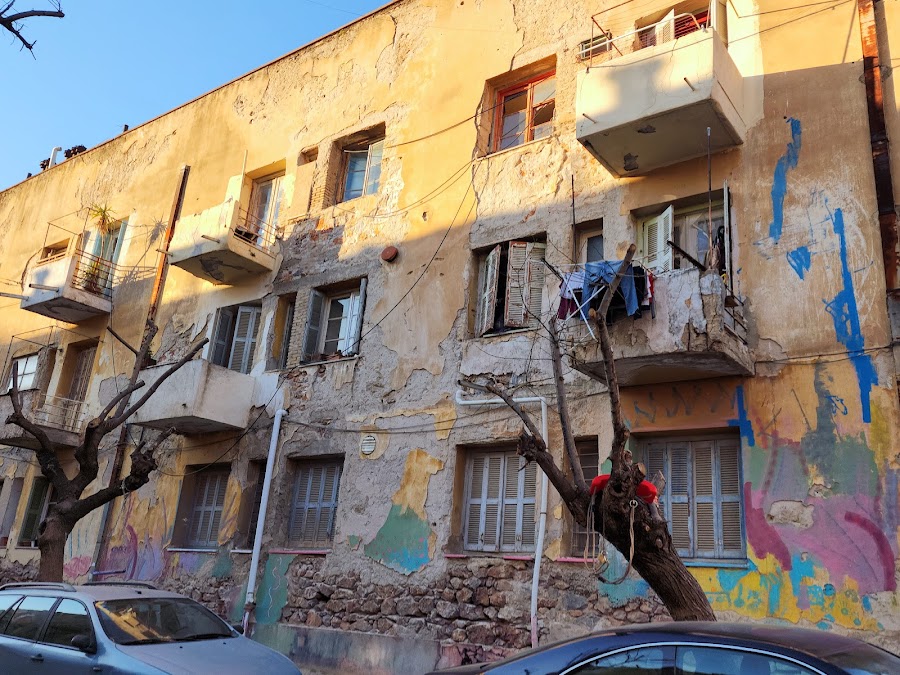
Not visible from the street, but behind the main row are another six rows, making 225 apartments. Supposedly there are bullet holes in the walls from the Greek civil war, as fighters of the resistance were hiding here. During the 2004 Olympics, they were covered with a huge cloth, so as not to be seen. They’ve been scheduled for demolition a number of times but nothing has happened and no one seems to know. They continue to be inhabited by “homeless squatters, artists, rights activists, drug addicts and recent refugees.” It’s a complicated issue.

This complex is unique in its problematic nature, but the city is full of neoclassical buildings that are abandoned, many covered with cloth or scaffolding that look as if they’re going to be renovated. But how? When?


One unusually damp summer evening in August a musician playing soft and mellow jazz on his soprano sax, stood against this graffiti splayed neoclassical building in the Plaka across from the Roman Agora.You wonder who lived here, who could afford such a house.

Besides the population explosion from Asia Minor, other 20th century events hit the country hard and encouraged a rush of cheap and fast apartment building. The German occupation in the 1940’s with its destruction of infrastructure and agriculture was followed immediately by the Greek civil war and its bitter divisions.
By the early 1950’s, refugees still lived in so -called temporary housing while those who traditionally lived in neoclassical mansions, barely had enough money to feed themselves and certainly not enough to repair damaged homes. As if the situation was not bad enough in Athens, thousands of people from the countryside were pouring into the capital to find work, once more doubling the population.
The government lacked money to help. What was to be done? Enter the ingenious system of antiparochi. One of those hard to translate words, antiparochi might be rendered as “mutual exchange” – this is how it worked.
A contractor would offer a houseowner a deal: to knock down his house and build a block of flats or apartments in its place. He promised the homeowner two or three flats and the contractor made money selling the remaining apartments. Under the junta in the late 60’s especially, antiparochi really took off in the efforts for Greece to appear more “modern.”
And because being a contractor was so profitable, this encouraged even more urbanization and moving to the city from small villages.
With this system, the state could concentrate on building up the economy and tourism. It only stepped in to regulate a maximum height (usually four or five stories) and no building was allowed on top of Athens’ “seven historical hills” or over archaeological sites. Fortunately, some of the downtown area was protected, since it’s full of antiquities. (This is what made digging the metro so difficult).
What did a typical building look like? A flat roof and balconies with matching awnings. Later came A/C units and on the roof, a tangled jumble of hot water heaters, satellite dishes and solar panels. And not only Athens, most Greek cities have this look.


An emphasis on maximizing profits, building at record speed, no central planning, and usually not using an architect, resulted in the look that you can see from the top of any hill. Here is looking south from the Acropolis, down through the Irodion theater:

Looking down on Aeropagus hill

Facing north and Lycabettus Hill, you can see the ceramic roofs of the houses closest to the Acropolis and then a myriad of other styles.

From Mt. Imitou, you really get a feel for a sea of unsightly low rise concrete apartment blocks.
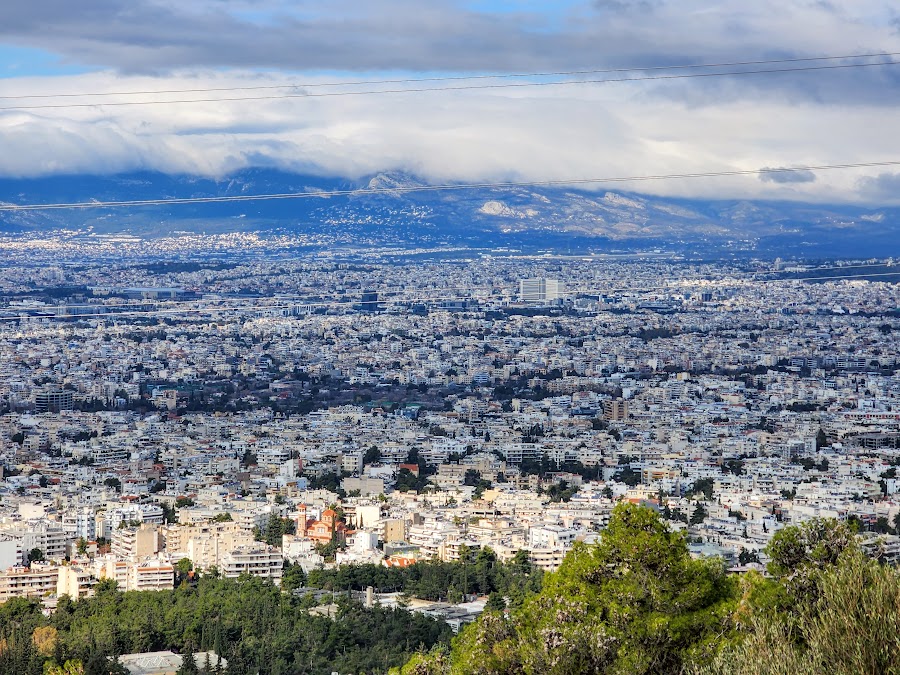
Many if not most residents are angry and sad at the lack of planning and disregard of aesthetics. Fortunately, with the laws protecting the Plaka, the neighborhood around the Acropolis, your eyes can “feast” on houses that have been untouched.
The view from Monastiraki Square shows a Plaka much unchanged from the 19th century.


A detail from a street art mural: some streets in the Plaka still look this charming.


In the Hellenic American Union exhibit, artist Manos Voutsinas depicted the polykatoikia in “Babylon” –: the “sinful” red shoes in a sea of conformity.

Artist Aleko Fasionos comments on high rise city buildings with his “Man and the modern times.”

Early buildings of the 50’s and 60’s often had an impressive interior and foyer as shown in this 1950’s lushly carpeted foyer.

In the building I lived in in the 1980’s when I first came to Greece (where I paid around 6000 drachmas or $30 a month) there was no such foyer, but there was a theroros (another polykatoikia institution that’s mostly gone), a kind of doorman/super who had a little desk in the foyer and took care of the building and always greeted you.
Exteriors too of apartments built in the 50’s and 60’s had a more pleasing appearance than what followed — they seem to be influenced by the Haussmann buildings, with the curved look.


Some paintings in the exhibit focused on activities on the balcony: reading under a bare light bulb on a warm summer night (who wants A/C?), talking to a friend or best of all in the summer months, listening to/watching a film shown nearby in an outdoor cinema.


In suburban areas like my neighborhood, at least trees were kept: bougainvillea, almond trees, and the ever present nerantzia trees found all over Athens sidewalks.


Many polykatoikias built today are energy saving buildings. Note the green leaf on the wall.

In one city neighborhood, painting the polykatoikia wall livened up the building, creating dreams of summer…

Athens might be quirky, cluttered and chaotic, with little sense of planning, where an 11th century Byzantine church rubs against a monstrous office building. What is sure is that you’ll spot architectural gems as you walk around the city. There are still many beautiful mansions around,

such as these on Dionysiou Aeropagitou near the Acropolis Museum.

You need your eyes open to spot unexpected treasures.Near Psyrri one day I came upon the “caryatid house“a late 19th century house where the owner was a sculptor that used his wife and her sister as models for the caryatids. (A more colorful legend circulated that the caryatids were his daughters who were poisoned by their evil step mother).

Let me take you on a little tour of neoclassical mansions and public buildings. Many mansions built for 19th century wealthy families are used for museums such as the Benaki museum. The house once belonged to the Benaki family, which contributed so much to the cultural and historical life of the city.

The elegant Stathatos Mansion from 1895 houses the Cycladic Museum,
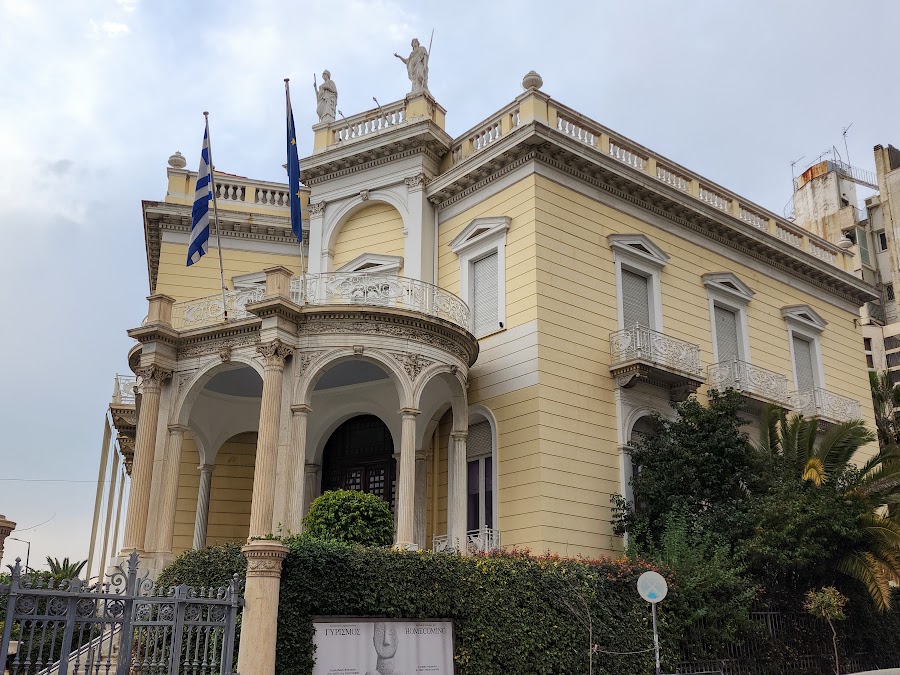
The house of archaeologist and discoverer of Troy Heinrich Schleimann is the Numismatic Museum, where in the cafe garden, there might be concerts and book presentations.

This grand Neoclassical building is the Archaeological Museum built in the late 19th century. Not as visited as the Acropolis Museum, it is the largest museum in the country and the place to go to see ancient Greek art and culture from prehistoric to Roman times. (This year it’s due for an expansion and the architect, Sir David Chipperfield, is being awarded the presigious Pritzker Prize for architecture in Athens in May.)

The Parnassos Literary Society, founded in 1865, has been housed in this neoclassical building since 1899 and still hosts concerts and literary activities.

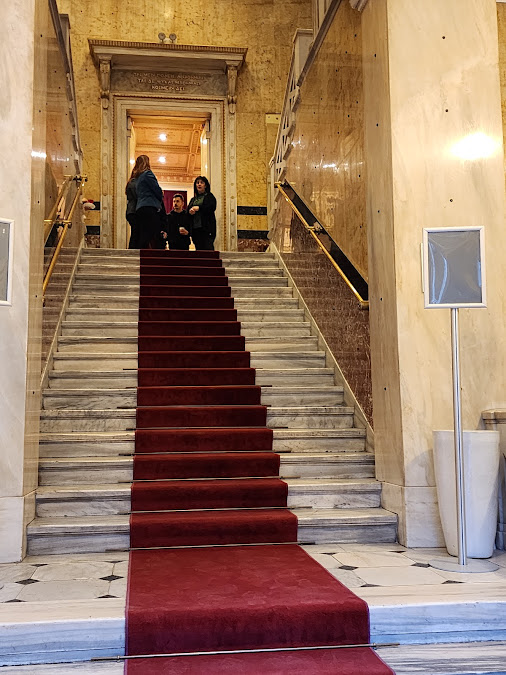
The magnificent Grand Bretagne hotel in its neoclassical and Renaissance style, was originally a residence built in 1842 and has been used as a luxury hotel in Athens since 1873.

Of course the neoclassical is in public and government buildings. Across from the Grand Bretagne and Syntagma Square sits the Parliament, originally the royal palace of King Otto, first King of Greece. The photo takes in the new palm trees planted on Panepistimiou Street

Not far away lies the old Parliament, now housing the National Historic Museum.

And finally: late Neoclassicism in the imposing Gennadius Library, built in 1923 and part of the American School for Classical Studies.

By this point you probably want to escape from all these stately columns and grand facades.
There are in fact structures that are lively and colorful, like these two in Psyrri. Not architectural gems but pleasant and playful. And despite the urban sprawl over much of the city, still much remains that is beautiful, much that is quirky and much that is fun, and sometimes that is all three.


If you like what you read, hit the like button and subscribe. Please share with your friends and social media. I’d love to hear your comments below.
There’s no need to log in to leave a comment. Just give an email address and your name.
Subscribe to become part of the olivesandislands community! Get new blogs and occasional newsletters delivered directly to your inbox. It costs nothing to subscribe. Olivesandislands does not share email information.
Note: Be sure to click on the confirmation email after you give your email address.

Sherri Moshman Paganos is a writer and former educator, inspired by her life in Athens, where she and her husband are happily retired and enjoying their travels in Greece and abroad. You can check out her writing — fiction, non-fiction, poetry and articles here.


I learned a lot from this blog entry. Thank you, Sherri!
Gillian
LikeLike
Thanks Gillian, I learned too!
LikeLike
Very informative – so much to be learned in this blog! Wonderful pictures too! Bravo!
LikeLike
Thank you Sue!
LikeLike
I adore your posts!
They always have such a nostalgic and optimistic view! Lovely photos, and wonderful descriptions. I have always the desire to visit those places and live all the experiences, as written on the posts!
No words to describe all I want, just strong positive emotions!
Thank you!
Keep posting those magnificent life instances!
All the best,
John
LikeLike
Thank you so much John for your kind words… “Nostalgic and optimistic” — I think yes that’s what I feel when I’m writing!
LikeLike
That was a lovely tour of the Athens we love. And the photos were super!
LikeLiked by 1 person
Thanks Nancy, always something to discover in our fascinating city —
LikeLike
No matter how many times you visit the downtown area of Athens, there is always a corner, a niche, a sidestreet, a building, and a lot more that you missed the previous times. Every visit unveils a small surprise for you!
Thank you, Sherri, for another pleasant and informative walk with you!
LikeLiked by 1 person
I’m glad Stella you enjoyed our walk together! So true, the unexpected is what makes Athens such a fascinating city —
LikeLike