
Like this dog in dreamland enjoying its sunshine snooze outside the Athens tourist information office, tourism might be sleeping right now. But in just a few days, May 15, it’s scheduled to open its eyes. That date certainly sounds déjà vu! Wasn’t it the same as after last year’s lockdown? So grateful were travel agencies to see the first tourists in Herakleion Crete last year that they were greeted at the airport with a guitar and bouzouki duet playing the music from “Zorba.” The cartoon from last year showed the welcoming of the first tourist(s).

Indeed it’s been a very long sleep for the hospitality and tour industry as well as the bars, cafes and restaurants, which opened Monday, May 3rd, the day after Greek Easter, with of course much fanfare. It gave us a much needed psychological boost to see tables outside full again of people drinking coffee and in some cases hearing the clack clack of the dice on the backgammon board. Walking around the previous week, I saw busy renovations. Sweeping. Scrubbing. Painting. Tape measure out again to measure distance between tables and chairs. Knocking down walls. Even opening ceilings to let in the sky, as tables must be fully outside. Tables placed not only on the sidewalk and the street, but we heard of a case where they even put tables on the raised platform at a bus stop!
People have complained about the closing time by 10:45 pm (but soon to be extended to 12:30 am, a much more acceptable time!) and government decision of no music. The reasons for this were explained due to the precaution against people speaking louder to be heard, and there the aerosols will spread…
The soothing power of music… I suppose during the pandemic you could not be too particular about your audience, as we see with this classical music cello school in rural Denmark…. According to one of the cellists, the cows were really responding to Mozart and Lizst (but didn’t seem to be Dvorak fans as they walked away when the cellists started playing his music!)

We’re free now to go from one municipality to the next, but still with the SMS system, actually wheezing out its last breaths (hopefully never to come back to life). With the opening of tourism, we’ll be finally free to move around the country. This will be the first time since the beginning of November.
But kalo mina, good month! Now it’s May, the month of flowers.


May 1st, besides being the traditional workers’ holiday, is the day for picking wildflowers. My friend Dahlgren shared with me some photos of wildflowers in our neighborhood.


While I was walking by the the sea, this field of unfamiliar yellow flowers caught my eye.

The lilac petals that belonged to April have all fallen. April indeed was the month of mauve, of purple, from the light lavender of the lilacs that spread in their grape like clusters and offer you their heavenly scent

to the magenta of the jacaranda trees.

April, “breeding lilacs out of the dead land,” might indeed be what T.S. Eliot called “the cruelest month” as we were still inside, yearning to get out. I felt like the mythic Tantalus with the fruit of freedom always exceeding my grasp. To describe my longing to reach that elusive fruit, I was playing around with some T.S. Eliot lines:
“I’ve known mornings, evenings, afternoons
I’ve measured out my life with coffee spoons”
from The Love Song of J. Alfred Prufrock
And here I offer my “Freedom Song.”
I’ve known mornings evenings afternoons
I’ve measured out my soul in ancient runes
That none can decipher, figure out or find.
Hear my deep throaty wailing in the night
Like the timeless cry of the flying loons
Over frozen lakes of northern climes.
I’ve known mornings, evenings, afternoons
More “measures,” that hated word, promised soon.
Closing schools and shops again, locking us in.
A word so badly out of tune
With budding leaves and almond blooms,
With waves that lap the shore, a sight
I wonder when I’ll see once more.
Lingering over a coffee, taking off in the car
Driving along that starlit road, window down,
Wind brushing my hair, maskless, I softly croon
A song of freedom under the rising moon.
Back in March we were “promised” that we would be able to celebrate Greek Easter May 2nd freely so people could roast their traditional lamb in the countryside and in their villages. But a stubbornly increasing number of cases overwhelming the hospital system thwarted these plans and again we had to stay and celebrate on our balconies.

Many Athenians tried to leave, not always legally. At the toll stations the police checked every single car and scanned papers that gave the right to travel and/or work. Woe to you if they found a paper forged: 500 euro fine and turn your car around. But the favored method instead of forging papers, was trying out various excuses that were mostly rejected: Taking care of elderly relatives in the village. Picking olives/grapes (wrong season!) Urgent house repairs. Taking the dog for a run. “My fiancee is waiting for me to propose marriage.” “I’m going to my mother-in-law’s wedding…”
When we were finally let out on weekends beyond our municipality borders, we bid farewell to our long mountain hikes and headed first to the sea. On our last walk a few days before Easter, I noticed this etching on the mountain rock.

Along the sea in Nea Makri, families spread blankets on the beach, opening tuppers of hardboiled eggs and keftedes (meatballs) while their kids were running around and playing ball or digging in the sand. Others picnicked on souvlaki or sipped their take out coffee.
The weather turned very warm over the days of the Easter holiday. Along with the crowded cafes and restaurants last Monday, were the crowded beaches. We too took our first dive into the smooth-as-glass sea. At first the cold hit you like a slap, but gradually the gentle waves started to caress you. Swimming season for us has officially begun!

This weekend, the organized beaches opened, with four meters between umbrellas (about 13 feet) and reservations already made for sunbeds and the beach bar! (No music though)
We relished our freedom not only at the sea, but also enjoyed our strolling in downtown Athens where we rediscovered the city like tourists. First stop, National Gardens, behind the Greek parliament. The main entrance is known for its characteristic 12 palm trees planted in 1838 under the reign of Amalia, first queen of the new state. Five hundred species of plants were brought to the gardens when it was created.

We really have to thank Amalia for this wonderful oasis in the heart of Athens. When the Gardens were created, however, the “Royal Gardens” were for the royal family only and it wasn’t until the 1920’s that they were renamed the “National Gardens” and “commoners” were allowed in.
Henry Miller, who visited Athens in the late 30’s, wrote of the Gardens in The Colossus of Maroussi, “It remains in my memory like no other park I have known. It is the quintessence of a park, the thing one feels sometimes in looking at a canvas or dreaming of a place one would like to be in and never finds.” Miller admittedly was entranced by everything he saw in Athens, but the park, with its beautiful cared for gardens, is still a lovely place to walk around, just sit, exercise in or have a coffee in the Garden Cafe.


In addition to the duck pond and kind-of zoo, that have seen better days, you always seem to stumble on something else you hadn’t noticed, such as mosaics from a Roman villa of the 1st century A.D.

or a collection of ancient columns. Not a bad place to rest.

In June there are sometimes music concerts but the park closes promptly at sundown, so you have to skedaddle out quickly.
Photos of the “History has a Face” paintings (mentioned in the last blog post) were still up outside the gardens when we visited a few weeks ago – the ones painted by the Belgian consul in the 1840’s and recently resurfaced – showing 1821 Greek war for independence personalities in all their finery and costume.

While looking at the portraits we were treated to the evzones, the presidential guard, marching to their post where they guard the parliament and the tomb of the unknown soldier.

In their unique costume, the evzones continually show up in tourist selfies. In case you’re wondering, the skirt they wear, the fustanella, dates back to many years before the 1821 War, and has a total of 400 pleats, each pleat representing the approximate 400 year Ottoman occupation. As if it isn’t enough ordeal to have to stand without moving, it’s said that the soldiers (and the guard are made up of elite soldiers) have to iron their own fustanella! (How long does that take?) The tsarouchia, the handmade shoes (clogs), with their characteristic black silk handmade pompon on the toe, are another integral part of the uniform, each one weighing 1 ½ kilos (3.5 pounds) and there are 60 nails on the base of each shoe, supposed to “simulate the sound of battle” when they move. More here about the uniform, the selection and training process.
What’s a walk in downtown Athens without visiting Plaka, under the shadow of the Acropolis and the oldest area of the city, always delightful.


As with the gardens, we always discover new and renovated small hotels.

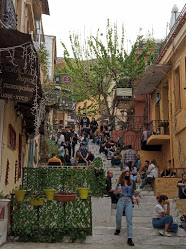
Mnesicleous Street is where crowds gather on the steps all day, and when the curfew ends, all night.
On our last walk, taking us near Syntagma Square, we noticed that souvlaki places have given way to Asian food takeouts. Pink Flamingo with its Asian street food had a big line, so we got some vegan ramen noodles from So So So around the corner with no line. Loved the pieces of roasted corn and the nori, the black seaweed.
The main cathedral, the Mitropolis, was getting ready for the Saturday night Easter celebration. In the background is the “Little Mitropolis” one of the many exquisite small Byzantine churches in the city. Dating from the 12th or 13th century, the church once had the colorful name of Panagia Gorgoepikoos meaning “The Panagia (Virgin Mary) who grants requests quickly” (!)

Our first stroll along the pedestrian walkway of everyone’s favorite street, Dionysiou Aeropagitou. Music is back.


We were intrigued by a home made contraption, worthy of Rube Goldberg, of a piano keyboard mounted on a desk with an office chair stuck on and wheels. Near the ancient Agora, we saw another resourceful street artist, with jewelry fitted and carried around on the back of a bicycle.


The ancient agora had a few tourists walking around. Archaeological sites have been open several weeks, indoor museums are scheduled to open next week, and later in the month, summer cinemas and outdoor venues for theater and concerts.

Not everything outside is ancient. One of the modern street sculptures that I find interesting is “O Dromeas” (the Runner) across from the Hilton Hotel, that took artist Costas Varotsos six years to create.
At 12 meters (30 feet) it’s pretty striking; it’s made up of individual jagged pieces of glass that give you the feeling of a runner in motion. Originally, the sculpture was in Omonia Square, but there was a fear that the vibrations of the metro underneath might shatter the glass, so it was moved across from the Hilton. Very appropriate as a symbol of Athens because of the origin of the Marathon here.

But even so, new is never far from the old. Several meters away from the runner is the oldest olive tree in the area 1,500 years old, information marked with a plaque next to the tree.

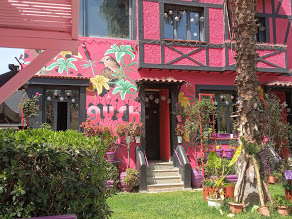
In back of the Hilton I was awed by the colors of a Mexican restaurant (San Miguel). Just for the outdoor decoration alone, it’s worth a try!

We’re told that one way to get the economy moving again is the covid self test, which has been mass distributed. Testing is mandatory for students and teachers (all the schools are open from May 10) as well as for employees in sectors like retail shops, transportation, restaurants and public sector.
But the real way to “normality” (that elusive word) is through vaccination. In many countries, as we’ve seen, there is limited access to vaccines. The idea of the “patent waiver” idea is to make it easier to produce and distribute vaccines in developing countries. In Greece only about 12% of the population has been fully vaccinated but vaccinating has recently charged full speed ahead for all ages. It has become a conversation starter: (did you get it yet? which one? any reaction? you’re not getting it? why not?) How to get more people vaccinated: the right incentives! In Romania, you can get the jab in Dracula’s castle. While in New York City you can get vaccinated under the giant blue whale at the Museum of Natural History – here shown with a bandaid over one of its flippers…now that’s an incentive all right!

Opening to tourism this early, actually ahead of other EU countries, is admittedly risky but we’re hopeful. Let’s see how it will go this summer. After months of quarantine, people are eager to travel but everything is so in flux and confusing. Once again we’re in unexplored territory. One minute we’re certain that the worst of the pandemic is behind us, the next, because of all the variants, we’re not sure. Several months ago, experts speculated on how India seemed to be doing so well with Covid, and look at it now, living a nightmare scenario.
It seems we’re getting out. The key is personal responsibility, setting your own risks. Besides what we all know about masks and social distancing, many articles in a light vein advise us: Get in touch with your pre and post pandemic wardrobe! Banish anxiety about your post-lockdown looks! Practice making small talk again! Learn how to start flourishing once more… And how about this, once the pandemic recedes, whenever that is, to stop talking about it… let’s see if we can follow that advice.
In the meantime, a toast: stin uyeia mas! To our health!
If you like what you read, hit the like button and subscribe. Please share with your friends and social media. I’d love to hear your comments below.
There’s no need to log in to leave a comment. Just give an email address and your name.
Subscribe to become part of the olivesandislands community! Get new blogs and occasional newsletters delivered directly to your inbox. It costs nothing to subscribe. Olivesandislands does not share email information.
Note: Be sure to click on the confirmation email after you give your email address.

Sherri Moshman Paganos is a writer and former educator, inspired by her life in Athens, where she and her husband are happily retired and enjoying their travels in Greece and abroad. You can check out her writing — fiction, non-fiction, poetry and articles here.


Love your pictures, Sherri! A real treat.
LikeLiked by 1 person
Thanks Nancy, glad you enjoyed them!
LikeLike
A lovely tribute to an almost post-covid-restricted Athens and surrounding area.
LikeLiked by 1 person
Thanks Georgia. Finally! Let’s hope things go well…
LikeLike
Hope that’ll be soon … and other places you didn’t see on your last visit so many years ago!
LikeLike
You always manage to bring new light and information to familiar places and sites! I enjoyed reading it, Sherri. I enjoyed your poem too.
LikeLiked by 1 person
Thanks Sue! Loved your comment.
LikeLike