
If you’ve ever pondered the existence of olive oil as you drizzle extra virgin olive oil on your salad, know that olive trees are among the oldest recorded trees in history.
When the Greek poet Homer referred to olive oil as “liquid gold,” olive trees had already existed for many centuries and olive oil production was one of the most successful industries in antiquity. Black and red figure vases have been found that picture agricultural scenes of olive cultivation, which resemble very much present day methods.

The first olive trees are believed to have been found in the Mediterranean area around 5,000 B.C. Greek and Phoenician explorers eventually brought the tree to Iberia (Spain). The first mention of olive trees growing in Greece dates from Minoan times on Crete as far back as 2,700 B.C. Stone tablets have been found mentioning olive oil use, and excavations on Crete in Minoan settlements in Knossos and Phaistos have found huge jars (pithoi) used for storing oil. In some cases, inside the jars, seeds were discovered or in some cases, entire olives with the flesh intact!

Olive oil was not only used for its nutrition, but also in medicines. Greek physicians Hippocrates and Galen praised it for its great healing and positive effects. (Galen also told stories of unscrupulous merchants who mixed high quality oil with cheaper substances like lard, showing us that olive oil fraud is nothing new – more later). In 600 BC, Solon, the Athenian legislator, to stimulate the growth of Attica’s trade and industry, forbade all exports except for olive oil. And the Romans became very involved in growing and exporting olive oil, and spread it to their colonies in North Africa (today Tunisia ranks 4th in olive oil exports behind Spain, Italy and Greece).

The olive tree is a sacred symbol in Greece with deep roots (pun not intended) in Greek mythology. Apparently, the gods were fighting to have the city (Athens) named for them and become its patron. The main rivals for this were Athena, goddess of wisdom and Poseidon, the god of the sea. Zeus decided that each of them would make a gift to the city; Poseidon struck the rock of the Acropolis with his trident, bringing forth water, but it then turned salty, while Athena gave an olive tree sapling, symbolizing peace and prosperity, not to mention food, oil and firewood, and so she was selected as Athens’ goddess patron. Numerous temples were devoted to her, including the Parthenon (Temple of Athena). (Part of the myth is that Poseidon, angry about the choice, put a curse on Athens to never have enough water, and the city has had its problems over the years with water shortages, but not lately.)

The olive branch is traditionally a symbol of peace. From the Bible, in the story of Noah, the dove (in itself a peace symbol) brings an olive branch, not only to show signs of land, but because of its symbolic peaceful nature. Whenever Greece entered into a truce with enemies, the branch was offered, and the Romans followed this too. The olive branch was also awarded to any athlete who won in the ancient Olympics and the leaves were worn as a crown.
Olive oil itself was given as a prize in athletic events, such as the Panathanaic Games held every four years to honor Athena. Amphorae (large ceramic vessels) filled with olive oil were given to the winners. But it was the chariot race winner that really got the prize — 140 amphorae filled with olive oil (how did he bring this home I wonder!) My eye caught sight of some of these beautiful amphorae, that were excavated while digging for the metro, in a display case at the Acropolis metro station.

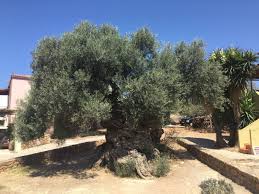
In 2004 in Athens and 2008 in Beijing, the winner of the Marathon was given an olive tree branch from what’s commonly known as the oldest tree in the world, said to be 3,000 years old, found on Crete in the village of Ano Vouves in the Kolimbari area near Chania. There are supposedly another ten trees in the area also very ancient, all still producing olives and oil. Near the tree an olive tree museum features tools and wooden ploughs (the so-called ‘Hesiod’s plough) used in the area well into the 1950’s. (This is number 1 on my list next summer to visit when I go to Chania)

A little digression… regarding the oldest olive trees in Greece, I came across this note in the thisavros gnoseon, (treasure of knowledge) a children’s encyclopedia that Elias had from the 1960’s. Under elia (olive) it mentioned that the olive tree under which Plato taught his students at Plato’s Academy at the Sacred Way still existed. Why does no one else mention that, I wondered, and found that in 1976 a bus ran over the tree and destroyed it (!) Then it becomes unclear what exactly was left. Some of the trunk was taken to the Agricultural University of Athens. Did the tree come back to life? Were new trees planted? What’s known is that what was left of the trunk disappeared completely one cold winter night in 2013. Taken for firewood during the days of the economic crisis? The mystery remains… This area of Athens, at one time full of olive trees and still called “elaionos” or “olive grove” is now under consideration for building a complex of sports stadiums. Sigh.
Olive trees can indeed live for centuries and have endured because they’re perfectly suited to the Mediterranean climate, with its warm summers and mild winters. Judging from the roots of this tree growing in the lovely courtyard of the Archaeological Museum in Athens, it must be many centuries old.

Some varieties can even grow on hilly rocky areas. “Olive groves have a magical ability,” writes olive oil expert Tom Mueller, “through frost, through fire, through drought.”

And here’s one more olive tree, a magnet that I just got in a Christmas grab bag, with a mati (eye), meaning good luck for the new year!

The ancient Greeks felt that animal fat was unhealthy, and only barbarians ate that way! Besides the nutritional value of olives and olive oil, in ancient times the oil had many other uses. Before exercising, Greeks and Romans covered themselves with oil to absorb dirt and sweat and then scraped off the dirt and sweat with a metal instrument, known as a stirgil, before entering the baths. Olive oil was also used in making soap. It still is and you can find it at the supermarket or as a popular tourist souvenir in Monastiraki or the Plaka .

Its vitamin E content made it ideal for using it in other cosmetics too: lotion and skin and hair moisturizer, fuel for lamps and furnaces and a base for perfumes. In ancient times it was used as well as a cure for heart ailments, constipation, stomach aches, hair loss, and even excessive perspiration. (Really, what didn’t it cure?)
It was common for Greek athletes, who performed in the nude in the gymnasia or palaestra, to anoint themselves with the oil that was scented with pressed flowers and roots. (Supposedly the olive oil made it more difficult for their opponents to get a grip on them.)
This using olive oil for anointment is still used in the Greek Orthodox church in various aspects, including baptism where the child is “anointed” with oil that the priest blesses and the godparents rub all over the child before it is dipped in the baptismal font.
But let’s get back to olives and olive oil for use in food.
Coming to live in Greece was my first “immersion” in using olive oil. At that time, tavernas, besides offering grilled meat, would display their two or three ladera dishes of the day in the kitchen and ask you to take a look and choose. The ladera, or dishes with ladi (oil) are with vegetables in season (yemista – stuffed tomatoes & peppers), eggplants, string beans, peas, okra, potatoes etc. that invariably looked like they were swimming in oil, the better to take your bread and dip it in.
Cooking even a ho-hum dish like string beans in fresh tomato and olive oil (yachni) brings it to life and makes it delicious. Today I’ve noticed there’s an attempt at better restaurants for a lighter touch, less oil used in cooking, or more healthily, the oil is added at the end. (My mother in law still has the idea that if the food is not drowning in olive oil, then it’s not really food or if the greek salad doesn’t have a whole cup of oil at the bottom to dip your bread, then it’s too dry.)

So, a few facts on Greek olive oil production:
While Greece ranks 3rd in the world in olive oil exports, it’s #1 in per capita consumption, about 18 kilos (36 pounds) a person a year, maybe more in Crete. This is about 4 tablespoons a day, and actually many people drink it down straight, including someone in my household. That’s a lot of oil, so most people buy it in 4 or 5 kilo, or even larger, tenekes or tins, such as this 17 kilo tin from Crete.

It’s hard to get any consensus on the areas of greatest growing or best olive oil: everyone would agree about areas of Crete, and the southwest Peloponese, especially the area of Messinia where Kalamata is located. But then it’s hard to say: other areas of the Peloponese, the islands of Mytilini, Samos, the Ionian island of Corfu, near Athens, just about anywhere in the country!

People are never far from the land in Greece and their agricultural roots. So many residents living in Athens have farms and olive tree groves where they have their own olive and/or olive oil production. Actually, most of the olive oil industry comes from small family farms.
THREE PLACES OF OLIVE OIL PRODUCTION
BARBARA IN NEAPOLI
When my friend Barbara came to live in Greece, she knew she wanted to have olive trees. I asked her how she got involved in the production of oil – her farm is located in the Peloponese near Neapoli in the province of Laconia.
Barbara, I hear that you had a very good olive harvest this year. I wonder if I can ask you some questions about your interest in cultivating olive trees. How did you get interested in growing olive trees? Do you have any background in agriculture?
“I’ll be happy to try and answer. From the time I moved to Greece in 2007, I wanted to have my own olive trees. I come from an agricultural background: my father grew up on a market garden in the Netherlands, and when he emigrated to the United States, he first owned and operated a nursery and garden store, then built greenhouses and grew carnations and roses commercially. Although I had never had olive trees, I believed I could learn whatever I needed to know. When I became serious about buying property, friends sold me a piece of property on the hillside above Neapolis with one hundred and twenty-three olive trees. My first olive harvest was in 2008 and I had an excellent yield.

What kind of olives do you grow? I know there are many different types, giving different kinds of oil.
The trees on my property fall into three groups. The previous owner inherited this property from his grandfather about sixty years ago. At that time, there were about a dozen very old – over one hundred years old – trees on it. Stratis immediately planted another fifty olives of the Athinolia variety. This is a local variety that produces medium-sized fruit that can be used for oil or for the table. Then Stratis went to Australia with his family, where they lived for about twenty years. When he and his family returned from Australia about thirty-five years ago, he planted another sixty trees on the property, this time of the Koroneiki variety. Koroneiki are relatively small trees that produce small olives with large pits – very inefficient olives – but known for producing the highest quality oil. In addition, there was one Kalamata olive tree and one Gaidero (donkey) olive tree, both producing large olives used only for the table.

Your olive trees are organic. Why was that important to you and what is the process that you need to follow to grow organic olive trees? If they’re organic, are you allowed to use pesticides?
Having previously lived in California, where I had studied gardening, was a certified Master Gardener and very interested in organic gardening, I decided the first thing to do was to join the local organic certification organization. I wanted to transition my trees to being fully organic and also wean them from irrigation. One of three organic certification organizations in Greece operates in the Peloponnese. It is called DIO. As soon as I joined, DIO sent an agronomist to visit my farm and look over my trees. To become fully certified organic is a three-year process. I could still use fertilizer on my trees, but it had to be organic fertilizer, one of a few approved brands. To counter pests, including the Mediterranean fruit fly, I could use only certain organic products. To wean my trees off of irrigation was a multi-year process. I had to continue irrigating them on a decreasing schedule until I no longer irrigated them at all.
Using only organic fertilizers and pest control, and at the same time decreasing irrigation, my annual yields were less than that first year. However, the trees were getting stronger, as their roots were forced to grow deeper to access water.
Is the picking done by hand or machine?
Because my farm is located on a hillside and the trees are planted on a series of seven interlocking terraces, harvesting the olives is labor-intensive. It is not feasible to use machines, so all the olives are picked by hand, using large plastic combs to strip the olive branches. Nets are laid on the ground, the olives drop onto the net, and then they are gathered into burlap bags for transport to the olive press.

The most efficient process is to have someone pruning the trees as we pick them, so the branches that are cut can be stripped of olives on the ground, rather than using ladders.

A few years ago I remember there was a big fire near Neapoli. Were your trees affected?
In July 2015, a huge fire burned the area in which my farm is located. Fortunately, most of my trees survived, although I lost almost all of my oldest trees. The fire caught in the bases of the largest trees and burned them from the inside out. The majority of my trees had to be severely pruned back, cutting off the damaged limbs in order to allow new limbs to grow. From the roots of the largest trees, several grew new shoots. I saved the thickest shoots and trimmed away the rest. If the shoots were growing from above the graft – all producing olives trees are grafted onto wild, non-producing roots – they will eventually produce olives. If the shoots were growing from below the graft, new grafts must be made onto those shoots. To replace several of the trees that had burnt to the ground, I planted new trees, all of the Athinolia variety.

The mixture of Athinolia and Koroneiki olives produces a very fine, flavorful oil..This year, for the first time since the 2015 fire, I had a normal olive harvest. My crew and I picked almost two tons of olives, which yielded three hundred kilos of oil: a 6.3:1 ratio. The acidity level was 0.3 percent, which is extra extra virgin quality oil. {my note: extra virgin olive oil is supposed to have an acidity level of .8% or less, while virgin olive oil .8% to 2%. 70-80% of the oil produced in Greece is EVOO, a higher number than in Spain and Italy.)
What are some factors that can affect an olive crop?
Next year, I will probably have a smaller crop. This will be due to the tendency of olive trees to produce more fruit in alternating years. In addition, many weather-related factors influence an olive crop, for example: how much rain will there be, and in which months; will there be a heat wave just as the flowers are blooming in the spring cause them to dry up; will heavy winds cause the olives to fall to the ground, just as they are getting ripe. This year, we had excellent conditions. Next year, as all farmers know, the harvest will depend on forces beyond our control…”
So, let’s taste Barbara’s oil. It’s said that a truly high quality oil, being slightly bitter, should produce a tickle in the throat, or even more, a cough. Oils can even be rated as one-two or three-cough oils! If oil is old or overripe, then you won’t cough.

Her oil indeed is delicious and the peppery flavor tickles my throat, definitely making me cough. Besides pepper, some popular tastes of high quality oil include fruit, grass, tomato, banana, roka (arugula), spinach, citrus and apple (!)
And the color is still green as she picks the olives relatively early before fully ripe. Other growers might wait longer, when the quantity is more, but not necessarily the quality.
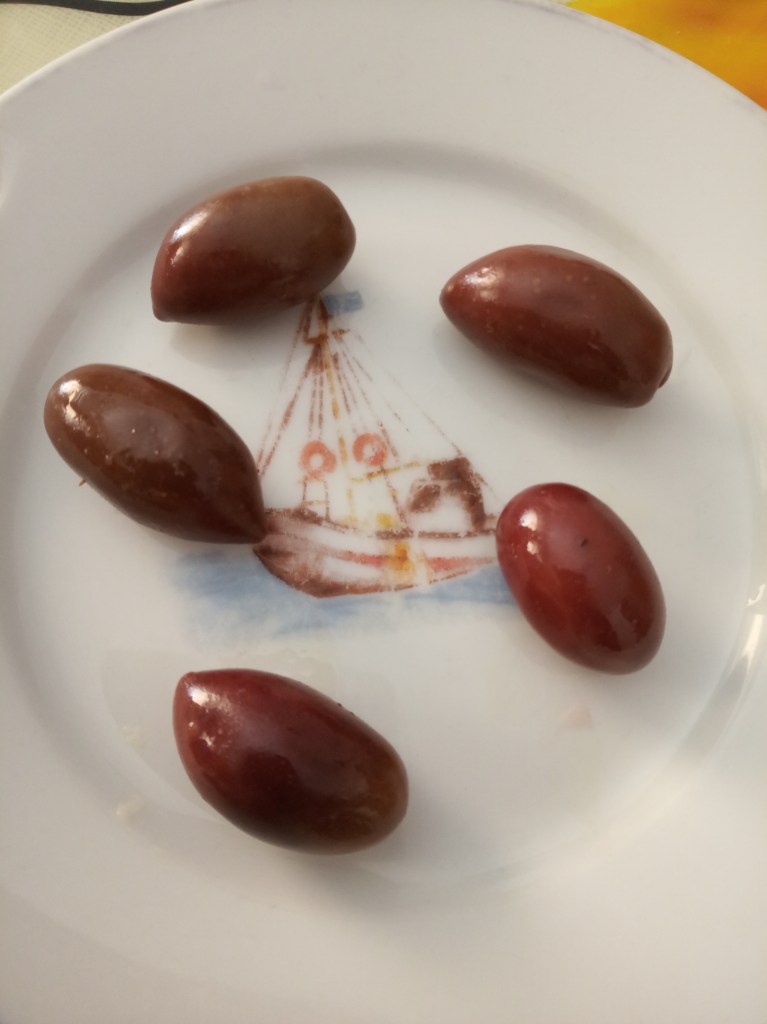
Barbara mentioned koroneiki olives; of the more than 80 varieties of olives in Greece, probably the majority of trees in Greece have this olive – they’re high in polyphenols (antioxidants) and they’re harvested when green and picked early – this oil is actually known as “agourelaio” (agoura, meaning unripe and elaio, oil). These olives have almost no acidity. As for table olives, the “king” is “kalamata” olives which are deep purple or burgundy, almond shaped. Eating these delicious olives will make the most olive-resistant person a follower.
NANCY & KOSTAS IN LIVADIA
My friend Nancy and her husband Costas have olive trees near the village of Livadia. In Nancy’s words:
“One of the best things about the autumn months in Greece is the harvesting of the olives and the pressing of those olives into olive oil. Olive trees give fruit once every two years and the rule of thumb is five to one. That means for every 5 kilos of olives pressed, you get 1 kilo of olive oil. Harvesting usually takes place in late November or in December but some growers harvest earlier in order to produce a green or more pungent oil than the golden color of mature olive oil.
My husband inherited an olive grove in his village in Boiotia near Levadia, some 100 miles from Athens. From the trees we harvest about 2000 kilos of olives and make 440 kilos of pure extra virgin olive oil on the average. We also keep some olives, about 100 kilos, to salt and cure for eating.

Nothing beats the smell, both sweet and savory, in the olive mill Pure Olea in Boiotia as our olives are pressed for their oil. After pressing, the oil is tasted and tested for clarity and purity, and poured into 10 and 20 kilo containers for our use. Tasting means chunks of local bread dipped in the new oil. There is nothing more delicious in the world!
This is a tradition that goes back centuries, more likely millennia. And after all, Athens got its name from the goddess Athena because she gifted the city with the olive tree – a source of food and symbol of peace.”
MARY IN ACHILLION (NEAR VOLOS)
My friend Mary, who grew up in a small village south of Volos called Achillion, writes about her memories of olive oil production and picking olives in the 1960’s. Like Nancy, she extols the taste of bread dipped in fresh oil!
“Achillion is a small picturesque village on the coast of Pagasitikos, Magnissia, Thessaly which is linked to the birthplace of Achilles, hero of the Trojan war. The village, maybe 500 or so, is cool even on the hottest days of summer. That’s where I grew up and where I discovered the world around me. My parents Giorgos and Efstathi devoted their lives to the cultivation of land. It was very hard manual work especially those times when facilities were few.
My father, now 95 years old, was born there and left it only twice, once, to serve in the Army and the other time to have a heart operation in Athens, where he kept counting the hours to go back to Ahillon! There he was absolutely content in his natural surroundings among the olive trees.

I remember him ploughing the land with his two horses after a huge breakfast of fried eggs, butter (ironically not olive oil), sausages, freshly homemade bread and a glass of his homemade wine, which he claimed gave him energy to work.
Then he would take my cousin and me on a kind of “raft” or wooden plank to flatten the ploughed land, him standing, holding the reins of the horses and us sitting on this board, each one of us holding one of his legs to add weight!
At those times, in the mid-60’s, farmers used horses and mules for their work, and for reaching the fields. The lands where the olive trees grew were scattered in different areas around the village, and the farmers would wake up at dawn to go there and start collecting the olives when they turned black – the end of November until mid-February, weather permitting. They used deep baskets which they filled and tied on the sides of the horses to take back home late in the evening, which they emptied on a big bench and started sorting them according to size. This took an extra two hours or longer. Finally the farmers put them in huge wooden containers in salted water to preserve them till spring when they were sold (as olives, not olive oil).The older members of the family – yiayia, pappous (grandma, grandpa)—helped with this process too.

Next morning they had to start all over for the next perivoli (piece of land)
To smoothly shake the branches of the tree so that the ripe olives would fall and then were collected from down below, my father used a louros, a long thin piece of wood. Later, as times went by, nets were spread under each tree and so their life became easier. And much later, they managed to buy a small truck, as did most of the villagers.

Technology has made the olive production much more manageable, but even nowadays, picking, pruning, weeding and cultivating is still a demanding job because it’s in the heart of winter and people have to deal with the cold rainy weather. My mother used to show her red rough hands with callouses and tell me and my brother, ‘Do you want hands like this? Then study so you won’t have to work like this.’

The olives that were very small or wrinkled and therefore would not bring income were used to make oil. In every village there was an eleotrivio, an oil mill or crusher. Villagers would take turns in order to produce their own oil. So everyone knew that every 10 or 15 days they would be among the ones to take their olives to be crushed and turned into oil. Those days were the best for us children. We would take freshly baked bread and go to the mill where our father used to toast the bread on the fire used for the oil production, and then dip it into the fresh hot oil. That crispy oily bread was delicious.
I still recall the days after school when we went to help our parents pick the olives and I remember the affection with which my father touched the trunk of the trees as if they were his children. And indeed they were, since he had planted most of the trees. And when he looked at the fresh oil he would exclaim ‘This is real gold.'”

There’s a need to be in touch with the land even if you live in a suburban or urban area. We went one weekend to gather some olives for eating from our tree in Salamina.

Last month in our neighborhood a flyer caught my eye, inviting people to “reclaim what’s ours” and to come and pick olives from several trees in an abandoned olive grove that probably no one knew about.

In the grove, I found a very small number of pickers. They had spread branches on top of the net and we sat and picked off olives of them.


I brought back home my very full bag of olives, which, with the Salamina olives we put in a bowl with plenty of salt water (some also put wine vinegar) and we’ll let it sit for a while until the bitterness leaves.

While Greece and other countries of the Mediterranean area have always made olive oil the center of their cooking and use for salads, I was particularly interested in changing habits in the States. When I grew up, olive oil was something exotic, a mostly unknown oil in the kitchen. (Honest admission, nearly all I knew about olive oil was “Olive Oyl,” Popeye’s girlfriend.) As “barbarians,” we used sometimes butter, but mostly margarine, polysaturated vegetable oils, perhaps a tub of Crisco in the refrigerator. Even olives meant the green pitted variety in a jar, which I didn’t touch.
Only in Greek and Italian groceries was olive oil even sold. Today it seems that most consumers are conscious of the Cretan or the Mediterranean diet and the many health benefits of olive oil. The antioxidants from the polyphenols destroy free radicals and may prevent numerous cancers, such as breast and prostate. The polyphenols and oleic acid reduce blood pressure, and also inflammation (increasingly thought of as the source of most illnesses we face). Olive oil has been shown to slow down bone loss as well.
Even in the early 80’s it was hardly a staple in American kitchens, but that’s all changed. EVOO has swept the U.S. – the market has seen a 250% increase in the last 17 years.
Despite the high quality of Greek olive oil, it’s Spanish and Italian oil that make up most of the U.S. imports. While Greek olive oil consistently wins top prizes in competitions (link), Greek brand names are not generally known. The way it is now, farmers prefer to sell bulk to Italian companies, who blend the EVOO oil into their own oil, often of lesser quality and sell it as Italian brands. This is perfectly legal under EU regulations. To bottle their own Greek brands would take a bit of work and investment and we’re talking about, as stated earlier, small family operations.

This repackaging is legal, but there are various other misrepresentations, all designed to maximize profits. The fraud that Galen mentioned back in the 2nd century A.D. continues today –the oil could be from rotten olives, or it could be mixed with other much cheaper vegetable oils, such as soybean or sunflower, “doctored blended and deodorized,” as Tom Mueller again describes in his book Extra Virginity — The Sublime & Scandalous World of Olive Oil, processes which are all amazingly easy to do without being detected.
He urges consumers who are buying Italian olive oil to look for labels saying PDO (protected designation of origin) or PGI, (protected geographical indication) — even though there’s no guarantee — rather than just a general “made in Italy.” You should look too for a “best by” (expiration date) and to beware of meaningless terms, for example “light“ or “extra light.” No such thing. Every olive oil has 120 calories for tablespoon. This label could only mean that all the goodness is refined out of it! Other labels to beware of: “cold press,” “pure,” “refined.” And I would add to beware of bottles that are just a little too cute.

There’s just not enough control. Sounds grim! What can we do? We can’t all have our own olive grove or know someone who does. Mueller says it just takes a lot of practice to recognize high quality oil and he offers some very helpful suggestions on his website.
To meet the growing insatiable demand for EVOO, California, particularly the wine growing Napa Valley, has started to enter the olive oil market, with large scale modern methods of farming.

What kind of container should you store your oil in? A dark bottle like the above. If you buy it in a large teneke or tin, like Barbara’s 5 liter tin or larger, you can keep the oil in there, then siphon it into a 1 liter glass bottle when we need it (often).
Or in case you have a huge jar or pithos, as the ancients used. (!)

Then store the bottle in a dark cupboard, not in the refrigerator, and never near a stove or oven. And never use a plastic bottle to store it as the harmful chemicals can seep into the oil. Ideally, the temperature should be around 15 degrees centigrade or 59 degrees fahrenheit. The truth is that immediately after bottling, it starts to disintegrate. After a year it’s better for cooking and two years is really the ideal shelf time limit.
About cooking, there are different theories: olive oil has a low smoke point, the beneficial compounds start to degrade with high heat but some say that olive oil is more stable than other oils in heating. I think it’s best to avoid cooking it at high heat. And if you use it, never more than once.
So, olives and the olive tree: health, nutrition and sacredness in Greek history and legend. As Odysseus Elytis, the Greek Nobel prize winning poet put it: “If Greece is destroyed completely, if only what’s left is an olive tree, a grape arbor and a boat, that will be enough to rebuild it again.”

Happy healthy holiday meals with olive oil, the gift of health!
If you like what you read, hit the like button and subscribe. Please share with your friends and social media. I’d love to hear your comments below.
There’s no need to log in to leave a comment. Just give an email address and your name.
Subscribe to become part of the olivesandislands community! Get new blogs and occasional newsletters delivered directly to your inbox. It costs nothing to subscribe. Olivesandislands does not share email information.
Note: Be sure to click on the confirmation email after you give your email address.

Sherri Moshman Paganos is a writer and former educator, inspired by her life in Athens, where she and her husband are happily retired and enjoying their travels in Greece and abroad. You can check out her writing — fiction, non-fiction, poetry and articles here.


Brilliant blog! Very informative essay concerning the nature of how one cultivates olive oil in Greece
. Thank you.
LikeLiked by 1 person
Thanks Connie — and to Barbara for her wonderful input!
LikeLike
Well done Sherry!!I’m so glad some of my childhood memories are part of such brilliant work.Thank you so much!
LikeLiked by 1 person
They’re lovely memories. I thank you for sharing them!
LikeLike
I was impressed with all the information you gathered, and from such a variety of sources! You presented it in a very appealing way. I enjoyed all the pictures too. Now I love and appreciate olive oil even more than before! Congratulations on another job well done, Sherri.
LikeLiked by 1 person
Thanks Sue — I guess when it comes to olive oil, you can’t appreciate it enough!
LikeLike
Sherri, I was impressed. Very informative and interesting, Good job. Frieda
LikeLiked by 1 person